
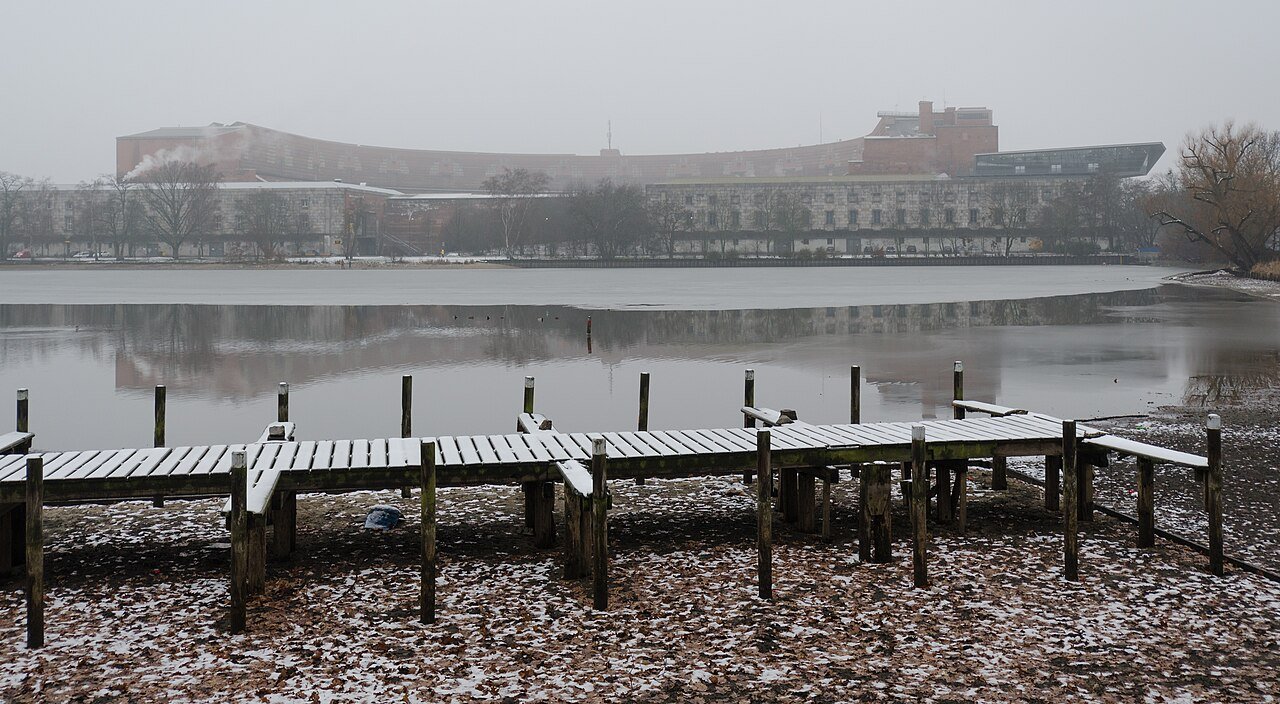
A congress hall modelled on the Colosseum and built to outlast centuries never got a roof, never held a single congress, and spent decades afterward as a mail-order company’s warehouse. It is now the site of the city’s documentation centre — and of a fight over building an opera house inside it.
At a glance
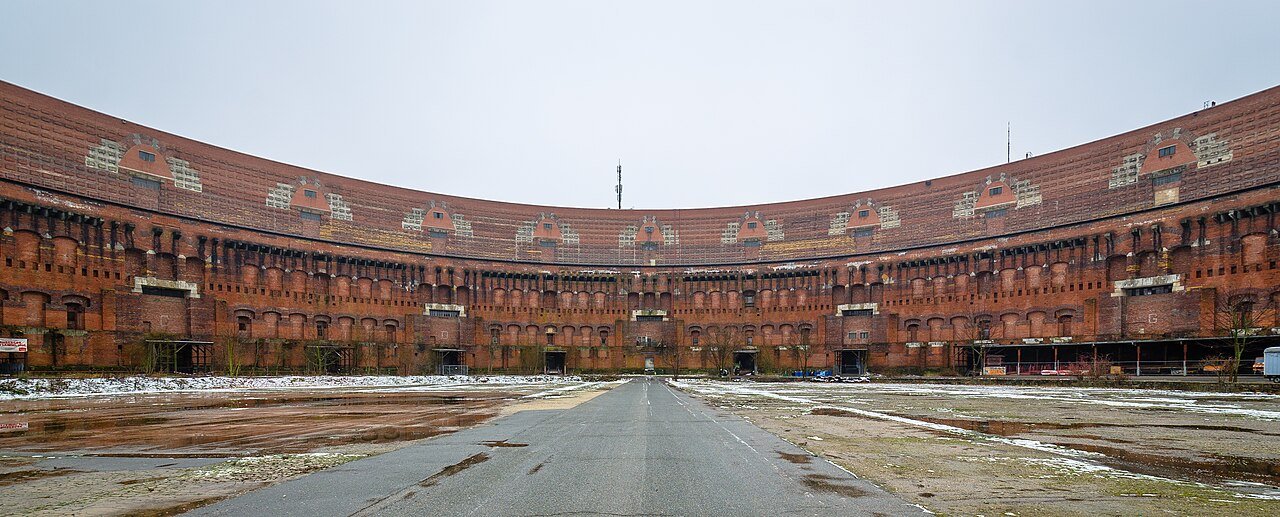
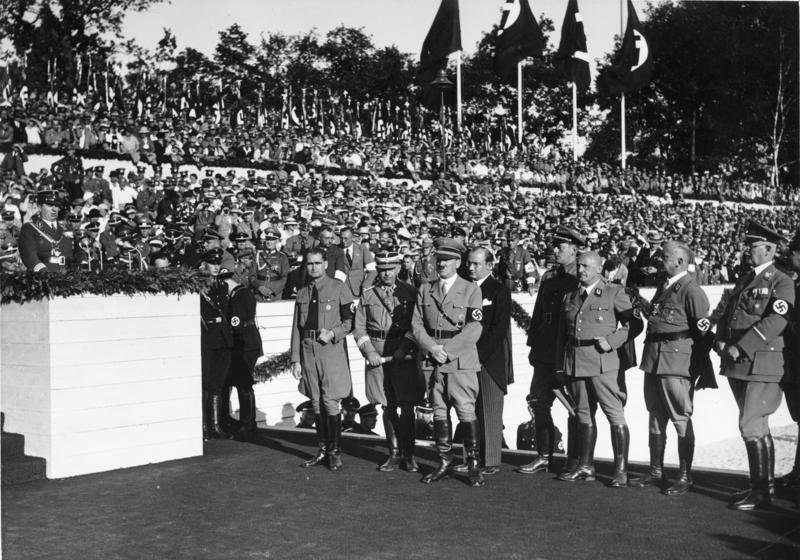
Architect Ludwig Ruff designed the Kongresshalle for the annual NSDAP party rally; after his death in 1934 his son Franz Ruff completed the design, and Hitler laid the cornerstone on 11 September 1935. Modelled on Rome’s Colosseum at about one and a half times its size, the horseshoe-shaped brick and concrete shell reached almost 40 of a planned 68–80 metres before construction slowed after 1939 and stopped for good in 1943. No free-spanning roof, no interior fit-out and no upper storeys were ever built, and no party congress was ever held inside it.
Since 2001 the northern head building has housed the Dokumentationszentrum Reichsparteitagsgelände; the wider 4-square-kilometre grounds, including the Zeppelinfeld nearby (covered on its own place card), remain the subject of an active city debate over how — and whether — to keep such architecture standing.
Key facts
- Scale: footprint 275 by 265 metres, inner courtyard 180 by 160 metres; planned capacity given as 50,000 by the city’s own account, 60,000 by an academic source — reported as a range. Height reached about 39 metres of a design that called for 68 to 80 metres with the roof.
- Construction and halt: roughly 1,400 workers on the shell; work slowed after 1939 and stopped in 1943 with the building unfinished. It never hosted a rally — the last Reichsparteitag was held in 1938, before the hall was usable.
- Postwar reuse: US Army food depot from 1945; returned to the city in 1948; trade fairs and a 1950 city jubilee exhibition held inside; the Nuremberg Symphony moved into the southern head building around 1962–63; from 1972 to 2006 the mail-order company Quelle used the rotunda as a warehouse.
- Preservation: placed under Bavarian monument protection in 1973. The city council adopted guidelines in 2004, reaffirmed in 2015, tying preservation of the whole rally grounds to educational use; a 2015 symposium titled «Preserve! For what?» set the terms of the current policy.
- Current construction: since December 2024 the city has been building an interim opera venue in the inner courtyard, on new foundations rather than the historic fabric — an 800-seat auditorium, budgeted in 2024 at €296 million, opening planned for late 2028.
- Coordinates: 49.4327° N, 11.1142° E.
Who tells it, and where the accounts diverge
The regime’s own architectural theory prized permanence — buildings designed, in Albert Speer’s phrase, to leave beautiful ruins centuries hence. The Kongresshalle’s own unfinished state is the rebuttal: the hall built for eternity never held the event it was built for, and stood at just over half its planned height when work stopped for good. The cornerstone speech of 1935 and the empty shell are both the regime’s own documents.
The city’s postwar decades tell a second story against themselves. A famously utilitarian sequence of reuses — food depot, trade fair hall, a mail-order warehouse for thirty-four years — sits against the same city’s 2004 and 2015 council decisions to preserve the whole complex as a place of historical learning. The pivot from storing goods to opening a documentation centre in 2001, argued through at a symposium literally titled «Preserve! For what?», is the city arguing with its own prior practice, not with an outside critic.
The current opera project keeps that argument alive in real time. The city’s own project pages describe the interim venue as a forward-looking engagement with history, built on new ground within the courtyard. The Documentation Center’s own director, Florian Dierl, has publicly warned that culture must not dilute the memorial function of the site; historians’ associations wrote in an open letter that the building «is not a property that can be used at will». The disagreement runs through the city’s own institutions, not around them.
Media
Street View — a 360° panorama at the Documentation Centre corner of the horseshoe.
Video — Museen der Stadt Nürnberg, «Digitale Erkundung der Kongresshalle».
Video — Museen der Stadt Nürnberg, «Das Reichsparteitagsgelände nach 1945».
3D model — the Documentation Centre wing, by gussbronze (CC BY).
What you see today
- The Dokumentationszentrum Reichsparteitagsgelände, reopened in test operation in May 2026 with a new permanent exhibition, «Nuremberg and the Nazi Party Rallies», and a grand opening planned for November 2026.
- The horseshoe exterior, viewable from the Dutzendteich lakeshore and from the Volksfestplatz.
- Twenty-three outdoor information panels across the wider rally grounds, including the remains of the Luitpoldarena parade ground, the unfinished Große Straße processional avenue, and the flooded excavation pit of the never-built Deutsches Stadion, now the Silbersee lake.
- The inner courtyard itself is a construction site while the interim opera venue is built, planned to open in late 2028.
Getting there
Bayernstraße 110, Nuremberg. The Documentation Center is open Monday to Friday 9:00–18:00 and weekends 10:00–18:00, fully wheelchair accessible; guided tours run weekends, with an English tour on Sundays. The wider grounds are open to the public at all times.
Sources
- Museums der Stadt Nürnberg / Dokumentationszentrum (museums.nuernberg.de), official — 2026 reopening, exhibition, grounds panels.
- City of Nuremberg, Kulturareal Kongresshalle pages (nuernberg.de) — construction history, dimensions, the opera interim project and budget.
- Historisches Lexikon Bayerns — academic account of the rally grounds, capacity figures, postwar reuse, the Luitpoldarena and Deutsches Stadion.
- City of Nuremberg conservation chronology for the Zeppelintribüne (nuernberg.de) — the 2015 symposium and the preservation-funding decisions that followed.
- Wikipedia, Kongresshalle (Nürnberg), used as cross-check only.
Find it on the map
See this place and what’s around it →📷 Become a Cultural Heritage Online photographer
Share your photos of places: they stay published under your name as the author. The more they're seen, the more you get noticed — and soon a contest will reward the most appreciated photos.
Log in or sign up free to add a photoIs this page about you?
This page is read by travellers and heritage enthusiasts who find it on Google. Tell us how you are connected to this place and we will take it from there.