
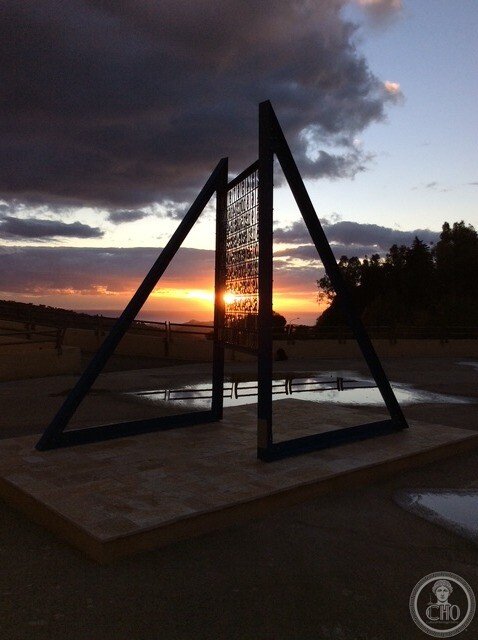
Two open triangles of steel on a square in a Calabrian hill town, and hung between them the multiplication table — ten by ten, up to a hundred, cut out in coloured metal with the sky behind it. In Italian the table is called the tavola pitagorica. The sculptor was born in this town and gave the work to it in 2016.
At a glance
- What — an installation-sculpture in steel: two open triangular frames with a ten-by-ten multiplication table set between them as an open screen
- Where — Piazza del Palio, in the Cacari quarter of Stilo, province of Reggio Calabria
- Size — the triangular frames stand about 4.20 m high; the number panel between them is roughly 2 × 2 m (“perhaps a little more,” in the sculptor’s words) and shorter than the triangles that hold it
- Material — painted steel, fabricated in a workshop near Stilo
- Unveiled — Saturday 1 October 2016, at five in the afternoon
- By — Giorgio Taverniti, born in Stilo and working from London, who gave the work to the town
- Access — an open public square, free at all hours
History
Pythagoras was born on Samos, but the school that carries his name was founded at Croton, on the Ionian coast of Calabria, in the last decades of the sixth century BC; from there its influence ran through the Greek cities of the south. Stilo lies about ninety kilometres down that same coast and a little inland, on the slope of Monte Consolino. The town has two claims of its own: the Cattolica, the small tenth-century Byzantine church of five brick drums that stands above the roofs, and Tommaso Campanella, born here in 1568, the Dominican who wrote The City of the Sun and paid for it with twenty-seven years in Spanish prisons.
In the autumn of 2016 the town acquired a third thing, and like the one before it, it was a gift. Giorgio Taverniti, a sculptor born in Stilo who has worked for decades from a studio in London, donated to the municipality an installation-sculpture called Pitagora. It was unveiled on Saturday 1 October 2016 at five in the afternoon in the Piazza del Palio, and afterwards the artist met the public at the Hotel Città del Sole, the same place where the conversation had been held eighteen months earlier for his first donation.
The local press presented the work as an homage to Pythagoras — described as one of the greatest philosophers, mathematicians and moralists of antiquity — and to the Calabrian land the sculptor comes from. It also drew the line that gives the piece its address: a work dedicated to Pythagoras is more pointed in the birthplace of Campanella, a Renaissance philosopher who took a good deal from the Pythagorean school, and not only for his philosophical arguments.
The first gift had come in April 2015: La Sfinge dello Stilaro, three stacked blocks of granite carved with the equations of infinity and a line of Campanella, installed on the belvedere at the eastern entrance to the town. The two works are eighteen months apart and stand about a hundred and fifty metres from one another, and they are made of opposite materials.
What you see
Two triangles of painted steel, fabricated in a workshop near Stilo, stand on a low paved plinth in the middle of the square. They are not solid: each is an open frame of steel section, an outline with nothing inside it, and they lean towards one another so that their apexes almost meet. Seen from the front they read as a single figure with a gap down the centre; walk round them and they separate. The outer faces are dark, close to black; the inner faces, which catch the light only at certain hours, are painted a bright blue-green.
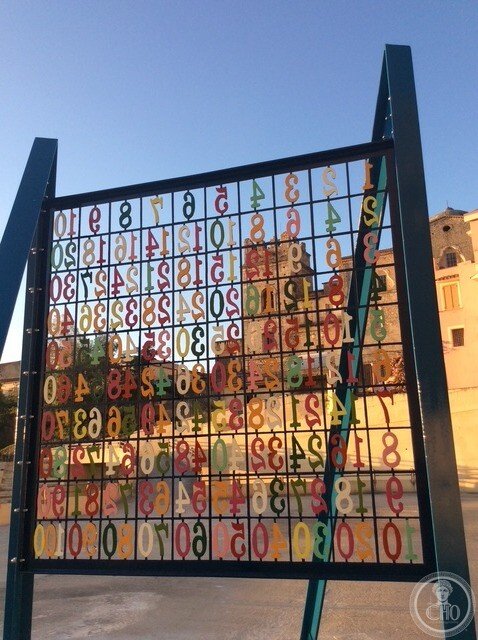
Between the two frames hangs the part that does the work: a square panel ruled into a grid of ten cells by ten, with a number fixed in every cell — cut from flat sheet and painted in a deliberately unmatched range of reds, greens, ochres, creams and oranges. The numbers are not scattered. The top row runs 1, 2, 3 up to 10; the second 2, 4, 6 up to 20; the third 3, 6, 9 up to 30; and the bottom row ends at 100. It is the multiplication table, which in Italian is called the tavola pitagorica — Pythagoras’s table — and that name is the whole subject of the piece.
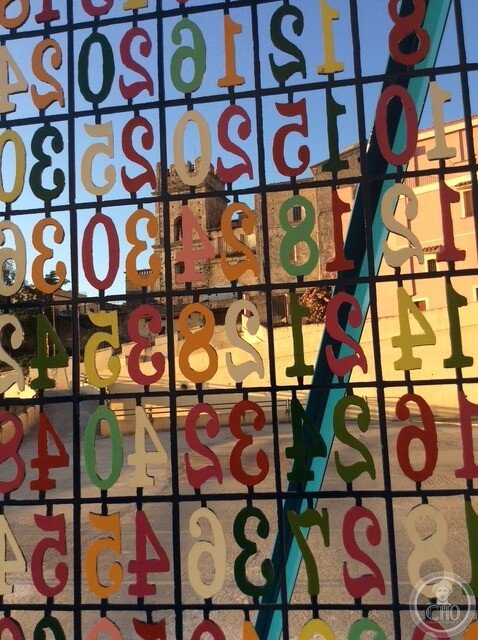
The numbers are held at their edges and the cells are otherwise empty, so the panel is a screen and not a wall: light passes through it, and so does the view. They also face outward, towards the square, which has a consequence the photographs make plain. Stand on the town side and the whole table is reversed — the products you learned by heart turn into hooks and loops, and through the gaps between them you see rough stone walls, a small arched window, roofs.
At the end of the day the effect turns over. The sun goes down behind the piece, the frames become silhouette, and the light comes through the table instead of falling on it.
Cultural significance
For anyone who has been to an Italian school, Pythagoras is two things: a theorem about triangles, and the grid of products you had to learn by heart. The sculpture puts both up at once and then leaves out the explanation. The triangles are empty outlines — no squares on their sides, no diagram, nothing to solve. Between them is the table itself, at the size of a doorway, in the wrong colours and open to the sky.
Taverniti confirmed that reading himself, in writing, once the piece was described online: the numbers, he said, “have never been imagined as decorative.” Multiply the top row by the left-hand column and the products that fall on the diagonal are the perfect squares — 1, 4, 9, 16, and on to 100 — and that diagonal cuts the square panel into two right triangles, the same shape as the two empty steel frames that hold it up. The theorem is not diagrammed anywhere on the piece. It is performed by the arithmetic itself, for anyone who traces the line.
The tavola pitagorica is one of those names nobody stops to hear. It is said by every seven-year-old in the country and by their parents, and the philosopher inside it has long since worn away. Enlarged and set on a public square in the province of Reggio Calabria — a hundred kilometres from the school he actually founded — the name becomes audible again, and the most ordinary thing in a child’s exercise book turns out to have a Greek address on this coast.
Placing it in Stilo rather than at Croton is the argument the local announcement made, and it is worth keeping. The Pythagorean school was a philosophical and political community as much as a mathematical one, and its influence on Magna Graecia was of that kind; Campanella, twenty-one centuries later and born a few hundred metres from this square, drew on it for a body of writing that got him imprisoned.
It is also the second half of a pair. The Sphinx of the Stilaro, given to the town the year before, is granite: heavy, uncut, its meaning incised into the stone in words and equations and ending in dal nulla al nulla. Pitagora is steel, colour and empty space. The same sculptor gave his town a monument you read, and a year later one you look through. Giorgio Taverniti also keeps a studio in the Veneto, which has its own page on this site.
Practical information & getting there
Stilo is about 45 km up the Ionian coast from Locri and roughly the same distance south of Catanzaro Lido. By car, leave the SS106 coast road at Monasterace Marina and climb inland for some 10 km; the nearest station is Monasterace–Stilo on the Ionian line, with local buses up to the town. Piazza del Palio is in the built-up area on the Cacari side, a short walk from the Chiesa di San Francesco. The work is outdoors and always accessible, and there is nothing to pay.
Two things are worth pairing with it. The Cattolica is up the slope above the houses; and the sculptor’s earlier Sphinx of the Stilaro stands on the Piettu terrace at the eastern entrance to the town, a couple of minutes’ walk away. Late afternoon is the hour for this one: the light comes through the table instead of onto it.
Sources & resources
- “Stilo. Inaugurazione della installa-scultura ‘Pitagora’”, Newz.it, 29 September 2016 — for the date, hour and place of the unveiling, the donation to the municipality, the homage to Pythagoras and to Calabria, the reference to Campanella and the Pythagorean school, and the meeting afterwards at the Hotel Città del Sole. Consulted in the Internet Archive copy: the original address still answers, but only with a maintenance page.
- The photographs published here, taken by the sculptor and sent by him on 27 August 2026 with permission to publish. The description of the frames, and the reading of the grid as a ten-by-ten multiplication table, are ours, made from those photographs; they are the only images of the work we have been able to consult.
- Giorgio Taverniti, e-mail to Cultural Heritage Online, 28 August 2026 — for the sculpture’s dimensions and material, its place of fabrication, and his own confirmation of the diagonal reading within the multiplication table.
- OpenStreetMap, for Piazza del Palio and the Cacari quarter, and for the distance between the square and both the Chiesa di San Francesco and the Piettu terrace.
Find it on the map
See this place and what’s around it →📷 Become a Cultural Heritage Online photographer
Share your photos of places: they stay published under your name as the author. The more they're seen, the more you get noticed — and soon a contest will reward the most appreciated photos.
Log in or sign up free to add a photoIs this page about you?
This page is read by travellers and heritage enthusiasts who find it on Google. Tell us how you are connected to this place and we will take it from there.