
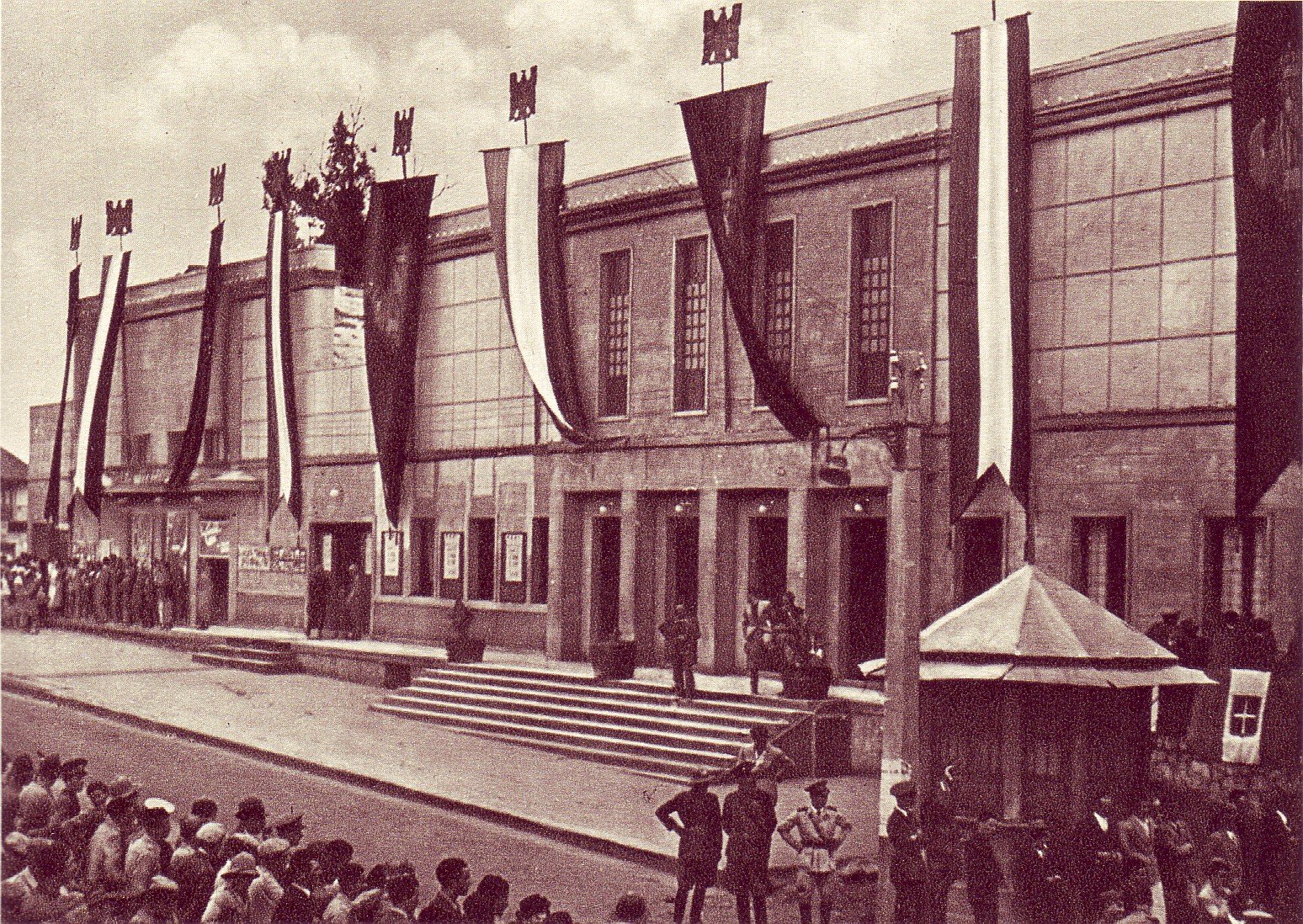
Italy rebuilt Addis Ababa’s former post office into a super-cinema in 1937. It still stands in the Piazza, renamed Cinema Ethiopia.
At a glance
Cinema Italia was the flagship of the cinemas Italy built in occupied Addis Ababa. The building that had served as the city’s post office before 1936 was reconstructed into a prestigious super-cinema, inaugurated in 1937 on Piazza del Littorio — the square in the Arada district that the occupiers renamed Piazza, a name it still carries. It stood immediately east of the Casa Littoria, the main Fascist assembly hall. When the occupation ended in 1941 the Italian names were stripped away, and the cinema was renamed Cinema Ethiopia, by which it is still known. It remains one of the oldest working cinemas in the city.
Key facts
- Inaugurated: 1937, as the Supercinema Italia
- Origin: reconstructed from Addis Ababa’s former city post office
- Location: Piazza del Littorio, Arada district (renamed Piazza), east of the Casa Littoria
- Context: one of seven cinemas Italy opened in the city, six of them at Arada/Piazza
- Renamed: Cinema Ethiopia in 1941, after the end of the occupation
- Today: a working cinema and one of the oldest in Addis Ababa
History
When the Italian army took Addis Ababa in May 1936, the Arada quarter — the historic commercial heart of the city — was set on fire, and its existing picture houses were destroyed. The occupiers then set about building cinemas “with European standard,” both to entertain the garrison and to spread Fascist propaganda. Seven theatres were opened, six of them in the district the Italians rebranded Piazza. The most prestigious was Cinema Italia, raised on the shell of the former city post office and standing next to the Casa Littoria.
These halls ran the newsreels and features of the Istituto LUCE — propaganda cinema for a colonial audience. The building programme was extensive: by one account there were about forty cinemas across Ethiopia by 1939. The pattern was also one of segregation, with a separate cinema opened in the walled-off Merkato that the plan had set aside for the Ethiopian population.
The Italian order lasted five years. When the occupation collapsed in 1941, the cinemas lost their Italian names: Cinema Marconi became Cinema Adwa, and Cinema Italia was renamed Cinema Ethiopia by Eda, a returning exile who had joined the Ethiopian patriots against Fascism. Under a succession of private managers the cinema stayed in use through the following decades, and the building survives in the Piazza today.
What you see
The photograph here catches the building on its opening day in 1937. The facade is long and rationalist: a plain masonry wall broken by tall, narrow window bands and a low, stepped entrance block, without cornice or ornament. For the ceremony it was hung with Italian tricolour drapes and topped with a row of Roman eagle standards, and a crowd of soldiers and civilians fills the street below.
Stripped of the banners, that austere front is still legible on Cunningham Street in the Piazza. The cinema is one of the clearest survivors of the district’s Italian-era fabric, which gives the quarter — still called Piazza — much of its early-twentieth-century character.
Practical information
- Status: a working cinema in central Addis Ababa; the exterior is freely visible from the street.
- Setting: the Piazza (Arada) district, the historic centre, walkable and busy by day.
- Pair it with: a walk of the Piazza’s Italian-era streetscape and St George’s Cathedral nearby.
Getting there
The cinema stands on Cunningham Street in the Piazza (Arada) district, at the historic centre of Addis Ababa. The area is a short taxi ride from most of the city and is best explored on foot; the Ethiopian capital is served by Bole International Airport, about ten kilometres to the south-east.
Nearby
- Piazza (Arada): the district around the cinema, dense with Italian-era shopfronts and public buildings.
- St George’s Cathedral: the octagonal cathedral a short walk north of the Piazza.
- Other Italian-era cinemas: among them the former Cinema Impero, part of the same building campaign.
Sources
- “Ethiopian Cinema: The Socio-economic and Political Impacts of Imperial Era on the Development of Screen Media,” Addis Ababa University — the seven Italian cinemas at Arada/Piazza, the post office reconstructed as Cinema Italia beside the Casa Littoria, the LUCE propaganda films, and the 1941 renaming to Cinema Ethiopia by Eda.
- Historic photograph (1937): the inauguration of the Supercinema Italia in Piazza del Littorio, Wikimedia Commons, public domain.
Find it on the map
See this place and what’s around it →Record researched and written by Luigi De Marchi for Cultural Heritage Online, 2026.

📷 Become a Cultural Heritage Online photographer
Share your photos of places: they stay published under your name as the author. The more they're seen, the more you get noticed — and soon a contest will reward the most appreciated photos.
Log in or sign up free to add a photoIs this page about you?
This page is read by travellers and heritage enthusiasts who find it on Google. Tell us how you are connected to this place and we will take it from there.