
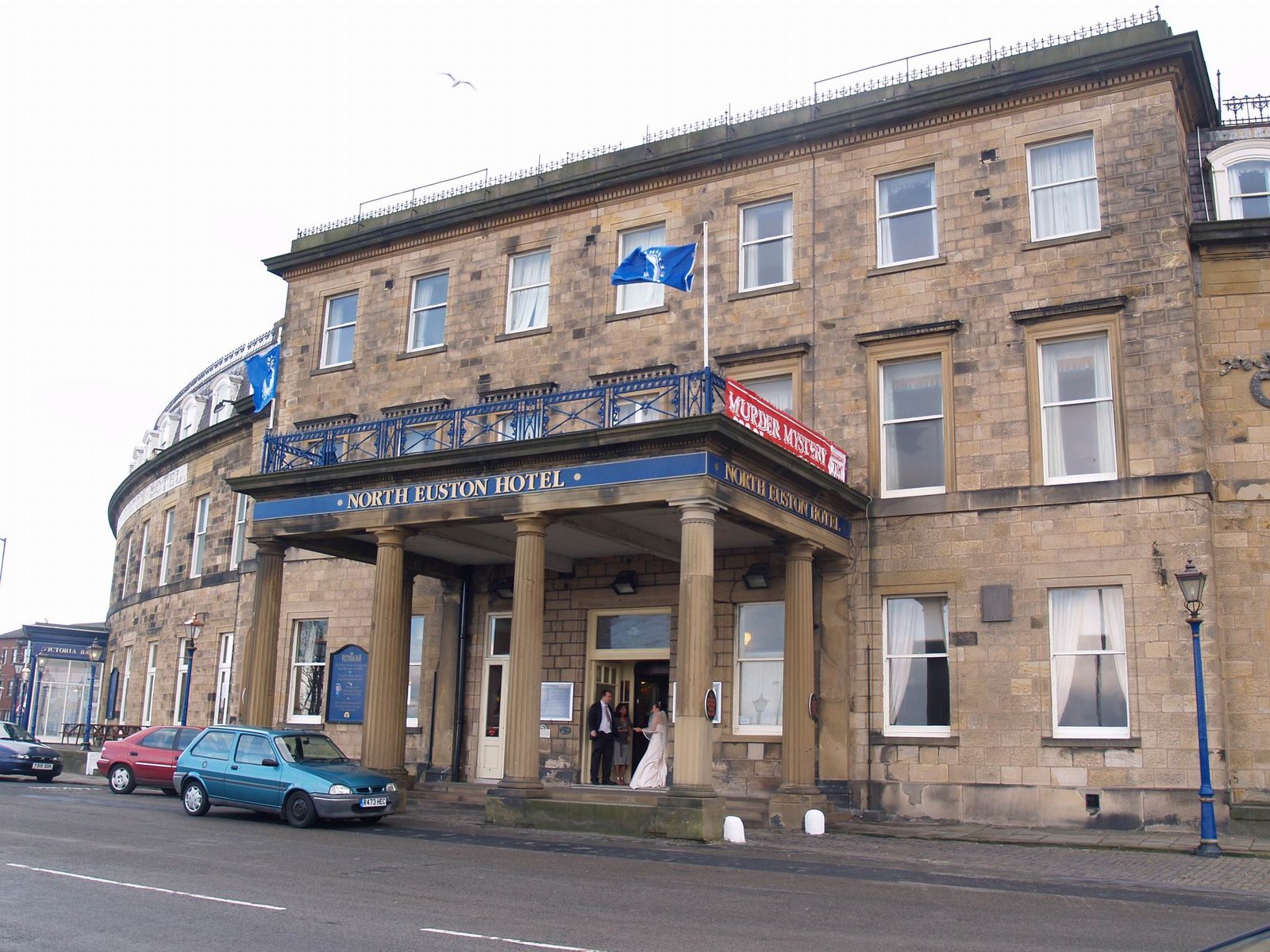
Decimus Burton built a great stone crescent at the end of the line, where Victorian travellers left the train from London and boarded a steamer for Scotland.
At a glance
The North Euston Hotel curves along the seafront at Fleetwood, the planned Lancashire town at the mouth of the River Wyre, looking out over Morecambe Bay to the Lake District hills. It was built in 1840–41 to a design by Decimus Burton (1800–1881), one of the leading architects of the age, as part of Sir Peter Hesketh-Fleetwood’s scheme to raise a whole new town and transport hub from the sand dunes. Its long ashlar crescent, mansard roofs and columned porte-cochere were meant to receive travellers in style. The hotel is a Grade II listed building and, unlike much of the grand plan around it, is still trading today.
Key facts
- Location: The Esplanade, Fleetwood, Lancashire, FY7 6BN
- Architect: Decimus Burton (1800–1881)
- Built: 1840–41
- Built for: rail travellers changing to the steamer for Scotland
- Form: curved ashlar crescent about 270 m long, with mansard roofs and a Doric porte-cochere
- Designation: Grade II listed (Historic England ref 1362181, listed 1950)
- Today: a working hotel of 53 rooms overlooking Morecambe Bay
History
Fleetwood was one of the boldest experiments of early Victorian Britain: a town conjured whole from the dunes by the landowner Sir Peter Hesketh-Fleetwood, who commissioned Decimus Burton to lay it out. The plan turned on the railway. When the line north from London reached only as far as Fleetwood, travellers bound for Scotland would leave the train here, spend the night, and take a steamer up the coast the next morning.
The North Euston was the hotel built to catch them. Its very name looks back down the line to Euston station in London, marking Fleetwood as the northern end of the journey. Burton gave it the sweep of a Regency seaside crescent, a building grand enough to reassure passengers that the remote new port took them seriously.
The idea did not last. Within a decade the railway pushed on up the west coast to Scotland directly, and the change at Fleetwood was no longer needed. The hotel that had been built for a broken journey lost its reason for being almost as soon as it opened. Yet it endured — through spells in other uses and back again — and remains one of the finest survivors of Hesketh-Fleetwood’s vanished dream.
What you see
Burton designed the North Euston as a single grand gesture: a long ashlar-faced crescent that bends to follow the shoreline, so that the whole building faces the sea. Above the main storeys the mansard roofs and dormers give it a French note, while the entrance is marked by a porte-cochere carried on fluted Roman Doric columns, the kind of classical detail Burton handled with ease. The curve is the thing you remember — nearly three hundred yards of stone sweeping round to embrace the bay.
The setting completes it. The hotel stands on the Esplanade at the very tip of the Fleetwood peninsula, with Morecambe Bay in front and the fells of the Lake District on the horizon across the water. Built to be the first and last sight of a new town, it still commands its stretch of coast, a piece of Regency-scaled ambition marooned on the Lancashire shore.
Practical information
- Operating hotel: the North Euston is a working hotel; its bar, restaurant and public rooms are open to non-residents.
- Exterior: the crescent and its seafront setting can be enjoyed for free from the Esplanade and the promenade.
- Time needed: 15–20 minutes to walk the seafront and take in the building; longer for a meal or a stay.
Getting there
Fleetwood sits at the northern tip of the Fylde coast in Lancashire, north of Blackpool. The town is reached by the Blackpool tramway, which runs the length of the coast to a terminus near the hotel, and by road via the A585 from the M55. The nearest mainline railway station is at Poulton-le-Fylde, a few miles inland, with connections to Preston.
Nearby
- Fleetwood’s Burton landmarks — the Pharos and Beacon lighthouses and the Mount, all part of Decimus Burton’s town plan.
- Morecambe Bay — the vast tidal bay in front of the hotel, famous for its birdlife and shifting sands.
- Blackpool — the great Victorian resort a tram-ride south, with its Tower and Pleasure Beach.
Sources
- Historic England, listed building record 1362181 — https://historicengland.org.uk/listing/the-list/list-entry/1362181
- Wikipedia, “North Euston Hotel” — https://en.wikipedia.org/wiki/North_Euston_Hotel
- Wikipedia, “Decimus Burton” — https://en.wikipedia.org/wiki/Decimus_Burton
- Wikidata Q7055329 — https://www.wikidata.org/wiki/Q7055329
Find it on the map
See this place and what’s around it →📷 Become a Cultural Heritage Online photographer
Share your photos of places: they stay published under your name as the author. The more they're seen, the more you get noticed — and soon a contest will reward the most appreciated photos.
Log in or sign up free to add a photoIs this page about you?
This page is read by travellers and heritage enthusiasts who find it on Google. Tell us how you are connected to this place and we will take it from there.