
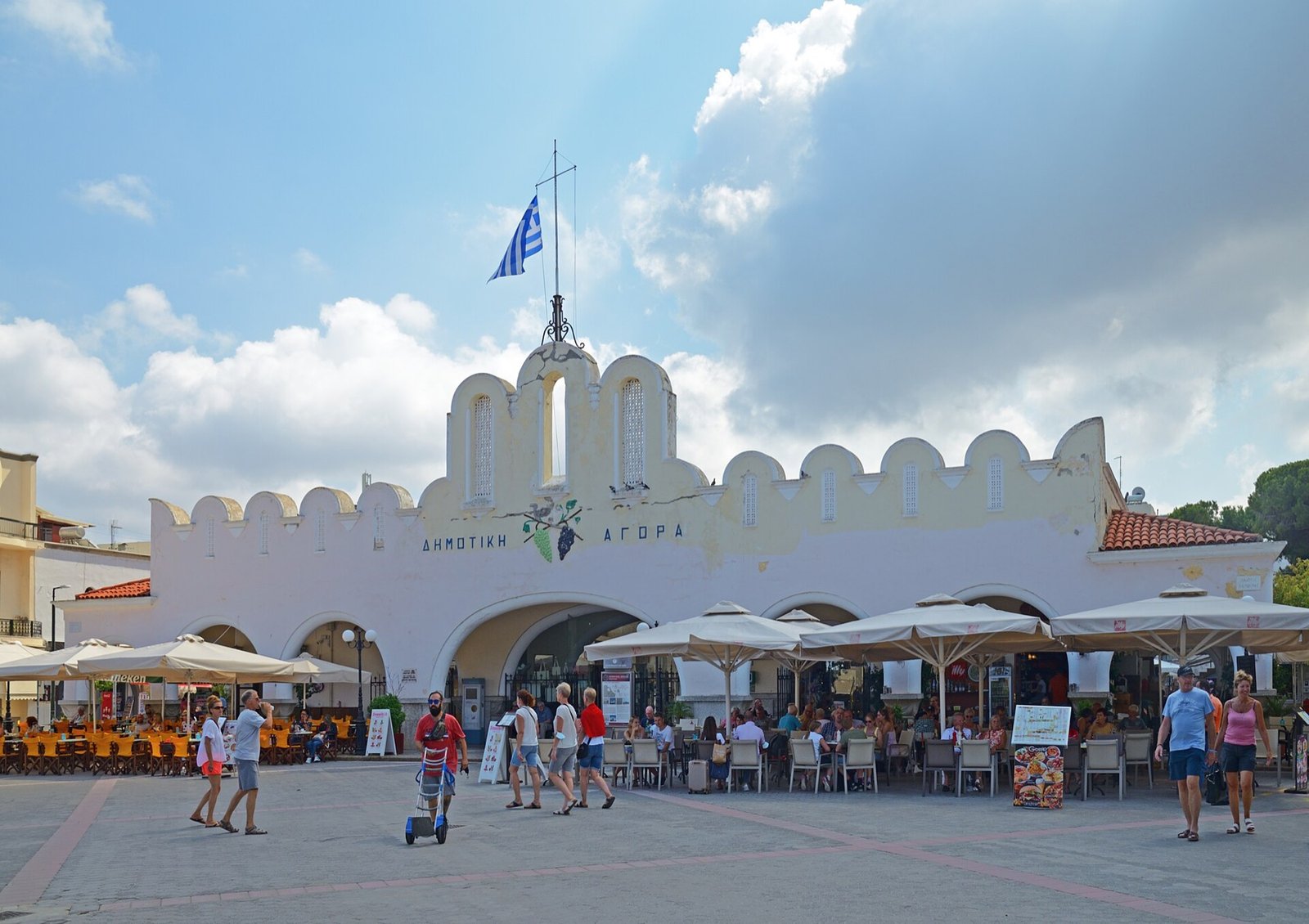
Kos (from 1934): after the earthquake of 23 April 1933 levelled the old town, Rodolfo Petracco replanned Kos as a low Rationalist city wrapped around the ancient agora the Italians excavated — a rare town rebuilt as an archaeological park.
At a glance
On the morning of 23 April 1933 an earthquake destroyed much of the old town of Kos. Italy, which had held the Dodecanese since 1912, treated the ruin as an opening. Its archaeologists dug down through the cleared ground to the ancient Greek and Roman city; its architects, led by Rodolfo Petracco, drew a new plan that set a low, modern town around the excavations. Kos was rebuilt, uniquely, as an archaeological city — ancient agora and 1930s market sharing the same few streets. Much of that town still stands, and still works.
Key facts
- The earthquake: 23 April 1933, which destroyed a large part of the old city
- New plan: drawn by Rodolfo Petracco, 1934 — residential, administrative and commercial zones around the archaeological areas
- Excavations: the ancient agora dug by the Italian Archaeological School, 1935–1942, with restoration of the ancient monuments
- Architects: Petracco, Armando Bernabiti and Florestano Di Fausto — Rationalism tempered by local vernacular
- Surviving buildings: the Municipal Market, the former Casa del Fascio, the archaeological museum, the Gelsomino hotel and the synagogue
- Context: the Italian Aegean possession, 1912–1943
History
The quake of 1933 was a catastrophe for the town and a chance for its rulers. Where a rebuilt city usually paves over its past, the Italian administration did the opposite: it sent in the archaeologists first. The Italian Archaeological School excavated the ancient agora and the western sites from 1935, work that ran to 1942, and Rodolfo Petracco built the finds into the shape of the new town. His 1934 plan, studied since as a deliberate “archaeological city”, left broad open zones over the dig sites and divided the rest into quarters for living, government and trade.
The architecture was the shared Aegean manner of the decade: Rationalist lines softened by whitewashed walls, arcades and pitched tile roofs borrowed from the islands. Petracco worked alongside Armando Bernabiti and Florestano Di Fausto, and the houses of Mario Paolini gave the residential streets their vernacular grain. It was, like the Foro Italico in Rhodes, the built instrument of colonial rule — and it should be read as that, even as it is admired for how it handled the ancient ground.
What you see
The centre of the rebuilt town is Eleftherias Square, and its landmark is the Municipal Market — a long, low hall with a scalloped white parapet and a raised, arched belfry over the entrance, still the food market of Kos. Around the square stand the other public buildings of the 1930s: the former Casa del Fascio, now a cinema, and the archaeological museum the Italians raised to hold what came out of the ground.
A few steps away the excavations open in the middle of the town: the columns and pavements of the ancient agora, restored and left in the open, with the modern streets running along their edge. The Gelsomino hotel, built for Italian officials, and the synagogue by Bernabiti and Petracco complete the record of a town remade in a single decade.
Visiting
- The whole ensemble is open and walkable; the market, the square and the agora excavations sit within a few minutes of each other.
- The archaeological museum on Eleftherias Square holds the finds from the Italian excavations; opening hours are seasonal.
- The agora is an open archaeological area at the heart of the town — free to walk through.
Getting there
Kos Town lies on the north-east coast of the island, around its harbour. Kos has an international airport about 25 kilometres to the south-west and frequent ferries to Rhodes, Bodrum and the other Dodecanese islands.
Nearby
Sources
- Wikipedia, Kos, 1933 Kos earthquake, Rodolfo Petracco and Armando Bernabiti — the earthquake, the 1934 replanning, the excavations of 1935–42, the architects.
- G. Rocco & M. Livadiotti, Il piano regolatore di Kos del 1934: un progetto di città archeologica, and discoveringkos.com — the archaeological-city plan and the surviving 1930s buildings.
- Cultural Heritage Online, The Italian Dodecanese: Rhodes, Leros and the Architecture of the Aegean Possession — colonial context.
Find it on the map
See this place and what’s around it →Record researched and written by Luigi De Marchi for Cultural Heritage Online, 2026.
📷 Become a Cultural Heritage Online photographer
Share your photos of places: they stay published under your name as the author. The more they're seen, the more you get noticed — and soon a contest will reward the most appreciated photos.
Log in or sign up free to add a photo