
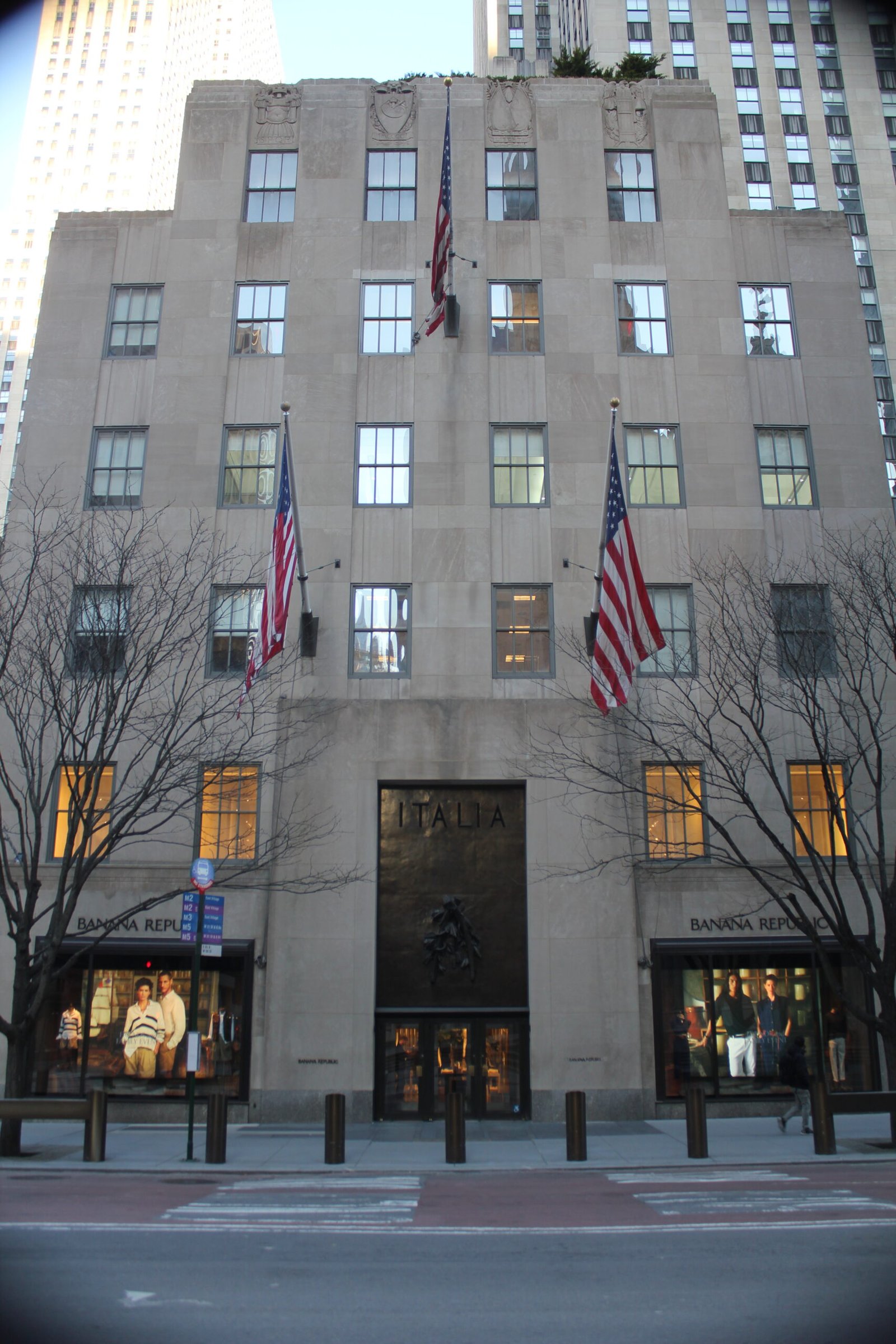
The Italian wing of Rockefeller Center opened in 1935 with iconography celebrating the regime then in power in Rome. Five days after Pearl Harbor its glass panel was boarded over; Manzù’s bronzes replaced it in 1965.
At a glance
The Palazzo d’Italia is the six-story, limestone-clad wing of the International Building at 626 Fifth Avenue — the Italian unit in Rockefeller Center’s ensemble of nationally themed fronts, beside the British Empire Building and La Maison Française. The International Building, designed in Art Deco style under Raymond Hood and the Associated Architects and raised in a famous 136 days, opened on 1 May 1935: a 41-storey, 156-metre tower with the palazzo at its Fifth Avenue foot. The wing’s original decorative programme, commissioned from Italian-American artists, reflected the Italy of 1935 — fascist Italy — and its fate over the following thirty years turned the little building into a barometer of Italian-American history.
Key facts
- Opened: 1 May 1935, with the International Building (Raymond Hood and the Associated Architects; the tower was built in 136 days)
- The wing: six storeys, limestone-clad, at 626 Fifth Avenue
- 1935 art: Attilio Piccirilli’s 10 × 16 ft glass-block panel over the entrance — a man with a spade and Italian inscriptions — and Leo Lentelli’s four roofline reliefs: Roman Empire, Renaissance, Unification, Fascist Italy
- December 1941: the Piccirilli panel, read as overtly celebrating fascism, was boarded over days after Pearl Harbor
- 1965: Giacomo Manzù’s bronze relief Italia and his bas-relief The Immigrant replaced the covered panel
- Status: New York City landmark (exteriors of the original Rockefeller Center complex, designated 23 April 1985)
History
The context, stated plainly: the Palazzo d’Italia was commercial real estate, not a state building — but it opened in 1935 wearing the imagery of the fascist state, at the height of the regime’s prestige among parts of the Italian-American public, and its subsequent stripping is as much a document as its construction. Both phases are recorded here as heritage.
Rockefeller Center’s planners conceived the Fifth Avenue frontage as a diplomatic row: low national pavilions — British, French, Italian — drawing tenants and prestige from their respective countries, with the International Building’s tower behind. For the Italian wing, the Italian-born sculptor Attilio Piccirilli produced a luminous glass-block panel over the entrance; Leo Lentelli carved the roofline sequence of Italy’s four ages, ending, as the regime’s own histories did, with fascism itself.
The arrangement lasted six years. Italy declared war on the United States in December 1941, and days after Pearl Harbor the Piccirilli panel was boarded over; the wing spent the war years as an ordinary office front. Not until 1965 did the entrance receive its present art: Giacomo Manzù — the sculptor of the Vatican’s Door of Death — contributed the bronze Italia, a spare composition of fruit and vine beneath the single word, and the small Immigrant relief, quietly replacing imperial rhetoric with the migrant experience. Since 1985 the whole original complex has been protected as a New York City landmark.
What you see
From the Fifth Avenue pavement the palazzo reads as a restrained limestone front, six storeys under a stepped attic, with the 41-storey slab of the International Building rising behind. Over the entrance, the dark bronze field carries the word ITALIA and Manzù’s hanging vine; at the roofline, Lentelli’s four reliefs still crown the composition. The building is best read together with its siblings — the British Empire Building and La Maison Française flanking the Channel Gardens a block south — as one architectural sentence about the 1930s world order, written in Manhattan limestone.
Inside the International Building’s lobby, a few steps away, the copper-clad columns and Lee Lawrie’s Atlas on the forecourt belong to the same 1935 campaign; the palazzo’s ground floor now houses retail.
Practical information
- The exterior is visible at all times from Fifth Avenue between 50th and 51st Streets; the ground floor is in commercial use.
- The International Building lobby is generally accessible during business hours.
- Combine with the Channel Gardens, Atlas and the Top of the Rock for a fuller Rockefeller Center visit.
Getting there
Fifth Avenue at 50th Street, Midtown Manhattan; nearest subway 47–50 Sts–Rockefeller Center (B, D, F, M). GPS: 40.75871, -73.97740 · Open in Google Maps.
Related places and reading
- Fascist-Era Architecture in Italy: One Label, Many Styles — the stylistic frame of the 1930s
- Architecture and Power in Fascist Italy — how the regime used building imagery
- The Atlantic Squadrons — the full story of the 1930–33 formation flights
- The Route of the Decennial Air Cruise — the three-stop historical route
Sources
- English Wikipedia, “International Building (Rockefeller Center)” (opening 1 May 1935, architects, tower data, the Palazzo d’Italia wing, Piccirilli panel and its 1941 covering, Lentelli reliefs, Manzù’s 1965 works, 1985 landmark designation).
- Rockefeller Center official magazine, “Italian Art Heritage at Rockefeller Center”.
- Wikidata Q3361346 (coordinates).
Find it on the map
See this place and what’s around it →Record researched and written by Luigi De Marchi for Cultural Heritage Online, 2026.
📷 Become a Cultural Heritage Online photographer
Share your photos of places: they stay published under your name as the author. The more they're seen, the more you get noticed — and soon a contest will reward the most appreciated photos.
Log in or sign up free to add a photoIs this page about you?
This page is read by travellers and heritage enthusiasts who find it on Google. Tell us how you are connected to this place and we will take it from there.