
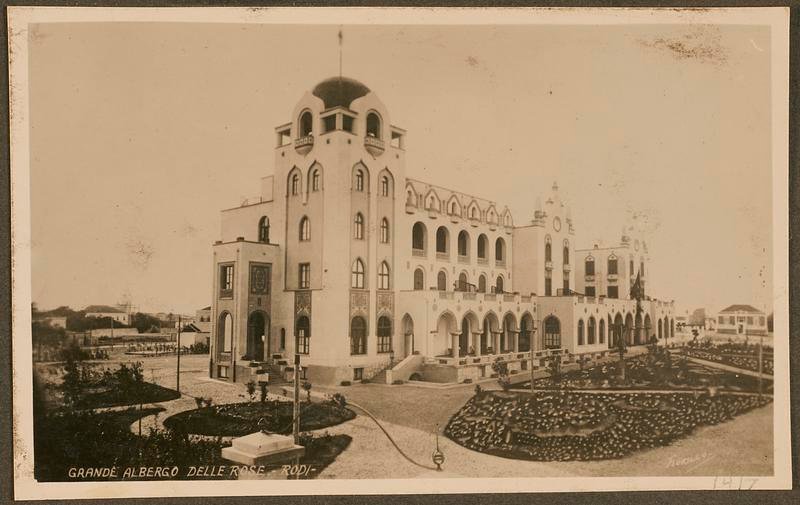
The flagship hotel of Italian Rhodes: opened in 1927 to the design of Florestano Di Fausto and Michele Platania, a seafront palace mixing Venetian, Byzantine and Arab motifs. Since 1999 it houses the Casino Rodos.
At a glance
The Grande Albergo delle Rose was the social centrepiece of Rhodes under Italian rule (1912–1943/47). Designed by Florestano Di Fausto — the “architect of the Mediterranean”, whose work runs from Rhodes to Tripoli — with Michele Platania, and opened in 1927, the hotel put the new colonial capital on the map of Mediterranean tourism: a great seafront block whose arcades, domed corner pavilions and decorative screens deliberately mixed Venetian, Byzantine and Arab references, the eclectic “Mediterranean” manner Di Fausto practised before his later, plainer phase. Restored at the end of the twentieth century, the building reopened in 1999 as the Casino Rodos; its silhouette still commands the northern tip of Rhodes town.
Key facts
- Architects: Florestano Di Fausto and Michele Platania
- Opened: 1927
- Style: eclectic “Mediterranean” — Venetian, Byzantine and Arab motifs
- Role: flagship hotel of the Italian Aegean, hub of interwar tourism to Rhodes
- Today: Casino Rodos (since 1999), Rhodes town seafront
History
Italy took the Dodecanese from the Ottoman Empire in 1912 and governed the islands until the Second World War; Rhodes was the seat of the governorate, and through the 1920s the administration of Mario Lago rebuilt the town’s waterfront — the Foro Italico at Mandraki harbour — with administrative palaces, a cathedral, markets and hotels, much of it by Di Fausto. The Albergo delle Rose was the programme’s showpiece for visitors: a grand hotel for the steamer tourism the colony promoted, alongside the thermal baths of Kallithea (Pietro Lombardi, inaugurated 1929).
The hotel’s guest books of the interwar years read as a roll of European society; after the war and the islands’ union with Greece (1947) the building passed through decades of changing use and decline before restoration returned it to life as a casino in 1999. It stands today as the most visible monument of the Italian decades in Rhodes — a chapter the town’s fabric records from the Foro Italico to the rebuilt Grand Master’s Palace.
What you see
The building is a long symmetrical block facing the sea, its centre raised, its corners marked by domed pavilions. Pointed and round arches, striped stonework, pierced screens and loggias carry the tripartite reference — Venice, Byzantium, the Arab Mediterranean — that Di Fausto assembled as the “style of the islands”. Comparison with his later Tripoli work, and with the plain rationalism of Lakki on Leros, shows the range of languages Italian building used overseas in a single generation.
Visiting
The building operates as Casino Rodos on the seafront of Rhodes town (Papanikolaou street), a short walk from Mandraki harbour and the Foro Italico ensemble; entry follows the casino’s rules. The exterior and the seafront front are freely visible. GPS: 36.45375, 28.22257 (Google Maps).
Related places and reading
- Lakki (Portolago), Leros — the rationalist new town of the Aegean
- Arch of the Philaeni, Libya — Di Fausto’s later monumental phase
- Italian Libya — the same architect’s African chapter
Sources
- Studies on Florestano Di Fausto and Italian architecture in the Dodecanese (governorate of Mario Lago).
- Documentation on the Grande Albergo delle Rose (1927) and its 1999 reopening as Casino Rodos.
- Period photographic record (1928), Wikimedia Commons / DPLA.
- Wikidata Q108902071 (coordinates).
Find it on the map
See this place and what’s around it →Record researched and written by Luigi De Marchi for Cultural Heritage Online, 2026.
📷 Become a Cultural Heritage Online photographer
Share your photos of places: they stay published under your name as the author. The more they're seen, the more you get noticed — and soon a contest will reward the most appreciated photos.
Log in or sign up free to add a photoIs this page about you?
This page is read by travellers and heritage enthusiasts who find it on Google. Tell us how you are connected to this place and we will take it from there.