
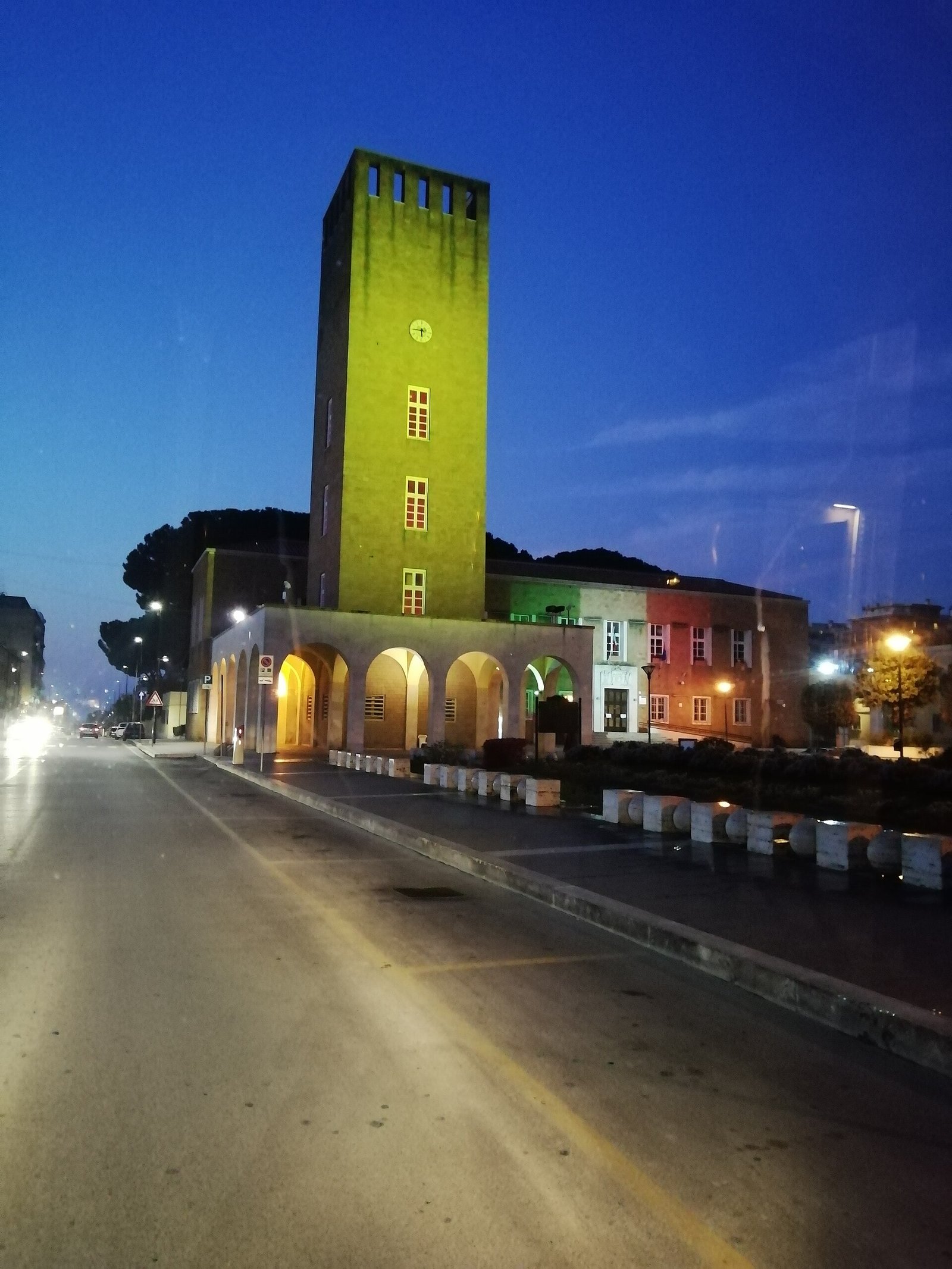
The town hall and tower of the last Pontine new town, centrepiece of the founding civic ensemble designed by the 2PST group and inaugurated in October 1939.
At a glance
Pomezia, fifth and last of the Pontine new towns, was founded on 25 April 1938 and inaugurated on 29 October 1939. Its plan came from the national competition won by the 2PST group — Concezio Petrucci, Mario Tufaroli Luciano, Emanuele Filiberto Paolini and Riccardo Silenzi, the same team that had built Aprilia. The Casa Comunale with its Torre Civica is the centrepiece of the founding civic ensemble (the nucleo aulico) on the main piazza, together with the post office, the church of San Benedetto and the former Casa del Fascio: a compact catalogue of the simplified, severe classicism of the late 1930s.
Key facts
- Design: 2PST group — Petrucci, Tufaroli Luciano, Paolini, Silenzi, winners of the national competition.
- Built: 1938–1939; the town was inaugurated on 29 October 1939.
- Tower: quadrangular plan in three orders, crowned by a pseudo-battlement recalling medieval towers.
- Ensemble: part of the founding civic core with post office, San Benedetto and the former Casa del Fascio.
- Character: simplified neoclassicism — smooth walls, round arches, plain cornices.
- Use: civic functions on the central piazza of Pomezia.
History
By 1938 the Pontine programme had produced four towns, each different from the last. For the fifth, a national competition was held, and the winning 2PST project gave Pomezia the most compact and unified civic centre of the series: a single composed piazza where town hall, tower, post office, church and party house faced each other as one architectural set.
Inaugurated on the eve of the war, Pomezia had little time to live its founding plan; after 1945 it grew into one of the most industrial towns of Lazio, and the founding core became a small historic centre inside a much larger city. The piazza and its buildings survive as the clearest record of what the last new town was meant to be.
What you see
The Casa Comunale presents a low arcaded front — round travertine-edged arches on plain piers — from which the brick tower rises in three telescoping orders, with the clock at its top and a shallow crown of pseudo-merlons that quotes the civic towers of medieval Italy. Decoration is reduced to the essentials: smooth wall, clean arch, thin cornice.
Around the piazza the rest of the founding ensemble completes the picture, from the church of San Benedetto to the former Casa del Fascio. Seen together they show the sober, severe face of Italian public architecture at the very end of the 1930s.
Practical information
- Access: public buildings on an open piazza; exteriors always visible.
- Time needed: 15–20 minutes for the whole founding ensemble.
- Combine with: ancient Lavinium at Pratica di Mare, 5 km away, for a two-millennia contrast.
Getting there
Pomezia is about 30 km south of Rome, reached by the Via Pontina (SS148); the station of Pomezia–Santa Palomba, on the Rome–Naples line via Formia, lies a few kilometres from the centre with local bus connections.
Coordinates: 41.6696, 12.5019 — open in Google Maps.
Nearby
- Pomezia, the founded town — the story of the fifth new town.
- Palazzo delle Poste e Telegrafi — the post office of the founding ensemble.
- Aprilia — the fourth new town by the same 2PST group, 20 km south-east.
Sources
- Rete Dimore Storiche Lazio — Pomezia, Nucleo Aulico della Città di Fondazione.
- QR Tour Pomezia — Nucleo Architettonico Aulico di Fondazione (1939).
- V. Palmieri, Pomezia 1939. Un concorso, un’idea di città (the 2PST competition).
Find it on the map
See this place and what’s around it →
📷 Become a Cultural Heritage Online photographer
Share your photos of places: they stay published under your name as the author. The more they're seen, the more you get noticed — and soon a contest will reward the most appreciated photos.
Log in or sign up free to add a photoIs this page about you?
This page is read by travellers and heritage enthusiasts who find it on Google. Tell us how you are connected to this place and we will take it from there.