
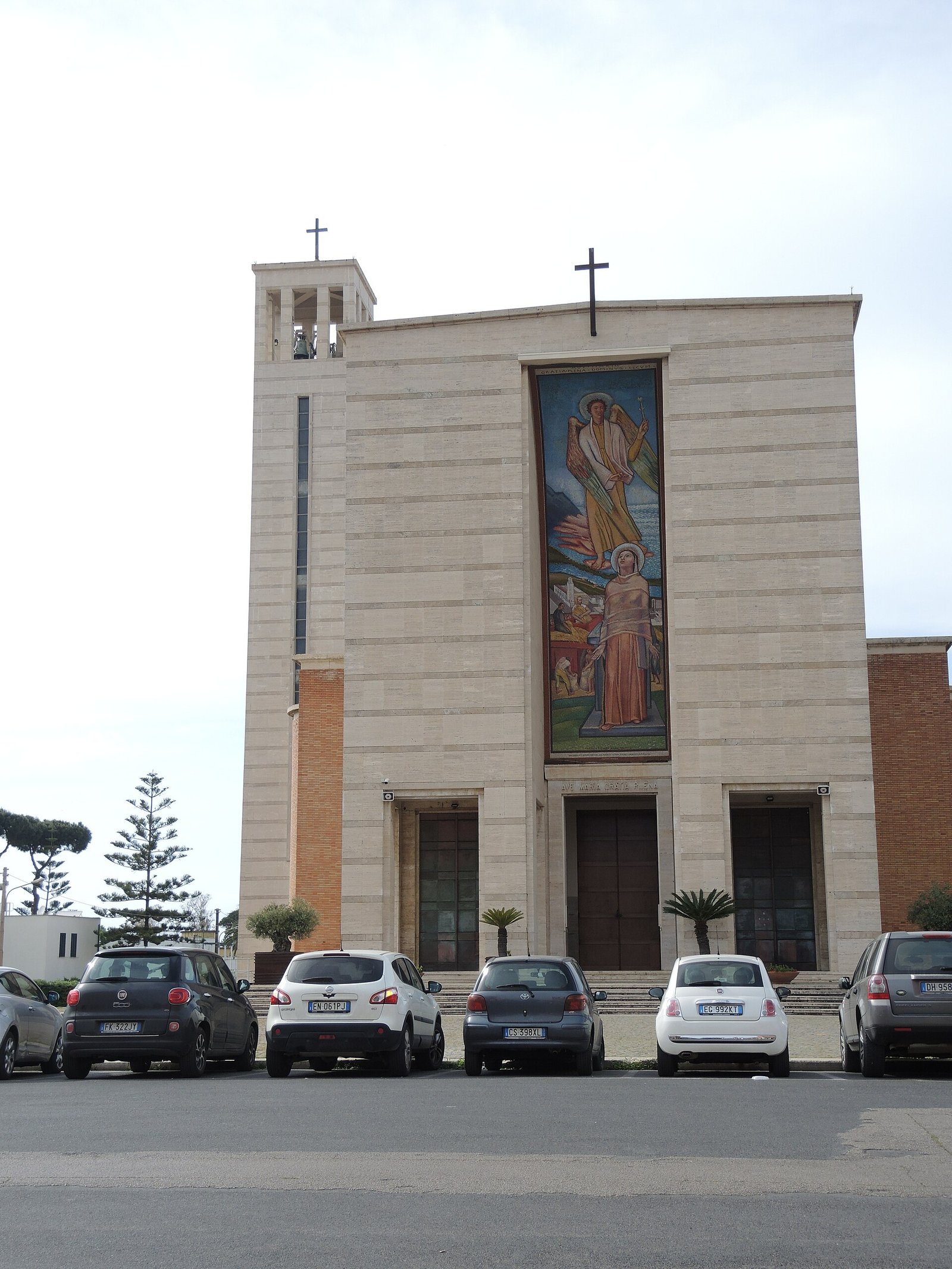
The church of the most celebrated Pontine new town: travertine rationalism by Gino Cancellotti, a 47-metre bell tower, and a facade mosaic by Ferruccio Ferrazzi that tells the story of the reclamation.
At a glance
The church of the Santissima Annunziata was built with the founding works of Sabaudia and inaugurated on 24 February 1935. Designed within the town plan of Gino Cancellotti, Eugenio Montuori, Luigi Piccinato and Alfredo Scalpelli — the church itself is credited to Cancellotti — it is a compact travertine volume 22 metres high, 55 long and 29 wide, flanked by a 47-metre bell tower. Its most distinctive feature is the tall vertical mosaic of the Annunciation by Ferruccio Ferrazzi, set into the facade, in which the sacred scene is surrounded by images of the drained land and the life of the reclamation years.
Key facts
- Architect: Gino Cancellotti, of the Sabaudia planning team (Cancellotti, Montuori, Piccinato, Scalpelli).
- Inaugurated: 24 February 1935, with the founding works of the city.
- Dimensions: 22 m high, 55 m long, 29 m wide; bell tower 47 m.
- Facade: porticoed, clad in travertine blocks and slabs in two shades; brick side walls.
- Mosaic: the Annunciation, by Ferruccio Ferrazzi (1891–1978), with imagery of the reclamation.
- Use: the parish church of Sabaudia, dedicated to the town’s patron.
History
Sabaudia was built in barely a year on the drained Pontine Marshes and inaugurated in 1934; its church followed within months, completing the civic centre around the piazza. Like the rest of the town, it was designed by the young Roman group that had won the 1933 competition — a plan still studied as a masterwork of rationalist urbanism.
For the facade the commission went to Ferruccio Ferrazzi, one of the leading Italian artists of the day. His mosaic sets the Annunciation against the world the settlers knew: the reclaimed fields, the water, the new buildings. Sacred iconography and the story of the place are fused in a single image — a document of how the new towns presented their own founding as providence.
What you see
The church reads as a sheer travertine screen: a flat facade with a low portico at its base, the tall mosaic panel rising above the entrance, and the thin campanile standing slightly apart, pierced by a vertical slot of windows and crowned by an open belfry. The two shades of travertine give the surface a quiet banding; the side walls, in red brick, warm the composition.
Up close, the mosaic rewards attention: the archangel above, the Virgin below, and around them boats, reclaimed land and working figures — the everyday world of 1935 drawn into the sacred scene, in Ferrazzi’s dense, luminous tesserae.
Practical information
- Access: an active parish church; opening follows service times, and the exterior is always visible.
- Best light: late morning, when the sun reaches the mosaic directly.
- Time needed: 15–20 minutes, within a walk through Sabaudia’s civic centre.
Getting there
The church stands just off Sabaudia’s central Piazza del Comune. Sabaudia is on the Tyrrhenian coast about 90 km south of Rome, reached by the SS148 Pontina; the nearest railway station is Priverno–Fossanova, with bus connections.
Coordinates: 41.3016, 13.0230 — open in Google Maps.
Nearby
- Sabaudia, the founded city — the rationalist plan of 1933–1934.
- Palazzo Comunale and civic tower — the town hall by the same team.
- Parco Nazionale del Circeo — dunes, coastal lakes and the promontory of Monte Circeo.
Sources
- Parco Nazionale del Circeo — Sabaudia, Chiesa della SS. Annunziata (parcocirceo.it).
- Parrocchia SS. Annunziata di Sabaudia — Storia (santissimannunziata.it).
- Radio Onda Blu — Sabaudia: la Chiesa SS. Annunziata (architecture and dimensions).
Find it on the map
See this place and what’s around it →
📷 Become a Cultural Heritage Online photographer
Share your photos of places: they stay published under your name as the author. The more they're seen, the more you get noticed — and soon a contest will reward the most appreciated photos.
Log in or sign up free to add a photoIs this page about you?
This page is read by travellers and heritage enthusiasts who find it on Google. Tell us how you are connected to this place and we will take it from there.