Founded in 1924, the Istituto Nazionale L.U.C.E. was Italy’s first public film body and, in all likelihood, the first State cinema institution in the world. The acronym stands for L’Unione Cinematografica Educativa — “the educational film union”. Born in the Twenties to produce and distribute films for education, information and propaganda, Luce filmed the life of the country for two decades; what remains of it today — the Archivio Luce Cinecittà — is Italy’s largest and oldest historical film archive, a collection its current custodians have called “the visual biography of our country”: more than 77,000 films and around 5 million photographs, listed since 2013 in UNESCO’s Memory of the World Register.
1924: Luciano De Feo and the educational idea
Luce was created in 1924 on the initiative of the journalist Luciano De Feo. Its first form was a private venture, the Sindacato Istruzione Cinematografica, which in September of the same year took the name L’Unione Cinematografica Educativa — the LUCE acronym that tradition says Mussolini approved personally. The founding idea was to use the young medium of film for popular instruction in a country still marked by widespread illiteracy: educational screenings, scientific documentaries, agricultural and public-health films for schools and cinemas. In the Twenties, cinema was the mass medium par excellence, able to reach even those who could not read — an observation at the root of Luce’s educational vocation and, equally, of its later political use.
1925: from private company to organ of the State
The turn came quickly. With royal decree-law no. 1985 of 5 November 1925, the small private company became a public body: “The Istituto Nazionale LUCE for popularisation and culture through cinematography” — the first State cinema institution in the world. Already in July 1925 a circular from the Prime Minister’s office had instructed ministries to use Luce exclusively for their educational and propaganda purposes. From then on, the Institute operated as the State’s central structure for producing and distributing documentaries and newsreels: the instrument through which the regime carried its visual communication into every cinema in Italy. This is a matter of historical record, verifiable in the legislation of the time.
The Giornale Luce newsreels (from 1927)
In 1927 the Institute launched the Giornale Luce, the newsreel screened in Italian cinemas before the main feature. Screening became effectively compulsory: for some twenty years, millions of spectators saw the news — institutional, sporting, everyday — through Luce’s voice and lens. It was precisely this serial, capillary production that generated the immense body of material that constitutes the archive today. The newsreels did not record politics alone: they filmed inaugurations, public works, popular festivals, fashion, sport, the daily life of cities and countryside. For the historian, the architect, the local researcher, they are a mine of details — often the only moving image of a place or a moment that survives.
1937: Luce and Cinecittà
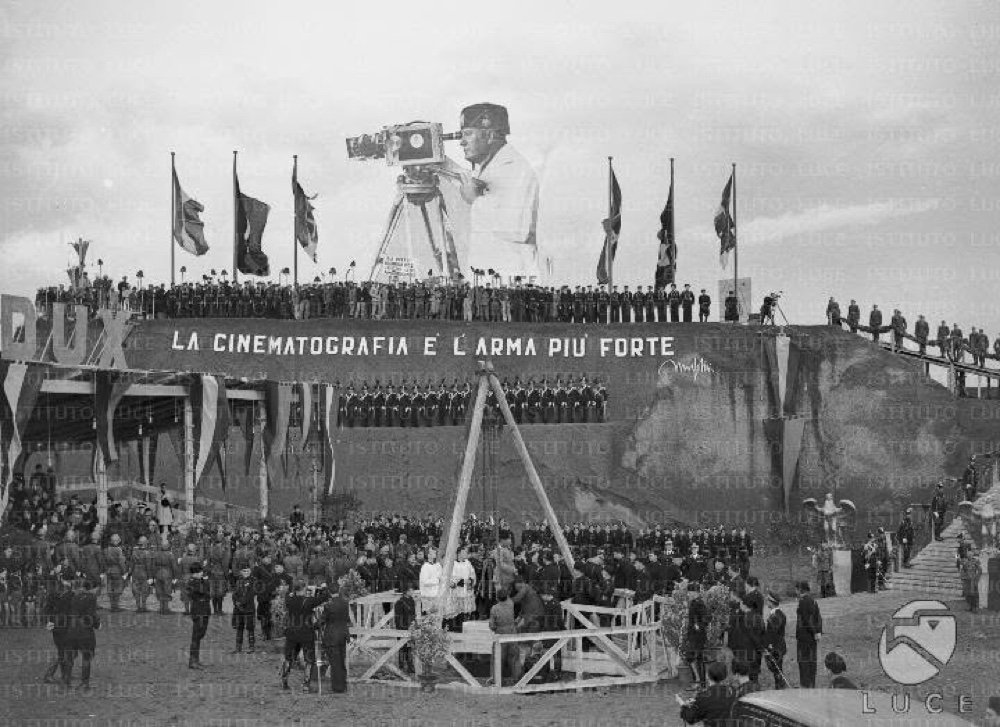
In 1937 the first stone of Cinecittà was laid, the great complex of film studios on Rome’s Via Tuscolana; the photograph opening this article documents that ceremony. In the same year Luce passed under the control of the Ministry of Popular Culture. The closeness between Luce and Cinecittà, born in those years, later became full unification: today the Luce Archive and the Via Tuscolana studios belong to the same public company.
UNESCO Memory of the World (2013)
On 24 June 2013 the Newsreels and Photographs Fund of the Istituto Nazionale L.U.C.E. was inscribed in UNESCO’s Memory of the World Register — the only Italian audiovisual archive on the list. The official motivation reads:
“The collection constitutes an inimitable documentary corpus for understanding the process of formation of totalitarian regimes, the mechanisms of creation and development of visual material, and the living conditions of Italian society. It is a unique source of information on Italy in the years of the Fascist regime, on the international context of Fascism (including East Africa and Albania, but also well beyond the areas occupied by Italy during Fascism, especially as regards the Second World War), and on mass society in the 1920s and 1930s.”
UNESCO Memory of the World Register, inscription motivation, 2013
The quotation is given verbatim because it is itself a document. The value UNESCO recognises is double: the collection is a source on the mechanisms of mass visual communication and, at the same time, a record of the concrete living conditions of the Italian population in those years. The same motivation points to an often overlooked aspect: Luce did not film only Italy. Its crews documented East Africa and Albania and, more broadly, the international context of the period and the Second World War. For those who study the history of those territories — not only Italian history — these films and photographs are a rare visual source, sometimes the only one left of a given place at a given moment.
From Istituto Luce to Cinecittà S.p.A.
The Institute’s post-war institutional history is a sequence of verifiable steps: placed in liquidation in 1947 but authorised to continue; converted into a joint-stock company in 1962; merged into Istituto Luce Cinecittà in 2011; renamed Cinecittà S.p.A. in 2021, under the Ministry of Culture; centenary in 2024. Through all these passages the archive’s function changed radically: from an instrument of production and diffusion it became a heritage to conserve, digitise and open to the public. Luce no longer produces newsreels; it keeps what it filmed, and makes it available to those who study, teach and tell.
In recent years a growing share of the fund has been digitised and catalogued with metadata of date, place and subject — the less visible work that turns a mass of reels and negatives into a source that can actually be consulted. More than 30,000 films are freely viewable on the archive’s official YouTube channel, and the Archivio Storico Luce portal allows searches by date, place and theme.
Why it matters for heritage
For those who document the heritage of places — as Cultural Heritage Online does — the Luce Archive is a precious point of departure: it lets you see what squares, buildings and towns looked like in the years when they were built or transformed, and compare the period image with what stands today. The fund’s UNESCO inscription is the subject of a companion piece in this magazine; the era that produced it is mapped in Architecture and Power in Fascist Italy and Art in Interwar Italy.