
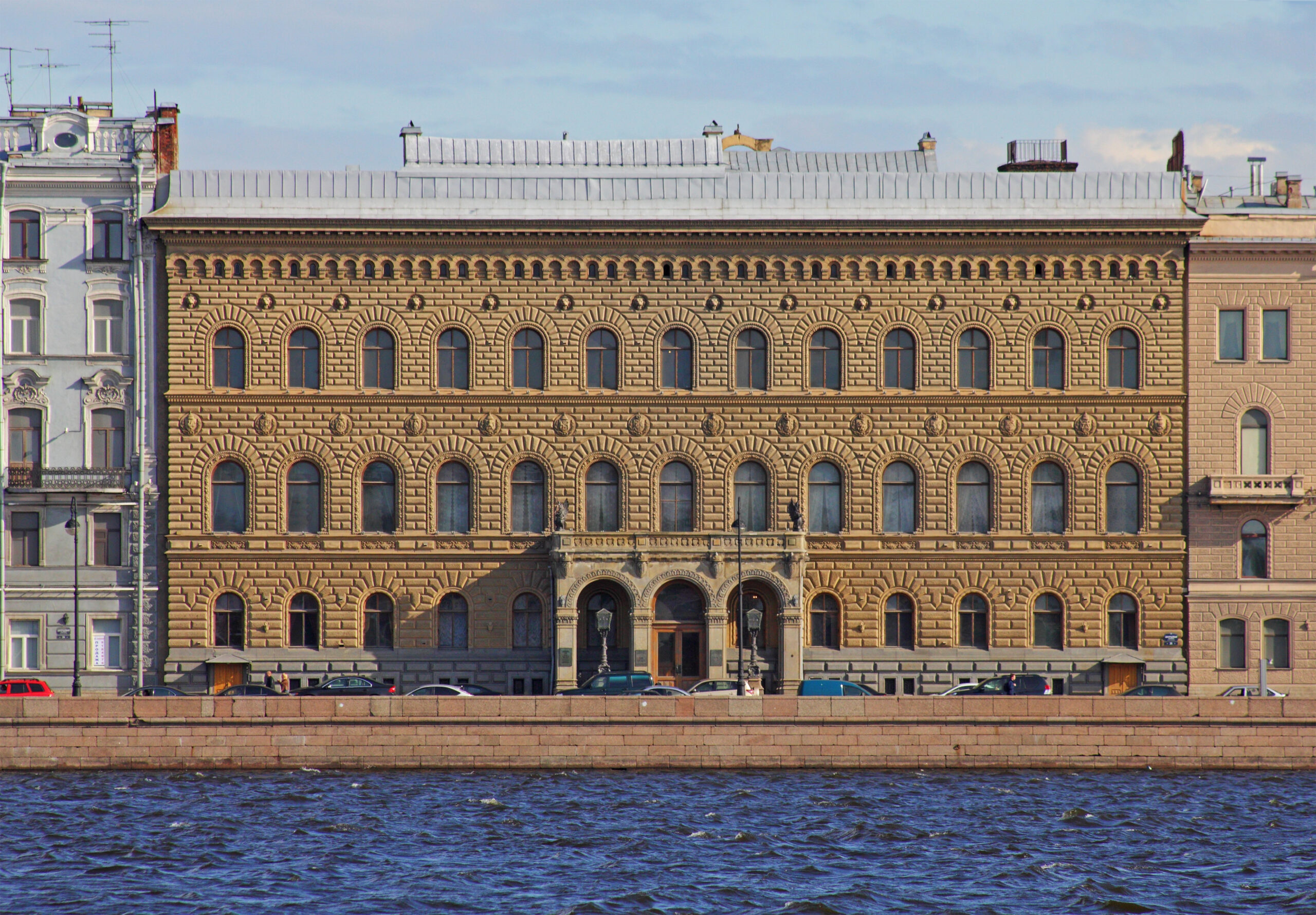
Built for Grand Duke Vladimir Alexandrovich on the Neva’s prized Palace Embankment, this Renaissance Revival mansion packs 360 rooms of clashing historicist styles behind a Florentine façade.
At a glance
The Vladimir Palace was one of the last grand ducal residences raised in imperial Saint Petersburg. Construction on the waterfront ran from 1867 to 1872, with further work through the 1880s and 1890s. A team led by Alexander Rezanov, alongside Vasily Kenel, Andrei Huhn, Ieronim Kitner, Vladimir Shreter and Maximilian Messmacher, shaped its interiors and extensions.
History
Grand Duke Vladimir, son of Alexander II, commissioned the palace for a site already flanked by the Winter and Marble Palaces. Work stretched across decades. Messmacher continued refining the interiors between 1881 and 1891, layering in ever more ornate historicist rooms. Vladimir filled his apartments with Russian paintings by Repin, Aivazovsky, Kramskoy and Vrubel among others. The October Revolution ended this world abruptly. The family fled, the state seized the property, and years of disputes followed before the palace passed, in the 1920s, to the House of Scientists, named for Maxim Gorky. Restorations came in the 1980s and again in 2010.
What you see
The façade draws directly on Leon Battista Alberti’s Florentine palazzi, its Neo-Renaissance stonework thick with stucco rustication. Bremen sandstone frames the main porch, carved with griffins and coats-of-arms and lit by cast-iron lanterns. Portland cement details fill in elsewhere. Inside, no single style dominates. A Neo-Renaissance reception room gives way to a Gothic Revival dining room. There is a Russian Revival Oak Hall, a Rococo White Hall, a Byzantine-inspired study, rooms after Louis XIV, and assorted oriental interiors. It is historicism taken to its logical, exhausting extreme.
Cultural significance
Art historians, including Nikolay Punin, have treated the palace’s interiors as a defining document of 19th-century historicist taste. Its survival matters more than most. Because the Academy of Sciences took stewardship early, more of the original decoration and tiling remains here than in comparable Romanov residences. The porcelain collection tells its own layered story. Vladimir’s imperial-era pieces from the Imperial Porcelain Factory now sit alongside early Soviet additions, among them figures of Chaliapin and Nijinsky and constructivist-inspired dinner services.
Key facts
- Location: Palace Embankment, south bank of the Neva, Saint Petersburg
- Built: 1867–1872, with extensions in the 1880s–1890s
- Architect: Alexander Rezanov, with Kenel, Huhn, Kitner, Shreter and Messmacher
- Style: Renaissance Revival, with eclectic historicist interiors
- Rooms: approximately 360
- Current use: House of Scientists (Dom Uchyonykh)
- Heritage status: listed
Practical information & getting there
The palace stands on Palace Embankment, within walking distance of the Winter Palace and Hermitage complex. As the House of Scientists, it functions as an academic institution rather than a standard museum, so visiting arrangements can differ from other Saint Petersburg palaces. Check current access details before planning a visit, and allow time simply to take in the embankment setting itself.
Sources & resources
Find it on the map
See this place and what’s around it →📷 Become a Cultural Heritage Online photographer
Share your photos of places: they stay published under your name as the author. The more they're seen, the more you get noticed — and soon a contest will reward the most appreciated photos.
Log in or sign up free to add a photoIs this page about you?
This page is read by travellers and heritage enthusiasts who find it on Google. Tell us how you are connected to this place and we will take it from there.