
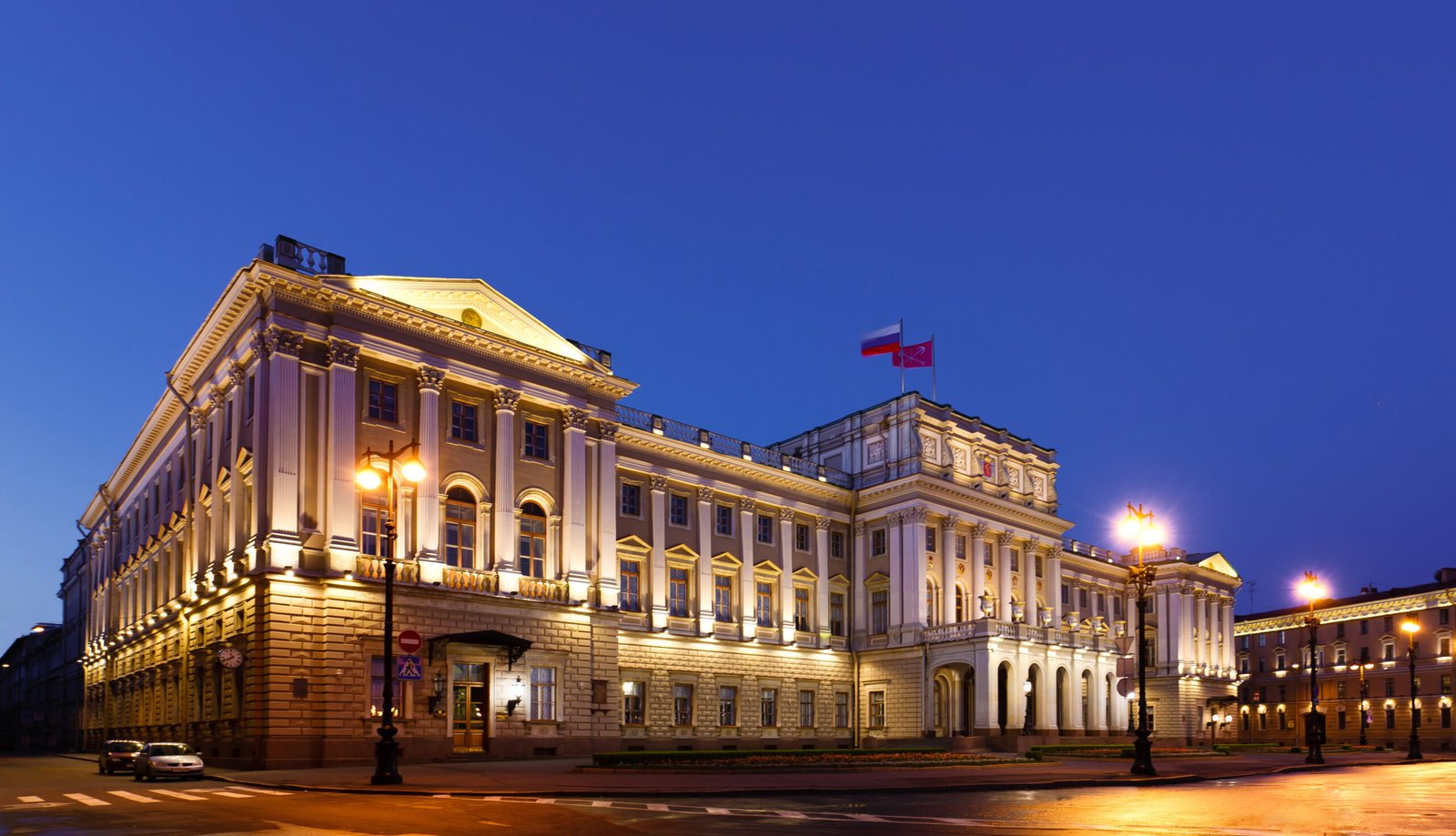
The last neoclassical Imperial residence built in Saint Petersburg stands across the Blue Bridge from Saint Isaac’s Cathedral, its reddish-brown facade now painted white over a century of political upheaval.
At a glance
Andrei Stackenschneider designed the palace between 1839 and 1844 as a wedding gift from Nicholas I to his daughter, Grand Duchess Maria Nikolaevna. It replaced an earlier residence on the site. Today it houses Saint Petersburg’s Legislative Assembly, and it is protected as a heritage site.
History
Before Stackenschneider’s palace rose here, the plot belonged to Zakhar Chernyshev, whose home by Jean-Baptiste Vallin had stood since the 1760s. It later served as the Nicholas Cavalry College, where the poet Mikhail Lermontov studied. That building was torn down in 1839, and its materials went into the new palace. The gift marked the marriage of Maria Nikolaevna to Maximilian de Beauharnais, grandson of Empress Joséphine. From 1884 to 1917 the palace returned to Imperial hands and became the seat of the State Council, the Imperial Chancellery, and eventually the Council of Ministers. In 1902, Minister of Internal Affairs Dmitry Sipyagin was assassinated here, shot by Socialist Revolutionary Stepan Balmashov between meetings. The building’s political life continued through revolution and war. The Provisional Government held it briefly in 1917. Soviet ministries followed, then a wartime hospital under bombardment, then the Petrograd Soviet. During the 1991 coup attempt, the palace briefly served as headquarters for the Emergency Committee, ringed with barricades that lingered afterward.
What you see
Stackenschneider’s design is deliberately eclectic. Corinthian columns and heavy rustication nod to Neoclassical convention, yet the overall composition draws on 17th-century French Baroque town houses. Renaissance ornament appears across the exterior. Inside, each room was decorated in a different historic style, a display of period taste rather than unity. The grand hall built for State Council sessions was the work of Leon Benois. It once held Ilya Repin’s monumental 1904 canvas, Ceremonial Sitting of the State Council on 7 May 1901, a painting nearly nine metres wide crowded with 81 historical figures, Nicholas II among them.
Cultural significance
The palace embodies a turning point in Imperial patronage, closing out the era of grand Neoclassical residences in the capital. Its rooms witnessed the machinery of late Imperial governance and the violence that could interrupt it. Later, the building tracked the twentieth century’s convulsions almost year by year, from provisional government to Soviet ministry to wartime hospital. Its continued use by the city’s legislature keeps that civic thread unbroken.
Key facts
- Location: Saint Isaac’s Square, Saint Petersburg, Russia
- Built: 1839–1844
- Architect: Andrei Stackenschneider
- Style: Eclectic, with Neoclassical and French Baroque influences
- Original purpose: Imperial residence, wedding gift to Grand Duchess Maria Nikolaevna
- Later use: State Council (1884–1917); Legislative Assembly of Saint Petersburg since 1994
- Heritage status: Listed heritage site
Practical information & getting there
The palace sits on the south side of Saint Isaac’s Square, directly across the Blue Bridge from Saint Isaac’s Cathedral. You can reach the area easily on foot from Nevsky Prospekt or via the nearby Admiralteyskaya metro station. As the working seat of the city’s Legislative Assembly, the building operates under government access rules rather than standard museum hours, so check the official site before planning a visit.
Sources & resources
Find it on the map
See this place and what’s around it →📷 Become a Cultural Heritage Online photographer
Share your photos of places: they stay published under your name as the author. The more they're seen, the more you get noticed — and soon a contest will reward the most appreciated photos.
Log in or sign up free to add a photoIs this page about you?
This page is read by travellers and heritage enthusiasts who find it on Google. Tell us how you are connected to this place and we will take it from there.