
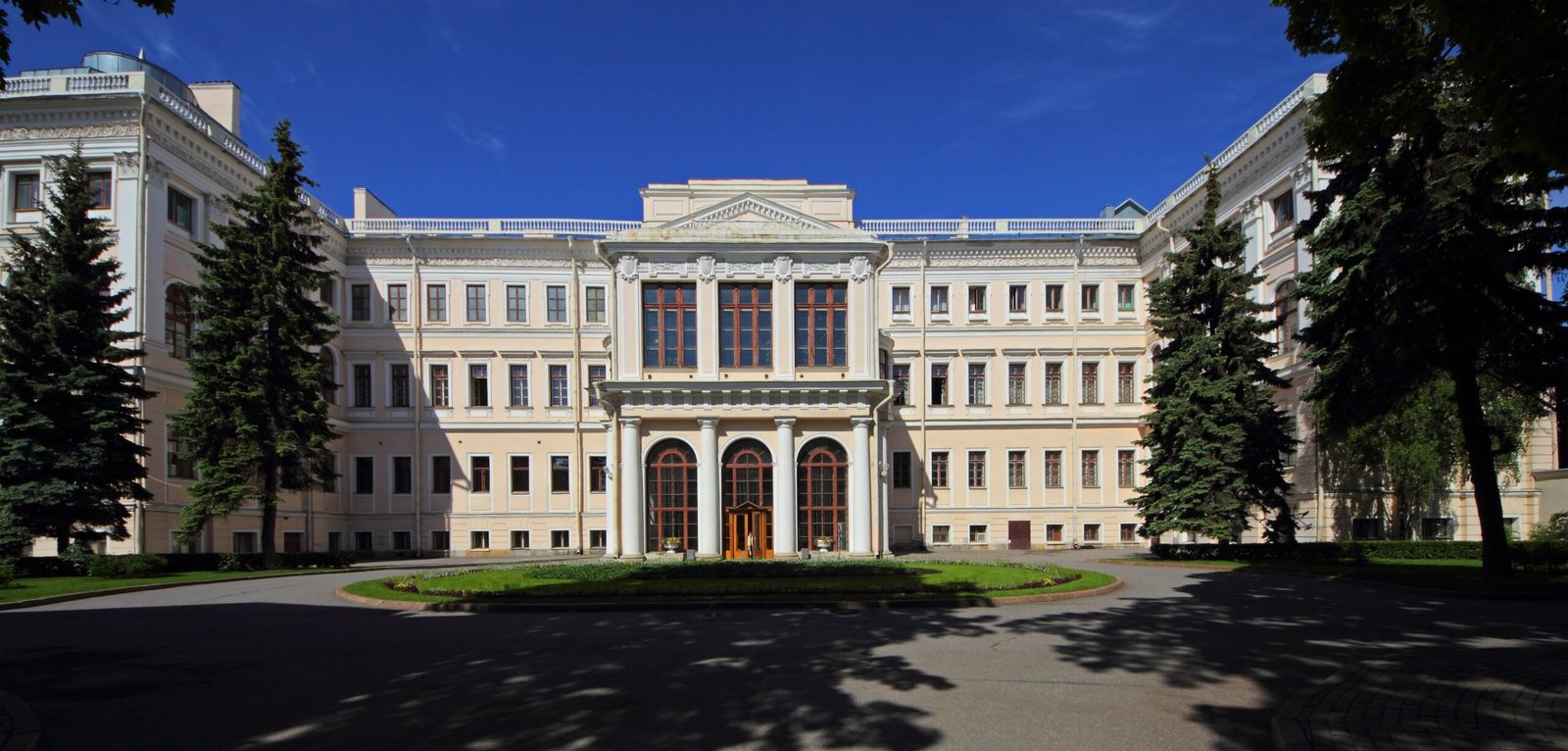
At the corner of Nevsky Avenue and the Fontanka River stands a palace that outgrew its own Baroque origins, layer by layer, tsar by tsar.
At a glance
Built for Empress Elizabeth and completed in 1754, the Anichkov Palace takes its name from the neighbouring Anichkov Bridge. Its riverfront facade, likely shaped by Francesco Bartolomeo Rastrelli, once opened onto a private canal. Today the building is heritage-listed and functions as a youth cultural centre, with a small museum open at select times.
History
The site once belonged to Antonio de Vieira. Construction dragged on for thirteen years before Elizabeth gifted the finished palace to her favourite, Count Aleksey Razumovsky, in 1754. It reverted to the crown at his death in 1771. Catherine the Great then passed it to Prince Potemkin in 1776, prompting Ivan Starov to remodel it in Neoclassical taste, with William Hould laying out an English garden alongside. After Potemkin died in 1791, the palace returned to imperial hands and served the Cabinet of Her Imperial Majesty. Quarenghi added the Nevsky Avenue wing under Alexander I, a stern Neoclassical block many still consider a poor match for Rastrelli’s original. Carlo Rossi proposed a further reconstruction in 1816; it was never built. From 1866 Alexander III and Maria Feodorovna made it their St. Petersburg home, raising their children, including Nicholas II, within its walls. Revolution ended imperial ownership in 1917; by 1934 the palace had become the Young Pioneer Palace, hosting more than a hundred children’s clubs.
What you see
Rastrelli’s river facade, if indeed his, carries the swagger of Elizabethan Baroque. Later hands intervened repeatedly. Starov’s Neoclassical alterations softened some of that exuberance; Quarenghi’s Nevsky wing imposed a colder, more rigid order entirely. The result is a building in visible dialogue with itself, one wing baroque, another austere. Interiors were refreshed again and again through the nineteenth century, absorbing whatever historic style was then in fashion, so no single decorative moment dominates inside.
Cultural significance
Few buildings in St. Petersburg carry so many regime changes on one footprint. Favourite of empresses, seat of princes, childhood home of the last tsar, site of a 1914 imperial wedding, then Soviet museum and children’s palace — the Anichkov has hosted every phase of Russian power since the mid-eighteenth century. Its facades still argue quietly over which century should win.
Key facts
- Location: junction of Nevsky Avenue and the Fontanka River, St. Petersburg
- Completed: 1754
- Architect: attributed to Francesco Bartolomeo Rastrelli
- Styles: Elizabethan Baroque, Classicism
- Later additions: Neoclassical wing by Giacomo Quarenghi
- Current use: youth cultural centre, with limited public museum access
- Heritage status: listed
Practical information & getting there
You will find the palace impossible to miss along Nevsky Avenue, facing the Anichkov Bridge and its famous horse statues. The building is not generally open to tourists; only a small internal museum admits visitors at selected times. Check the official website before planning a visit, as access is limited compared with other St. Petersburg palaces.
Sources & resources
Find it on the map
See this place and what’s around it →📷 Become a Cultural Heritage Online photographer
Share your photos of places: they stay published under your name as the author. The more they're seen, the more you get noticed — and soon a contest will reward the most appreciated photos.
Log in or sign up free to add a photoIs this page about you?
This page is read by travellers and heritage enthusiasts who find it on Google. Tell us how you are connected to this place and we will take it from there.