
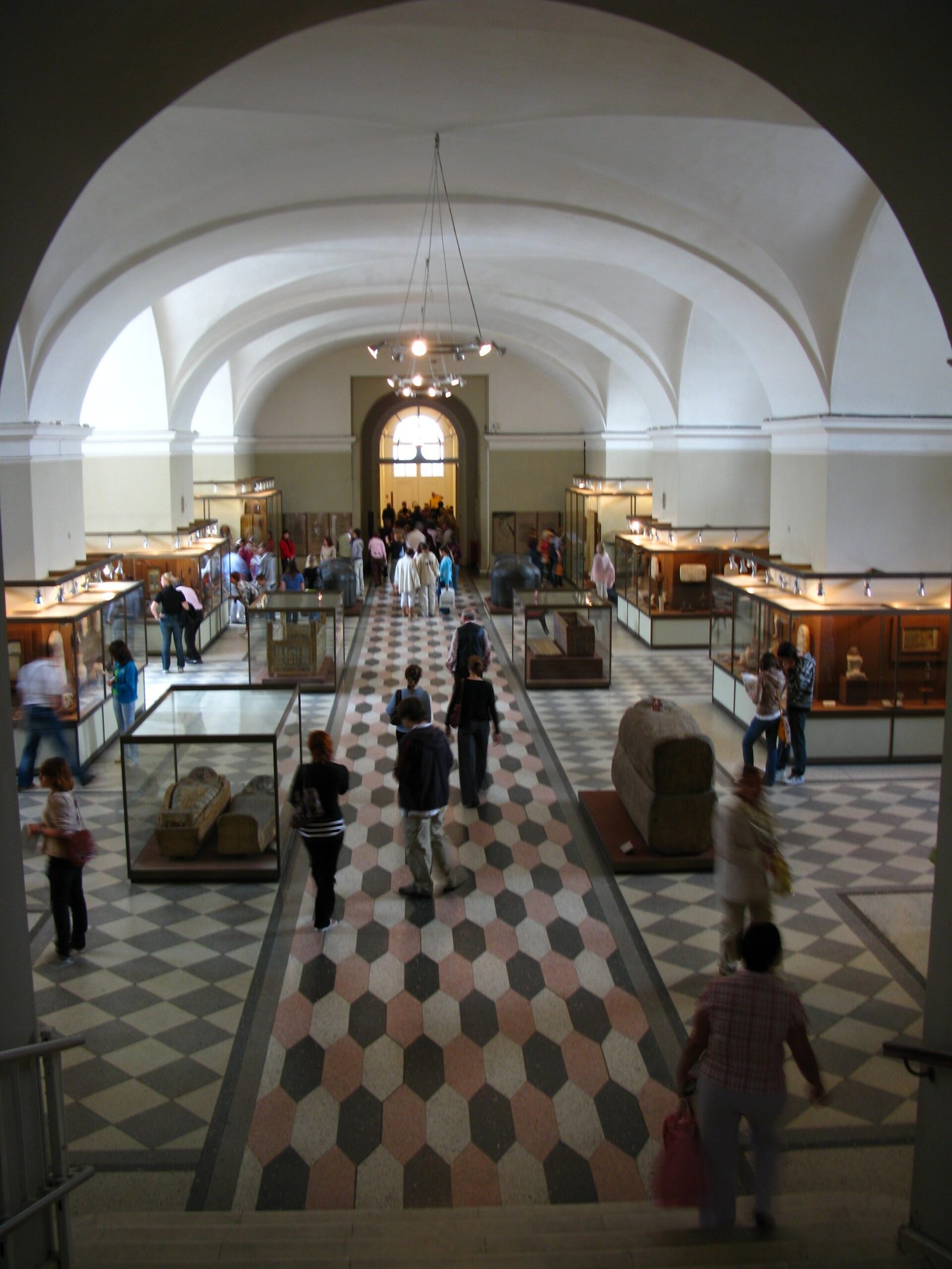
A single vaulted hall beneath St. George’s Hall holds some 7,500 objects spanning the Predynastic Period to the 12th century AD, gathered from private collections, academic transfers and the diggings of nineteenth-century collectors.
At a glance
Part of the Hermitage’s Oriental Art department, the collection occupies the ground floor of the Winter Palace’s eastern wing. Visitors pass through it on the way to the museum’s Classical Antiquities galleries. The room itself has history: it once served as the palace’s main buffet before Alexander Sivkov redesigned it for the exhibition in 1940.
History
The collection began in 1852, the year the Hermitage opened to the public. That founding purchase brought in Countess Alexandra Lavalle’s statuettes and the Egyptian material assembled by Maximilian, Duke of Leuchtenberg, including two black basalt sarcophagi of the Late Period and a sculpture group depicting the Theban governor Amenemheb with his wife and mother. A statue of Sekhmet, retrieved from the Theban Necropolis by Alexei Norov in the 1830s, joined the museum the following year.
Growth continued through transfers rather than expeditions. In 1862 the Castiglione collection, over 900 items bought by the Imperial Academy of Sciences in Milan decades earlier, arrived from the Kunstkamera. Russia had no Egyptologist yet. That changed when Vladimir Golenishchev began working at the Hermitage in the 1870s; at his urging, the rest of the Kunstkamera’s Egyptian holdings were transferred in 1881. He published the first full inventory in 1891, then sold his own private collection to Moscow’s Pushkin Museum in 1909, shortly before emigrating. Vasily Struve oversaw the collection from 1918 to 1933.
What you see
The hall is long, top-lit, and lined with sarcophagi, stelae and sculpture rather than architectural ornament. The two basalt sarcophagi from Leuchtenberg’s collection stand at its center. Among the smaller objects are a fragment of the peace treaty between Ramesses II and the Hittites, one of the earliest surviving international treaties, and the mummy of the priest Petese, dated to the 10th century BC. Nothing here shouts. The room reads as a corridor of accumulated centuries.
Cultural significance
The collection traces the formation of Russian Egyptology itself, from aristocratic curio-gathering to Golenishchev’s scholarly cataloguing. Its objects arrived through a tangle of private purchase, academic transfer and diplomatic gift rather than systematic excavation, which gives the holdings an unusually documented provenance for a nineteenth-century museum. The Ramesses II treaty fragment connects the room to the broader ancient Near East, beyond Egypt alone.
Key facts
- Founded: 1852, alongside the Hermitage’s public opening
- Holdings: approximately 7,500 items, Predynastic to 12th century AD
- Hall redesigned by Alexander Sivkov in 1940
- Former use of the room: main buffet of the Winter Palace
- Notable objects: two black basalt sarcophagi, statue of Sekhmet, mummy of priest Petese, Ramesses II peace treaty fragment
Practical information & getting there
The hall sits within the Winter Palace, the Hermitage’s main building on Palace Square, and is reached on the standard museum route toward the Classical Antiquities galleries. You should plan the Egyptian hall as a stop along a longer Hermitage visit rather than a standalone destination, since it opens off the museum’s central circulation. Nearby, the Quay with Sphinxes on Universitetskaya Embankment displays two genuine sphinxes of Amenhotep III, a short walk across the river.
Sources & resources
Find it on the map
See this place and what’s around it →📷 Become a Cultural Heritage Online photographer
Share your photos of places: they stay published under your name as the author. The more they're seen, the more you get noticed — and soon a contest will reward the most appreciated photos.
Log in or sign up free to add a photoIs this page about you?
This page is read by travellers and heritage enthusiasts who find it on Google. Tell us how you are connected to this place and we will take it from there.