
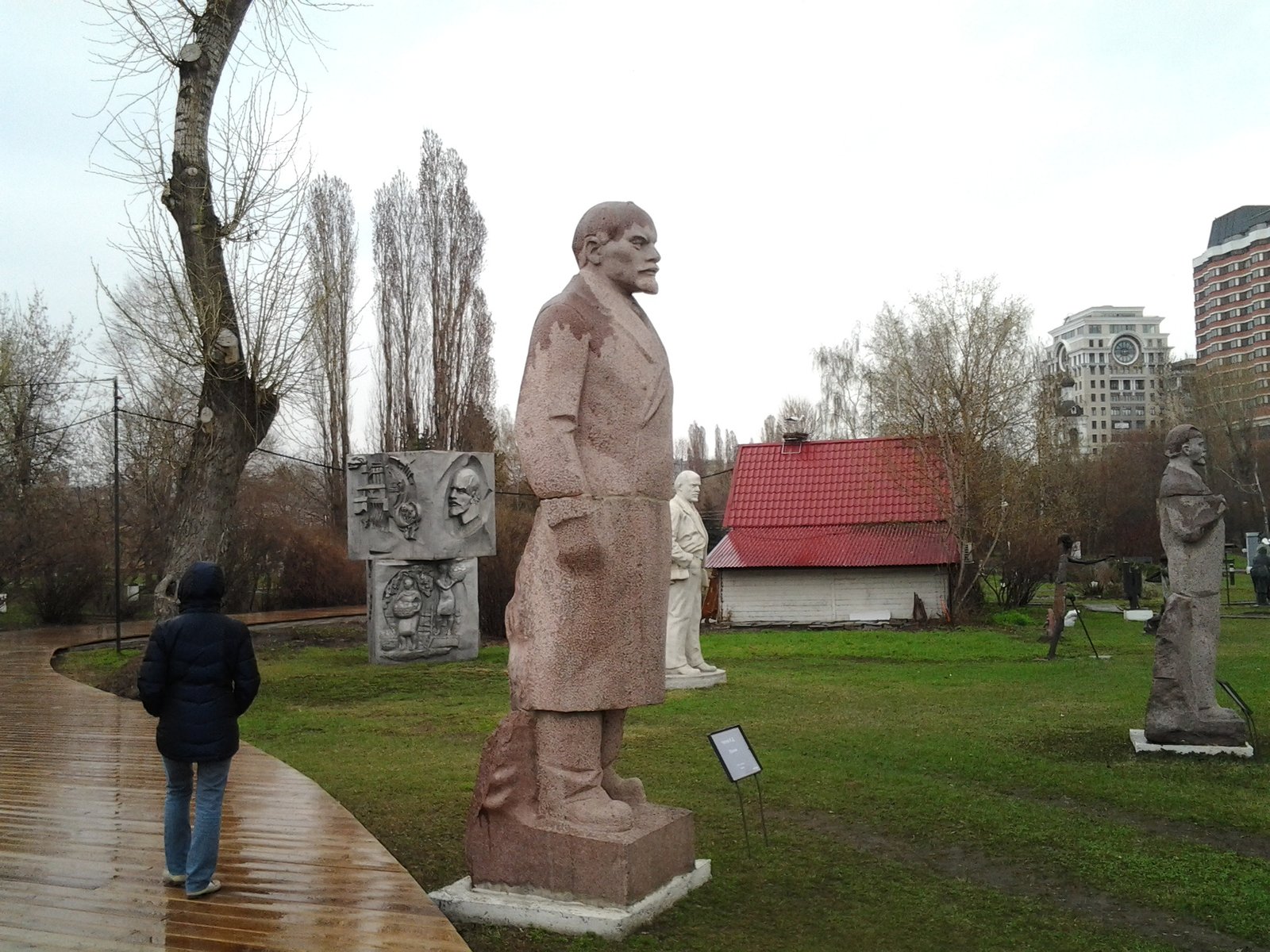
Toppled leaders and rehabilitated statues share the grass beside the Moskva River, in the largest open-air sculpture museum in Russia.
At a glance
Muzeon sits outside the Krymsky Val building, home to the Tretyakov Gallery’s modern-art wing and the Central House of Artists. Over 1,000 sculptures fill its grounds, arranged in themed sections such as the Oriental Garden, Pushkin Square, and Portrait Row. Founded by mayoral decree in January 1992, it is now folded into Gorky Park’s wider network of paths and gardens.
History
The land carries layers of Soviet ambition. It began as the site of the 1923 All-Russia Agricultural and Industrial Craft Exhibition, with pavilions by Konstantin Melnikov, Vladimir Shchuko, and Vera Mukhina. Lenin passed through here on his last visit to Moscow, three months before his death. War left the ground scarred with anti-aircraft positions; peacetime turned it into a snow dump. Culture Minister Yekaterina Furtseva pushed through the Central House of Artists instead of rival proposals, and construction began in 1965.
The park’s real founding moment came later. When the statue of Felix Dzerzhinsky was pulled down outside KGB headquarters in August 1991, it was hauled here. Busts of Lenin, figures of Kalinin and Sverdlov, a pink-granite Stalin with his face smashed by hammers, followed from squares across the city. Some statues were later re-erected; others still lie where they fell.
What you see
Granite embankments, laid down after the 1938 Krymsky Bridge, frame the park’s river edge. A 2011 master plan by architect Yevgeny Asse replaced rickety Soviet-era structures with a diagonal granite promenade linking Krymsky Val to Bolotny Island. The “School” pavilion, by Igor Chirkin and Alexey Podkidyshev, hosts education programs. Nearby, the 2013 Wowhaus redesign of Krymskaya Embankment added perennial flower beds, skate obstacles, bike lanes, and a splash fountain. Sculptures range from anonymous factory-made Soviet figurines to contemporary limestone works donated during symposiums held since the 2000s.
Cultural significance
Muzeon is a physical record of how Russia argues with its own past. Lenin’s 1918 decree ordering tsarist monuments removed set a precedent that Communist authorities themselves would later suffer. The park’s mixed display, some statues fallen, some restored to pedestals, mirrors an unresolved national reckoning. A 2019 poll cited by the New York Times found 70 percent of Russians view Stalin’s role in history positively; the pink-granite Stalin statue here now stands upright again. Comparable sites, Grūtas Park in Lithuania, Poland’s PRL Museum, Budapest’s Memento Park, show this was a regional pattern, not an isolated gesture.
Key facts
- Location: Krymsky Val, Moscow, Russia
- Established: January 1992, by decree of Mayor Yury Luzhkov
- Collection: over 1,000 sculptures
- Nearest stations: Park Kultury and Oktyabrskaya
- 2011 master plan: architect Yevgeny Asse
- 2013 embankment redesign: Wowhaus (Dmitry Likin, Oleg Shapiro)
Practical information & getting there
You can reach Muzeon on foot from either Park Kultury or Oktyabrskaya metro stations. The park connects directly into Gorky Park and the Krymskaya Embankment promenade, so plan time for both. Paths are granite-paved and level, suitable for a slow walk between sculpture clusters. Visit in warmer months to catch the flower beds and splash fountain in use.
Sources & resources
Find it on the map
See this place and what’s around it →📷 Become a Cultural Heritage Online photographer
Share your photos of places: they stay published under your name as the author. The more they're seen, the more you get noticed — and soon a contest will reward the most appreciated photos.
Log in or sign up free to add a photoIs this page about you?
This page is read by travellers and heritage enthusiasts who find it on Google. Tell us how you are connected to this place and we will take it from there.