

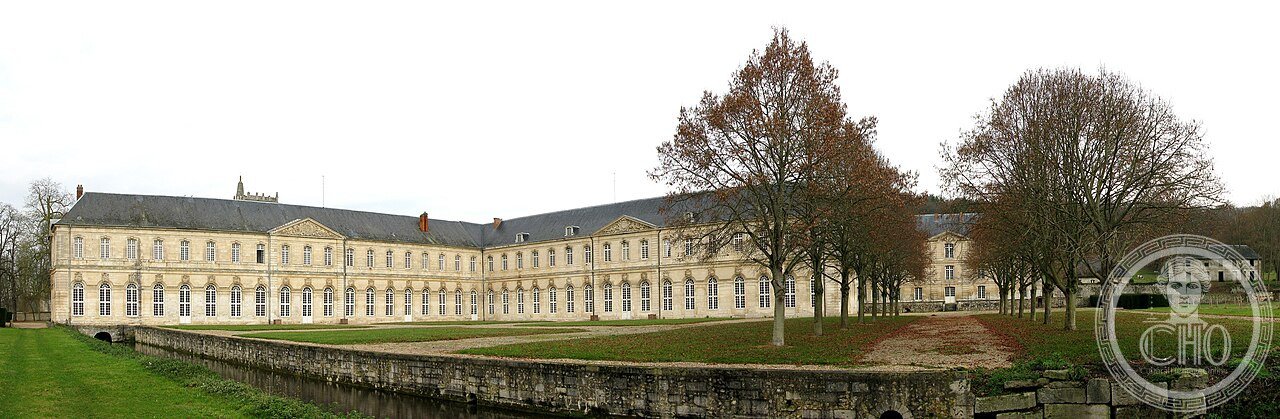
Founded in 1034 by the Norman knight Herluin, the abbey became a leading intellectual centre with the arrival, in 1041, of Lanfranc of Pavia, already a celebrated teacher of law and grammar. Both Lanfranc and his successor Anselm of Aosta, the second and third abbots of Bec, would become archbishops of Canterbury — making this corner of Normandy one of the most influential centres of thought in eleventh-century Europe.
About Bec Abbey
Bec Abbey was founded in 1034 by Herluin, a Norman knight who around 1031 had left the court of Gilbert, Count of Brionne, to devote himself to religious life; construction began in 1034 and continued through 1035, with additional lands added through 1040. The abbey’s intellectual transformation began with the 1041 arrival of Lanfranc of Pavia, an already brilliant professor of law and grammar from Pavia and Avranches, under whom Bec became a leading focus of 11th-century intellectual life — the community developing both a cloister school for monks and a separate outside school for clerics and the sons of Norman nobles. When the new abbey church, which had taken some fifteen years to build, was finally finished in 1077, it was consecrated by Lanfranc himself, by then Archbishop of Canterbury. Herluin, the founding abbot, died the following year in 1078, and Anselm of Aosta succeeded him as the second Abbot of Bec; only six years later, Abbot Anselm was likewise called to succeed his own former master Lanfranc as Archbishop of Canterbury. Bec became the most influential abbey of the 12th-century Anglo-Norman kingdom, and the successive careers of Lanfranc and Anselm — both rising from Bec’s abbacy directly to the see of Canterbury — made this small corner of Normandy internationally famous within medieval European intellectual and ecclesiastical history.
Key facts
- Foundation: 1034, by Herluin, a Norman knight; construction 1034-1035, lands expanded through 1040.
- Lanfranc’s arrival: 1041; transformed Bec into a major centre of 11th-century intellectual life, with a monastic school and an outside school for clerics and nobles’ sons.
- Church consecration: 1077, by Lanfranc, then Archbishop of Canterbury, after 15 years of construction.
- Herluin’s death: 1078; succeeded as abbot by Anselm of Aosta.
- Anselm’s promotion: 1093, succeeding Lanfranc as Archbishop of Canterbury.
- Significance: the most influential abbey of the 12th-century Anglo-Norman kingdom.
History
The remarkable succession of two consecutive Bec abbots — Lanfranc and Anselm — each subsequently rising to become Archbishop of Canterbury gives this single small Norman monastery an outsized, genuinely exceptional influence over English ecclesiastical and intellectual history during the crucial period immediately following the 1066 Norman Conquest, when the newly Norman-controlled English Church required exactly the kind of learned, reform-minded leadership Bec’s monastic school had specifically cultivated. Lanfranc’s own prior reputation as a celebrated professor of law and grammar at Pavia and Avranches before his monastic career at Bec illustrates how the abbey drew on and then further developed genuinely first-rate secular scholarly talent, transforming purely academic expertise into a specifically monastic and eventually archiepiscopal intellectual tradition.
Anselm of Aosta’s subsequent career as Archbishop of Canterbury, during which he became one of medieval Christianity’s most significant philosophical theologians — his ontological argument for God’s existence remains a foundational text in the history of Western philosophy — demonstrates how thoroughly Bec’s specific intellectual formation shaped one of the era’s genuinely first-rank philosophical minds. The direct institutional link between Bec’s abbacy and the Canterbury archbishopric, occurring twice in immediate succession, reflects the close, ongoing relationship between the Anglo-Norman kingdom’s monastic and ecclesiastical elites following the Conquest, with Norman monasteries like Bec serving as a genuine talent pipeline for England’s highest ecclesiastical offices.
What you see
The abbey church and surrounding monastic buildings, substantially shaped by the 15-year construction campaign completed in 1077, give visitors direct access to the physical setting of Lanfranc and Anselm’s formative intellectual careers. The abbey’s continuing status as an active Benedictine community connects its long institutional history directly into the present. Le Bec-Hellouin village itself, recognised among the most beautiful villages of France, extends the site’s appeal beyond the abbey’s own walls.
Practical information
- Opening hours: generally open daily, check current hours before visiting; free admission to the church, guided tours available.
- Address: Rue Pierre Mendès France, 27800 Le Bec-Hellouin, France.
Getting there
Le Bec-Hellouin is reachable by car from Bernay (approximately 20 minutes) and Rouen (approximately 45 minutes) in the Eure department, Normandy. GPS: 49.2287° N, 0.7221° E.
Nearby
- Le Bec-Hellouin village — recognised as one of the most beautiful villages of France, surrounding the abbey.
- Bernay — approximately 20 minutes away; a historic Norman town with its own abbey.
- Rouen — approximately 45 minutes away; Normandy’s historic capital.
Sources
- Wikipedia — “Bec Abbey” (en.wikipedia.org).
- Catholic Encyclopedia — “Abbey of Bec” (newadvent.org).
- Normandy Tourism — “Le Bec-Hellouin and its Abbey” (en.normandie-tourisme.fr).
Find it on the map
See this place and what’s around it →Events here — now on & upcoming
- Feast of Saint Anselm of Canterbury — April 2121 Apr 2027See the event →
📷 Become a Cultural Heritage Online photographer
Share your photos of places: they stay published under your name as the author. The more they're seen, the more you get noticed — and soon a contest will reward the most appreciated photos.
Log in or sign up free to add a photo