

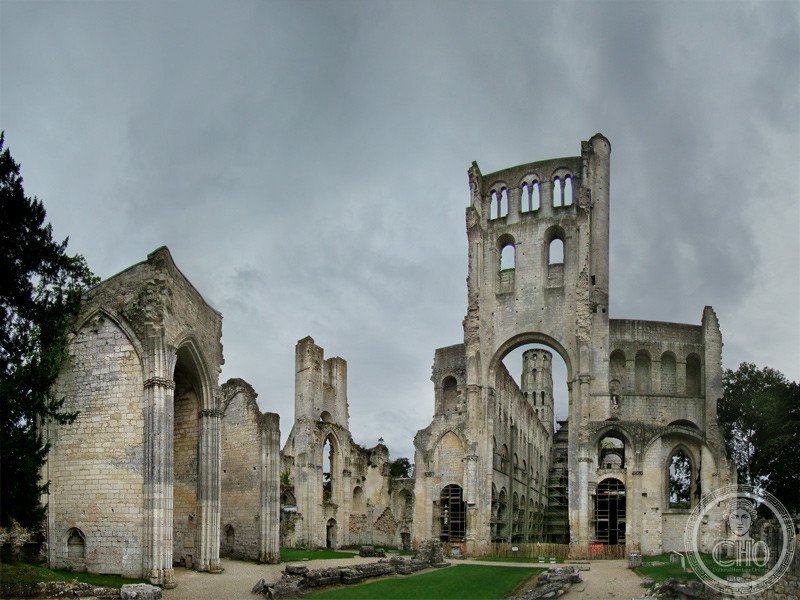
Founded in 654, the abbey came to count a thousand monks under its second abbot, before being sacked and burned to ashes by the Viking raids of the late ninth century, while the monks carried manuscripts and relics to safety in the priory of Haspres. Rebuilt on a far larger scale, the new abbey was consecrated in 1067 in the presence of William the Conqueror himself — and it would be Victor Hugo, centuries later, who called it the “most beautiful ruin in France”.
About Jumièges Abbey
Jumièges Abbey, standing to the north of the meandering Seine river in the small Normandy town of Jumièges, is renowned as one of the most important and ancient monastic sites in Western Europe, and is often described as the most beautiful ruin in France. Founded in 654, it ranks among the oldest Benedictine abbeys in Normandy; by the time of its second abbot, the community had grown to around a thousand monks. Viking raids along the Seine, reaching as far upstream as Paris toward the end of the 9th century, resulted in the abbey being pillaged and burned to the ground; during these Norman incursions of the 9th and 10th centuries, the monks fled to the priory of Haspres near Cambrai, where they safeguarded their precious manuscripts and relics. A new, much larger abbey was subsequently rebuilt and consecrated in 1067 in the presence of William the Conqueror himself and the bishops of Normandy — the resulting building stands today as a definitive example of Norman Romanesque architecture. The abbey’s ultimate destruction came during the French Revolution, when it was dissolved, leaving the beautiful ruins visible today. It was the personal intervention of Victor Hugo that truly sparked renewed interest in the abbey, and thanks to him, Jumièges Abbey was formally classified as a historical monument; the “most beautiful ruin in France,” as it became known, subsequently attracted generations of artists and writers seeking inspiration in its uniquely atmospheric setting. In 1947, the French state acquired the abbey to ensure its ongoing preservation, with the Seine-Maritime department taking over its management in 2007.
Key facts
- Foundation: 654; one of the oldest Benedictine abbeys in Normandy
- Early growth: around 1,000 monks by the time of the second abbot
- Viking destruction: late 9th century; monks fled with manuscripts and relics to the priory of Haspres near Cambrai
- Reconstruction: consecrated 1067, in the presence of William the Conqueror and the bishops of Normandy
- French Revolution: dissolved, leaving the ruins visible today
- Victor Hugo’s intervention: sparked renewed interest and classification as a historical monument
- 1947: acquired by the French state for preservation; managed by Seine-Maritime department since 2007
History
The Viking destruction of Jumièges in the late 9th century situates the abbey within the broader, well-documented pattern of devastating Norse raiding along major navigable French rivers during this period — the same wave of Viking activity along the Seine that reached as far as Paris itself and directly precipitated the eventual 911 Treaty of Saint-Clair-sur-Epte, granting Viking leader Rollo formal territory that became the Duchy of Normandy. The abbey’s 1067 reconsecration in William the Conqueror’s own presence, occurring just one year after his celebrated 1066 conquest of England, situates Jumièges directly within the immediate aftermath of one of medieval European history’s most consequential military and political events, the newly crowned King of England still closely engaged with major religious and architectural projects across his original Norman duchy.
Victor Hugo’s specific 19th-century advocacy for Jumièges reflects the broader French Romantic movement’s fascination with ruined medieval monuments as sources of melancholic aesthetic and historical inspiration — Hugo’s own influence, as one of 19th-century France’s most prominent literary and cultural figures, carried genuine practical weight in securing the abbey’s formal heritage protection, illustrating how individual celebrity advocacy could directly shape official historical preservation policy during this period. The eventual 1947 state acquisition, following the ruins’ celebrated 19th-century Romantic reputation, completed Jumièges’s transformation from a working medieval monastery through Revolutionary-era destruction to its present status as a formally protected and actively managed heritage site.
What you see
The abbey church’s twin towers, rising 46 metres and dominating the surrounding Romanesque façade, remain the site’s most visually iconic feature, their partially open, roofless state giving the ruins their distinctive dramatic silhouette against the sky. The remaining cloister and convent buildings offer visitors a broader sense of the medieval monastery’s original scale. The abbey’s riverside setting on a meander of the Seine, within the same Normandy landscape that inspired generations of Romantic-era artists and writers, rewards a leisurely visit taking in both architecture and surrounding countryside.
Practical information
- Opening hours: generally open daily during the visitor season, check current hours before visiting; admission fee
- Address: Jumièges, 76480 Seine-Maritime, France
Getting there
Jumièges is reachable by car from Rouen (approximately 30 minutes) in Seine-Maritime, Normandy, following the Seine river. GPS: 49.4308° N, 0.8196° E.
Nearby
- Rouen — approximately 30 minutes away; Normandy’s historic capital, with its own major Gothic cathedral
- Parc naturel régional des Boucles de la Seine Normande — the regional nature park surrounding Jumièges’s Seine meander
- Étretat — the famous chalk cliffs on the Normandy coast, within reach
Sources
- Wikipedia — “Jumièges Abbey” (en.wikipedia.org)
- Archaeology Travel — “Jumièges Abbey – The Most Beautiful Ruins in France?” (archaeology-travel.com)
- Normandy Tourism — “Jumièges Abbey” (en.normandie-tourisme.fr)
Find it on the map
See this place and what’s around it →📷 Become a Cultural Heritage Online photographer
Share your photos of places: they stay published under your name as the author. The more they're seen, the more you get noticed — and soon a contest will reward the most appreciated photos.
Log in or sign up free to add a photo