

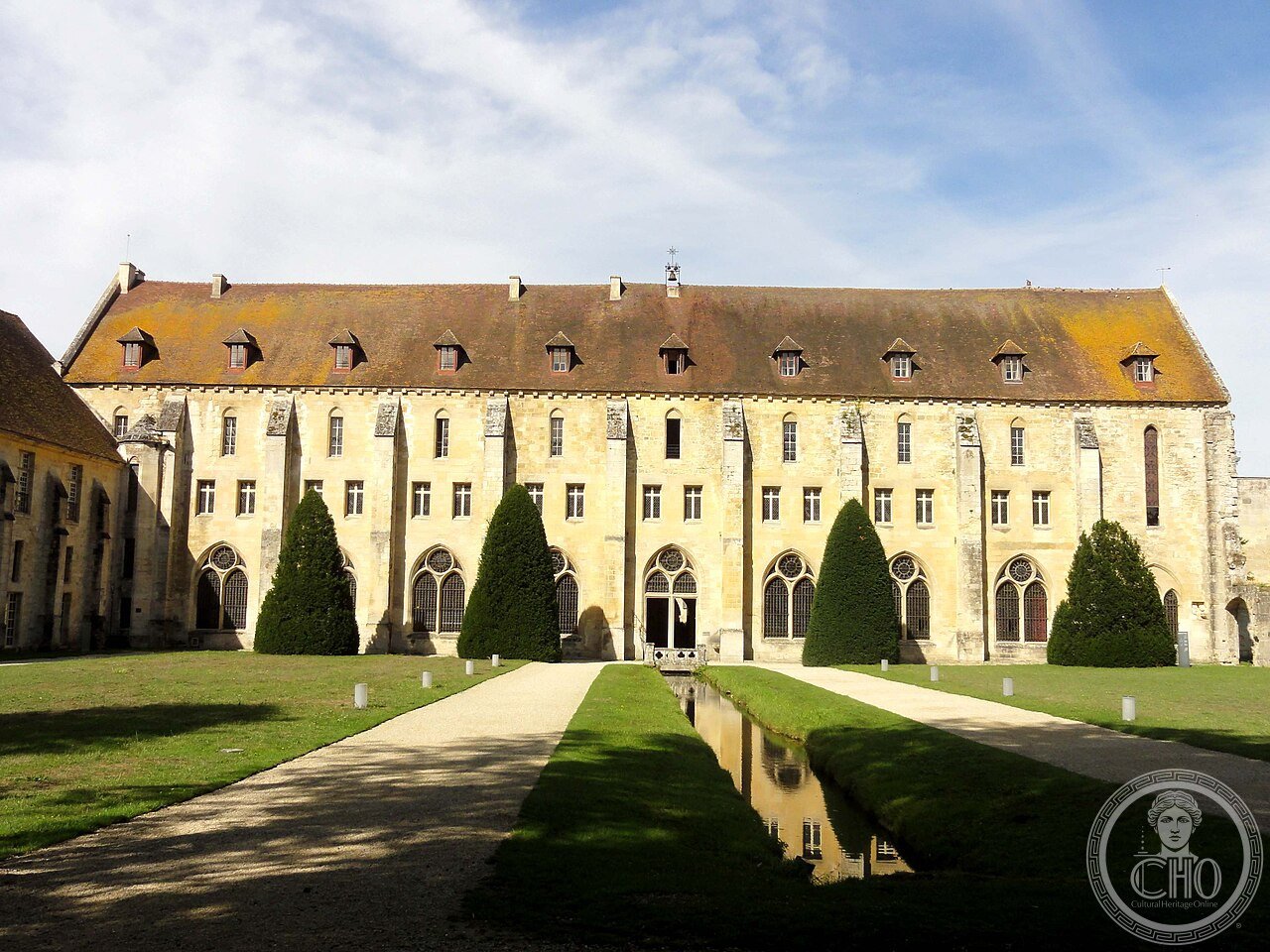
The young king Louis IX, the future Saint Louis, and his mother Blanche of Castile founded Royaumont in 1228, devoting to it as much as two thirds of the kingdom’s annual revenue. The king often stayed there, sharing the monks’ daily life: he waited on them at table, asked to be allowed to wash their feet, cared for them through illness — even in cases of leprosy.
About Royaumont Abbey
Royaumont Abbey, just north of Paris in the Val d’Oise, was founded in 1228 by the young King Louis IX (Saint Louis) and his mother, Blanche of Castile, in fulfilment of a wish expressed by his father, Louis VIII; the king entrusted the new foundation to a community of Cistercian monks, with construction completed and the church dedicated in 1235. Louis IX devoted up to two-thirds of his kingdom’s annual income to the project, and the sheer scale of the church and the wealth of property granted to the monks reveal the young king’s genuine ambition — Royaumont became one of the largest religious establishments north of Paris after Saint-Denis itself, and remains today the largest Cistercian abbey in the entire Île-de-France region. Saint Louis frequently stayed at Royaumont, sharing directly in the monks’ daily life: the king personally served the monks at table, asked to be permitted to wash their feet, and cared for them during illness — including, in one documented case, a monk suffering from leprosy. Louis IX issued a proclamation stipulating that royal children were to be interred at Royaumont, and upon the king’s death the abbey received a third of the contents of the royal library, becoming one of the best-equipped libraries in the entire kingdom; drawing on this wealth of documents, the resident scholar Vincent of Beauvais was able to compile his Speculum Maius, the most important encyclopedic compilation of knowledge produced during the Middle Ages. The abbey was dissolved in 1791 during the French Revolution, and its stones were partly repurposed to build a factory. Today, Royaumont functions as a cultural centre, hosting artistic residencies, concerts, and exhibitions.
Key facts
- Foundation: 1228, by King Louis IX (Saint Louis) and Blanche of Castile; church completed 1235
- Royal investment: up to two-thirds of the kingdom’s annual income
- Scale: the largest Cistercian abbey in Île-de-France, second in size north of Paris only to Saint-Denis
- Saint Louis’s personal devotion: served monks at table, washed their feet, cared for the sick including a leprosy patient
- Royal necropolis proclamation: royal children to be interred at Royaumont
- Library: received one-third of the royal library on the king’s death; enabled Vincent of Beauvais’s Speculum Maius encyclopedia
- Dissolution: 1791, French Revolution; stones partly used to build a factory
- Today: cultural centre for residencies, concerts, and exhibitions
History
Louis IX’s extraordinarily personal engagement with Royaumont — sharing directly in monastic life through table service and the foot-washing of monks, including a leper — situates the king’s own well-documented reputation for piety, humility, and charitable devotion within a specific, concrete institutional setting, giving the more abstract accounts of “Saint Louis’s holiness” a grounded, physically verifiable historical location. His subsequent 1297 canonisation as Saint Louis, one of medieval France’s most significant royal saints, drew directly on this documented pattern of personal religious devotion, of which Royaumont represents perhaps the most sustained and best-recorded single site.
The abbey’s role as recipient of a third of the royal library upon Louis IX’s death, and its direct enabling of Vincent of Beauvais’s Speculum Maius — an encyclopedic compilation whose scope and influence made it one of medieval Europe’s most significant single works of scholarly synthesis — gives Royaumont genuine intellectual-historical significance extending well beyond its religious and dynastic role. The abbey’s eventual 1791 dissolution and partial demolition for industrial reuse reflects the broader French Revolutionary pattern of repurposing confiscated ecclesiastical property for practical secular use, even as Royaumont’s specific royal Capetian associations made its destruction a particularly pointed act of revolutionary symbolism against the old monarchy.
What you see
The monks’ building and surviving cloister, product of the original 1228-1235 construction campaign, give visitors direct access to the physical setting of Saint Louis’s personal devotional visits. The abbey’s continuing role as a contemporary cultural centre, hosting residencies and concerts, gives Royaumont a genuinely living institutional character distinct from a purely static historical monument. The site’s scale, still legible despite Revolutionary-era partial destruction, conveys something of the original royal ambition behind its 13th-century foundation.
Practical information
- Opening hours: generally open daily during the visitor season, check current hours before visiting; admission fee
- Address: Les Tilleuls, 95270 Asnières-sur-Oise, France
Getting there
Royaumont Abbey is reachable by car or train (via Viarmes station) from Paris (approximately 45 minutes) in the Val-d’Oise department, Île-de-France. GPS: 49.1470° N, 2.3812° E.
Nearby
- Chantilly — a nearby historic town, with its own château and gardens
- Paris — approximately 45 minutes away
- Parc naturel régional Oise-Pays de France — the surrounding regional nature park
Sources
- Wikipedia — “Royaumont Abbey” (en.wikipedia.org)
- Royaumont.com — official portal, “History of Royaumont Abbey” (royaumont.com)
- Sortiraparis — “Royaumont Abbey, the largest Cistercian abbey in Île-de-France” (sortiraparis.com)
Find it on the map
See this place and what’s around it →📷 Become a Cultural Heritage Online photographer
Share your photos of places: they stay published under your name as the author. The more they're seen, the more you get noticed — and soon a contest will reward the most appreciated photos.
Log in or sign up free to add a photo