
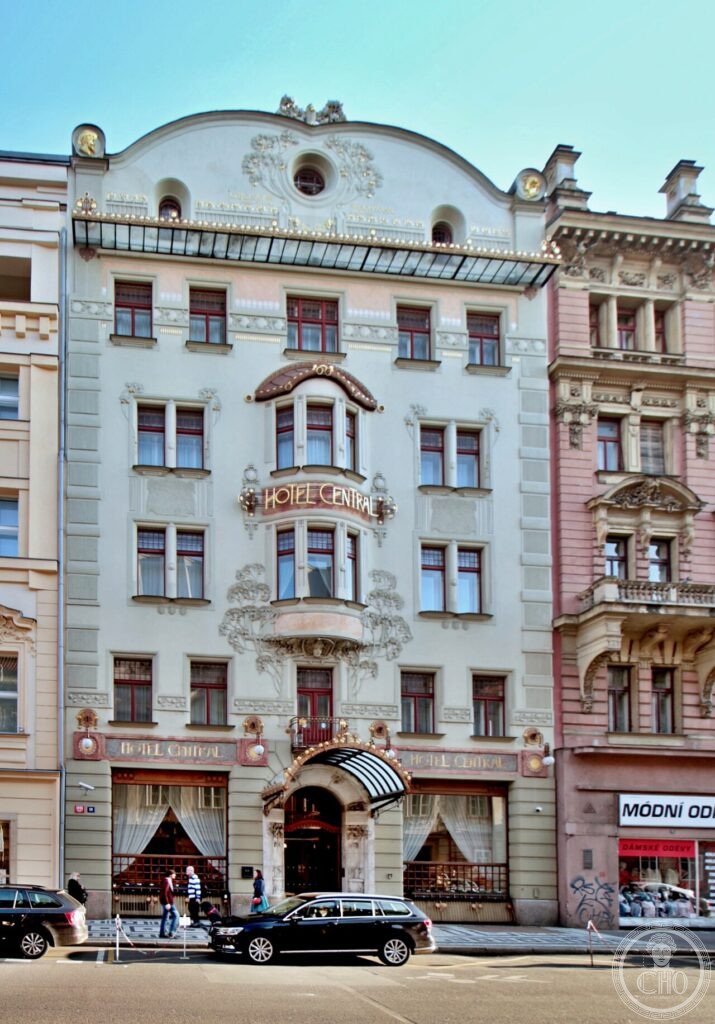

Prague’s Art Nouveau century begins here: the Hotel Central, opened in November 1901, brought the new floral style to the city’s hotel trade — and Auguste Rodin to its beds within six months.
At a glance
The Hotel Central at Hybernská 10 was the first Art Nouveau hotel in Prague. Designed by Friedrich Ohmann — the Vienna-trained professor who imported the style to Bohemia — and carried through by his pupils Bedřich Bendelmayer and Alois Dryák, it rose between 1898 and 1901 near the railway terminus later named Masaryk Station. Its facade, built by the firm of Quido Bělský, whose name appears with Ohmann’s in the upper storey, introduced to Prague the vocabulary of the new century: stucco vegetation, sinuous mouldings, and ornament drawn from the natural world.
Key facts
- Built: construction from 1898; opening ceremony 14 November 1901
- Architects: Friedrich (Bedřich) Ohmann, with Bedřich Bendelmayer and Alois Dryák
- Builder: Quido Bělský — his name and Ohmann’s appear on the upper facade
- Distinction: Prague’s first Art Nouveau hotel
- Famous guest: Auguste Rodin, during his celebrated Prague visit of May 1902
- Address: Hybernská 10, Prague 1
- GPS: 50.0868194, 14.4308504 — View on Google Maps
- Today: Operating hotel (K+K Hotel Central)
History
At the turn of the century, the blocks around the Masaryk terminus were Prague’s arrival hall, and a modern hotel there was a statement of what the city wanted to be. Ohmann, who held the decorative-architecture chair at the Prague School of Applied Arts before returning to Vienna, drew the design; Bendelmayer and Dryák — soon to build the Grand Hotel Evropa on Wenceslas Square — saw it to completion in 1901. Within months the hotel hosted Auguste Rodin on the visit that Czech artists treated as a coronation of their own modernity. The building has remained a hotel through every regime since, and after restoration operates today under the K+K flag, its facade one of the best-preserved first-generation Art Nouveau fronts in the city.
What you see
The facade concentrates its energy above the entrance: a tall glazed bay rises through the upper floors under a curving gable, framed in stucco branches and blossoms that seem to grow out of the wall — the natural-world imagery that would spread across Prague within five years. Wrought iron and glass canopy work at street level announce the hotel; look up to find the signatures of Ohmann and the builder Bělský worked into the upper facade. The interiors retain Art Nouveau elements in the public rooms, seen most easily from the café-restaurant. Compare it with Bendelmayer and Dryák’s later Grand Hotel Evropa to watch the style gain confidence in the space of four years.
Practical information
- Operating hotel — the facade is visible freely; public rooms are accessible to guests and café patrons
- Hybernská is a busy street: the opposite pavement gives the full elevation
- Combine with Municipal House, three minutes away, for the full first-generation Art Nouveau circuit
Getting there
Hybernská 10 is three minutes on foot from Náměstí Republiky (metro B, trams) and the Municipal House, and two minutes from Masaryk Station. From the Powder Tower, walk down Hybernská past the Kinský Palace gardens.
Nearby
- Municipal House (Obecní dům) — the total artwork of Czech Art Nouveau, three minutes away
- Grand Hotel Evropa — Bendelmayer and Dryák’s Wenceslas Square masterpiece of 1903–05
- Prague Main Station (Fanta Building) — Josef Fanta’s station cathedral, ten minutes east
- Koruna Palace — the geometric late Secession landmark at the foot of Wenceslas Square
Sources
- The Prague Vitruvius (pragitecture.eu), “Hybernská 1001/10: Hotel Central” — architects, dates, builder, Rodin visit
- K+K Hotels — current operation and restoration
- OpenStreetMap Nominatim — coordinates of Hybernská 1001/10
Find it on the map
See this place and what’s around it →Record researched and written by Luigi De Marchi for Cultural Heritage Online, 2026.
📷 Become a Cultural Heritage Online photographer
Share your photos of places: they stay published under your name as the author. The more they're seen, the more you get noticed — and soon a contest will reward the most appreciated photos.
Log in or sign up free to add a photoIs this page about you?
This page is read by travellers and heritage enthusiasts who find it on Google. Tell us how you are connected to this place and we will take it from there.