
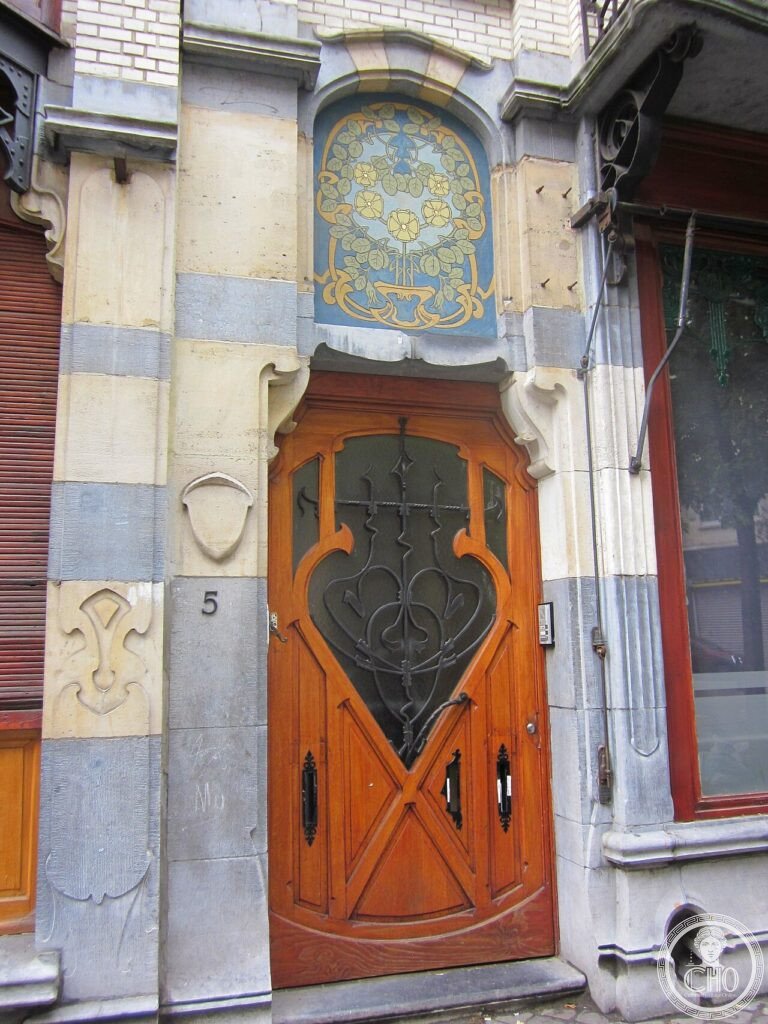

One architect, one street, fourteen houses: on the odd side of Rue Vanderschrick, Ernest Blerot built the only complete Art Nouveau street front in Brussels — and signed and dated every single facade.
At a glance
Between 1900 and 1902, at the request of a wealthy widow, Madame Elsom, the architect Ernest Blerot designed an entire block of fourteen houses along the odd side of Rue Vanderschrick in Saint-Gilles, near the Porte de Hal. The eastern run (nos. 1–13, with the corner onto the Chaussée de Waterloo) went up in 1900; the western run (nos. 15–25, with the corner buildings on Avenue Jean Volders 42–48) followed in 1902. The result is unique in Brussels: a continuous Art Nouveau streetscape where the houses share size and rhythm yet no two facades repeat.
Key facts
- Built: 1900 (nos. 1–13 and Chaussée de Waterloo corner) and 1902 (nos. 15–25 and Avenue Jean Volders 42–48)
- Architect: Ernest Blerot
- Commissioned by: Madame Elsom, widow and property investor
- Extent: Fourteen houses on the odd side of the street, plus corner buildings
- Signature detail: Each facade carries Blerot’s signature followed by the year
- Location: Rue Vanderschrick, Saint-Gilles, Brussels
- GPS: 50.831029, 4.341917 — View on Google Maps
- Protected: Ensemble classified 8 August 1988
History
Speculative row housing was the bread and butter of Brussels construction around 1900 — but almost nobody commissioned it from an Art Nouveau architect for a whole street at once. Madame Elsom did. Ernest Blerot, one of the style’s most fluent and prolific practitioners, delivered plans for the entire block: same plot widths, same cornice logic, and then variation everywhere else. The scheme was built in two campaigns, 1900 and 1902, and Blerot autographed each house in stone with the construction year — an architect’s signature run rare anywhere in Europe. The ensemble was classified as a protected group on 8 August 1988 and remains lived-in housing, with cafés at the corners; the ground floors have changed, but the upper facades survive remarkably intact.
What you see
Walk the odd pavement slowly from the Chaussée de Waterloo end. The houses are siblings, not twins: doorways shift position, bay windows swell and retreat, gables rise and flatten. A multitude of sgraffiti fills window transoms and tympanums — floral panels in the warm palette typical of the technique — and every house carries at least one wrought-iron balcony of an original design, nowhere repeated. Look for Blerot’s incised signature and date near the base of each facade. Then cross the street: only from the even side does the ensemble read as what it is, a single composition a hundred and fifty metres long.
Practical information
- Inhabited private houses — the ensemble is enjoyed from the street, free, at any hour
- Morning light favours the odd (built) side of the street
- Allow 20–30 minutes to walk both pavements and find the signatures; the corner cafés on Avenue Jean Volders make a natural stop
Getting there
Rue Vanderschrick begins a step from the Porte de Hal: from the Hal Gate metro and tram stops, cross toward Saint-Gilles and the street opens off the Chaussée de Waterloo almost immediately. The Hôtel Winssinger and the route up to the Horta Museum continue the Art Nouveau walk southward.
Nearby
- Hôtel Winssinger — five minutes away; Victor Horta’s 1894–97 town house, converted to apartments by Horta himself
- Porte de Hal — the surviving medieval city gate, now a museum, at the head of the street
- Horta Museum — fifteen minutes on foot into Saint-Gilles
- Brussels — Victor Horta and Art Nouveau — the CHO city guide
Sources
- Brussels regional heritage inventory (monument.heritage.brussels), Rue Vanderschrick street file — client, campaigns 1900/1902, extent, classification 1988
- admirable-facades.brussels, “Maisons en série d’Ernest Blerot” — sgraffiti, balconies, signatures
- Wikidata Q85074048 — street coordinates
Find it on the map
See this place and what’s around it →Record researched and written by Luigi De Marchi for Cultural Heritage Online, 2026.
📷 Become a Cultural Heritage Online photographer
Share your photos of places: they stay published under your name as the author. The more they're seen, the more you get noticed — and soon a contest will reward the most appreciated photos.
Log in or sign up free to add a photoIs this page about you?
This page is read by travellers and heritage enthusiasts who find it on Google. Tell us how you are connected to this place and we will take it from there.