
.jpg)
Few buildings let you watch an architect edit his own youth: Victor Horta built the Hôtel Winssinger in the 1890s — and returned in 1928 to convert it into apartments with his own hands.
At a glance
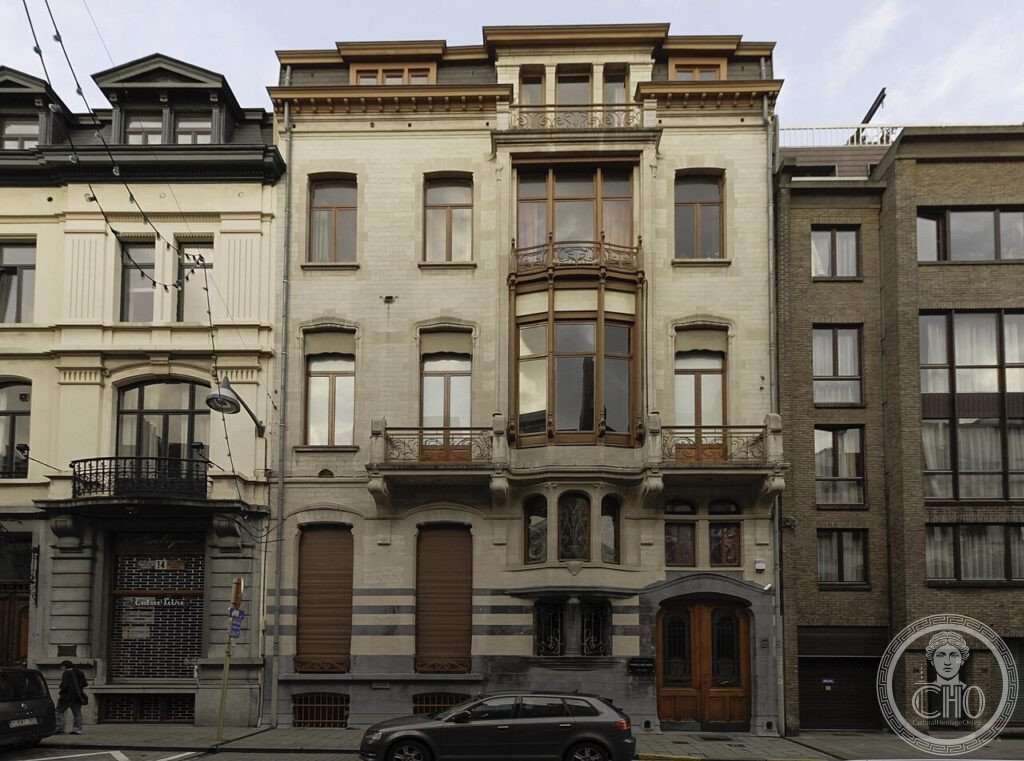
Designed between 1894 and 1897 for the engineer Camille Winssinger, this town house at rue de l’Hôtel des Monnaies 66 in Saint-Gilles belongs to Horta’s breakthrough years, the same period as the Hôtel Tassel and Hôtel Solvay. Its facade combines white and blue stone with the supple ironwork of the young Horta. Unusually, the building’s later history also belongs to him: in 1928–29 Winssinger had the house converted into an apartment building, and it was Horta himself who carried out the transformation of facade and interior.
Key facts
- Built: 1894–1897
- Architect: Victor Horta
- Client: Camille Winssinger, engineer
- Facade: White and blue stone, refined bay windows
- Converted: 1928–29, into apartments, by Horta himself
- Address: Rue de l’Hôtel des Monnaies 66, Saint-Gilles, Brussels
- GPS: 50.831078, 4.348619 — View on Google Maps
- Protected: Classified December 1984 (facade, staircase, hall and mezzanine); extended 2007
History
Camille Winssinger commissioned the house from a Horta still in his early thirties, fresh from the shock of the Hôtel Tassel. Three decades later, taste and economics had changed: grand single-family town houses were becoming hard to sustain, and in 1928–29 Winssinger asked for the building to be divided into apartments. Rather than let another hand touch it, Horta — by then Belgium’s most decorated architect, deep in his classical late period — reworked his own youthful design. The building was classified in December 1984, with the protection extended in 2007, and after a recent renovation it now houses an architecture and design office, an art gallery and several apartments. Interior woodwork, stained glass and marble mosaics survive in fine condition.
What you see
The street front plays white stone against blue stone in broad horizontal registers, opened by generous bay windows that push gently forward — a facade at once robust and finely drawn. The composition is calmer than the contemporary Tassel facade, but the details reward attention: the profiles of the bays, the ironwork, and the rhythm of openings that lets unusually deep daylight into the plan. Inside — accessible mainly during heritage tours — the protected staircase, hall and mezzanine preserve woodwork, stained glass and marble mosaics from both of Horta’s campaigns, the 1890s original and the 1928–29 remodelling laid one over the other.
Practical information
- Private building (offices, gallery and apartments) — the facade is freely visible from the street
- Interiors open occasionally during Brussels heritage events (BANAD festival, Heritage Days) — book ahead
- Combine with the Horta Museum, ten minutes away in the same commune
- In October 2026 the house is one of the venues of the Festival ARTONOV, which stages performances inside Brussels heritage interiors — one of the few chances to see the interior.
Getting there
Rue de l’Hôtel des Monnaies climbs from the Porte de Hal toward the Saint-Gilles town hall; no. 66 is a few minutes on foot from the Hal Gate and its metro and tram stops. The Art Nouveau ensemble of Rue Vanderschrick lies just across the Chaussée de Waterloo.
Nearby
- Rue Vanderschrick — five minutes away; Ernest Blerot’s complete Art Nouveau street front
- Horta Museum — the architect’s own house and studio, ten minutes south
- Hôtel Hannon — Jules Brunfaut’s photogenic corner house of 1902
- Brussels — Victor Horta and Art Nouveau — the CHO city guide
Sources
- Brussels regional heritage inventory (monument.heritage.brussels), building file 4935 — dates, client, 1928-29 conversion, protection
- admirable-facades.brussels (official regional facades programme) — facade description
- Wikidata Q2252836 — coordinates
Find it on the map
See this place and what’s around it →Record researched and written by Luigi De Marchi for Cultural Heritage Online, 2026.
📷 Become a Cultural Heritage Online photographer
Share your photos of places: they stay published under your name as the author. The more they're seen, the more you get noticed — and soon a contest will reward the most appreciated photos.
Log in or sign up free to add a photoIs this page about you?
This page is read by travellers and heritage enthusiasts who find it on Google. Tell us how you are connected to this place and we will take it from there.