Bolívar State, Venezuela · UNESCO World Heritage Site 1994 · Tepui table mountains and Angel Falls
Canaima National Park: Where to Stay and What to See Nearby
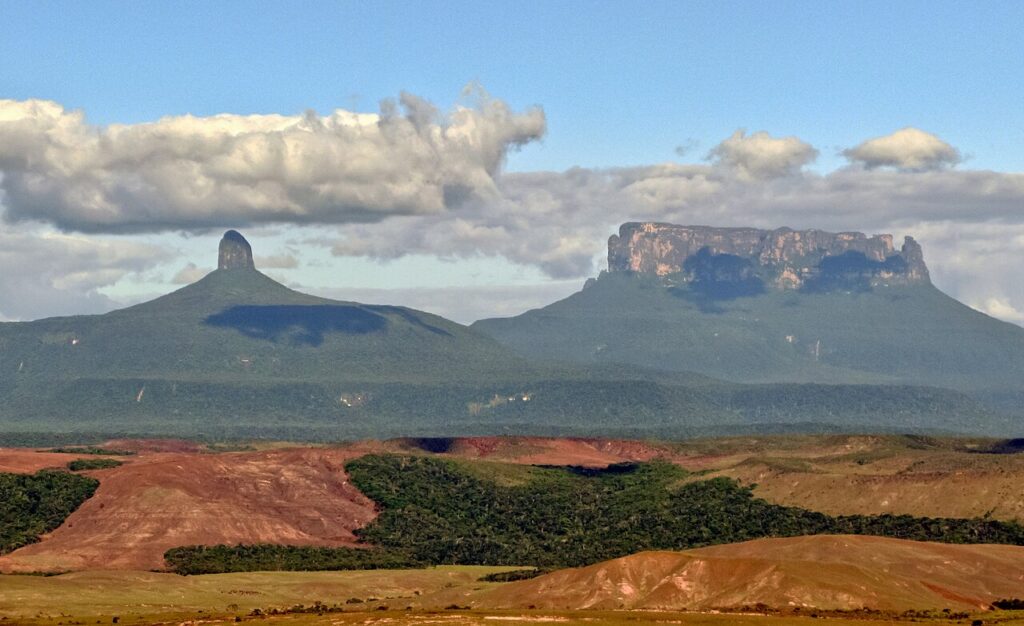
The flat-topped sandstone tepuis of southeastern Venezuela — table mountains rising 1,000 metres above the surrounding forest on sheer vertical walls, their summits isolated ecosystems that inspired Arthur Conan Doyle’s “The Lost World” — reach their most dramatic expression in Canaima National Park, home to 115 tepuis, the world’s highest uninterrupted waterfall (Angel Falls, 979m), and a landscape so ancient and so alien that it seems geological rather than geographical.
Sources
- S1 — UNESCO World Heritage Centre — Canaima National Park (Ref. 701) — https://whc.unesco.org/en/list/701/
- S2 — Instituto Nacional de Parques de Venezuela (INPARQUES) — Parque Nacional Canaima — https://www.inparques.gob.ve/
Frequently Asked Questions about Canaima National Park
- What is the best time to see Angel Falls?
- The rainy season (June–November) gives the fullest flow and is required for river access by boat — the only way to reach the viewpoint. The falls are at their most impressive in July–September when rainfall is heaviest; the Churún River runs high and the falls produce a wide, dramatic curtain of water. In the dry season (December–May), water levels drop significantly; the falls often reduce to a narrow thread or a mist, and the river journey may be impossible. May and November (the transition months) can give both adequate water and fewer clouds obscuring the summit. Mornings typically offer clearer views before clouds build up around the escarpment.
- Are the falls really named after a person?
- Yes — Jimmie Angel (James Crawford Angel, 1899–1956) was an American aviator who made the first recorded flight over the falls in 1933 and who landed his plane on the Auyantepui summit in 1937 (becoming stranded there for 11 days before descending on foot). His aircraft, the El Río Caroni, was recovered in 1970 and is on display at the aviation museum in Maracay, Venezuela. The Pemón name for the falls is Kerepakupai Merú (or Kerepakupai Vená in some transliterations) meaning “waterfall of the deepest place.” The Venezuelan government decreed in 2009 that the official name should be the Pemón version; international usage continues to use “Angel Falls.”
- What is a tepui and what lives on their summits?
- Tepuis are flat-topped sandstone table mountains of the Guiana Highlands — Precambrian rock approximately 1.7 billion years old, sculpted by erosion into the mesa formations seen today. Their vertical escarpments (often 600-1,000m of bare cliff) have biologically isolated their flat summits from the surrounding forest for millions of years, creating endemic ecosystems found nowhere else. The tepui summit vegetation is dominated by carnivorous plants (Heliamphora pitcher plants, sundews), bromeliads (including Brocchinia — the only carnivorous bromeliad genus), orchids, and a diverse array of flowering plants — 60-80% endemic to individual tepuis. Giant Oreophrynella frogs and endemic lizards, spiders, and insects complete the isolated communities. No large mammals or reptiles have colonised the tepui summits permanently.
Spotted an error? Write to the editors and we correct it the same day.