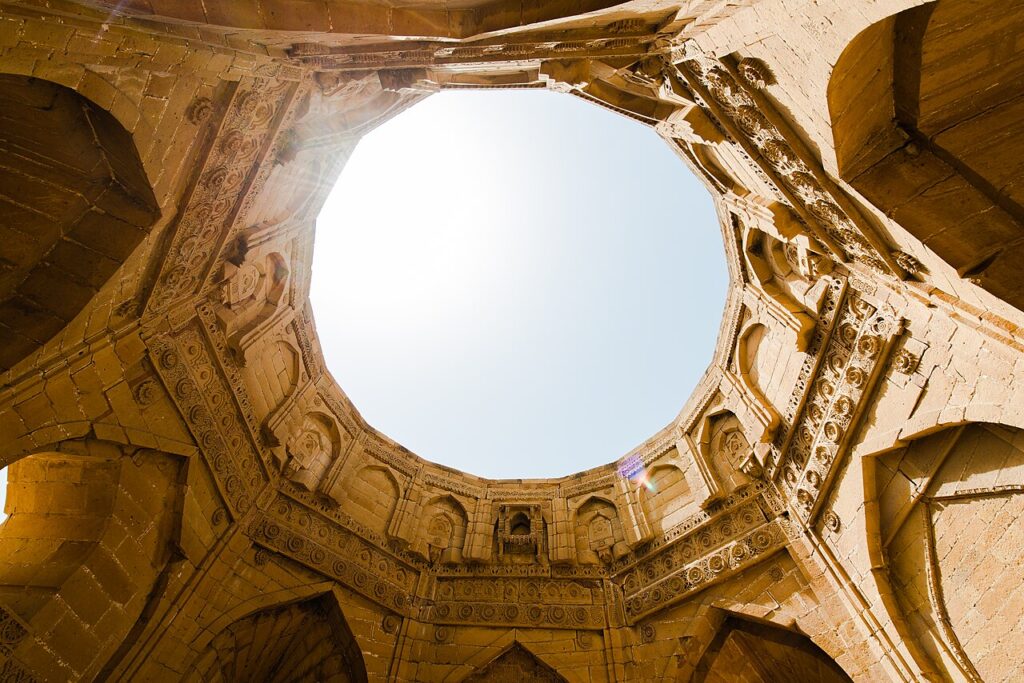
The Historical Monuments at Makli, Thatta (Sindhi: “مڪلي” — Makli, the name of the limestone hill approximately 2 km from the city of Thatta in the Sindh Province of Pakistan, approximately 98 km east-southeast of Karachi and approximately 40 km northwest of the current mouth of the Indus River), inscribed by UNESCO in 1981, is the largest Islamic necropolis in the world — a funerary landscape covering approximately 10 km² of a flat limestone plateau (approximately 4 km × 3 km, rising approximately 35 m above the surrounding alluvial plain) that contains an estimated 500,000 to 1.5 million graves (the range reflects the difficulty of counting individual graves in a necropolis that includes both monumental tombs and vast fields of unmarked or minimally-marked grave slabs covering the entire surface of the plateau) from approximately the 14th to the 18th century CE, spanning four successive dynasties that ruled Sindh during this period: the Samma dynasty (approximately 1333–1524 CE), the Arghun dynasty (approximately 1520–1556 CE), the Tarkhan dynasty (approximately 1554–1592 CE), and the Mughal provincial dynasty (approximately 1592–1736 CE, during which Thatta/Makli was the capital of the Mughal Sindh province). The concentration of monumental funerary architecture at Makli — approximately 60–100 significant individual mausoleums and commemorative structures distributed across the plateau (amid the hundreds of thousands of simpler grave markers), including the large domed mausoleums of Samma sultans, the Arghun-Tarkhan governors, the Mughal military commanders, and the major Sufi saints of the Sindh tradition — makes Makli one of the most important sites for the study of Islamic funerary architecture in the Indian subcontinent, with a distinctive local Sindhi style that synthesises elements from Persian, Central Asian, Gujarat Sultanate, and Mughal architectural traditions in a way not replicated elsewhere.
Makli’s necropolis landscape and the lower Sindh heritage circuit Makli Hill · Thatta Shah Jahan Mosque · Indus Delta · Karachi · Mohenjo-daro — 0 to 280 km
The architectural diversity of the Makli Necropolis reflects the successive cultural and artistic influences that passed through Sindh as a strategic corridor between the Arabian Sea, the lower Indus delta, and the overland trade routes toward Central Asia and the Gangetic plain. The Samma dynasty tombs (the earliest major phase of monumental construction, approximately 14th–early 16th century CE) are built in the local Sindhi tradition of carved sandstone and limestone, with distinctive carved geometric and floral stone decoration on the exterior tomb surfaces, slender octagonal minarets at the corners of large mausolea, and the “mehrab” (prayer niche) mihrab decorative programme inside the tomb chambers. The most significant Samma tomb is that of Jam Nizamuddin II (died approximately 1509 CE, the most powerful Samma sultan, who maintained the independence of Sindh against the Arghun invasion for his entire reign) — a large octagonal domed mausoleum with a distinctive carved stone lantern tower and elaborately carved stone grilles (jali screens) in the windows, a style that has parallels with the contemporaneous Gujarati sultanate architectural tradition in Ahmedabad and shows the commercial and cultural connections between Sindh and Gujarat through the Gulf of Khambhat maritime trade route. The Mughal period tombs (approximately late 16th–17th century CE) are the most elaborate in terms of material wealth — the Mirza Jani Beg Tarkhan mausoleum (of the last Tarkhan ruler, who submitted to Akbar in 1591 CE) and the Mirza Ghazi Beg mausoleum (the Mughal governor of Sindh 1596–1612 CE, a talented administrator and man of letters who was also the patron of the construction of the Shah Jahan Mosque in Thatta) use polychrome glazed tile in the Central Asian “kashi kari” tradition imported from Sind’s trade with Safavid Iran and Timurid Central Asia. The Shah Jahan Mosque in Thatta (approximately 1.5 km from the Makli Hill, in the historic core of the town of Thatta) is one of the finest Mughal mosques in Pakistan — built approximately 1647–1649 CE by Shah Jahan in gratitude for the hospitality of Thatta’s people during his flight from his father Jahangir approximately 1624 CE, the mosque’s interior is lined with approximately 100 different tile mosaic designs in the Makli-Thatta regional style, creating one of the most varied tile decoration programmes in any single Mughal building.
Practical information
Thatta is approximately 98 km east of Karachi by the National Highway N-5 (approximately 1.5 hours by car). The Makli Necropolis is located on a raised hill approximately 2 km north of Thatta town centre. The site is open during daylight hours; a nominal entrance fee is charged. The Shah Jahan Mosque in Thatta town centre (approximately 5 minutes from the Makli Hill) is open to visitors outside of prayer times (modest dress required; remove shoes). The Makli Necropolis plateau is very large — a full exploration of the major monuments requires 3–4 hours of walking on the plateau (the surface is generally flat but uneven, with grave markers at various heights, no paved paths between major tombs; sturdy footwear is recommended). The area around the plateau has minimal tourist infrastructure — accommodation is almost entirely in Karachi, making this a day trip from Karachi. The Indus Delta and the Keenjhar Lake (a large freshwater lake approximately 10 km northeast of Thatta, a significant wintering site for migratory waterfowl from Central Asia and a weekend recreation area for Karachi residents) complement the Makli visit. Best visiting months: October–February (the Sindh summer is extreme; November–February is pleasant).
Frequently Asked Questions
Why was Makli such a significant burial site and how did it become the world’s largest Islamic necropolis?
The creation of the Makli Necropolis as the primary burial ground for the Sindhi ruling class, religious establishment, and wealthy merchant community from approximately the 14th through 18th century CE reflects a specific configuration of Islamic religious geography, local political history, and geographical factors. The Islamic practice of burial in distinct funerary enclosures (the “maqbara” — necropolis or tomb garden, following the Persian garden-of-paradise funerary tradition that was adopted into Islamic mortuary practice from approximately the 8th–10th centuries CE) was well established in the Islamic world, and the siting of a major necropolis required a location that was (1) dry and elevated above the floodplain (to prevent inundation of graves during the annual Indus River floods — the Makli limestone plateau, approximately 35 m above the alluvial plain, provided exactly this protection: the river and its floods regularly inundated the surrounding agricultural land while the plateau remained dry); (2) close to a major city (Thatta was the capital of Sindh and one of the most important commercial cities of the lower Indus throughout the period — its population was estimated at approximately 300,000–400,000 in the 17th century CE, making it one of the largest cities in the Indian subcontinent at that date, comparable to contemporary Agra or Lahore); (3) associated with Sufi saint tombs (the burial of a major Sufi saint — in the Makli case, the 14th-century Sufi master Hamid al-Din is the earliest major saint buried on the plateau, and his tomb became the spiritual nucleus around which subsequent rulers and notables sought burial, on the principle that proximity to the holy person’s grave transmitted spiritual benefit — “barakah” — to those buried nearby, a practice known as “tabarruk bi-l-qubur” in Islamic theology). The three-century duration of Makli as the primary necropolis of Sindh (approximately 1350–1700 CE, with gradual decline as Thatta itself declined under the competition from the British East India Company’s Karachi development from the 19th century onward) produced the extraordinary accumulation: each generation of rulers, nobles, officers, merchants, and ordinary devotees chose to be buried on the sacred plateau, and the volume of burials over 350 years on a 10 km² plateau produced the current density of approximately 50,000–150,000 graves per km². The variety of burial types across the necropolis also reflects the social stratification of the society: the large domed mausolea of dynasties and governors (several reach 15–20 m in height with elaborately carved or tiled exteriors); the intermediate-sized walled tomb enclosures of wealthy merchants and military officers; the simple stone-slab graves of craftsmen and servants; and the small inscribed stone markers of the common population — all coexisting on the same plateau in a physical diagram of Sindhi Islamic society’s hierarchy.
What distinctive architectural style did the Sindh funerary tradition develop at Makli?
The Makli necropolis architectural tradition developed a distinctive regional synthesis that is best described as “Sindhi Sultanate” style — a funerary architecture tradition unique to the lower Sindh region and not replicated elsewhere in the Islamic world, which combines elements from multiple architectural traditions into a coherent local vernacular. The key identifying elements of the Sindhi Sultanate funerary style at Makli are: (1) carved sandstone and limestone construction (the Makli plateau’s local limestone and the sandstone quarried from the Sindh hills were the primary materials for the Samma-period tombs; their carved stone surfaces show a dense covering of geometric interlace, arabesque foliage, Quranic calligraphy in Naskh and Thuluth scripts, and stylised bird-and-flower motifs — a combination of ornamental vocabularies from Persian Islamic, Hindu Rajput, and local Sindhi decorative traditions); (2) the octagonal funerary tower form (several of the major Samma tombs are not dome-on-square-chamber but tall octagonal towers with multiple external carved stone niches and a “kund” — a projecting carved cornice at the top — a form that has no close parallel in Mughal, Deccan, or Timurid architecture but resembles the “burj” tomb towers of the Mamluk Cairo necropolis tradition in a general typological sense, though no direct connection has been established); (3) the “mehrab” decorative programme (all significant Makli tombs have a mihrab — a pointed-arch prayer niche — on the qibla [west-facing toward Mecca] interior wall, decorated with the most elaborate carved or tile-mosaic decoration in the tomb; the quality of the Makli mihrabs ranges from rough local limestone carving in minor tombs to the exceptional polychrome tile mosaic mihrab of the Jam Nizamuddin tomb, which uses turquoise, cobalt, white, and yellow glazed tile in a style that combines the Sindhi tradition with influence from the Timurid Central Asian kashi kari of Samarkand); (4) the composite Muslim-Hindu decorative vocabulary (the later Samma and Arghun-period tombs show a degree of Hindu/Jain decorative vocabulary absorption — bell-and-chain motifs, the “kalpavriksha” wish-granting tree pattern, and figurative bird and animal representation in the carved stone decoration that reflects the coexistence of Muslim ruling class and Hindu merchant/artisan community in 16th-century Sindh). The Makli necropolis is one of the very few Islamic monumental sites where this composite Sindhi architectural vocabulary survives intact at large scale, making it irreplaceable as a source of information about the artistic culture of pre-Mughal Sindh.
EXCERPT: Historical Monuments at Makli, Thatta, Pakistan, UNESCO-inscribed 1981, is the world’s largest Islamic necropolis — 500,000–1.5 million graves on a 10 km² limestone plateau above the Indus delta, four dynasty styles (Samma sandstone towers, Arghun polychrome tile, Mughal kashi kari), and the 1647 Shah Jahan Mosque with 100 different tile mosaic designs built in gratitude for Thatta’s hospitality.
META: UNESCO World Heritage Sites near Historical Monuments at Makli Thatta Pakistan: Mohenjo-daro 280 km north (UNESCO 1980), Lahore Fort and Shalamar Gardens 1100 km north (UNESCO 1981), Rohtas Fort 1000 km north (UNESCO 1997) — Makli Necropolis Thatta Pakistan UNESCO 1981, largest Islamic necropolis world, Samma Arghun Tarkhan Mughal Sindh, Shah Jahan Mosque tile mosaic, Indus delta Karachi heritage.
Sources
- S1 — UNESCO World Heritage Centre — Historical Monuments at Makli, Thatta (Ref. 143) — https://web.archive.org/web/20230601000000/https://whc.unesco.org/en/list/143/
- S2 — UNESCO World Heritage Centre — Statement of Outstanding Universal Value (Ref. 143) — https://whc.unesco.org/en/list/143/
Spotted an error? Write to the editors and we correct it the same day.