Carlsbad Caverns National Park — inscribed by UNESCO in 1995 — preserves one of the most significant and most beautiful cave systems in the world beneath the Guadalupe Mountains of southeastern New Mexico: a karst limestone landscape containing at least 119 known caves, including Carlsbad Cavern (one of the world’s largest cave chambers — the Big Room, 3.7 hectares in area and 78 metres tall at its highest point, the largest natural underground chamber in North America), Lechuguilla Cave (the deepest cave in the continental United States at 489 metres, and one of the most scientifically significant caves in the world, formed by the distinctively rare mechanism of hypogenic speleogenesis — dissolution by rising hydrogen sulphide gas rather than descending rainwater — and containing some of the most extraordinary mineralogical formations discovered in any cave system), and the spectacular nightly free-tail bat flight (from mid-spring to October, approximately 400,000 Brazilian free-tailed bats emerge from the cave’s natural entrance in a spiral column lasting up to two hours).
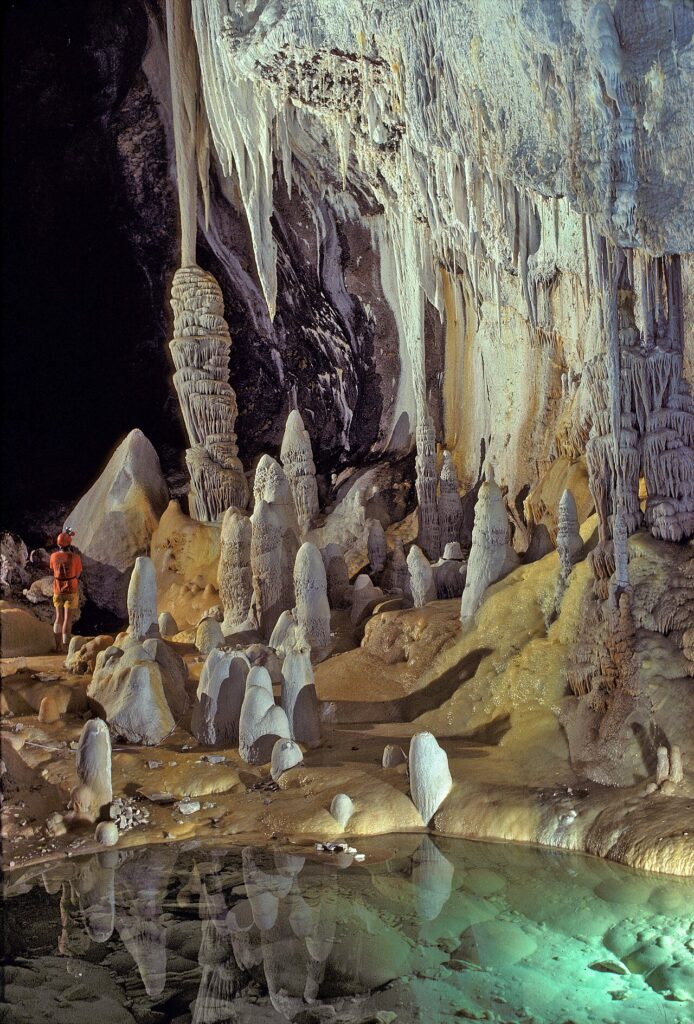
The Big Room, Lechuguilla Cave, and hypogenic speleogenesis in the Guadalupe Mountains Carlsbad Cavern Natural Entrance (steep path descent, approximately 1 km, 230 m elevation loss — guided tours only) · The Big Room (self-guided trail, 3.2 km loop, elevator access from visitor center) · Lechuguilla Cave (permit-required science and recreation trips only, no public tours) · Bat Flight Amphitheater (natural entrance overlook, evening bat flight programs mid-spring to October) · Slaughter Canyon Cave (lantern-lit tour, prior booking required) — Eddy County, southeastern New Mexico
Carlsbad Caverns National Park occupies a portion of the Guadalupe Mountains (a northwest-trending escarpment in southeastern New Mexico and adjacent West Texas, composed primarily of Capitan Reef limestone — a massive fossil reef complex formed in the Permian Period approximately 265–252 million years ago, when the region lay at the edge of an inland sea called the Delaware Basin, and subsequently uplifted by the Basin and Range tectonic event approximately 20–30 million years ago to expose the limestone to erosional processes). The caves of Carlsbad Caverns are the result of an unusual and scientifically important dissolution mechanism: unlike the vast majority of the world’s limestone caves (which form by meteoric speleogenesis — the dissolution of limestone by carbonic acid produced when rainwater absorbs atmospheric CO₂ and descends through fractures in the rock from above), the Guadalupe Mountain caves formed by hypogenic speleogenesis (dissolution by rising hydrogen sulphide gas). The process: petroleum deposits in the Delaware Basin (deep beneath the limestone) decomposed over millions of years, producing hydrogen sulphide (H₂S) gas that rose through fractures in the overlying rock; when the H₂S encountered oxygen-bearing groundwater near the cave levels, it was oxidised to sulphuric acid (H₂SO₄), which dissolved the limestone from within the mountain rather than from above, creating large, irregular chambers with no necessary connection to the surface drainage pattern (the “dissolution from below” character of hypogenic caves explains why the Big Room — the largest chamber — is at the lowest point of the accessible cave, not the highest, as would be expected in a descending-water cave). The sulphuric acid dissolution also produced secondary sulphate minerals (gypsum — calcium sulphate, the same mineral used in plaster of paris) that coat many of the cave walls and floors in thick white deposits: the “cave popcorn” (clusters of gypsum globules), “cave cotton” (delicate fibrous gypsum in gossamer tufts), and “cave clouds” (thick gypsum deposits) of Carlsbad Cavern are among the most spectacular mineralogical features of any cave in the world. Lechuguilla Cave (discovered in its full extent only in 1986 CE, when cavers pushing a known guano mine in the park broke through to the enormous cave system beyond — making it the most significant cave discovery in the United States in the 20th century) is the most scientifically important cave in the Guadalupe system: at 489 metres depth (the deepest cave in the continental United States) and 251 km of surveyed passage (the fourth longest cave in the world as of 2024 CE), it contains a mineralogical inventory of extraordinary diversity — including chandeliers (large, branching speleothems of aragonite and selenite growing from the ceiling), hydromagnesite and moonmilk deposits (rare minerals found in very few other caves worldwide), pool spars (large calcite crystals growing underwater), cave pearls (smooth balls of calcium carbonate formed by concentric coating around a grain of sand or other nucleus in cave pools — the Pearlsian Gulf is the most celebrated pool pearl deposit in the world), sulphur deposits and yellow sulphur crystals lining fractures, and bacillite (a rare mineral first identified in Lechuguilla). Because Lechuguilla has been almost entirely isolated from the surface (and therefore from human contamination) for millions of years, its microbial communities have been of particular interest to astrobiologists: bacteria living in the cave’s walls have evolved entirely on chemolithotrophy — metabolising minerals rather than organic compounds — and have developed antibiotic resistance without ever encountering human antibiotics (a finding that has implications for understanding antibiotic resistance and that revealed entirely new bacterial phyla previously unknown to science). For this reason, access to Lechuguilla is restricted to specifically permitted scientific research expeditions and a limited number of permitted recreational caving trips; no public tours are offered, and all participants must undergo rigorous decontamination to avoid introducing surface microorganisms. Carlsbad Cavern (the main accessible cave, with the Big Room forming the centrepiece of the visitor experience) was discovered in modern times by Jim White, a young cowboy who noticed the enormous emerging bat cloud from the natural entrance in the 1890s CE and explored the cave over several years, eventually persuading the US General Land Office to investigate. President Calvin Coolidge designated Carlsbad Cave National Monument in 1923 CE and Congress established Carlsbad Caverns National Park in 1930 CE. The Brazilian free-tailed bat colony (Tadarida brasiliensis — a migratory bat species that winters in Mexico and spends the summer roosting in Carlsbad Cavern’s main entrance section, which provides the large, stable temperature environment bats require for communal roosting) is the largest concentration of free-tailed bats in the world within a single cave: approximately 400,000 bats (the colony has declined from historical estimates of up to 8 million, attributed to pesticide exposure during the mid-20th century CE and white-nose syndrome) emerge each evening from mid-May through October in a column that spirals clockwise from the cave entrance (the rotation is induced by the bats’ wing beats creating a rotating air current) lasting 1–2 hours as the bats fly out to feed on insects in the surrounding desert, consuming an estimated 3 tonnes of insects per night at peak season.
Practical information
Carlsbad Caverns National Park is located in southeastern New Mexico, approximately 40 km southwest of the town of Carlsbad via US Highway 62/180 to the park entrance road. The nearest airports are Carlsbad Cavern City Air Terminal (CNM, approximately 55 km northeast, limited commercial service) and El Paso International Airport (ELP, approximately 240 km west, the most convenient major airport). By road from El Paso: US-285 north to Carlsbad, then US-62/180 southwest to the park entrance; from Albuquerque (approximately 300 km north), I-25 south to US-285 south to Carlsbad. Entry fee: approximately $15/person (cave access) plus the park entrance fee. The main cave (Carlsbad Cavern) is accessible by two routes: the Natural Entrance Trail (steep, 1 km descent through the cave entrance, available on guided and self-guided tours) and the elevator (built in 1932 CE, dropping directly from the visitor center to the Big Room level). The Big Room self-guided tour (3.2 km loop, approximately 1.5–2 hours, fully paved and accessible to wheelchairs) is the most popular experience. Additional tours of other cave sections (the Left Hand Tunnel, Lower Cave, Spider Cave) require advance reservation. The Bat Flight program (free, at the outdoor Bat Flight Amphitheater near the natural entrance, typically beginning mid-May and ending October–November with the bats’ departure for Mexico) is one of the most spectacular natural events in the American Southwest: rangers narrate the ecology of the bat colony as the animals emerge in their characteristic spiral column at sunset (the exact timing varies by season — the park posts the expected departure time daily). Best season: spring (March–May) and autumn (September–November) for comfortable temperatures (the cave maintains a constant 13°C year-round, though summer surface temperatures can exceed 40°C); the bat flight is best in August–September when the colony is largest and the evenings are warm enough for comfortable viewing.
Frequently Asked Questions
What is hypogenic speleogenesis and how does it differ from the way most limestone caves form?
The vast majority of the world’s limestone cave systems (including the famous caves of the Dordogne in France, the Škocjan Caves of Slovenia, Mammoth Cave in Kentucky, and virtually all other tourist cave systems) form by meteoric speleogenesis — a process driven by descending rainwater. The mechanism: atmospheric CO₂ dissolves in rainwater to form weak carbonic acid (H₂CO₃); this mildly acidic water percolates downward through fractures and bedding planes in the limestone, dissolving calcium carbonate (CaCO₃ + H₂CO₃ → Ca²⁺ + 2HCO₃⁻) as it descends; over millions of years, the preferential enlargement of certain fractures (those with the highest water flow) creates conduits, chambers, and eventually the cave passage networks that cavers explore. In meteoric caves, the largest chambers tend to be near the top of the cave (where the dissolving acid is most concentrated) and passage networks typically follow the downslope path of the water table. Hypogenic speleogenesis (the mechanism responsible for the Guadalupe Mountain caves including Carlsbad Cavern and Lechuguilla) is essentially the reverse: instead of descending water dissolving rock from above, rising gas and fluid dissolves rock from below. The specific mechanism at Carlsbad: hydrogen sulphide (H₂S) produced by the bacterial reduction of sulphate in the underlying Permian-age oil and gas deposits of the Delaware Basin rose through fractures in the overlying Capitan limestone reef; when the H₂S reached oxygenated water near the cave levels, it was oxidised to sulphuric acid (H₂SO₄ + CaCO₃ → CaSO₄ + H₂O + CO₂); the sulphuric acid dissolved the limestone quickly and aggressively, creating large, irregular chambers with no necessary relationship to the surface drainage (unlike meteoric caves, hypogenic caves can form at any depth, in any orientation, and in patterns controlled by the fracture network through which the H₂S rose rather than by surface topography). The sulphate byproduct (calcium sulphate = gypsum) accumulates on cave walls and floors as white deposits — the distinctive “cave popcorn,” “cave cotton,” gypsum crusts, and other sulphate formations that give Carlsbad Cavern and especially Lechuguilla Cave their extraordinary mineralogical character. The recognition that the Guadalupe Mountain caves formed by sulphuric acid dissolution (first proposed by Carol Hill in a 1987 CE paper that was initially controversial but is now accepted as the definitive explanation) was one of the most significant advances in speleology of the late 20th century, revealing that a substantial fraction of the world’s caves may have formed by hypogenic mechanisms previously unrecognised — a finding that has implications for understanding groundwater systems, mineral deposits, and the distribution of cave habitats globally.
What has been discovered in Lechuguilla Cave that is scientifically significant?
Lechuguilla Cave (discovered in its current extent in May 1986 CE, when a team of cavers led by Dave Allured pushed a draughting dig — a passage where air is moving, indicating a cave beyond — in an old guano mine in the park, breaking through into the vast cave system beyond) is one of the most scientifically significant geological sites discovered in the 20th century, contributing to multiple scientific disciplines in ways that extend far beyond its extraordinary mineralogy. The mineralogical inventory of Lechuguilla is unrivalled among accessible caves: researchers have identified over 40 distinct mineral species in the cave, including several that had never previously been observed in a natural geological setting. Among the most remarkable formations: aragonite chandeliers (large, branching speleothems of aragonite — the orthorhombic polymorph of calcium carbonate, less stable than calcite but produced under specific chemical conditions in Lechuguilla’s waters — growing from the ceiling in elaborate branching shapes up to 6 metres long, requiring thousands of years to grow); U-loops and helictites (speleothems that defy gravity, growing in curved, corkscrewing, or branching shapes controlled by capillary forces and crystal growth kinetics rather than gravity); pool spars (large, transparent calcite crystals growing underwater in the cave’s pools, some exceeding 30 cm in length); and massive gypsum block deposits (blocks of selenite gypsum, some exceeding 1 cubic metre, formed as the sulphuric acid dissolved the cave walls). The microbiological discoveries in Lechuguilla have been equally significant: in 1988 CE, researchers discovered a community of bacteria living in the cave walls’ mineral substrate, deriving energy entirely from chemolithotrophy (metabolising iron, manganese, and sulphur minerals rather than organic carbon from the surface food chain). These bacteria — which have been isolated from the surface ecosystem for millions of years — had developed resistance to 18 different antibiotics (including several modern clinical antibiotics) without any exposure to human medical practice, demonstrating that antibiotic resistance is a natural evolutionary phenomenon that predates human antibiotic use by millions of years. The discovery (published in PLOS ONE in 2012 CE by Hazel Barton and colleagues) had important implications for the ongoing global antibiotic resistance crisis, demonstrating that antibiotic resistance genes exist in the environment independent of clinical antibiotic use and that “pristine” environments — even deep caves isolated for millions of years — are not free of resistant bacteria. The discovery also led to the isolation of several bacteria from Lechuguilla that produce compounds active against drug-resistant pathogens, making Lechuguilla a source of potential novel antibiotics. The cave’s astrobiology significance: the chemolithotrophic bacteria of Lechuguilla are considered one of the best terrestrial analogues for hypothetical life forms on other planetary bodies (Mars, Europa, Enceladus) where sunlight-driven photosynthesis is impossible but mineral energy sources may be available — NASA has funded research at Lechuguilla specifically to understand how life might survive in such environments.
What causes the bat flight at Carlsbad Caverns and why do the bats rotate in a spiral column?
The Brazilian free-tailed bat colony at Carlsbad Cavern (Tadarida brasiliensis, also known as the Mexican free-tailed bat — a highly migratory species that ranges from the southern United States to South America, named for the distinctive tail that extends beyond the tail membrane, unlike most bat species) uses the cave as a summer maternity roost: female bats arrive from their Mexican wintering grounds in mid-March to mid-April, give birth in June (each female produces a single pup), and nurse the pups until they can fly independently in late July–August, before the colony departs for Mexico in October–November. At peak season (August–September), the colony numbers approximately 400,000 individuals — down from historical estimates of 8.7 million in the 1930s CE, with the decline attributed primarily to DDT and other chlorinated pesticide exposure in the 1950s–1970s CE (the bats consume enormous numbers of insects in the agricultural fields of Texas and Mexico, concentrating pesticides through bioaccumulation) and, more recently, to white-nose syndrome (a fungal disease — Pseudogymnoascus destructans — that has devastated North American bat populations since 2006 CE). The evening emergence (which begins at or just after sunset, with the exact timing varying by season and weather conditions) is one of the most spectacular wildlife events in North America: the bats stream out of the cave entrance in a column that rotates clockwise (as viewed from above), spiralling upward to flight altitude before dispersing in multiple directions to feed. The rotating column forms for aerodynamic reasons: the bats emerging from the cave entrance first fly along the cave walls (where the air resistance is lowest), naturally following the curved shape of the entrance bowl in a clockwise direction; subsequent bats follow the same path, and the combined aerodynamic wake of hundreds of thousands of bat wings moving in the same direction creates a rotating air current that reinforces the column structure. At peak emergence, a single bat passes the entrance every few milliseconds, giving the column its characteristic dense, almost liquid appearance. The bats feed on insects throughout the night in the surrounding Chihuahuan Desert and neighbouring agricultural areas of southeastern New Mexico and west Texas: radio telemetry studies have shown that individual bats travel up to 60 km from the cave entrance on a single night’s foraging, returning to the cave just before dawn. The collective insect consumption of the colony — estimated at approximately 3 metric tonnes per night at peak season — represents significant pest control services for agricultural operations in the region (including corn, sorghum, and cotton fields where lepidopteran pest moths are a primary target), and has been estimated to provide approximately $700,000 in annual pest control value to regional farmers.
EXCERPT: Carlsbad Caverns National Park New Mexico (UNESCO 1995) — one of the world’s most significant cave systems: the Big Room (the largest natural underground chamber in North America), Lechuguilla Cave (489 metres deep, formed by sulphuric acid rather than rainwater, containing extraordinary mineralogy and antibiotic-resistant bacteria isolated for millions of years), and approximately 400,000 Brazilian free-tailed bats emerging each evening in summer.
META: UNESCO World Heritage Sites near Carlsbad Caverns New Mexico USA: Pueblo de Taos 550 km north, San Antonio Missions 450 km east — Southwest USA heritage circuit from the ancient desert cave systems to the living adobe pueblo of Taos and the Spanish colonial missions of Texas.
Sources
- S1 — UNESCO World Heritage Centre — Carlsbad Caverns National Park (Ref. 721) — https://web.archive.org/web/20230601000000/https://whc.unesco.org/en/list/721/
- S2 — National Park Service — Carlsbad Caverns National Park — https://www.nps.gov/cave/
Spotted an error? Write to the editors and we correct it the same day.