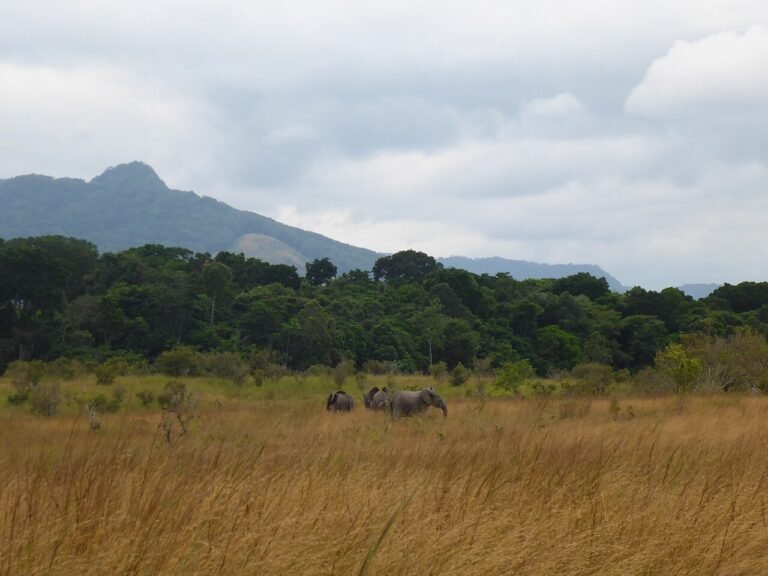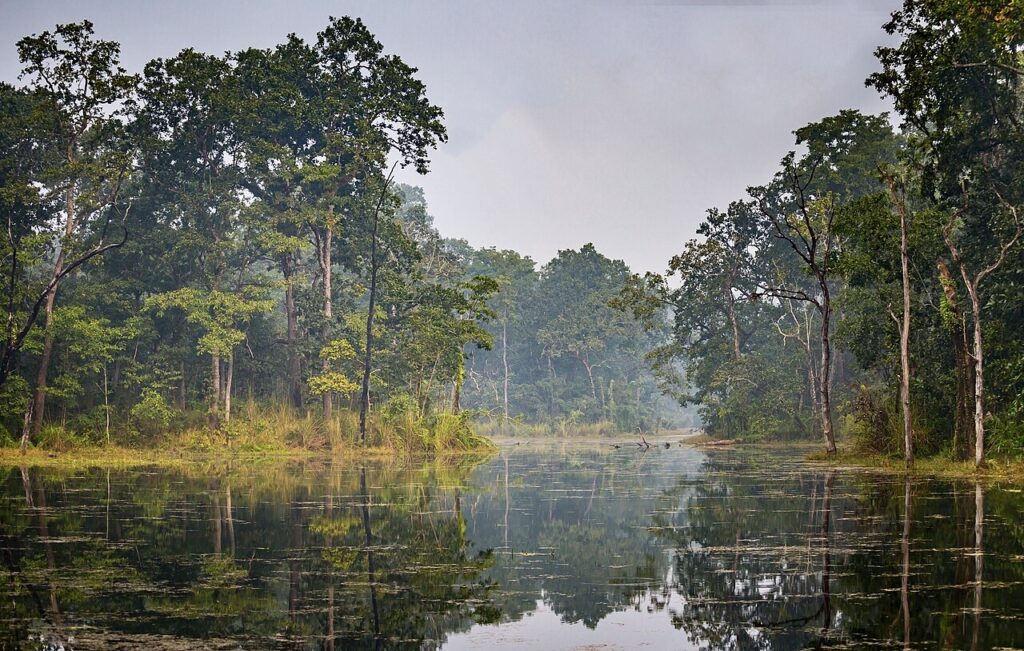
Royal Chitwan National Park (Nepali: “चितवन राष्ट्रिय निकुञ्ज” — “Chitwan” from Chepang language, “chitwana” = heart of the jungle), inscribed by UNESCO in 1984, is a protected area of approximately 932 km² in the Inner Terai lowland of southern Nepal (the Terai being the narrow subtropical lowland belt at the base of the Himalayan foothills, approximately 100–200 km wide, running east–west along the entire length of Nepal’s southern border with India) that is the primary habitat for Nepal’s — and one of the most important surviving habitats for Asia’s — most threatened large mammals: the Greater One-Horned Rhinoceros (Rhinoceros unicornis, the Indian one-horned rhinoceros or Great Indian rhinoceros — the largest of the three Asian rhinoceros species, with a single horn that can reach 25–60 cm in length, a body weight of 1,800–2,700 kg, and a characteristic heavily armoured “plate” appearance created by the folded skin folds at the neck, shoulders, and hindquarters — a rhinoceros species that was once distributed across the entire Gangetic plain from Pakistan to Myanmar but was reduced to near extinction by the combination of colonial-era hunting and habitat loss in the 19th–early 20th century CE). The Chitwan park and its surrounding buffer zone and corridor forests also support: the Bengal tiger (Panthera tigris tigris — Chitwan has approximately 100–130 tigers as of 2022 CE censuses, making it one of the highest tiger-density protected areas in Nepal and a key source population for the Terai tiger metapopulation); the Asian elephant (Elephas maximus — both a wild population and the domesticated elephant population used by the park for anti-poaching patrol and tourist wildlife viewing); the Marsh mugger crocodile (Crocodylus palustris) and the Gharial (Gavialis gangeticus — the critically endangered fish-eating crocodilian with its distinctive narrow elongated snout, confined to a few rivers in northern India and Nepal, with one of the largest surviving Gharial populations in the Rapti and Narayani rivers that flow through Chitwan); and the Ganges river dolphin (Platanista gangetica gangetica, the Gangetic dolphin — a blind freshwater dolphin that navigates by echolocation in the murky river waters, one of the world’s most endangered cetaceans, present in the Narayani River corridor).
Chitwan’s wildlife and the Terai Arc landscape Sauraha village · Narayani River · Rapti River · Lumbini · Kathmandu — 0 to 180 km
Chitwan National Park is divided ecologically into the inner core protected zone (where no permanent human habitation is permitted and all visitor access requires park entry permits and approved guides) and the buffer zone (the surrounding ring of approximately 750 km² of community forests and agricultural land managed jointly by the park and the surrounding community forest user groups, which serve as habitat corridors for wildlife movement between the core zone and adjacent protected areas in India). The dominant vegetation types are: the tall-grass savanna (the Saccharum spontaneum “elephant grass” floodplain habitat on the river banks, which reaches 4–8 m in height during the monsoon growing season and is the primary hunting habitat of the Bengal tiger — the tall grass provides cover for stalking), the sal forest (Shorea robusta dominant forest on the well-drained upland areas of the park — sal is the most commercially valuable timber tree of the Terai, and the prevention of logging in the core zone has produced the most mature sal forest in Nepal within the park boundaries), and the riverine forest (gallery forest along the Rapti and Narayani rivers, dominated by Trewia nudiflora, Bombax ceiba [the silk-cotton tree, whose red flowers bloom February–March before the leaves emerge], and Dalbergia sissoo [rosewood]). The most wildlife-rich experience at Chitwan is the early-morning and late-afternoon game drive (by jeep, elephant-back ride, or dugout canoe on the Rapti River) into the tall-grass areas and sal forest where rhinoceros, deer (spotted deer/chital, barking deer/muntjac, hog deer, sambar), gaur (Indian bison), wild boar, and, more rarely, tiger are sighted. The rhinoceros is the emblematic wildlife encounter at Chitwan: the park contains approximately 700–750 rhinoceros (approximately 60% of Nepal’s total rhinoceros population, which is itself one of the two primary survival populations for the species — the other being India’s Kaziranga National Park in Assam), and sightings are frequent from both jeep and elephant-back.
Practical information
Chitwan National Park is approximately 150 km south of Kathmandu (approximately 4–5 hours by tourist bus or private vehicle via the Prithvi Highway and East-West Highway) or approximately 5 hours from Pokhara. The main tourist hub is Sauraha village on the north bank of the Rapti River, where the majority of budget and mid-range guesthouses and the park’s main entrance gate are located; more upmarket lodges are located inside the buffer zone or in Kasara (the main park headquarters area). The Narayani Beach resort area to the west offers the most exclusive accommodation options, adjacent to the Narayani/Gandaki River confluence. Park entrance fees are significant for foreigners (considerably higher than for Nepali nationals). Permits must be obtained at the Sauraha entrance gate. Activities available: jeep safari (2–4 hours, most wildlife encounters), elephant-back safari (1–2 hours, closer approach to rhinoceros in tall grass), dugout canoe ride (1 hour, excellent for Gharial and Marsh crocodile sightings and bird watching), guided nature walk in the buffer zone (3 hours, with naturalist guide). Best visiting season: October–February (dry season — the tall grass is cut during February–March for the fire-management programme, opening sightlines dramatically and making February–March the most productive month for wildlife sightings; October–February has the best weather and the grass is partly seasonal). March–June: tiger territory sightings improve as vegetation opens; July–September: monsoon closes the park (roads inaccessible), most lodges closed.
Frequently Asked Questions
How did the Indian one-horned rhinoceros recover from near-extinction and what is its current status?
The Greater One-Horned Rhinoceros (Rhinoceros unicornis) is one of the most dramatic conservation recovery stories in Asian wildlife history. At the beginning of the 20th century CE, the species had been reduced from its historic range across the entire Gangetic floodplain (from Pakistan’s Indus valley to Myanmar’s Irrawaddy delta) to a remnant population estimated at only 200–600 individuals, confined to the Terai grasslands of Nepal and the Brahmaputra floodplain in Assam (India), by three interacting factors: colonial-era sport hunting (the British Raj’s tiger and rhinoceros hunting culture made large-scale rhinoceros hunting a prestige activity for British officers, Indian princes, and aristocratic tourists — an 1898 royal hunting camp in the Chitwan area is reported to have killed 39 rhinoceros in a single 10-day shoot); conversion of Terai forest to agricultural land (the British colonial malaria-control programme in the Terai, which extended with Indian independence into the DDT-based malaria eradication programme of the 1950s–1960s CE, made the previously unhealthy lowland forest accessible to human settlement, resulting in the clearing of approximately 90% of the Terai forest in India and Nepal for agriculture and human habitation); and poaching for the rhinoceros horn trade (the rhinoceros horn is traded in traditional Chinese and Vietnamese medicine markets as an ingredient in fever-reducing preparations and aphrodisiacs — the horn is composed of keratin, the same protein as human fingernails, without any demonstrated bioactive pharmacological property — at prices that have reached USD 60,000–100,000 per kg, making it more valuable by weight than gold, and creating a persistent poaching pressure that has driven several African and Asian rhinoceros species to extinction or near-extinction). The recovery of the Indian rhinoceros population in Chitwan began with the establishment of the Royal Chitwan National Park in 1973 CE by the Nepal government (under the Parks and Wildlife Conservation Act 1973), following a government survey in the late 1960s that documented the severe decline of the rhinoceros population and recommended strict protection. The park’s establishment moved the approximately 1,500 Tharu indigenous families living within the park boundary out of the core zone (a resettlement that was conducted without adequate compensation or genuine consultation — a controversial aspect of the park’s conservation history that has been the subject of ongoing advocacy by Tharu rights organisations) and established a system of armed anti-poaching patrols by the Royal Nepal Army. The combination of habitat protection, anti-poaching enforcement, and international conservation support (WWF’s Operation Tiger programme provided technical and financial support from 1975 onward) produced a steady population recovery: from approximately 100 rhinoceros in Chitwan in 1968 CE to approximately 700–750 in 2022 CE. The IUCN Red List status of the species has improved from “Endangered” (the status in the early 20th century) to “Vulnerable” (the current IUCN 2022 assessment) — a meaningful improvement, though the species remains critically dependent on the two primary protected populations in Chitwan and Kaziranga for its long-term survival.
Who are the Tharu people and what is their relationship to the Chitwan ecosystem?
The Tharu (a group of ethnically and linguistically distinct but politically self-identifying indigenous communities — the Tharu include several sub-groups such as the Dangaura Tharu, Chitauni Tharu, Rana Tharu, and Saptariya Tharu, whose languages are mutually unintelligible and who practice distinct cultural traditions, but who share a common claim to indigenous land rights in the Terai and a common experience of historical marginalisation) are the indigenous population of the Terai lowlands of Nepal and the adjacent Indian states of Uttar Pradesh, Bihar, and Uttarakhand — their oral traditions hold that they have been cultivating and managing the Terai forests since before the memory of their earliest ancestors (archaeological evidence of Terai cultivation patterns in the first millennium BCE is broadly consistent with a long Tharu presence in the lowlands). The Tharu’s distinctive epidemiological adaptation — a significantly higher resistance to malaria than non-Tharu populations (attributed in contemporary genetic research to a combination of sickle-cell trait and other haemoglobin variants at relatively higher frequency in Tharu populations compared to adjacent hill populations) — allowed the Tharu to inhabit the malaria-endemic Terai lowlands while caste Hindus from the hills and plains avoided permanent settlement in the malarial forest. This distinctive ecological niche meant that the Tharu were the primary human inhabitants and managers of the Chitwan ecosystem for hundreds of years before the post-1950s DDT malaria eradication programme opened the Terai to hill-origin settlers. The Tharu’s traditional relationship to the ecosystem included: rotational cultivation of small forest clearings with periodic fallow; fishing in the rivers and oxbow lakes; gathering of non-timber forest products (including medicinal plants, thatching materials, and edible plants from the tall-grass habitats); and a sophisticated knowledge of the medicinal and practical properties of the plants and animals of the Terai ecosystem that constitutes a significant body of traditional ecological knowledge. The establishment of Chitwan National Park in 1973 CE displaced approximately 22,000–26,000 Tharu people from villages within the core park zone (different sources give different figures, reflecting the difficulty of counting an informally-living subsistence population) — a displacement that was carried out by the government under the legal framework of eminent domain without adequate prior consultation, land compensation, or resettlement support, creating a lasting grievance that the Tharu rights movement has articulated since the 1990s CE in the context of Nepal’s post-Panchayat democratic transition. The current situation of the Tharu in the Chitwan buffer zone is complex: the Community Forest User Group system (which gives formal management rights over buffer-zone forests to local communities including Tharu groups) has provided some economic benefit sharing from tourism revenue, while the core zone restrictions on fishing, firewood collection, and cultivation within the park boundary continue to constrain the traditional livelihood options of the Tharu communities most closely adjacent to the park.
EXCERPT: Royal Chitwan National Park, Nepal, UNESCO-inscribed 1984, is the Inner Terai lowland habitat of Nepal’s 700+ Indian one-horned rhinoceros (from near-extinction in 1968 to “Vulnerable” recovery), the Bengal tiger at 100–130 individuals, Gharial crocodiles in the Narayani River, and the Tharu indigenous people who inhabited the malarial Terai for centuries before the 1973 park displaced 22,000+ from the core zone.
META: UNESCO World Heritage Sites near Royal Chitwan National Park Nepal: Lumbini 115 km west (UNESCO 1997), Kathmandu Valley 150 km north (UNESCO 1979), Sagarmatha National Park 380 km northeast (UNESCO 1979) — Chitwan National Park Nepal UNESCO 1984, Indian one-horned rhinoceros Rhinoceros unicornis, Bengal tiger Terai Arc, Gharial crocodile Narayani River, Tharu indigenous people Sauraha safari.
Sources
- S1 — UNESCO World Heritage Centre — Chitwan National Park (Ref. 284) — https://web.archive.org/web/20230601000000/https://whc.unesco.org/en/list/284/
- S2 — UNESCO World Heritage Centre — Statement of Outstanding Universal Value (Ref. 284) — https://whc.unesco.org/en/list/284/
Spotted an error? Write to the editors and we correct it the same day.