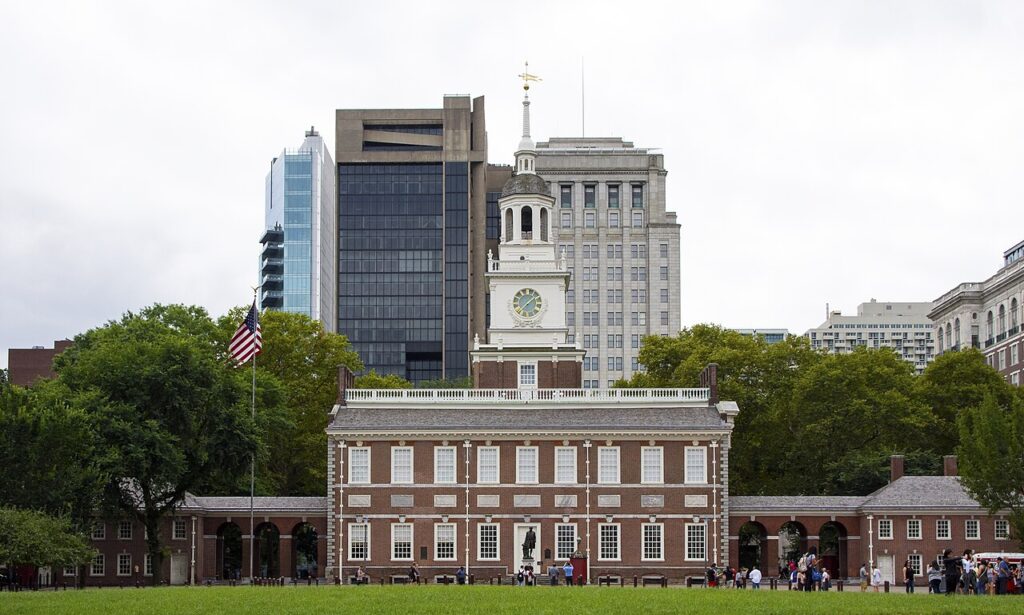
Independence Hall — inscribed by UNESCO in 1979 — is the building in which both the Declaration of Independence (1776 CE) and the United States Constitution (1787 CE) were drafted and adopted, making it the most historically significant building in the United States and one of the most consequential meeting rooms in the history of democratic governance: a Georgian brick building in Philadelphia, Pennsylvania, constructed between 1732 and 1756 CE as the State House of the Province of Pennsylvania, where fifty-six delegates signed the Declaration of Independence on 4 July 1776 CE, where the Articles of Confederation were adopted in 1781 CE, and where fifty-five delegates met for four months in 1787 CE to draft and sign the Constitution of the United States.
The Declaration of Independence, the Constitutional Convention, and the architecture of democracy Independence Hall (South side, Chestnut Street) · Liberty Bell Center (across the street) · Congress Hall (west of Independence Hall, where the first US Congress met 1790–1800) · Old City Hall (east, Philadelphia’s first city government 1791–1800) · Franklin Court (Benjamin Franklin’s home site, one block north) — Old City Historic District, Philadelphia, Pennsylvania
Independence Hall (the building was known simply as the “State House of Pennsylvania” until after the Revolution — the name “Independence Hall” became common usage in the 1820s CE, when the building was recognised as the site of the Declaration) was designed by Andrew Hamilton (the colonial lawyer and architect, not to be confused with Alexander Hamilton) and Edmund Woolley, the master carpenter who oversaw its construction, as the seat of the Pennsylvania Provincial Assembly between 1732 and 1756 CE. The building is a two-storey red-brick structure with a central tower and steeple (the original steeple was removed in 1781 CE due to structural deterioration and replaced with a simpler wooden structure; the current steeple is a reconstruction of 1828 CE designed by William Strickland) in the Georgian architectural style (the dominant British colonial architectural tradition of the 18th century, characterised by symmetry, regular fenestration, classical proportions derived from Italian Renaissance precedents, and restrained brick construction with white-painted stone or wood trim), reflecting the British colonial context in which it was designed and built. The building’s primary interior space — the Assembly Room on the ground floor, where both the Declaration of Independence and the Constitution were signed — measures approximately 19 metres by 14 metres, with a wooden floor, plaster walls, high-backed leather chairs arranged around a raised central platform (where the presiding officer sat during the conventions), and large windows that the delegates frequently complained allowed insufficient ventilation during the hot Philadelphia summer meetings of both 1776 and 1787 CE. The room has been restored to its approximate 1775 CE appearance, with period furniture including the “Rising Sun” chair in which George Washington presided over the Constitutional Convention — a Windsor chair whose carved sun-back Thomas Jefferson noted in his journal as providing the famous comment by Benjamin Franklin at the conclusion of the Constitutional Convention: “I have often looked at that picture behind the President without being able to tell whether it was rising or setting. But now at length I have the happiness to know that it is a rising and not a setting sun.” The Declaration of Independence was drafted primarily by Thomas Jefferson (with significant input from John Adams and Benjamin Franklin, who edited Jefferson’s draft in the Assembly Room), presented to the Continental Congress on 28 June 1776 CE, debated and revised over three days (Congress removed approximately one-quarter of Jefferson’s original text, including a lengthy condemnation of the slave trade that Jefferson had included but which delegates from South Carolina and Georgia — as well as some Northern delegates — insisted be removed), and finally adopted on 4 July 1776 CE, with the formal signing by all fifty-six delegates completed on 2 August 1776 CE. The Constitutional Convention of 1787 CE (held in the same Assembly Room, from 25 May to 17 September 1787 CE, with the proceedings kept strictly secret — the windows were closed and guards posted to prevent eavesdropping, even in the Philadelphia summer heat) produced a document that James Madison (who kept the most complete notes of the proceedings) later described as “the work of many heads and many hands,” establishing the federal framework of the United States government: three branches (legislative, executive, judicial), a bicameral legislature (Senate and House of Representatives), the Electoral College for presidential elections, and a mechanism for constitutional amendment. The Constitution was signed by thirty-nine of the fifty-five delegates on 17 September 1787 CE, with three delegates (Edmund Randolph, George Mason, and Elbridge Gerry) refusing to sign because they opposed the absence of a Bill of Rights — a deficiency corrected by the first ten amendments (the Bill of Rights), ratified in 1791 CE. The site also contains Congress Hall (where the United States Congress met from 1790 to 1800 CE during Philadelphia’s decade as the capital of the United States, and where George Washington was inaugurated for his second term and John Adams was inaugurated as the second President) and Old City Hall (Philadelphia’s first city hall, 1791–1800 CE, where the Supreme Court of the United States held its first sessions). The Liberty Bell (the large bell originally commissioned in 1751 CE for the State House steeple, cast at the Whitechapel Bell Foundry in London, cracked at some point between its 1753 installation and the 1840s CE, exhibited in Independence Hall until 2003 CE and now displayed in the Liberty Bell Center directly across Chestnut Street from Independence Hall) has become the most recognisable symbol of American freedom and the abolition movement, though its connection to the Liberty Bell name derives from the abolitionists who adopted it as a symbol in the 1830s CE — the original bell was simply called the “State House bell” during the 18th century.
Practical information
Independence Hall is located in Independence National Historical Park in Old City, Philadelphia, at Chestnut Street between 5th and 6th Streets. Entry to Independence Hall requires a timed ticket (free but must be booked in advance at recreation.gov, especially March–November when demand is highest). The Liberty Bell Center (directly across Chestnut Street) is free and requires no ticket. By public transport: the Market-Frankford Line (Blue Line) to 5th Street station is the most convenient approach. Nearest Amtrak station: Philadelphia 30th Street Station (approximately 3 km west, served by Amtrak Northeast Corridor and long-distance trains from New York, Washington, and Boston). From Philadelphia airport (PHL): SEPTA Airport Line train to Jefferson Station, then Market-Frankford Line east to 5th Street. Opening hours: Independence Hall open daily 9 AM–5 PM (extended summer hours); last tours generally at 4:30 PM. Guided ranger tours run throughout the day and last approximately 35 minutes. The surrounding Independence National Historical Park (designated “America’s most historic square mile”) contains additional sites within walking distance: Carpenters’ Hall (where the First Continental Congress met in 1774 CE), the National Constitution Center (2 km north, the most comprehensive museum of American constitutional history), Franklin Court (the site of Benjamin Franklin’s house, with a ghost-frame steel structure marking the building’s footprint above an underground museum), and the Betsy Ross House. The visitor center (6th and Market Streets) provides context and distributes timed tickets. Philadelphia in December offers Independence Hall without summer crowds; January–February sees the smallest visitor numbers but the sites are fully operational.
Frequently Asked Questions
What exactly happened in Independence Hall and why is it historically significant?
Independence Hall served as the political crucible in which the United States was created as a nation and as a constitutional republic over a remarkable decade of meetings (1775–1787 CE) in the building’s ground-floor Assembly Room. The significance of the site is not merely symbolic: the specific acts performed in the Assembly Room — the adoption of the Declaration of Independence, the drafting of the Articles of Confederation and Perpetual Union (adopted 1777 CE, ratified 1781 CE — the first attempt at a federal structure, which proved too weak and was replaced by the Constitution), and the drafting and signing of the Constitution of the United States — are the founding documents of American government and the legal basis for the governmental structure of the United States for over 235 years. The Continental Congress met in the Assembly Room from May 1775 CE (immediately after the Battles of Lexington and Concord that opened the Revolutionary War) through the Declaration of Independence in July 1776 CE and the conclusion of the Revolutionary War in 1783 CE, making the room the de facto seat of government of the thirteen colonies-turned-states during the most consequential years of American history. The Constitutional Convention of 1787 CE brought together fifty-five delegates from twelve of the thirteen states (Rhode Island did not attend) including George Washington (who presided in silence, speaking only twice during the four months of deliberations), James Madison (whose meticulous notes are the primary historical record of the debates), Benjamin Franklin (at 81 the oldest delegate, brought to sessions in a sedan chair), Alexander Hamilton, Gouverneur Morris (who drafted the final literary text of the Constitution, including the “We the People” preamble), and Roger Sherman. The Great Compromise (the Connecticut Compromise, July 1787 CE), which resolved the conflict between large and small states by creating a bicameral legislature with proportional representation in the House of Representatives and equal state representation in the Senate, was the decisive agreement that allowed the Convention to continue after it had nearly collapsed in June 1787 CE. The decision by UNESCO to inscribe Independence Hall in 1979 CE specifically cited its role as a “birthplace of the United States” and as a monument to “fundamental rights of citizens, fundamental principles of government” that influenced constitutions worldwide — including the French Constitution of 1791 CE, the constitutions of South American independence movements, and numerous post-colonial constitutions of the 20th century.
What is the Liberty Bell and why did it crack?
The Liberty Bell is a large bell (approximately 943 kg, 1.2 metres tall, 1.2 metres in diameter at the lip) originally commissioned in 1751 CE by the Pennsylvania Provincial Assembly to hang in the steeple of the State House (Independence Hall) to mark the 50th anniversary of William Penn’s 1701 CE Charter of Privileges (Pennsylvania’s original constitution, which granted significant religious freedom to the colony’s inhabitants). The bell was cast at the Whitechapel Bell Foundry in London (the same foundry that cast Big Ben and many of the bells in Westminster Abbey) and bears the inscription “Proclaim LIBERTY Throughout all the Land unto all the Inhabitants thereof” (from Leviticus 25:10, chosen by the Assembly as a reference to the Jubilee year in which debts were forgiven and slaves freed — an ironic choice given the subsequent history of the bell as a symbol of abolition while many of its commissioners were enslavers). The bell cracked on its first ringing in Philadelphia (according to tradition, on the first test ring in 1753 CE — though the actual timing of the crack and whether it cracked on test or in service is disputed by historians), was twice recast by Philadelphia metalworkers John Pass and John Stow (the names “Pass and Stow, 1753” are cast into the bell alongside the Whitechapel foundry’s original inscription), and cracked again at some point in its subsequent history in a catastrophic crack that runs from the lip upward through the bell, permanently silencing it. The Liberty Bell’s transformation from a routine state-house bell to a national and international symbol of freedom happened in the 1830s CE: the Pennsylvania Anti-Slavery Society adopted the bell (which it named the “Liberty Bell” for the first time in 1837 CE in the abolitionist pamphlet “Liberty”) as a symbol of the freedom denied to enslaved people in the United States, reproducing its image and the Leviticus inscription in anti-slavery literature and eventually making the bell internationally recognisable as a symbol of freedom from oppression. The bell was displayed in Independence Hall throughout the 19th and 20th centuries, touring the country in the 1880s–1890s CE on a series of railroad tours that dramatically increased its national fame, and was moved to a pavilion across Chestnut Street in 1976 CE and to the current Liberty Bell Center (designed by Bohlin Cywinski Jackson, opened 2003 CE) directly across from Independence Hall.
How did the Constitutional Convention of 1787 resolve the conflict between large and small states?
The Constitutional Convention of 1787 CE faced its most serious threat of collapse in June 1787 CE when the conflict between large states (Virginia, Pennsylvania, Massachusetts) and small states (New Jersey, Delaware, Maryland) over the structure of the legislature deadlocked the proceedings for weeks: the Virginia Plan (drafted primarily by James Madison and presented by Edmund Randolph on 29 May 1787 CE) proposed a bicameral legislature with both chambers proportioned by population — favouring the large states; the New Jersey Plan (presented by William Paterson on 15 June 1787 CE) proposed retaining the unicameral structure of the Articles of Confederation with equal state representation — favouring the small states. The impasse was resolved by the Great Compromise (the Connecticut Compromise, proposed by Roger Sherman and Oliver Ellsworth of Connecticut and adopted on 16 July 1787 CE by a single-vote margin) which created the bicameral legislature that exists today: the House of Representatives (seats apportioned by population, with representatives elected directly by the people every two years — the “peoples’ chamber”) and the Senate (two senators per state regardless of population, senators originally chosen by state legislatures rather than direct popular election until the 17th Amendment of 1913 CE — the “states’ chamber”). This compromise was not the only major compromise at the Convention: the Three-Fifths Compromise (Article I, Section 2, adopted alongside the Great Compromise) counted enslaved people as three-fifths of a person for purposes of apportioning both House representation and direct taxation — a provision that gave slaveholding states disproportionate political power in the House of Representatives and the Electoral College and directly shaped American politics until the abolition of slavery and the passage of the 13th and 14th Amendments after the Civil War. The Slave Trade Compromise (Article I, Section 9) prohibited Congress from banning the importation of enslaved people until 1808 CE — twenty years after ratification — in exchange for Southern states’ agreement to the Constitution’s stronger federal commercial powers. These compromises — particularly the Three-Fifths Compromise and the slave trade protection — have been described by historians as the “original sin” of the Constitution and the primary structural cause of the political instability that led to the Civil War seventy-four years later.
EXCERPT: Independence Hall Philadelphia (UNESCO 1979) — the birthplace of American democracy: the Georgian State House (1732–1756 CE) where the Declaration of Independence was signed on 4 July 1776 CE and the Constitution of the United States drafted and signed in 1787 CE — the most consequential meeting room in the history of the United States.
META: UNESCO World Heritage Sites near Independence Hall Philadelphia USA: Statue of Liberty New York 150 km northeast, Monticello and University of Virginia Charlottesville 400 km south — Eastern Seaboard American founding sites circuit from Philadelphia to New York Harbour and the Virginia plantation of Thomas Jefferson.
Sources
- S1 — UNESCO World Heritage Centre — Independence Hall (Ref. 78) — https://web.archive.org/web/20230601000000/https://whc.unesco.org/en/list/78/
- S2 — National Park Service — Independence National Historical Park — https://www.nps.gov/inde/
Spotted an error? Write to the editors and we correct it the same day.