
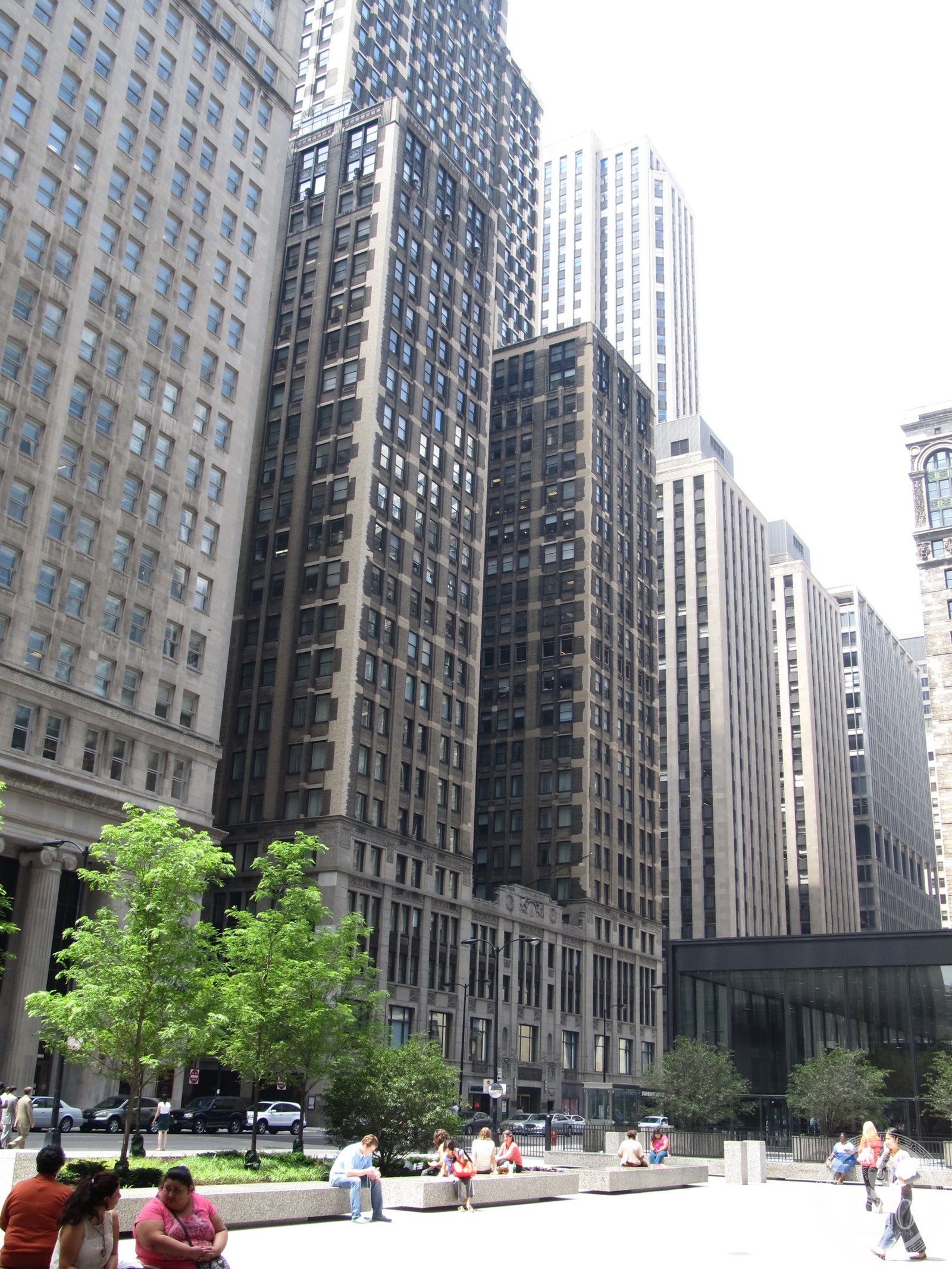
At 45 floors and 535 feet, the Field Building was the last major office skyscraper erected in Chicago before the construction hiatus of the Depression and World War II — a farewell statement from the city that invented the modern office tower.
At a glance
The Field Building stands at 135 South LaSalle Street in Chicago’s financial district, one of the most densely built blocks in the city’s architectural history. Designed by Graham, Anderson, Probst & White and completed in 1934, the 45-story Art Deco tower carries the vocabulary of the late-1920s skyscraper boom into the Depression era with unusual restraint and discipline. Named after Marshall Field, the department store magnate whose wealth shaped Chicago’s commercial culture for decades, the building was designated a Chicago Landmark on February 9, 1994.
Key facts
- Completed: 1934 (construction began 1931)
- Architect: Graham, Anderson, Probst & White
- Height: 45 floors, 535 feet (163 m)
- Address: 135 South LaSalle Street, Chicago
- Style: Art Deco
- Chicago Landmark: February 9, 1994
- Historical note: Last major office building erected in Chicago prior to the World War II construction hiatus
History
The Field Building was commissioned and constructed during the early years of the Great Depression, a period when most speculative office development had halted entirely. Its completion in 1934 at forty-five stories marked the end of a building cycle that had transformed the Chicago skyline over the preceding decade. The same firm — Graham, Anderson, Probst & White — had designed the Civic Opera Building (1929) and the Merchandise Mart (1930) within walking distance; the Field Building closed out their defining run of large-scale Chicago commissions before the construction economy seized.
Named for Marshall Field, whose retail empire had made him one of the wealthiest men in nineteenth-century America, the building occupied a strategic site on South LaSalle Street in the heart of Chicago’s banking district. LaSalle had been the city’s financial spine since the late nineteenth century, and the Field Building added a final exclamation point to a corridor already lined with some of the most significant commercial architecture in the United States.
The building weathered the Depression, the postwar boom, and successive waves of corporate consolidation that reshuffled its office tenants. Its Chicago Landmark designation in 1994 confirmed what architecture critics had recognized for decades: that the Field Building belonged to the short list of Art Deco towers that defined what the American office building looked like at the peak of the form. Restoration work in subsequent decades has maintained its exterior stonework and primary public spaces.
What you see
The Field Building presents a pale stone facade along South LaSalle Street, its massing organized in the stepped setbacks that Chicago’s zoning had encouraged since the 1920s. The lower stories are weighted with heavier stone courses and more pronounced horizontal articulation; the tower shaft above rises with the vertical emphasis typical of Graham Anderson Probst & White’s mature work, the vertical piers drawn upward to the crown. The overall composition is more restrained than the expressionist Art Deco of New York — Chicago’s version of the style tended toward structural clarity over ornamental profusion.
At street level the LaSalle entrance is framed by carved stone and substantial bronze hardware — the scale of a building that expected to be approached on foot from the financial district’s sidewalks. The lobby interior reads as a sequence of carefully proportioned volumes: the transition from the street into the elevator core is handled with the spatial discipline that characterizes the firm’s best work. The upper floors command wide views across the Loop and, on clear days, north toward the lakefront.
Practical information
- Status: Active commercial office building; lobby accessible during business hours
- Exterior: Freely viewable year-round from South LaSalle Street
- Chicago Landmark: Designated February 9, 1994
- Nearest transit: CTA Brown/Orange/Pink/Purple lines at Quincy station (one block south); CTA Blue line at Washington/Dearborn (two blocks east)
- Time needed: 20 minutes for exterior and lobby; pair with nearby LaSalle Street corridor architecture walk
Getting there
The Field Building is located at 135 South LaSalle Street in Chicago’s Loop, one block south of the intersection with Adams Street. O’Hare International Airport (ORD) is 17 miles northwest via CTA Blue Line to Clark/Lake, then one block south. The building is a five-minute walk from the Chicago Architecture Center on the Riverwalk. GPS: 41.8798°N, 87.6316°W.
Nearby
- Rookery Building (1888) — Burnham & Root’s landmark iron-and-glass commercial building, same block
- Marquette Building (1895) — Sullivan-era landmark lobby mosaics, steps north on Dearborn
- Civic Opera Building (1929) — Graham Anderson Probst & White’s earlier Art Deco masterwork, Wacker Drive
- Chicago Board of Trade (1930) — Art Deco financial landmark at the foot of LaSalle Street
Sources
- Wikipedia: Field Building (Chicago)
- City of Chicago, Commission on Chicago Landmarks — Landmark designation, February 9, 1994
- Chicago Architecture Center — South LaSalle Street corridor documentation
- Graham, Anderson, Probst & White — firm commission records and project history
Find it on the map
See this place and what’s around it →Record researched and written by Luigi De Marchi for Cultural Heritage Online, 2026.
📷 Become a Cultural Heritage Online photographer
Share your photos of places: they stay published under your name as the author. The more they're seen, the more you get noticed — and soon a contest will reward the most appreciated photos.
Log in or sign up free to add a photoIs this page about you?
This page is read by travellers and heritage enthusiasts who find it on Google. Tell us how you are connected to this place and we will take it from there.