
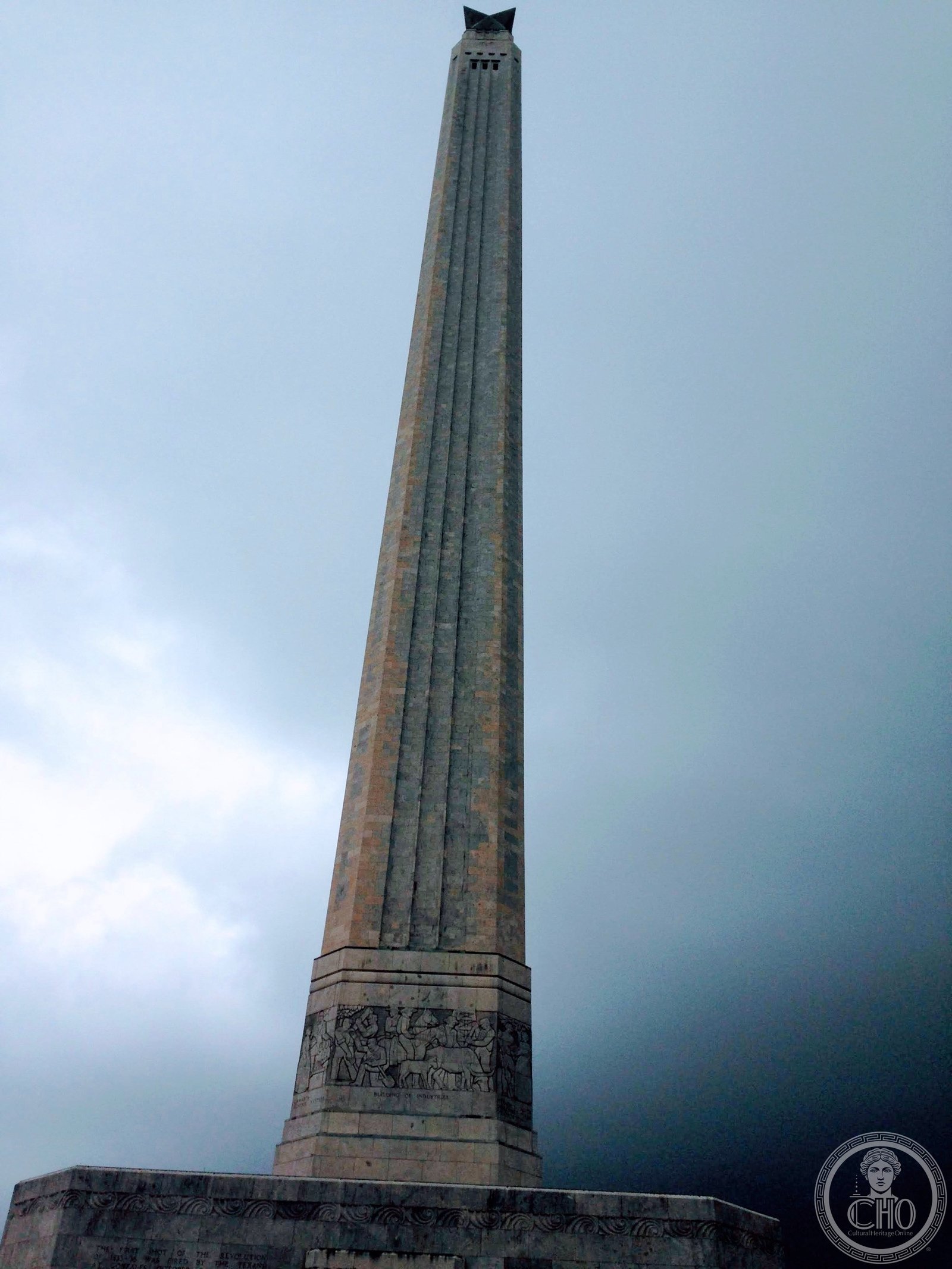
Rising 567 feet from the flat coastal plain east of Houston, the San Jacinto Monument is the tallest battle monument in the world — an Art Deco column capped with a 220-ton star that commemorates the 1836 battle that established Texas as an independent republic.
At a glance
The San Jacinto Monument stands on the battlefield where General Sam Houston’s Texian army defeated the forces of Mexican General Antonio López de Santa Anna on 21 April 1836, in an engagement that lasted approximately eighteen minutes. The monument, completed in 1939, was funded jointly by the state of Texas and the federal government as a centennial commemoration of the battle. Its Art Deco shaft is taller than the Washington Monument in Washington D.C., and the star at its apex — one of the largest in the world — is visible for miles across the flat Galveston Bay coastal plain.
Key facts
- Completed: 1939
- Height: 567 feet (173 m) — taller than the Washington Monument
- Style: Art Deco obelisk with octagonal shaft
- Design: Texas Centennial Commission (architect attributed to William C. Hedrick)
- Star weight: Approximately 220 tons of reinforced concrete
- Designation: National Historic Landmark; State of Texas Historic Site
- Setting: San Jacinto Battleground State Historic Site, Harris County, Texas
History
The Battle of San Jacinto, fought on 21 April 1836, ended the Texas Revolution. Sam Houston’s force of roughly 900 men surprised Santa Anna’s army of similar size at their encampment near the confluence of the San Jacinto River and Buffalo Bayou, achieving complete surprise during the Mexican midday rest. The battle lasted fewer than twenty minutes; Texas independence was secured the following day when Santa Anna, captured while attempting to escape in civilian clothing, signed the Treaties of Velasco. Texas became an independent republic and, nine years later, the 28th state of the Union.
Planning for a permanent monument on the battlefield began in the late 1920s, and a centennial commission was established by the Texas legislature to coordinate a suitable commemoration. The monument was designed in an Art Deco idiom, attributed to architect William C. Hedrick, — an octagonal concrete shaft faced in Texas limestone, tapering slightly as it rises, and crowned with the distinctive 34-pointed star. Construction began in 1936 and the monument was dedicated on 21 April 1939, the 103rd anniversary of the battle. A museum and research centre occupy the base, with a café and observation deck accessible by elevator inside the shaft.
The USS Texas — one of the few surviving World War I-era battleships — was moored adjacent to the monument for decades as a museum ship and is currently undergoing restoration.
What you see
The monument’s shaft is octagonal in plan, faced throughout in Texas Cordova limestone — a cream-coloured material whose warmth is perceptible even at a distance. The shaft tapers almost imperceptibly from base to crown, a classical proportion executed in Art Deco vocabulary. Carved bas-relief panels at the base depict scenes from Texas history; the shallow, linear style of the carving is characteristic of the Moderne aesthetic that governed American public sculpture in the 1930s. The star at the apex is a 34-pointed form, finished in a style somewhere between astronomical diagram and heraldic badge.
The scale only becomes comprehensible at ground level, where the shaft rises vertically and the star disappears from view against the sky. The surrounding Battleground State Historic Site is flat and open, planted with live oaks, which keeps the monument visible from great distances across the bay and the Ship Channel. On clear days it is visible from downtown Houston, approximately 22 miles to the northwest.
Practical information
- Grounds: San Jacinto Battleground State Historic Site — open daily; free admission to grounds
- Museum: Museum of History at the base of the monument — nominal admission fee
- Observation deck: Elevator to near the top of the shaft — check current opening status
- USS Texas: Currently under restoration; verify access before visiting
- Time needed: Allow 1.5–2 hours for grounds, museum, and observation deck
- Parking: Free on-site parking
Getting there
The San Jacinto Monument is located in La Porte, Harris County, approximately 22 miles east of downtown Houston. From Houston, take State Highway 225 east toward La Porte, then State Highway 134 north to the Battleground Road entrance. There is no convenient public transit to the site; a car is the practical means of access. The Houston Ship Channel is visible from the grounds, and the monument is sometimes included in Houston industrial tours that explore the broader Bayport-Ship Channel industrial corridor.
Nearby
- Houston Ship Channel — one of the busiest commercial waterways in the United States, immediately adjacent to the Battleground site; Port of Houston Authority offers public boat tours
- Battleship Texas State Historic Site — the last surviving American dreadnought battleship from World War I, undergoing major hull restoration; currently not accessible to visitors
- Space Center Houston — NASA’s official visitor centre, approximately 15 miles south; the original Mission Control for Apollo and Shuttle missions is nearby
Sources
- Texas Historical Commission — San Jacinto Monument and Battleground designation records
- San Jacinto Museum of History — monument construction and battle history
- National Park Service, National Historic Landmarks Programme — San Jacinto Battleground designation file
- Wikipedia: San Jacinto Monument — engineering data, architect attribution, and historical sources
Find it on the map
See this place and what’s around it →Record researched and written by Luigi De Marchi for Cultural Heritage Online, 2026.
📷 Become a Cultural Heritage Online photographer
Share your photos of places: they stay published under your name as the author. The more they're seen, the more you get noticed — and soon a contest will reward the most appreciated photos.
Log in or sign up free to add a photoIs this page about you?
This page is read by travellers and heritage enthusiasts who find it on Google. Tell us how you are connected to this place and we will take it from there.