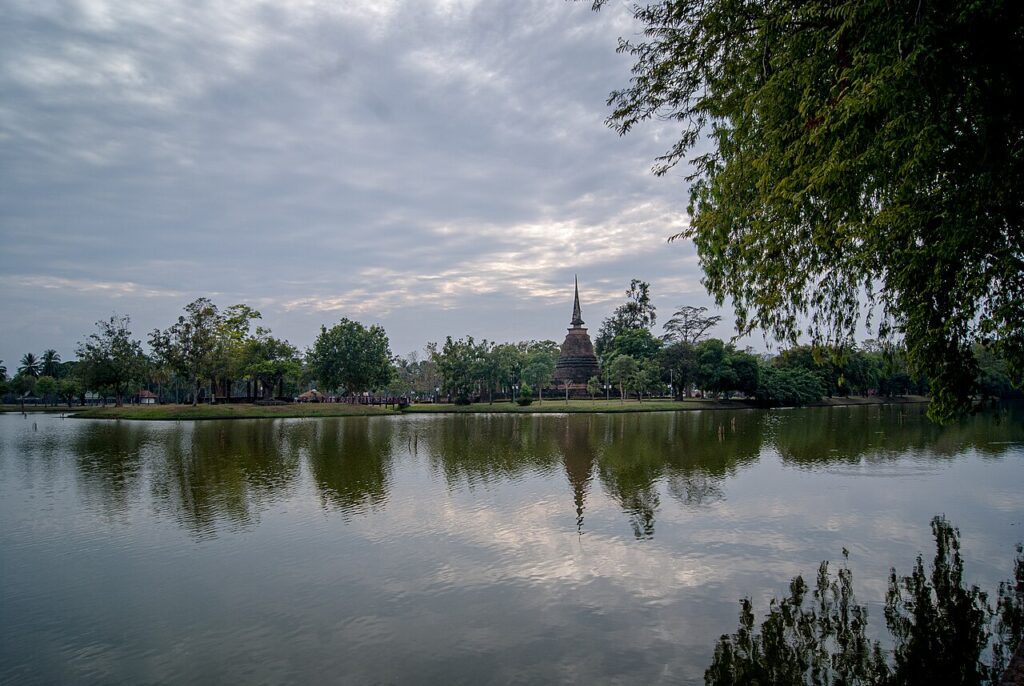
The Historic Town of Sukhothai (สุโขทัย, “Dawn of Happiness” in Thai — from Sanskrit “sukha” meaning happiness and “udaya” meaning dawn), inscribed by UNESCO in 1991 alongside its associated historic towns of Si Satchanalai and Kamphaeng Phet (which form a serial UNESCO site known as the “Historic Town of Sukhothai and Associated Historic Towns”), was the first capital of the Sukhothai kingdom (approximately 1238–1438 CE) — the first major Siamese/Thai political entity to establish an independent kingdom in the upper Chao Phraya river basin after the decline of the Khmer Empire’s provincial administration in the region. The Sukhothai Historical Park (the archaeological park on the site of the original city, approximately 12 km from the modern town of Sukhothai) covers approximately 70 km² of city ruins including an inner walled city area (approximately 1.8 km × 1.5 km, enclosed by three concentric earthen ramparts and the Khlong Mae Lamphan moat channel) and an outer zone extending approximately 10 km in all directions, containing approximately 190 individual heritage monuments (temples, palaces, ponds, and city infrastructure) in various states of preservation. The most significant monument is the Wat Mahathat (“Temple of the Great Relic”) — the royal chapel at the centre of the inner city, the largest and most architecturally significant temple in Sukhothai, which exemplifies the specifically Sukhothai architectural style in its combination of Sri Lankan-influenced chedi tower forms (the “lotus-bud chedi”, a characteristic tower form in which the tower crown is shaped like an unopened lotus bud rather than the bell-shaped Burmese chedi or the tapering spire of the Khmer tower) with a Khmer prang tower form at the temple complex’s centre — a visual expression of the Sukhothai kingdom’s cultural position between the Khmer tradition (which had previously dominated the region) and the new Theravada Buddhist tradition arriving from Sri Lanka.
Sukhothai’s UNESCO heritage complex and the Thailand heritage corridor Wat Mahathat · Wat Si Chum · Si Satchanalai · Kamphaeng Phet · Ayutthaya — 0 to 400 km
The Sukhothai Historical Park’s heritage significance rests on the combination of architectural remains and the historical importance of the Sukhothai period as the foundational moment of Thai cultural identity: the Sukhothai period (particularly the reign of King Ramkhamhaeng, approximately 1279–1298 CE) is traditionally credited with the creation of the Thai script (the “Ram Khamhaeng inscription” of approximately 1292 CE, carved in a four-faced stone pillar and now displayed in the Bangkok National Museum, is the oldest known text in the Thai script and one of the most important documents in Thai cultural history — though its authenticity has been debated), the establishment of Theravada Buddhism as the state religion of the Siamese kingdoms (in the specific form of the Sinhalese Theravada tradition brought from Sri Lanka via Burma — the “forest tradition” of the Lankan Mahavihara monastic order, whose emphasis on scriptural study, vinaya discipline, and meditation retreat was adopted by the Sukhothai kingdom as the spiritual foundation of royal legitimacy), and the development of the distinctive Thai artistic tradition (the Sukhothai Buddha image style — with its specific iconographic features of a perfectly oval face, the “walking Buddha” posture with one leg raised in a step, and the elaborate flame ushnisha at the head — represents the high point of Thai Buddhist sculpture and influenced Thai Buddhist art for the next 500 years). The three associated historic towns of the serial inscription — Sukhothai (the primary capital), Si Satchanalai (approximately 55 km north of Sukhothai — a secondary capital and major ceramic production centre, with the Sawankhalok kilns that produced the famous Sawankhalok celadon pottery exported across Southeast Asia), and Kamphaeng Phet (approximately 75 km south of Sukhothai — a frontier defensive city with the Wat Phra Kaeo temple complex and extensive laterite city walls) — together represent the full extent of the Sukhothai kingdom’s urban planning and architectural programme across three distinct city types (royal capital, secondary city, and military frontier fortress).
Practical information
Sukhothai Historical Park is approximately 12 km from Sukhothai town (regular songthaew shared pickups from Sukhothai bus terminal). Sukhothai has a domestic airport (Sukhothai Airport, THS, approximately 30 km from the old city, with flights from Bangkok Don Mueang) and bus connections from Bangkok (approximately 7 hours), Chiang Mai (approximately 5 hours), and Phitsanulok (approximately 1 hour). The Historical Park is open daily 06:30–21:00; zone fees apply (different zones have separate entry fees). Bicycle hire is the standard way to visit the inner zone and the outer zone temples. The park is illuminated on Friday, Saturday, and Sunday evenings (19:00–21:00) for evening visits. The Sukhothai Candle Festival (mid-July, the start of the Buddhist Lent/Khao Phansa period) and the Loy Krathong festival (November full moon, when the Sukhothai moat is filled with floating lotus-cup candles in the traditional Thai celebration of the water spirit — the Sukhothai celebration is the oldest and most historically significant of all Thai Loy Krathong celebrations, traditionally held here since the Sukhothai period) are the major festival events. Si Satchanalai (55 km north by road, approximately 1 hour) and Kamphaeng Phet (75 km south by road, approximately 1.5 hours) are best visited as separate day excursions from Sukhothai. Best visiting months: November–April (dry season; the November Loy Krathong festival period is spectacular at Sukhothai, with advance booking essential).
Frequently Asked Questions
What is the significance of the Sukhothai period for Thai history and culture?
The Sukhothai period (approximately 1238–1438 CE, the 200 years from the establishment of the independent Sukhothai kingdom to its absorption into the Ayutthaya kingdom) holds a specific and somewhat contested place in Thai national identity as the “foundational period” of Thai civilisation — a foundational narrative that was significantly elaborated and given its current form in the 19th and early 20th century by the Thai royal historiographical tradition (particularly under Kings Mongkut/Rama IV and Chulalongkorn/Rama V, who were engaged in modernising Thailand in the context of European colonial expansion and who emphasised the antiquity and continuity of the Thai state as a counter-narrative to colonial-era claims of civilisational hierarchy). The specific events or achievements of the Sukhothai period that are attributed foundational significance in the Thai national narrative are: (1) the Ram Khamhaeng inscription (approximately 1292 CE) — a carved stone pillar inscription attributed to King Ram Khamhaeng describing the prosperity and justice of the Sukhothai kingdom (“In the water, there are fish; in the fields, there is rice. The ruler does not levy a tax on goods transported along roads…”), which if genuine represents the earliest documentation of the Thai script and the earliest example of Thai historical prose; its authenticity has been debated since Prince Damrong Rajanubhab proposed in 1909 that it might be a later forgery, and the debate remains technically open (though most scholars currently accept its 13th-century authenticity); (2) the Sukhothai Buddha image tradition — the development of the “walking Buddha” and the “Sukhothai face” type (with its elongated oval physiognomy, the flame ushnisha, the elongated fingers with the Gandhari/Hellenistic influence visible in the drapery of the monastic robe) represents the most significant original artistic contribution of the Thai tradition to Buddhist iconography, distinct from the Cambodian and Burmese traditions that preceded it; (3) the adoption of Sinhalese Theravada Buddhism — the establishment of the Sinhala (Sri Lankan) forest tradition of Theravada Buddhism as the state religion of the Sukhothai kingdom (in the reign of King Lithai/Maha Dharmaraja I, who also wrote the “Traiphum Phra Ruang” — the Three Worlds according to King Ruang, a cosmological text describing the structure of the Buddhist universe that is the oldest surviving extended Thai-language literary text) established the Theravada Buddhist monastic tradition that remains the foundation of Thai religious life to the present.
What is the “walking Buddha” statue type and why was it developed at Sukhothai?
The “walking Buddha” (พระพุทธรูปปางลีลา, Thai: “Phra Phuttha Rup Pang Lila” — “the image of the walking Buddha in graceful posture”) is a specific sculptural type created at Sukhothai in the 14th century CE that has no close precedent in earlier Buddhist sculptural traditions in India, China, Burma, or Cambodia — a genuinely original Thai contribution to Buddhist iconography. The standing and seated Buddha image types (derived from the Indian sculptural tradition of the Mathura and Gandhara schools of the 1st–3rd century CE) show the Buddha in static, symmetrical poses (seated in meditation, standing with hand gestures in mudra) that are the canonical image types across all Buddhist traditions. The Sukhothai walking Buddha breaks this symmetry by showing the Buddha in mid-stride — one leg raised with the weight on the rear foot, the body slightly inclined forward, the arms in movement (one hand raised in the abhaya gesture of protection, the other arm swinging in natural walking position) — a posture that no earlier Buddhist sculptural tradition had used as a primary canonical image type. The iconographic text that records the walking Buddha posture is the “Jinakalamalin” chronicle (a Thai Pali text of approximately 1516 CE that describes the Buddha walking in the forests of India during his teaching mission) and the Pali Jataka tale texts that depict the Buddha in active movement. The Sukhothai sculptors’ solution to the artistic challenge of representing movement in stone sculpture is specifically Thai: rather than depicting the walking posture through multiple figures or sequential scenes (as Indian temple sculpture depicted movement through narrative panels), the Sukhothai bronze-casters developed a single isolated figure that captures the dynamic of walking in a single image through specific formal choices — the elongated oval head (reducing the visual weight of the head, creating upward movement), the elongated fingers and hands (emphasising the gestural trajectory of the raised arm), the transparent monastic robe (allowing the body’s contrapposto to be visible through the draped fabric), and the flame ushnisha (the traditional sign of the Buddha’s supernatural wisdom, here enlarged and stylised into a long decorating upward flame form that reinforces the upward movement of the composition). The Sukhothai walking Buddha image in its mature form (the finest examples are the large bronze walking Buddhas in the Sukhothai National Museum in Sukhothai town and in the Bangkok National Museum) is universally recognised as one of the great achievements of world sculpture — not primarily for its technical virtuosity (though the bronze casting technique was remarkable) but for the way it achieves the illusion of graceful movement in static metal through compositional means that are specific to the Thai aesthetic tradition.
EXCERPT: Historic Town of Sukhothai, UNESCO-inscribed 1991 (serial site with Si Satchanalai and Kamphaeng Phet), was the 13th–15th century first Thai capital — Wat Mahathat’s lotus-bud chedis, the earliest known Thai-script inscription (Ram Khamhaeng, c.1292 CE), the “walking Buddha” sculptural type invented here, and the November Loy Krathong festival in the moats since the Sukhothai period.
META: UNESCO World Heritage Sites near Historic Town of Sukhothai Thailand: Historic City of Ayutthaya 390 km south (UNESCO 1991), Ban Chiang Archaeological Site 300 km northeast (UNESCO 1992), Thungyai-Huai Kha Khaeng Wildlife Sanctuaries 150 km southwest (UNESCO 1991) — Sukhothai Historical Park walking Buddha Thai script Ram Khamhaeng inscription, Sawankhalok celadon pottery Si Satchanalai, Loy Krathong.
Sources
- S1 — UNESCO World Heritage Centre — Historic Town of Sukhothai and Associated Historic Towns (Ref. 574) — https://web.archive.org/web/20230601000000/https://whc.unesco.org/en/list/574/
- S2 — UNESCO World Heritage Centre — Statement of Outstanding Universal Value (Ref. 574) — https://whc.unesco.org/en/list/574/
Spotted an error? Write to the editors and we correct it the same day.