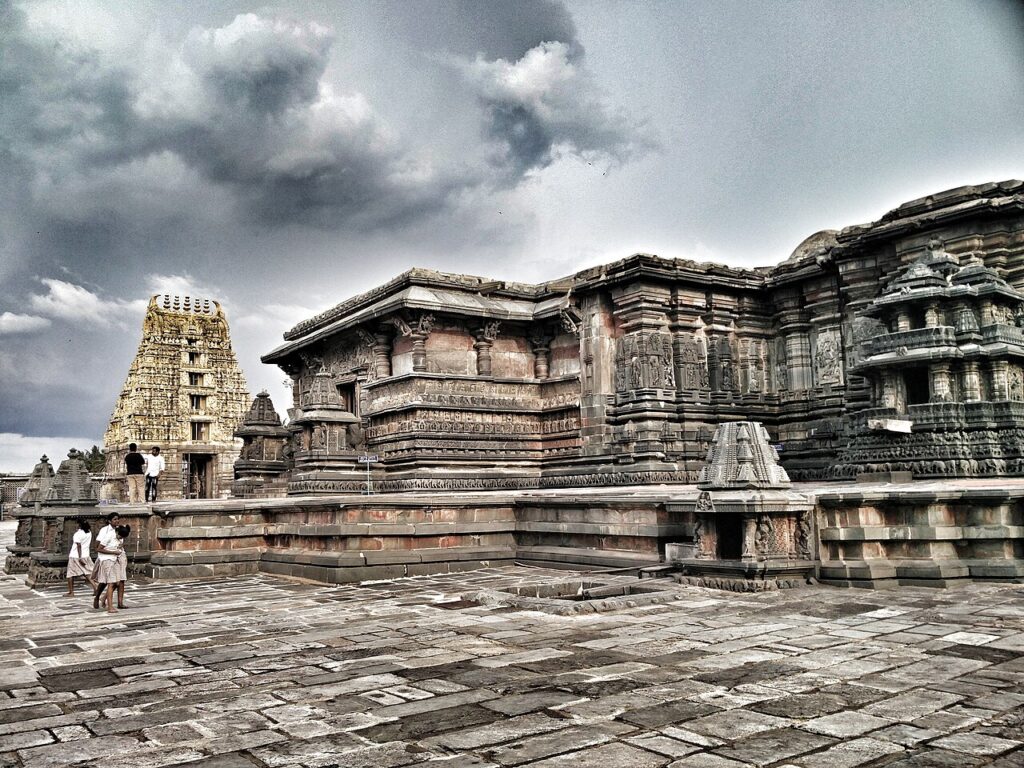
The Hoysala Sacred Ensembles, inscribed by UNESCO in 2023 (one of India’s most recent UNESCO inscriptions), comprises three outstanding temples of the Hoysala dynasty (a Karnataka-based Hindu dynasty that ruled the Deccan plateau from approximately 1050 to 1346 CE) — the Chennakeshava Temple at Belur (1117 CE, the earliest and largest of the three), the Hoysaleshwara and Shanthaleshwara temples at Halebidu (approximately 1121–1160 CE, the twin-temple complex at the Hoysala dynasty capital), and the Keshava Temple at Somanathapur (1268 CE, the last and most perfectly proportioned of the three, the only one with all three shrines intact to their full tower height) — forming a serial UNESCO site that represents the complete arc of Hoysala temple architecture from its origins in the early 12th century to its culmination in the late 13th century. The Hoysala temples are among the most elaborately decorated buildings in the history of world architecture: every exterior surface — the walls, the towers, the projecting balcony rails, the tower courses — is covered with horizontal bands of carved sculpture in a continuous programme of religious iconography and decorative pattern that has no parallel in density or variety in any comparable tradition. The Belur Chennakeshava Temple alone is estimated to carry approximately 700 individual larger sculptural panels plus uncountable smaller decorative motifs — a total carving area of approximately 8,000–10,000 m² on the exterior of a single temple building, representing an estimated total carving labour of approximately 100+ years of skilled craftsmen’s work over the 103 years that the temple took to complete.
The three Hoysala temples and the Karnataka heritage corridor Belur · Halebidu · Somanathapur · Hassan · Mysuru · Shravanabelagola — 0 to 145 km
The three Hoysala temples are architecturally unified by their distinctive features: the star-shaped (stellate) plan of each temple’s basement — instead of a square or octagonal foundation plan (the standard for most Indian temple traditions), the Hoysala temples are built on a star-shaped foundation plan where the corners of a square plan are successively chamfered to produce a 16-pointed or 24-pointed star plan, and all the horizontal courses of the superstructure follow the same stellate profile, creating the densely articulated three-dimensional surface that characterises the Hoysala style. The specific technical achievement that allows the extraordinary density of Hoysala carving is the material: the temples are built in chloritic schist (a green-grey micaceous stone locally called “soapstone” — though technically distinct from true soapstone, the chloritic schist of the Karnataka region has a similar softness and workability when freshly quarried, hardening significantly on exposure to air, allowing carvers to work with metal-tipped tools at a speed and detail impossible in harder granites or sandstones, and hardening to a weather-resistant surface after decades of exposure). The iconographic programme of the three temples covers the complete Hindu divine hierarchy: the Chennakeshava Temple at Belur features 42 large “Shalabanjikas” (bracket figures — elegant female figures in dynamic tribhanga poses, each carrying specific attributes identifying her as a specific divine or semi-divine being, positioned at each corner of each projecting balcony of the temple’s outer wall and inner porch); the Hoysaleshwara Temple at Halebidu features continuous horizontal bands of carved elephants (approximately 2,000 individual elephant sculptures at the base, representing the earth), horses (cavalry scenes), scrolling vegetal patterns, geese (hamsa), mythological composite animals (makara, vyala), episodes from the epics (Ramayana and Mahabharata), individual divine images (Shiva, Vishnu, Brahma, the 10 avatars of Vishnu, the 8 directional deities), and apsaras in the upper courses — in a total of approximately 6 horizontal decorative bands covering the entire outer wall circuit of the temple at equal heights. The Keshava Temple at Somanathapur (1268 CE, built by Somanatha Dandanayaka, a general of the Hoysala king Narasimha III) is the most compact and proportionally balanced of the three — a trikuta temple (three shrines connected by a common vestibule) in which all three towers rise to their complete height (unlike Belur where the tower was never completed, and Halebidu where the tower is also incomplete), allowing a full appreciation of the Hoysala temple silhouette that the other two sites cannot provide.
Shravanabelagola (approximately 80 km south of Halebidu — the Jain pilgrimage site with the 57 m Gommateshwara monolithic granite statue of 981 CE, the tallest ancient monolithic statue in the world and the principal Digambara Jain pilgrimage destination in Karnataka) and Mysuru (approximately 145 km south of Halebidu — the former Mysore kingdom capital with the Mysore Palace, the Chamundeshwari Temple on Chamundi Hill, and the Devaraja Market) are the most significant heritage centres within day-trip range of the Hoysala temple circuit. Hassan (approximately 60 km from both Belur and Halebidu, the district headquarters and transport hub, with regular bus services to both temples) is the standard base.
Practical information
The three Hoysala temple sites are in the Hassan district of Karnataka, with Hassan city as the transport hub. Belur (39 km from Hassan) and Halebidu (32 km from Hassan, 16 km from Belur) are most efficiently visited together on a single day from Hassan — the two sites are connected by a direct road (approximately 30 minutes). Somanathapur (approximately 145 km from Hassan, near Mysuru) is best visited from Mysuru (approximately 40 km, 1 hour). Hassan has a railway station on the Mangalore–Bengaluru line, with trains from Bengaluru (approximately 3.5 hours) and Mysuru (approximately 2 hours). The nearest major airport is Mysuru Airport (MYQ, approximately 135 km from Halebidu; flights to Bengaluru and Chennai) or Mangaluru International Airport (IXE, approximately 160 km from Halebidu). The temples are managed by the Archaeological Survey of India. All three are open daily 06:00–18:00. Admission fees apply (foreign visitor rate). Temple dress code: no shorts, shoulders covered (traditional requirement for Hindu temple entry). The temples are still active places of worship — the Chennakeshava Temple at Belur in particular receives substantial Hindu pilgrimage, and major pujas (ritual worship services) are conducted daily and during festival periods (particularly the Vishnu-related festivals of Ekadashi and Karthika). Best visiting months: October–March (temperatures 20–30°C; April–May can reach 38°C). The UNESCO inscription in 2023 has significantly increased international visitor numbers; early-morning visits (06:00–09:00) provide the best light for photography and smaller crowds.
Frequently Asked Questions
What makes the Hoysala temple carving style unique in Indian architecture?
The Hoysala temple style occupies a specific and unique position in the history of Indian architecture at the intersection of two major regional traditions — the Northern (Nagara) temple style (characterised by the curvilinear “shikhara” tower profile, the use of horizontal sandstone coursed masonry, and the integration of sculpture in defined niches) and the Southern (Dravida) temple style (characterised by the tiered “vimana” tower profile, the use of granite and laterite, and the separation of the tower from the mandapa entrance hall) — producing a synthesis that shares some characteristics with both but is distinctively Karnatakan in its specific combination: the stellate plan, the chloritic schist material, the extreme horizontal density of the sculptural programme, and the specific iconographic emphasis on “Shala-bhanjika” bracket figures (the female bracket figures that are the Hoysala sculptors’ highest technical achievement and the most immediately distinctive visual element of the Hoysala style for the first-time visitor). The technical distinctiveness of the Hoysala carving tradition rests on three specific features: (1) the chloritic schist material (see above — soft when quarried, hardening on exposure, allowing detail impossible in other stones); (2) the “lathe-turned” decorative columns (the Hoysala temples use cylindrical columns with continuous horizontal mouldings and intermediate bosses that were produced by a rotating technique equivalent to metal-turning, using the stone’s specific softness to produce the smooth curved surfaces that characterise the interior column profiles — a production technique documented in the ASI excavation reports but whose specific mechanism remains debated); and (3) the specific iconometric canon used by the Hoysala sculptors (the proportional system for representing the human body in the bracket figures, which differs from the Mathura and Amaravati canons used in the older North and South Indian traditions and produces the specific Hoysala figure type — elongated, multiple-armed, in dynamic tribhanga three-point flexion, with extremely elaborate ornamentation that includes multiple necklaces, anklets, belt, armlets, and headdress carved simultaneously with the figure). The density of carving on the Hoysala temples — the characteristic that most immediately strikes the visitor — is not a random accumulation but a strictly organised horizontal band programme: at Halebidu, the Hoysaleshwara Temple’s outer wall carries (from bottom to top) approximately 7 cm high base moulding, then 2.5 m band of elephants, then a band of horses, then a band of scrolling vegetal motifs, then a band of geese, then a band of makaras (mythological sea-serpents), then the band of deity sculptures, then a band of miniature tower forms at the top — each band at a specific height so that the full programme reads as a text from the base of the temple to the top of the wall, beginning with the earth (elephants, symbolising stability and the earth element) and ascending through the intermediate realm (horses, nature) and the divine realm (the deity sculptures) to the celestial (the tower forms that represent Mount Meru). The programme is visible in its complete sequence on the exterior walls of the Halebidu twin temple, where the total wall circuit is long enough (approximately 180 m per temple exterior) to appreciate the repetition and variation of each horizontal band around the full perimeter.
Who were the Hoysala kings and why did they build such elaborate temples?
The Hoysala dynasty (approximately 1050–1346 CE) were a Kannada-speaking warrior clan from the Malnad (the wet hilly region of the Western Ghats in Karnataka) who initially served as vassals of the Western Ganga dynasty and later established independent rule over the Deccan plateau after the decline of the Rashtrakuta and Western Chalukya empires. The three temple-builders were: King Vishnuvardhana (ruled approximately 1110–1141 CE), who built the Belur Chennakeshava Temple as a commemoration of his conversion from Jainism to Vaishnavism (under the influence of the Vaishnava saint-theologian Ramanuja, who had taken refuge in the Hoysala kingdom after fleeing the Shaivite persecution in the Chola kingdom of Tamil Nadu — Ramanuja’s presence at the Hoysala court was a major factor in the conversion of the Hoysala ruling class from Jain to Vaishnava patronage, and the Belur temple was specifically built as a statement of this religious-political alliance); King Veera Ballala II (ruled approximately 1173–1220 CE), under whose reign the Halebidu complex reached its current scale; and Somanatha Dandanayaka (a general of King Narasimha III), who built the Somanathapur Keshava Temple in 1268 CE — approximately 150 years after Belur, demonstrating the sustained tradition of Hoysala temple patronage over five generations of rulers. The motivation for the extraordinary investment in temple building and sculptural programmes reflects the specific political context of the Hoysala kingdom: the Hoysala kings were competing for legitimacy with multiple neighbouring dynasties (the Chola kingdom in Tamil Nadu, the Western Chalukya kingdom in north Karnataka, and the Yadava kingdom in Maharashtra), and the construction of large, elaborately decorated temples served both as an expression of royal piety (which legitimised political authority in the Hindu theological framework, where a righteous king is seen as the protector of dharma, and the construction of temples is a primary expression of royal dharma) and as a display of economic and technological capacity (the ability to mobilise hundreds of skilled craftsmen for decades on a single building project is itself a demonstration of state power that rivals and subordinate chiefs were intended to recognise). The Hoysala dynasty ended abruptly in 1346 CE with the Bahmani Sultanate’s conquest of the Deccan — the last Hoysala ruler Veera Ballala IV was killed in battle at Tiruvannaamalai in Tamil Nadu, and the kingdom was absorbed into the new Vijayanagara Empire (which itself maintained the temple-building tradition through its own architectural patronage at Hampi, UNESCO 1986). The three temples built in the Hoysala period survived the subsequent Bahmani, Vijayanagara, and British colonial periods in good preservation — primarily because the specific location of Belur, Halebidu, and Somanathapur (inland Karnataka, away from the main invasion routes and port cities that bore the brunt of successive conquest periods) protected them from the iconoclasm and deliberate destruction that affected many Indian temple complexes in the 14th–16th centuries.
EXCERPT: Hoysala Sacred Ensembles, UNESCO-inscribed in 2023, comprises three Karnataka temples from the 12th–13th century CE — the Belur Chennakeshava Temple (700 sculptures, 103 years to build), Halebidu’s twin temple (2,000 carved elephants at the base), and Somanathapur’s Keshava Temple — carved in chloritic schist so soft when quarried that carvers achieved density impossible in other stones.
META: UNESCO World Heritage Sites near Hoysala Sacred Ensembles Karnataka India: Group of Monuments at Hampi 250 km east (UNESCO 1986), Pattadakal 300 km north (UNESCO 1987) — Hoysala temple architecture Belur Halebidu Somanathapur Hassan, Karnataka stellate temple plan chloritic schist carving, Shravanabelagola Gommateshwara Jain monolith.
Sources
- S1 — UNESCO World Heritage Centre — Sacred Ensembles of the Hoysalas (Ref. 1670) — https://web.archive.org/web/20230601000000/https://whc.unesco.org/en/list/1670/
- S2 — UNESCO World Heritage Centre — Statement of Outstanding Universal Value (Ref. 1670) — https://whc.unesco.org/en/list/1670/
Spotted an error? Write to the editors and we correct it the same day.