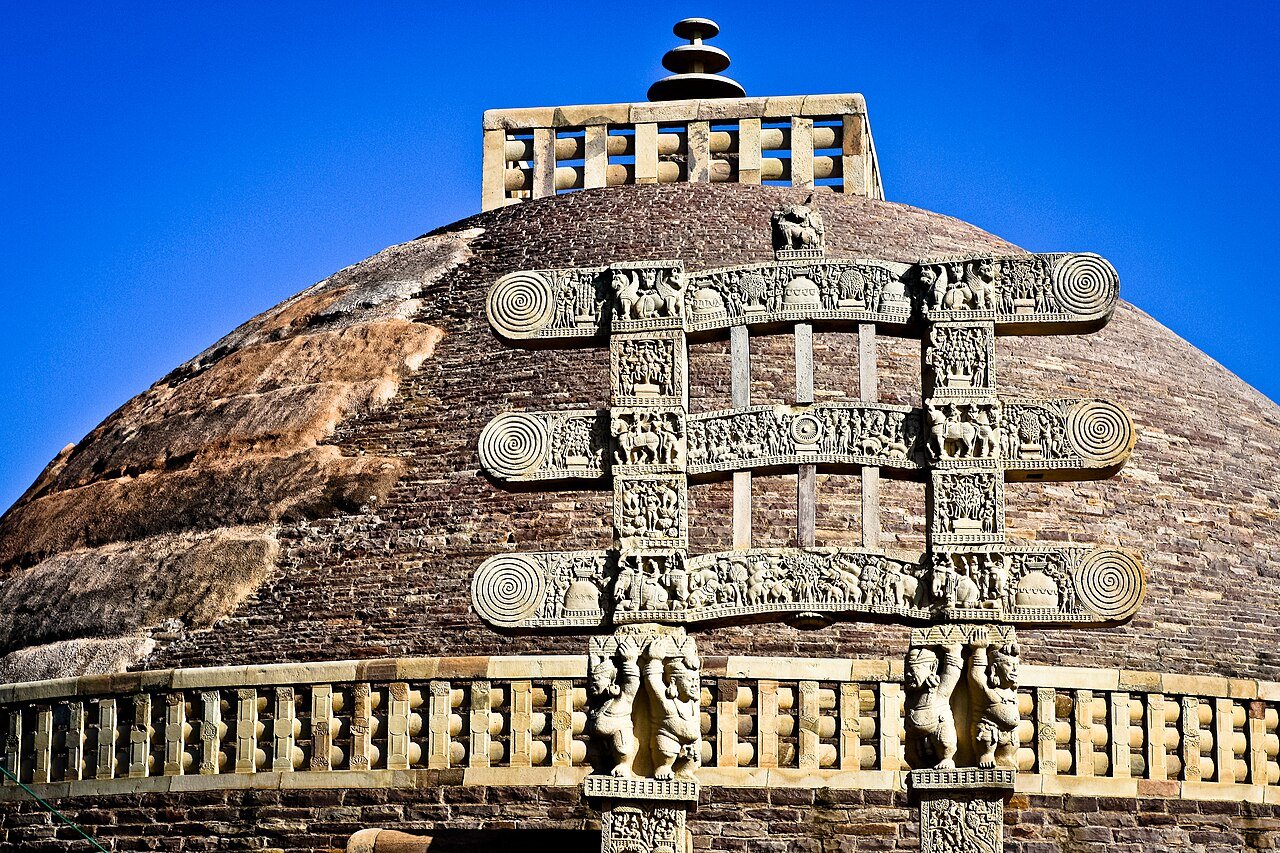
Buddhist Monuments at Sanchi (साँची के बौद्ध स्मारक), inscribed by UNESCO in 1989, is a complex of Buddhist monuments on a hill at Sanchi, 46 km northeast of Bhopal, Madhya Pradesh, India — the most important and best-preserved site of early Buddhist architecture and sculpture in India, spanning from the 3rd century BCE (when Emperor Ashoka of the Maurya dynasty built the original Great Stupa on the hill) to the 12th century CE (when Buddhist practice at Sanchi was finally discontinued), and encompassing monuments from every principal phase of Buddhist architectural development in India. The Sanchi inscription comprises the Great Stupa (Stupa No. 1, the defining monument — the original mud-brick stupa enlarged in stone in the Shunga period, approximately 2nd–1st century BCE, and further enlarged and elaborated in the early centuries CE, reaching its current form of a hemispheral dome approximately 36 m in diameter and 16 m in height above the ambulatory platform, with four elaborately carved stone torana — gateway towers — each approximately 10 m in height, commissioned approximately 25 BCE–25 CE), two smaller stupas (Stupa 2 and Stupa 3, each with carved toranas), several temples, monastery ruins, and an Ashokan pillar of the 3rd century BCE (the capital of which, carved with four addorsed lions back-to-back, is the prototype for the Ashoka Pillar capital that was adopted as the official emblem of the Republic of India in 1950 CE and appears on all Indian currency notes and official documents).
The Great Stupa and the Buddhist heritage landscape of Madhya Pradesh Great Stupa (Stupa 1) · Stupa 2 and 3 · Ashoka Pillar · Mahabodhi Temple Bodh Gaya — 0 to 500 km
The Great Stupa (Stupa 1) is the defining monument of the Sanchi complex — its current form, the result of enlargement and embellishment over approximately 500 years (the original Ashokan stupa of the 3rd century BCE was a small solid dome of mud-brick; the Shunga-period enlargement of approximately 150–100 BCE covered it in stone and added the balustrade and the raised ambulatory path; the Satavahana-period additions of approximately 25 BCE–25 CE added the four toranas and further elaborated the railings), is the most studied monument of early Buddhist architecture in India. The four torana (carved stone gateways, each approximately 10 m in height, located at the four cardinal points of the stupa’s balustrade — north, south, east, and west) are the sculptural masterworks of the Sanchi site: each gateway is composed of two square posts connected by three horizontally curved crossbars (the characteristic lotus form of the curved architraves, derived from timber construction prototypes), with every surface covered in narrative relief sculptures depicting scenes from the Jataka tales (the Buddha’s previous lives), events from the life of the historical Buddha Shakyamuni (presented through aniconic symbolism — no human figure of the Buddha appears in the torana sculptures, his presence indicated instead by symbolic substitutes: a pair of footprints, a riderless horse, an empty throne under a bodhi tree, a parasol — a sculptural convention reflecting the early Buddhist reluctance to represent the transcendent Buddha in human form), and scenes of worship at the sacred sites of Buddhism. The north torana (considered the finest of the four, approximately 25 BCE) includes the famous “Assault on the Bodhi Tree” panel and the “Great Departure” of the young Prince Siddhartha from his palace — sculptural narratives that provide the most detailed visual record of early Mahayana Buddhist iconographic development before the introduction of the human Buddha image (approximately 1st century CE, at Gandhara in Afghanistan and Mathura in UP). The Ashokan pillar (one of the original approximately 40 pillar proclamations built by Emperor Ashoka, 3rd century BCE, each with royal edicts incised in Brahmi script; the Sanchi pillar’s capital, now in the Sanchi Museum, shows four addorsed lions on an abacus decorated with the Wheel of Dharma and four animals — the specific design adopted by the Constituent Assembly of India as the official emblem of the Republic in 1950) is at the base of the Great Stupa’s south torana. Stupa 3 (approximately 1st century BCE–1st century CE, a smaller stupa approximately 15 m in diameter with a single torana) contained the relics of the Buddha’s disciples Sariputta and Maudgalyayana when excavated by Alexander Cunningham in 1851 CE — the relics were sent to England for study and not returned to India until 1949 CE, when they were installed in a new temple at Sanchi.
Bhimbetka Rock Shelters (UNESCO 2003, approximately 46 km south of Bhopal and approximately 90 km south of Sanchi by road) is the closest UNESCO site to Sanchi and an important prehistoric complement — the Bhimbetka shelters contain some of the oldest known rock art in India (paintings from approximately 30,000 BCE to approximately 7,000 BCE, spanning the Upper Palaeolithic through the early Mesolithic, with the most numerous paintings from the Mesolithic period approximately 8,000–6,000 BCE depicting hunting scenes, ritual dances, and community activities in the Vindhya hill shelters). The Mahabodhi Temple Complex at Bodh Gaya (UNESCO 2002, approximately 500 km east of Sanchi in Bihar, the site of the Buddha’s enlightenment and the most sacred site in Buddhism) is the natural extension for serious Buddhist pilgrimage — the Sanchi stupa and the Bodh Gaya Mahabodhi Temple represent the two principal poles of early Buddhist sacred geography in the Madhya Pradesh-Bihar corridor (Sanchi was the site of the Buddhist sangha’s administrative activity and the original home of the monastic community; Bodh Gaya was the existential site of the Buddha’s enlightenment and the theological centre of Buddhism).
Practical information
Sanchi is accessible from Bhopal (46 km north, approximately 1 hour by road) by MPSRTC bus (several daily departures from Bhopal bus stand) or by hired taxi; or by train to Sanchi station (Bhopal–Vidisha route, trains pass through Sanchi station approximately 8 km from the monument hill — auto-rickshaw from the station). The site is open daily 06:00–18:00. Admission fee (foreign visitors): standard ASI fee. The Sanchi Museum (at the base of the hill, the Archaeological Survey of India museum established 1919 CE) displays the original carved lion capital of the Ashokan pillar (one of the most important archaeological objects in India, on-site rather than in Delhi), the original carved railings recovered during Cunningham’s 1851 excavation, and numerous votive objects from the site. The museum visit (approximately 45 minutes) provides important context for the stupa’s sculptural programme. Visiting time: 2–3 hours for the Great Stupa complex, toranas, and smaller stupas; add 45 minutes for the museum. The hill is low (approximately 91 m above the plain) and the walk from the entrance gate to the stupa is 5–10 minutes. Best visiting season: October–March (temperatures 15–28°C, dry and clear). Sanchi is a single-day excursion from Bhopal (46 km); it can be combined with the Bhimbetka Rock Shelters (90 km from Bhopal by road in the opposite direction) in a long day from Bhopal with a car. Accommodation is available in Sanchi (basic MPTDC guesthouse and a few private options) but Bhopal offers a much wider range of hotels. Sanchi village (at the base of the monument hill) has a small bazaar with Buddhist art reproductions and Madhya Pradesh handicrafts.
Frequently Asked Questions
Why was the Buddha not depicted in human form in the Sanchi torana sculptures?
The absence of a human image of the Buddha in the torana carvings of Sanchi (and in the entire corpus of early Indian Buddhist sculpture from approximately 200 BCE to approximately 100 CE) is one of the most debated questions in South Asian art history — the so-called “aniconic phase” of Buddhist art, in which the Enlightened One (Shakyamuni Buddha, approximately 563–483 BCE) is indicated by symbolic substitutes rather than represented in human likeness. The sculptural conventions used at Sanchi to indicate the Buddha’s presence without depicting him include: a pair of footprints (buddhapada, indicating the Buddha’s walking presence or the sacred spot where he stood); an empty throne with a cushion-cover, sometimes with a parasol above it (indicating his seated meditation or teaching presence); a riderless horse (the horse Kanthaka that the young Prince Siddhartha rode on his “Great Departure” from his palace at Kapilavastu — the episode depicted on the north torana without a rider on the horse); a pipal tree (the species of fig tree, Ficus religiosa, under which the Buddha attained enlightenment — depicted as the bodhi tree at Bodh Gaya, always empty of a seated figure in early aniconic art); and the Dharmachakra (wheel of dharma, the symbol of the Buddha’s “First Sermon” at the Deer Park at Sarnath). The explanation for the absence of the human image is not simple reluctance to represent the divine in human form (a concept that would be more natural to the Abrahamic traditions than to Hindu-Buddhist India, where the human-bodied deity is the norm rather than the exception in Hindu iconography) but appears to reflect the specific theological position of early Buddhism on the nature of a Fully Enlightened Being: the Buddha after his enlightenment is no longer bound by the causal chain of samsara (suffering-death-rebirth) that defines the human condition, and therefore cannot be “pictured” in the way that a human being or a divine being still bound by samsara can be pictured — any human image of the Enlightened One would by definition be inadequate, showing the container (the physical body) rather than the reality (the transcended state). The introduction of the human Buddha image — the sitting, standing, and reclining Buddha figures that became the standard of Buddhist iconography from the 1st century CE onward — appears to have occurred simultaneously at two centres (Gandhara in Afghanistan-Pakistan, where Graeco-Roman sculptural influence from the Hellenistic world produced the first anthropomorphic Buddha images in Greco-Buddhist art, and Mathura in Uttar Pradesh, where an indigenous Indian sculptural tradition developed the human Buddha image independently). The approximately 300-year period of aniconic Buddhist art documented at Sanchi (200 BCE to 100 CE) therefore represents a transitional theological phase in Buddhist iconographic history rather than a simple artistic convention.
What is the Ashoka Pillar at Sanchi and why is its capital India’s national emblem?
The Ashoka Pillar at Sanchi is one of approximately 40 monolithic sandstone pillars erected throughout the Maurya Empire by Emperor Ashoka (r. approximately 268–232 BCE) as physical proclamations of the imperial Dharma policy — the Buddhist-influenced ethical programme of non-violence, religious tolerance, welfare of subjects, and respect for all living beings that Ashoka adopted after the catastrophic Kalinga War (approximately 261 BCE, in which approximately 100,000 were killed and 150,000 deported) caused him to renounce military conquest. The pillars were quarried from a single type of fine-grained grey sandstone found at Chunar, near Varanasi, approximately 800 km from Sanchi (the same Chunar sandstone was used for all the Ashokan pillars, regardless of where they were erected, indicating a single central imperial workshop that quarried, polished, inscribed, and transported the monoliths over hundreds of kilometres — a logistical achievement comparable to the Egyptian obelisk transport). The Sanchi pillar’s capital (now in the Sanchi Museum at the base of the hill, removed from the broken shaft of the pillar during the 1851 Cunningham excavation) shows four addorsed lions (four lions placed back-to-back, facing the four cardinal directions) standing on a circular abacus decorated with four small animals (an elephant, a horse, a bull, and a lion) alternating with four Dharmachakra wheels in relief, surmounting a lotus bell. The specific reason the Sanchi capital was chosen as the model for the Republic of India’s national emblem (the “State Emblem of India”, adopted by the Constituent Assembly on 26 January 1950, the same day as the Constitution of India came into force) is complex: the Sarnath capital (the pillar originally at Sarnath near Varanasi, the site of the Buddha’s first sermon, now in the Sarnath Museum) is actually the specific pillar capital chosen as the model, not the Sanchi capital — but the two capitals are very similar in design, as they come from the same Ashokan imperial workshop tradition. The symbolic significance of the four-lion capital for independent India was that it represented: the authority of the dharmic (ethical) principle of governance (lion as royal authority + wheel as dharma); the universality of its directional reach (four directions = all directions, appropriate for the Republic that succeeded the empire); and the connection to the ancient Indian imperial tradition that predated the Mughal and British periods (Ashoka’s empire was the first pan-Indian polity, and claiming his symbol as India’s national emblem was a statement about pre-colonial cultural continuity).
EXCERPT: Buddhist Monuments at Sanchi, UNESCO-inscribed in 1989, is the best-preserved early Buddhist site in India — the 3rd-century BCE Ashokan stupa with four 1st-century BCE carved torana gateways depicting the Buddha symbolically (footprints, riderless horse, empty throne — the aniconic tradition preceding the human Buddha image), and the Ashokan pillar capital that became India’s national emblem, 46 km from Bhopal.
META: UNESCO World Heritage Sites near Buddhist Monuments at Sanchi Madhya Pradesh India: Rock Shelters of Bhimbetka 90 km south (UNESCO 2003), Khajuraho Group of Monuments 370 km north (UNESCO 1986), Mahabodhi Temple Bodh Gaya 500 km east (UNESCO 2002) — Madhya Pradesh-Bihar Buddhist heritage route from Sanchi to Bodh Gaya to Nalanda.
Sources
- S1 — UNESCO World Heritage Centre — Buddhist Monuments at Sanchi (Ref. 524) — https://web.archive.org/web/20230601000000/https://whc.unesco.org/en/list/524/
- S2 — UNESCO World Heritage Centre — Statement of Outstanding Universal Value (Ref. 524) — https://whc.unesco.org/en/list/524/
Spotted an error? Write to editorial@culturalheritageonline.com and we correct it the same day.