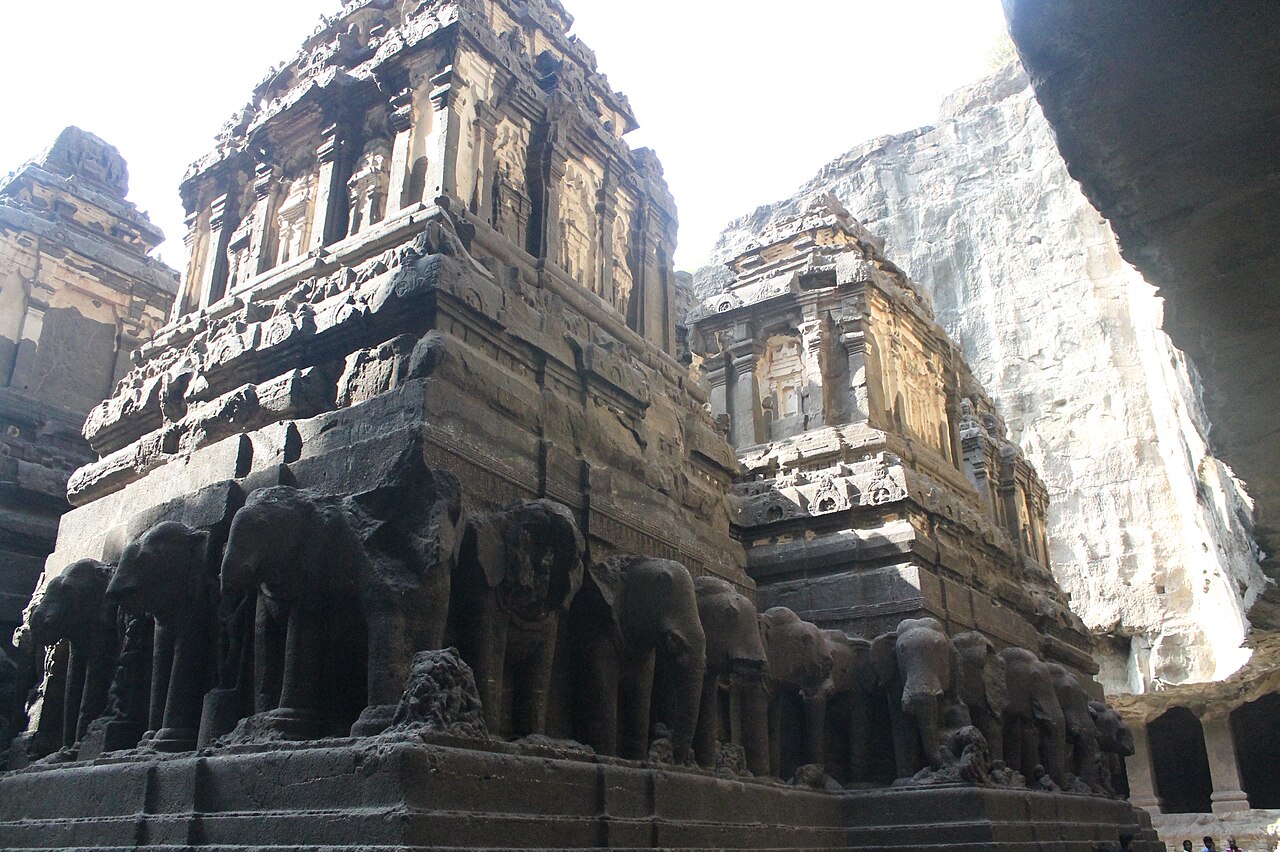
The Ellora Caves (एलोरा), inscribed by UNESCO in 1983, is a complex of 34 rock-cut caves excavated between approximately 350 CE and 1200 CE in the volcanic basalt escarpment of the Charanandri hills, approximately 30 km northwest of Aurangabad, Maharashtra, India — the largest single archaeological complex in India demonstrating the coexistence and sequential occupancy of Buddhist, Hindu, and Jain religious communities in the same monumental site over 800 years. The 34 caves are divided into three groups: the Buddhist group (Caves 1–12, approximately 350–700 CE, comprising viharas or monastery halls with multiple residential cells surrounding a central prayer hall, including Cave 12, the largest Buddhist cave in India, three storeys high with a Hall of Supreme Enlightenment at the top storey containing colossal figures of the Buddha flanked by bodhisattvas in a fully developed Mahayana iconographic programme); the Hindu group (Caves 13–29, approximately 600–900 CE, including the Kailasa Temple — Cave 16 — the largest and most extraordinary of all the Ellora monuments); and the Jain group (Caves 30–34, approximately 800–1200 CE, the most refined in sculptural detail and representing the Digambara Jain sect’s distinctive iconographic tradition of the Tirthankaras, the 24 enlightened beings of Jain cosmology). The inscription’s Outstanding Universal Value rests on the extraordinary achievement of the Kailasa Temple and on the collective demonstration of three distinct religious-artistic traditions sharing a single landscape — the proximity of Buddhist, Hindu, and Jain sacred art in the Ellora cliffs is the most compressed physical record of the pluralistic religious culture of the Deccan Plateau in the mid-first millennium CE.
The Kailasa Temple and the multi-religious landscape of the Ellora escarpment Kailasa Temple · Buddhist group Caves 5-12 · Jain group Caves 32-34 — 0 to 2 km
The Kailasa Temple (Cave 16, named for Mount Kailash in the Himalayas — the mythological dwelling of Shiva, whose cosmological home the temple is intended to represent) is the defining monument of the Ellora complex and one of the most extraordinary architectural achievements in world history, for a specific reason: it is a complete Hindu temple complex (comprising a gateway, an inner court, a Nandi shrine (for Shiva’s bull vehicle), a main temple with a 33-metre-high shikhara tower, and the surrounding court walls with subsidiary shrines and a two-storey gallery) carved directly from the living rock — not built up by stacking stones, but by removing the rock surrounding the intended temple shape from above, leaving the temple standing free in a court cut approximately 33 m below the plateau surface. The construction (approximately 757–773 CE, under Rashtrakuta king Dantidurga who began the project and his successor Krishna I who completed it — the primary source evidence is the later Rashtrakuta inscription at Nilkantheshwar, though dating remains somewhat debated) required the removal of approximately 200,000–276,000 tonnes of volcanic basalt — a figure derived from the calculated volume of the court (approximately 85 m long × 46 m wide × 33 m deep, minus the temple complex itself) converted to basalt density. The engineering logic is remarkable for its top-down sequence: the craftsmen first determined the temple plan on the surface of the plateau, then excavated downward from all sides simultaneously, constantly adjusting to keep the temple form emerging precisely from the rock mass. Any error would be uncorrectable (unlike built architecture, where a miscalculated stone can be replaced). The temple’s principal exterior surface — the main shikhara tower and the surrounding gallery walls — is covered with narrative relief sculpture in a high-energy Shaivite style: scenes from the Ramayana and Mahabharata epics, the cosmic battle between Shiva and the demon Ravana (who attempts to lift Mount Kailash and is crushed by Shiva pressing it down with his toe — the Ravana Anugraha panel on the south wall of the Kailasa Temple is one of the great narrative sculptures of world art), and the Dashavataras (ten incarnations of Vishnu, demonstrating that the temple, though primarily Shaivite, acknowledged the Vaishnava tradition in a typical Deccan syncretism). The interior of the main sanctuary contains a large Shivalingam in the principal shrine — the temple is an active place of Hindu worship, with priests conducting puja (ritual worship) at the main shrine on a daily basis.
The Jain caves (30–34, approximately 800–1200 CE, 2 km north of the Kailasa Temple at the northern end of the Ellora escarpment) are architecturally the most refined at Ellora — the Indra Sabha (Cave 32, approximately 800 CE, a large two-storey hall with columns in the finest carved detail at the site, the upper storey’s central pillar carved with interlocking serpents and flowering vines in the most intricate stone cutting at Ellora) and the Chhota Kailash (Cave 30, approximately 800 CE, a miniature version of the Kailasa Temple in Jain iconographic programme rather than Hindu — the comparison between the two rock-cut temple complexes demonstrates the different aesthetic sensibilities of the Shaivite and Jain traditions using the same structural typology). The Ajanta Caves (UNESCO 1983, approximately 100 km northeast of Ellora by road, 2.5 hours) are the standard complementary UNESCO visit — Buddhist cave architecture and painting from an earlier period (200 BCE to 480 CE), predating the Hindu and Jain phases at Ellora and providing the chronological beginning of the Deccan rock-cut tradition. The Aurangabad Caves (not UNESCO-inscribed, approximately 10 km northeast of Aurangabad city, accessible by auto-rickshaw from the centre) are a smaller group of 7 Buddhist caves (approximately 6th–8th century CE) with sculptural detail that bridges the Ajanta and Ellora phases.
Practical information
Ellora is accessible from Aurangabad (30 km west, approximately 45 minutes by road) by MSRTC bus (several daily departures from Aurangabad bus stand), by hired taxi, or by auto-rickshaw. The Ellora site is open Wednesday–Monday 06:00–17:30 (closed Tuesdays). Admission fee (foreign visitors): standard ASI monument fee. The Kailasa Temple (Cave 16) is the mandatory centrepiece; allow at minimum 1.5 hours here for the exterior court and interior shrine. The Buddhist caves (Caves 5, 10, 12 as priorities) and Jain caves (Cave 32) each require approximately 30–45 minutes. Total recommended visiting time: 4–5 hours for a serious visit; the most common rushed visits (2 hours) do not allow enough time for the Buddhist caves or the Jain group. The Ellora sound-and-light show (evening, Tuesday–Sunday) narrates the site history using the Kailasa Temple court as the theatrical space — one of the most impressive heritage sound-and-light shows in India, highly recommended. Aurangabad itself (the nearest city for accommodation) has several heritage monuments: the Bibi Ka Maqbara (1660s CE, “Mini Taj Mahal”, built by the Mughal prince Azam Shah for his mother Dilras Banu Begum, an explicit homage to the Taj Mahal built 17 years earlier and architecturally instructive as a comparison with the original); and the Panchakki (water-mill complex of the Sufi dargah of Baba Shah Musafir, 17th century CE). Best visiting season: October–March (temperatures 15–30°C, post-monsoon the basalt is clean; monsoon is possible but the escarpment can be slippery). Combine Ellora and Ajanta in a 2-day Aurangabad itinerary — Ellora is closer (45 minutes from Aurangabad) and can fill one full day, with Ajanta (3 hours from Aurangabad) filling the next.
Frequently Asked Questions
How was the Kailasa Temple at Ellora built and why is it unique in world architecture?
The Kailasa Temple (Cave 16, approximately 757–773 CE) is unique in world architecture not because of its size or the sophistication of its sculptural decoration (though both are extraordinary) but because of its structural logic: it is the only monumental temple in the world to be built by subtraction rather than addition. Every other large religious monument in the world — the Parthenon, the Pantheon, the Gothic cathedrals, the Angkor temples, the Pyramids — was built by placing materials (stone, brick, wood, concrete) on top of or beside each other to create a structure. The Kailasa Temple was created by taking away: the Rashtrakuta craftsmen began with the plateau surface and removed rock from above, from the sides, and from within the intended temple form until the temple stood free in its court, as if it had always been there. The construction sequence (necessarily top-down) meant that the topmost features — the shikhara finial and the roof of the main temple — were completed first, then the lower walls and court, then the subsidiary shrines. Any error in the structural calculation at the beginning would have been irrecoverable: if the shikhara was made too narrow, there would be no way to add stone to correct it; if the court walls were cut too deep, there would be no way to raise them. The Rashtrakuta engineers who planned the Kailasa project were therefore solving a problem uniquely different from conventional construction planning — not “how do we assemble these materials into this shape?” but “how do we remove this material from around this shape without removing the shape itself?” The answer required a precise three-dimensional plan of the temple in the planners’ minds (or on some now-lost preparatory drawings) before a single chisel touched the rock. The volume of rock removed — approximately 200,000–276,000 tonnes of basalt over approximately 18 years — gives an average removal rate of approximately 30–45 tonnes per day, which required a workforce of several hundred to several thousand craftsmen (the historical chronicles do not give a specific workforce number). The Kailasa Temple’s uniqueness extends to the fact that no other rock-cut temple in India or elsewhere attempted to equal it — the Jain Chhota Kailash (Cave 30) is a reduced echo of the concept, and several later sites in Karnataka (the Indrabesvarar temple at Dharwad, various Chalukyan rock-cut temples) use the rock-cut method but at much smaller scale. The Kailasa Temple was the singular apogee and the end of the tradition simultaneously: the Rashtrakuta achievement was so complete that no successor found it worth attempting to surpass.
Why do Buddhist, Hindu, and Jain monuments coexist at Ellora?
The coexistence of Buddhist, Hindu, and Jain rock-cut monuments at Ellora within a 2-km stretch of the same cliff reflects the pluralistic religious culture of the Deccan Plateau during the approximately 800-year period of Ellora’s occupancy (350–1200 CE) and the patronage economics that sustained large-scale rock-cut monument construction. The Buddhist caves at Ellora (350–700 CE, the earliest phase) were commissioned by wealthy merchants and their guilds from the Chalukya period trade networks — the Western Deccan in this period had an extensive network of long-distance trade (linking the Gujarat ports to the Konkan coast and the interior Deccan) whose merchant patrons competed for prestige through donations to Buddhist monasteries, which were also important commercial and banking institutions (Buddhist monasteries in ancient India charged interest on loans to merchants, served as secure depositories for valuable goods during transit, and provided hospitality networks across trade routes). The transition from Buddhist to Hindu patronage at Ellora in the 7th–8th centuries CE reflects the shift of royal patronage in the Deccan from Buddhism to Shaivism — the Chalukya dynasty of Vatapi (Badami) and their successors the Rashtrakutas were explicitly Shaivite rulers who commissioned Hindu temples at Ellora as assertions of royal identity and cosmic authority, while the earlier Buddhist caves continued to be maintained by their monastic communities. The Jain caves (800–1200 CE) reflect the patronage of the prosperous Jain merchant communities of the northern Deccan — Jainism’s strong merchant base (Jain communities have historically dominated specific trade sectors in India, including textile trading, moneylending, and gem trading) provided the sustained private donations that funded the Jain cave complex over 400 years. The physical proximity of the three groups at Ellora is partly accidental (the same excellent-quality basalt for rock-cutting was the geographic draw for all three communities) and partly intentional (the site’s existing religious prestige may have attracted successive communities who wished to share in an already sacred landscape — a pattern well-documented in South Asian religious sites, where pilgrimage centers tend to accumulate monuments of multiple traditions over time). UNESCO’s decision to inscribe all three groups as a single property recognised the Outstanding Universal Value of the collective evidence for religious pluralism rather than attributing value to any single tradition’s contribution.
EXCERPT: Ellora Caves, UNESCO-inscribed in 1983, is a 2-km stretch of 34 Buddhist, Hindu, and Jain rock-cut caves in Maharashtra — centred on the Kailasa Temple (Cave 16, 757–773 CE), the largest rock-cut structure in the world: 276,000 tonnes of basalt removed from above a complete Shaivite temple freestanding in a 33-metre-deep court — 30 km from Aurangabad and 100 km from Ajanta Caves (UNESCO 1983).
META: UNESCO World Heritage Sites near Ellora Caves Maharashtra India: Ajanta Caves 100 km northeast (UNESCO 1983), Elephanta Caves 310 km southwest near Mumbai (UNESCO 1987), Chhatrapati Shivaji Terminus Mumbai 340 km southwest (UNESCO 2004) — Maharashtra UNESCO heritage trail from Ajanta through Ellora to Elephanta and Mumbai.
Sources
- S1 — UNESCO World Heritage Centre — Ellora Caves (Ref. 243) — https://web.archive.org/web/20230601000000/https://whc.unesco.org/en/list/243/
- S2 — UNESCO World Heritage Centre — Statement of Outstanding Universal Value (Ref. 243) — https://whc.unesco.org/en/list/243/
Spotted an error? Write to editorial@culturalheritageonline.com and we correct it the same day.