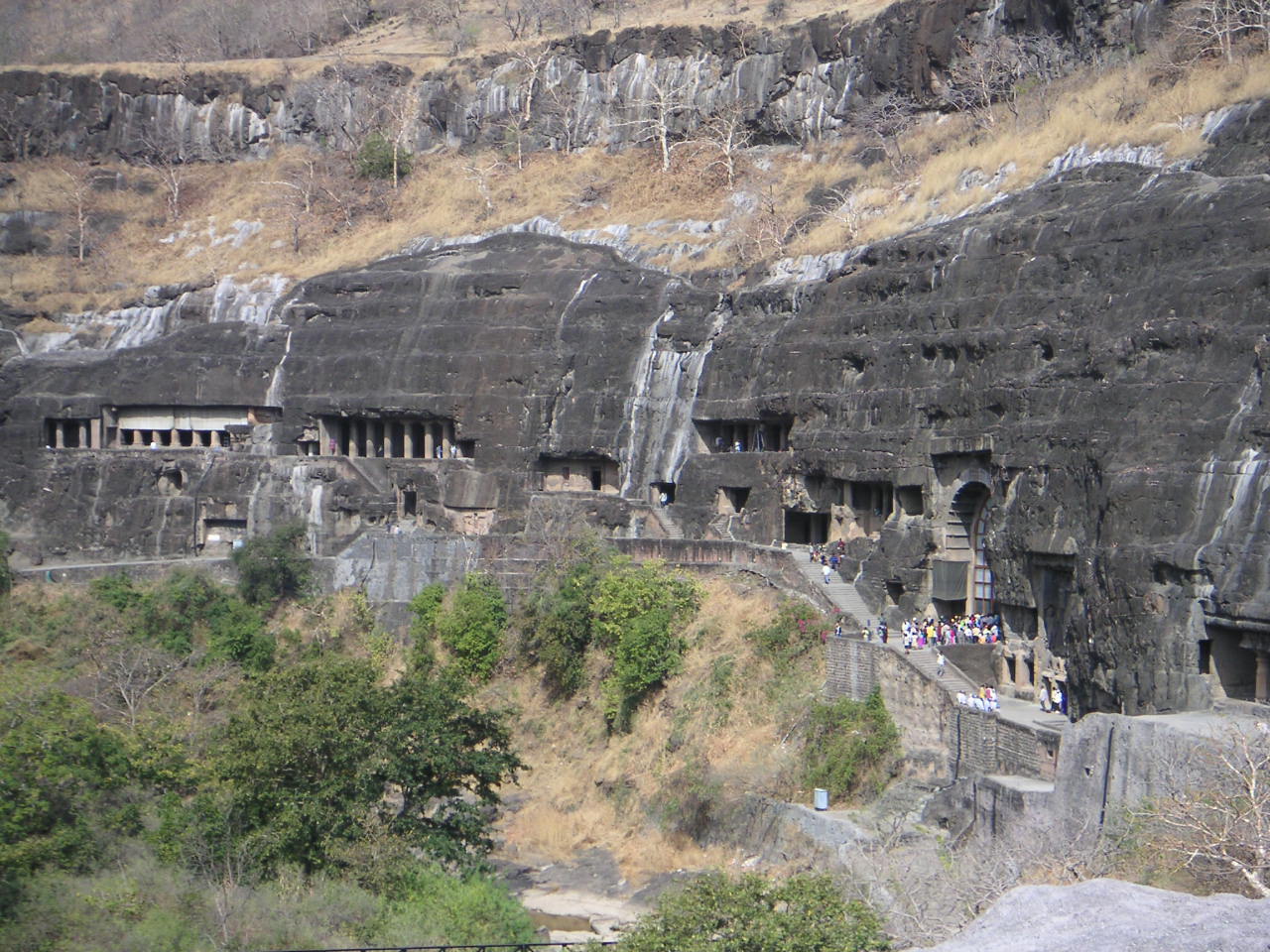
The Ajanta Caves (अजिंठा लेणी), inscribed by UNESCO in 1983, is a complex of 30 rock-cut Buddhist cave monuments in a horseshoe-shaped gorge of the Waghora River approximately 107 km northeast of Aurangabad, Maharashtra, India — excavated in two principal phases separated by approximately four centuries, the earlier Hinayana phase (approximately 200 BCE to 100 CE, Caves 8–10, 12, 13, 15A) commissioned by wealthy donors in the trade networks of the Satavahana dynasty, and the later Mahayana phase (approximately 460–480 CE, the remaining 25 caves) commissioned principally under the patronage of Vakataka dynasty rulers, especially Harisena (r. approximately 460–477 CE, the Vakataka Emperor whose reign saw the most intensive period of Ajanta cave excavation). The Ajanta Caves are significant for three overlapping reasons: as Buddhist religious sites (both viharas, or residence halls for monks, and chaityas, or prayer halls with apsidal ends containing a stupa) from the formative period of Mahayana Buddhist iconographic development; as the largest surviving body of ancient Indian mural painting (the cave interiors are covered with paintings in tempera-like technique on mud-plaster ground that cover approximately 5,000 square metres of surface — the most extensive ancient painted surface in India and among the most extensive in Asia); and as examples of rock-cut architecture in which the cave interior, the veranda, the pillars, and the portal sculpture were carved directly from the volcanic basalt of the Deccan Plateau in one continuous act of subtraction rather than construction, demonstrating a uniquely Indian approach to monumental religious space that had no exact parallel in the Mediterranean world.
The Ajanta cave paintings and the Ellora and Aurangabad Buddhist heritage corridor Ajanta Caves · Ellora Caves · Aurangabad · Daulatabad Fort — 0 to 107 km
The Ajanta Caves are best understood in the order of their excavation phases rather than their cave numbers (which run consecutively 1–30 along the gorge from west to east, but were not excavated in that order). The prayer halls (chaitya grihas) of the earlier Hinayana phase — especially Cave 9 (approximately 100–125 BCE, one of the two earliest surviving chaityas in India, with a vaulted ceiling carved to imitate timber construction and a carved stupa at the apsidal end) and Cave 10 (approximately 150 BCE, the largest chaitya, its nave approximately 30 m long and 12 m wide) — preserve the earliest surviving pictorial painting at Ajanta, in fragmented fragments on the Cave 10 walls: the earliest dated paintings in India depicting Buddhist narrative scenes (Jataka tales, the stories of the Buddha’s previous lives in animal and human form that provide the narrative subject matter for virtually all early Buddhist painting). The Mahayana-phase caves (Caves 1, 2, 16, 17 are the most richly painted) contain the masterworks of Ajanta wall painting: Cave 1’s famous painting of the Bodhisattva Padmapani (approximately 470–480 CE, the blue-lotus-bearing bodhisattva with a crown of flowers and jewels, languid in attitude and with a characteristic slight bend at the waist — considered among the greatest works of figurative painting in world art history, described by art historian Heinrich Zimmer as “the most perfect expression of the serene compassion of the Bodhisattva ideal”) and Cave 2’s ceiling panels (elaborate geometric and floral designs in orange, gold, green, and black interspersed with medallion paintings of Buddhist mythological figures). The painting technique (mineral pigments ground in water and gum, applied to a plaster ground of clay and cow-dung covered with a final lime wash — not true fresco, which requires painting into wet lime, but a sophisticated distemper technique requiring the application of each section quickly before the surface dried) has survived approximately 1,500 years in the cave microclimate (the caves are naturally air-conditioned by the river gorge below, maintaining relatively stable humidity) but has been increasingly damaged since the caves were “rediscovered” by British officer John Smith in 1819 CE (the influx of visitors, humidity changes from body heat and breathing, and early conservation attempts with caustic chemicals all damaged surfaces).
Ellora Caves (UNESCO 1983, approximately 30 km northwest of Aurangabad by road, 100 km south of Ajanta — a separate inscription from Ajanta but the standard complementary visit in a 2-day Aurangabad itinerary) represent the successive occupation of a similar basalt escarpment by Buddhist, Hindu, and Jain religious communities approximately 350–1200 CE, in 34 caves organised in three groups along a 2 km stretch of cliff. The Kailasa Temple (Cave 16, the centrepiece of Ellora’s Hindu caves, commissioned by the Rashtrakuta king Dantidurga and built approximately 757–773 CE by his successor Krishna I) is a freestanding temple carved entirely from a single mass of basalt — 276,000 tonnes of rock removed from above the intended temple shape to leave the temple standing in a court cut 33 m below the surrounding plateau surface. The scale of the undertaking (the Kailasa Temple is approximately twice the area of the Parthenon in Athens and was carved top-down over an estimated 18 years with approximately 7,000 workers) makes it the largest rock-cut structure in the world.
Practical information
The Ajanta Caves are accessible from Aurangabad (the nearest large city, approximately 107 km southwest) by Maharashtra State Road Transport Corporation (MSRTC) bus (approximately 3 hours, inexpensive, departing from Aurangabad bus stand) or by hired taxi (approximately 2 hours each way, allowing more time at the caves). From the MSRTC bus terminus at the caves, a shuttle bus covers the final 3.5 km to the cave complex (private vehicles are not permitted on the final approach road). The site is open Wednesday–Monday 09:00–17:30 (closed Tuesdays for maintenance). Admission fee (foreign visitors): standard ASI monument fee, plus additional camera fee. The permit system limits the number of visitors per day in some seasons — pre-booking recommended during peak season (October–February). Each cave is lit internally but a personal torch is helpful for examining painting details. Visiting time: 4–5 hours for a serious engagement with the principal painted caves (Caves 1, 2, 9, 10, 16, 17, 19); add 30 minutes for the viewpoint above the gorge that gives the horseshoe perspective. The nearest accommodation is at the MTDC (Maharashtra Tourism Development Corporation) tourist complex at Fardapur (approximately 5 km from Ajanta), but Aurangabad (hotels of all categories) is the comfortable base for visiting both Ajanta and Ellora. Best visiting season: October–March (Ajanta is in Maharashtra’s rain shadow but receives some monsoon rain July–August; October–March has clear skies and temperatures 15–30°C). Avoid May–June (temperatures up to 42°C, limited shade on the approach).
Frequently Asked Questions
How were the Ajanta cave paintings made and how have they survived 1,500 years?
The Ajanta paintings survive in a fragile state that reflects both the sophistication of their original production and the challenges of their long history of neglect and problematic early conservation. The technique used at Ajanta (applied in two phases in the 2nd century BCE and the 5th century CE) is a form of tempera painting on a prepared plaster surface — not true fresco, in which pigments are applied directly into wet lime plaster while it is still chemically active, but a more complex system in which the wet lime plaster provides the substrate and the pigments are applied in a water-based binder (gum, plant resin, or animal glue) after the plaster has set. The plaster preparation at Ajanta was itself technically complex: the first layer was a rough mortar of clay, cow dung, and vegetable fibre (straw, rice husks) approximately 1–2 cm thick applied directly to the rock surface; the second layer was a finer clay-lime mortar approximately 1–2 mm thick providing a smooth surface; and the final layer was a thin white lime-wash on which the actual painting was done. The pigments used (white from lime or china clay, yellow and red from iron oxide minerals, blue from lapis lazuli or azurite, green from locally available copper silicate or vegetable green, black from lamp black or charcoal, purple from a mixture) are all mineral or charcoal-based — these are exceptionally stable over geological time and have not faded in the fundamental sense. What has changed is the binder and the plaster substrate: the organic binders have decomposed, allowing some pigments to detach from the plaster; moisture infiltrating cracks in the rock has caused plaster detachment; and the deposits of soot from butter lamps used for worship and from fires lit by the shepherds who used the caves as shelter for approximately 900 years after the monastery was abandoned (approximately 480 CE) covered many surfaces with a carbonaceous layer that has darkened the appearance of paintings. The history of conservation is also a history of damage: the first systematic conservation attempt in the 1910s–1920s by the Bombay Government photographer Griffiths used shellac varnish that initially revived the colours but subsequently yellowed and created a vapour barrier that accelerated plaster detachment; the subsequent removal of the Griffiths varnish by Italian conservators in the 1960s was partially successful but itself caused further damage. The current ASI (Archaeological Survey of India) conservation programme takes a minimal-intervention approach — cleaning, stabilising loose plaster, and controlling the cave microclimate by limiting visitor numbers and monitoring humidity.
What is the significance of the Bodhisattva Padmapani painting in Cave 1?
The Bodhisattva Padmapani (literally “Lotus-bearer”, one of the principal bodhisattvas of Mahayana Buddhism — the being who has attained enlightenment but remains in the cycle of rebirth to assist other beings toward liberation) in Cave 1 at Ajanta (approximately 470–480 CE, the later Mahayana phase, left antechamber wall mural) is one of the few ancient Indian paintings that has become a specific iconic work in the global history of art — comparable in art-historical reference to specific frescoes of the Italian Renaissance. The painting’s significance rests on several qualities: the psychological depth of the figure’s expression (the slightly downward-gazing eyes, the subtle half-smile, the relaxed and languid body posture communicate an attitude of absorbed compassion that art historians have compared to the mood of the Virgin Mary in 13th-century Byzantine painting and to the Mona Lisa of Leonardo da Vinci, though of course entirely independent of both traditions); the technical mastery visible in the continuous modelling of the body contour (the shading from the light center of the torso to the darker periphery is achieved by colour gradation without outline — the modelling technique used at Ajanta, called shading or “bhumi-spandana” in Sanskrit aesthetic vocabulary, is more sophisticated than the outline-based figure style that preceded it in Indian painting); and the iconographic elaboration of the bodhisattva’s attributes (the blue lotus in the right hand, the decorated crown, the elaborate necklace and wrist ornaments, the triptych-like composition with attendant female figures on either side and a variety of small figures filling the upper register). The painting’s “discovery” by European audiences in the early 20th century (through photographs published by V.S. Gokhale in 1908 and subsequent reproductions in art-historical publications) significantly influenced the European awareness of pre-colonial Indian painting as a sophisticated artistic tradition — the Ajanta murals, previously known only to specialists, became the first Indian paintings to enter the general art-historical canon of great world art.
EXCERPT: Ajanta Caves, UNESCO-inscribed in 1983, is a complex of 30 Buddhist rock-cut caves in a basalt gorge in Maharashtra — 5,000 sq m of 5th-century CE mural painting including Cave 1’s Bodhisattva Padmapani (among the greatest figurative paintings in world art history), chaitya prayer halls from 200 BCE imitating timber vaulting in carved stone — 107 km from Aurangabad and 100 km from Ellora Caves (UNESCO 1983).
META: UNESCO World Heritage Sites near Ajanta Caves Maharashtra India: Ellora Caves 100 km south (UNESCO 1983), Elephanta Caves 350 km southwest near Mumbai (UNESCO 1987), Buddhist Monuments at Sanchi 450 km northeast in Madhya Pradesh (UNESCO 1989) — Maharashtra-Madhya Pradesh Buddhist heritage route from Ajanta to Ellora to Sanchi spanning 5th century BCE to 12th century CE.
Sources
- S1 — UNESCO World Heritage Centre — Ajanta Caves (Ref. 242) — https://web.archive.org/web/20230601000000/https://whc.unesco.org/en/list/242/
- S2 — UNESCO World Heritage Centre — Statement of Outstanding Universal Value (Ref. 242) — https://whc.unesco.org/en/list/242/
Spotted an error? Write to editorial@culturalheritageonline.com and we correct it the same day.