The Ryukyu Kingdom occupied Okinawa and the surrounding island chain from approximately 1429 to 1879 CE, operating as a maritime trading state that simultaneously maintained vassal relationships with both China and Japan — a geopolitical balancing act without precedent in East Asian history. The nine component properties of the Gusuku Sites and Related Properties of the Kingdom of Ryukyu, inscribed by UNESCO in 2000, document that history through stone castle architecture, sacred groves and royal gardens. Shuri Castle, the kingdom’s royal palace and the most important of the nine components, burned in an electrical fire on 31 October 2019 and is currently under reconstruction, expected to complete in 2026.
The Ryukyu Kingdom and its stone castles Nine components across Okinawa Prefecture — main sites within 90 min of Naha by bus or monorail
The Ryukyu Kingdom was an independent maritime state centred on Okinawa Island, formally unified under King Sho Hashi in 1429 after a period of competing regional lords (aji). Its power rested almost entirely on re-export trade: Ryukyuan ships — using Chinese junk technology and operating under the diplomatic privileges of the Chinese tributary system — purchased goods in Southeast Asia (Thailand, Java, Malacca, Korea) and resold them in China and Japan, taking the margin. The kingdom produced little of export value itself. Its wealth was commercial, not extractive.

This position required extraordinary diplomatic agility. Ryukyu was formally a vassal of China, sending tribute missions to the Ming and later Qing courts and receiving trading privileges and investiture (the Chinese recognition of each new Ryukyuan king) in return. At the same time, from 1609 onwards, Ryukyu was also a domain under the Satsuma han (the feudal lord of southern Kyushu) following a military invasion that the Ryukyuan court could not repel. Satsuma exploited Ryukyu’s Chinese connections — Japan was officially barred from direct trade with China — by using Ryukyu as a conduit. The Ryukyuan court maintained the fiction of independence and continued its Chinese ritual calendar and court culture, because Satsuma needed China to believe it was dealing with an independent kingdom. This arrangement lasted 270 years.
Japan formally annexed Ryukyu in 1879 in what is known as the Ryukyu Shobun (Disposition of Ryukyu), abolished the kingdom, forced the last king Sho Tai into exile in Tokyo, and incorporated the territory as Okinawa Prefecture. The Ryukyuan people spoke Ryukyuan languages — a family of languages linguistically related to Japanese but mutually unintelligible with it, as different from Japanese as Portuguese is from Spanish, approximately.
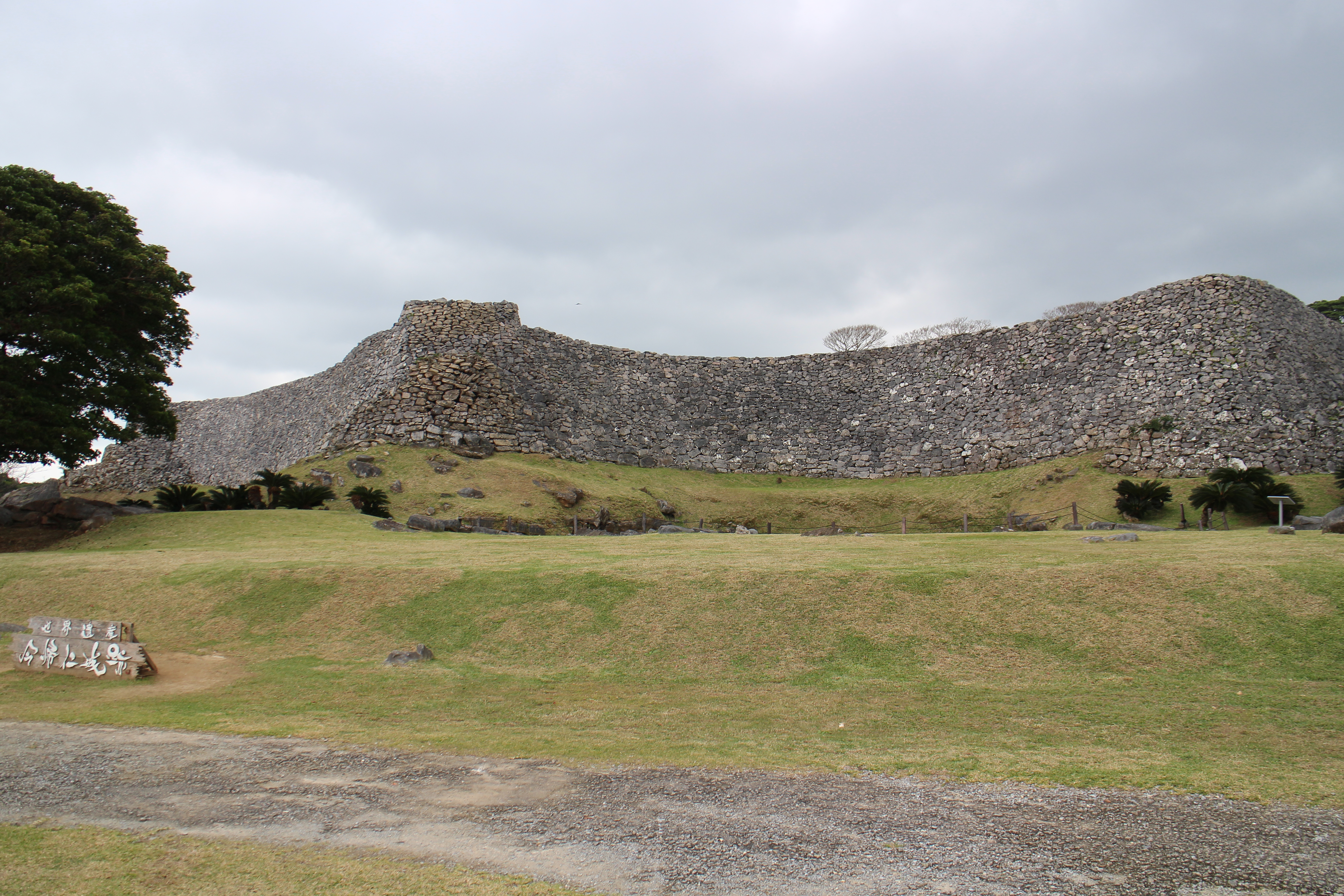
The gusuku — stone-walled castles — are the most visible architectural legacy of the kingdom. Their construction technique is distinct from both Chinese and Japanese fortification methods: the walls use locally quarried Ryukyuan limestone, laid in a curved bowing pattern (nuno-zumi) without mortar, relying entirely on the precision fitting of irregular stones to achieve structural stability. The curves are not decorative; they distribute tensile stress across the wall more effectively than straight courses and proved remarkably resistant to earthquakes. Eight of the nine UNESCO components include gusuku remains, at varying states of preservation and reconstruction.
Shuri Castle, Sefa-utaki, and the 2019 fire Shuri — 15 min by Okinawa Monorail from Naha Airport to Shuri Station
Shuri Castle served as the royal palace of the Ryukyu Kingdom and was the administrative, cultural and religious centre of the kingdom for most of its 450-year history. Its architectural character — red-lacquered wooden halls, Chinese-influenced curved rooflines, approached through stone gates bearing Chinese and Japanese inscriptions simultaneously — reflects the kingdom’s dual cultural position. The palace complex was destroyed in the 1945 Battle of Okinawa, the bloodiest engagement in the Pacific War, fought on the island from 1 April to 22 June 1945. Approximately 100,000 Okinawan civilians died in the 82-day battle, alongside approximately 110,000 Japanese military and 12,000 American servicemen. The battle reduced most of Okinawa’s urban built environment to rubble.
Reconstruction of Shuri Castle began in 1992 and the main hall (Seiden) was completed in 1998 — two years before the UNESCO inscription. On 31 October 2019, at approximately 2:40 in the morning, a fire broke out in the Seiden. The cause was an electrical fault in a lighting system. The fire spread rapidly because the water suppression system inside the main hall had been deactivated for maintenance and had not been reactivated — a governance failure that has been well documented in the subsequent investigations. The Seiden, the North Hall (Hokuden) and the South Hall (Nanden) were completely destroyed, along with numerous Ryukyuan cultural artefacts that could not be evacuated in time. Reconstruction began in 2022 and is expected to complete in 2026. During the interim, the stone foundations, outer gates and ramparts remain accessible and visible.
Sefa-utaki, at the southeastern cape of Okinawa, is in many respects the most historically significant of the nine components. It is the most sacred utaki (sacred grove) in the Ryukyuan religious system. Ryukyuan religion — distinct from both Shintoism and Buddhism, though it absorbed elements of both — centred on female religious specialists (noro and yuta) who mediated between the human and divine realms. Utaki are sites where the divine is considered to be directly present. Sefa-utaki has no built structures. The sacred space is defined entirely by the natural geology: two boulders lean against each other to form a triangular passage (Sangui) that opens toward the sacred island of Kudaka, visible offshore. During the kingdom period, men were prohibited from entering the site; only the noro (royal priestesses) and, on a single annual pilgrimage, the king performed ceremonies here. The site survived the 1945 battle with its stone formations intact.
Practical information Naha Airport — main gateway; sites across Okinawa Island and beyond
Naha Airport is connected to Tokyo (Haneda, Narita), Osaka (Kansai, Itami), and other Japanese cities by frequent direct flights, approximately 2.5 hours from Tokyo. The Okinawa Urban Monorail (Yui Rail) connects Naha Airport to Shuri Station in 27 minutes; Shuri Castle is a 15-minute walk from the station. Buses connect Naha to most sites on Okinawa Island; the Nakijin Castle (the largest surviving gusuku ruin, on the Motobu Peninsula) is approximately 2 hours by bus from Naha. Sefa-utaki is approximately 1 hour from Naha by bus or car, near the town of Nanjo.
Shuri Castle grounds admission is ¥400 (adults); some interior halls and temporary exhibitions charge separately. Sefa-utaki admission is ¥300. Nakijin Castle is ¥600. The Okinawa Prefectural Museum and Art Museum in Naha, a 10-minute walk from Omoromachi Monorail Station, houses an excellent collection of Ryukyuan artefacts including textiles (Ryukyuan bingata dyed fabrics), lacquerware and ceramics that provide essential context before visiting the castle sites. Admission ¥530. Okinawa’s subtropical climate means year-round accessibility; July and August are hot and humid with occasional typhoons. October through December offers the most comfortable temperatures for walking the gusuku sites.
Frequently Asked Questions
What is the current state of Shuri Castle reconstruction after the 2019 fire?
The fire of 31 October 2019 destroyed the Seiden (main hall), the Hokuden (North Hall), the Nanden (South Hall) and several smaller structures, along with artefacts inside that could not be removed before the fire spread. The cause was confirmed as an electrical fault in the main hall’s lighting installation, compounded by the deactivation of the interior water suppression system for maintenance work that had not been completed — the suppression system was therefore offline when it was needed. Post-fire investigations also identified that the castle’s fire prevention planning had not been adequately updated after the 1998 reconstruction and did not account for the combustibility of the replicated traditional materials used. Reconstruction is funded through a combination of national government appropriations and a public donation campaign that raised over 3 billion yen (approximately 20 million USD) in its first year. The reconstruction timeline targets completion of the Seiden by 2026, with other structures to follow in phases through 2026 and beyond. The outer stone gates — Shureimon (the most photographed gate, built in the 16th century and reconstructed in 1958, before the main castle reconstruction), Kankaimon, Zuisenmon and Roukokumon — were not damaged in the fire and remain fully accessible. The stone ramparts and courtyards are also intact. Visitors can observe the Seiden reconstruction in progress from designated viewing points within the castle grounds.
How did the Ryukyu Kingdom maintain political independence while paying tribute to both China and Japan?
The core mechanism was managed ambiguity. Ryukyu’s relationship with China (the Ming Dynasty, from 1372, and later the Qing) was formalised as a tributary relationship: Ryukyuan envoys carried tribute to the Chinese court, received imperial gifts and trade privileges in return, and obtained Chinese investiture (cefeng) for each new Ryukyuan king — a ceremony in which a Chinese imperial envoy travelled to Okinawa and formally recognised the new ruler. This gave Ryukyu access to the Chinese trade network, including ports and products not available to countries outside the tributary system. Japan’s relationship with China was hostile or non-existent for much of this period; Japanese ships could not legally trade directly in Chinese ports. After Satsuma’s military conquest of Ryukyu in 1609, the han entered into what historians call the “double-subordination” arrangement: Ryukyu continued its China tributary relationship outwardly intact, while Satsuma extracted a portion of the profits. Satsuma actively required the Ryukyuan court to conceal its subordination to Japan when Chinese envoys visited Okinawa — Ryukyuan officials who had adopted Japanese-style topknots were required to return to traditional Ryukyuan hairstyles before the Chinese delegates arrived, and Japanese-language documents were hidden. The Qing court likely knew or suspected the arrangement but found it convenient to maintain the fiction, since it kept trade channels open. This three-party arrangement — Ryukyu nominally independent, China a patron, Japan an overlord — lasted until Japan’s 1879 annexation made it unsustainable.
What makes Sefa-utaki a sacred site and why were men excluded from it?
Sefa-utaki is the most sacred of Okinawa’s utaki — sites where the divine is understood to be directly present within the natural landscape, without any built mediation. In Ryukyuan religious cosmology, the divine realm (niraikanai, roughly equivalent to a paradise beneath or beyond the sea) communicates with the human world through specific physical locations, typically marked by natural features: unusual rock formations, ancient trees, mountain summits or coastal promontories facing the open ocean. Sefa-utaki is a limestone outcrop on a headland facing southeast toward the island of Kudaka, which is itself considered the most sacred island in the Ryukyuan cosmological system — the place from which the gods are said to have first given agriculture to the Ryukyuan people. The site’s defining feature is the Sangui, a triangular passage formed by two boulders leaning together, through which the ocean and Kudaka Island are framed like a view through a gate. The exclusion of men from the site during the kingdom period was integral to the Ryukyuan religious system, in which spiritual authority resided with women. The noro — royal and village-level priestesses — were the principal religious officiants. The kikoe-ogimi (chief priestess of the kingdom) was invariably a female relative of the reigning king, and her spiritual authority was considered to complement and legitimise his political authority. Sefa-utaki was the ceremonial site of the kikoe-ogimi’s investiture. The taboo on male entry was lifted after the abolition of the kingdom in 1879, but the site retains its status as the most sacred location in Okinawan religious memory.
Sources
- S1 — UNESCO World Heritage Centre — Gusuku Sites and Related Properties of the Kingdom of Ryukyu (Ref. 972) — https://whc.unesco.org/en/list/972/
- S2 — Wikipedia — Shuri Castle — https://en.wikipedia.org/wiki/Shuri_Castle
All addresses were reachable on 20 October 2026.
Spotted an error? Write to editorial@culturalheritageonline.com and we correct it the same day.