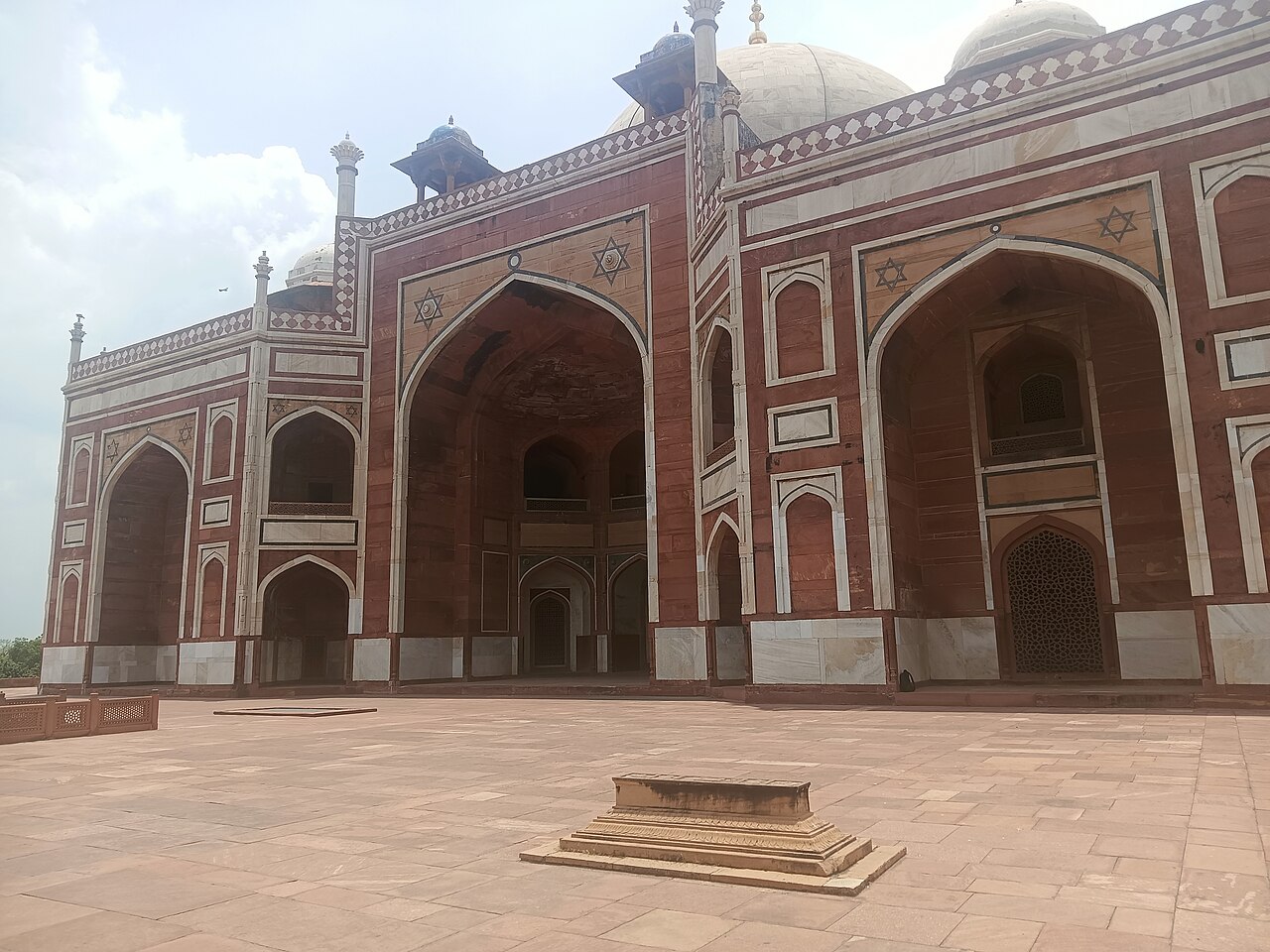
Humayun’s Tomb (हुमायूँ का मकबरा, Maqbara-i-Humāyūn), inscribed by UNESCO in 1993, is the mausoleum of the second Mughal Emperor Humayun (نصير الدين محمد همايون, r. 1530–1540 and 1555–1556 CE) — built 1565–1572 CE in Delhi (Nizamuddin neighbourhood, approximately 6 km south of the Red Fort) by Humayun’s senior widow, the Persian princess Bega Begum (also called Hajji Begum, who had made the Hajj pilgrimage to Mecca and whose devotion to her late husband’s memory drove the commission of the most ambitious architectural project attempted in India since the Delhi Sultanate), under the architectural direction of Mirak Mirza Ghiyas (ميرک ميرزا غياث, a Persian-trained architect from Herat). The mausoleum is the first great Mughal tomb on Indian soil — preceding the Taj Mahal by approximately 65 years and establishing virtually every formal element that would reach its canonical form at the Taj Mahal: the raised platform garden (chahar bagh, the formal Persian four-quadrant garden divided by water channels, here approximately 300 m × 300 m), the centrally placed domed mausoleum on a high podium (the mausoleum platform approximately 6.7 m above garden level), the double-shell dome (the outer dome in white marble appearing much taller than the inner dome that defines the interior chamber height — the double dome became the standard Mughal funerary dome system, used at the Taj Mahal and all subsequent Mughal mausoleums), and the combination of red sandstone and white marble as the two primary architectural materials (white marble for the dome and the decorative panels, red sandstone for the main body). The UNESCO inscription also encompasses approximately 100 associated tombs within the chahar bagh complex — the mausoleum of Bega Begum herself, the tombs of several Mughal nobles and court figures, the dargah of the Sufi saint Nizamuddin Auliya (1238–1325 CE, approximately 200 m southwest of the main mausoleum, one of the most important shrines in South Asia), and the dargah of the poet Amir Khusrow (1253–1325 CE, within the Nizamuddin dargah complex).
Humayun’s Tomb and the Nizamuddin Sufi shrine complex Main mausoleum · Nila Gumbad · Nizamuddin Dargah · Isa Khan’s Tomb — 0 to 0.5 km
The Humayun’s Tomb complex (entered from the west gateway) reveals its most important architectural effect only at the moment of entering the chahar bagh garden: the mausoleum’s dome (approximately 42 m in height from the garden level) appears suddenly at the end of the long central water channel axis, framed by the garden’s cypress trees and the double arcades of the garden’s enclosure wall. The effect is the earliest surviving example in India of the monumental architectural approach sequence that would reach its ultimate expression at the Taj Mahal’s reflecting pool — the Mughal garden mausoleum tradition uses the garden not primarily as a pleasure garden but as a controlled approach sequence that builds the viewer’s anticipation and frames the mausoleum at its most impressive scale. The interior of the main mausoleum (accessible from the south door, the octagonal central chamber approximately 16 m across and 15 m high to the springing of the interior dome) contains Humayun’s cenotaph in the centre and several other cenotaphs of Mughal nobles around the periphery — the actual burials are directly below at podium level. The surface detail of the interior (red sandstone with white marble geometric inlay in the arched niches, the central cenotaph in white marble on a low platform) is restrained compared to the Shah Jahan-period interiors at the Taj Mahal, reflecting the earlier, more architecturally austere stage of Mughal decorative development. The Nila Gumbad (Blue Dome, approximately 100 m northeast of the main mausoleum entry, within the complex boundary, a standalone funerary structure with a tiled blue dome — the only surviving original Mughal blue tile dome in Delhi) marks the tomb of an unknown Mughal noble and is the only building in the complex with the blue-and-white glazed tile decoration characteristic of Timurid Central Asian architecture rather than the red sandstone and white marble of the main mausoleum. Isa Khan’s Tomb (the tomb of Isa Khan Niyazi, a nobleman of the Sur Empire that temporarily displaced the Mughal dynasty 1540–1555 CE, approximately 50 m south of the main mausoleum entry in the outer enclosure) is a compact octagonal red sandstone tomb with a surrounding verandah — a style predating the Mughal chahar bagh mausoleum tradition and providing an architectural contrast that illustrates the stylistic rupture between Sur and Mughal traditions.
The Nizamuddin Dargah (approximately 200 m southwest of Humayun’s Tomb across the Mathura Road, accessible by a lane through the Nizamuddin neighbourhood basti) is among the most important Sufi shrines in South Asia — the dargah of Hazrat Nizamuddin Auliya (نظام الدين اولياء, 1238–1325 CE), the most revered of the Chishti Sufi masters, whose tomb has been a pilgrimage site for Muslims of all backgrounds (and many Hindus, Sikhs, and others) for 700 years. The tomb of the poet Amir Khusrow (امیر خسرو, 1253–1325 CE — the most celebrated medieval poet of the Indian subcontinent, inventor of the khayal style of classical music, the Hindustani music form that would develop into what is known today as North Indian classical music, and a devoted disciple of Nizamuddin Auliya whose tomb he requested to be placed at the feet of his master) is within the dargah complex, separated from Nizamuddin’s tomb by a few metres. The qawwali music performances at the Nizamuddin Dargah (held Thursday evenings and on the Urs (death anniversary) of both Nizamuddin and Amir Khusrow) are the most authentic and atmospherically intense qawwali performances accessible to visitors in India — the dargah’s courtyard fills with devotees, the qawwali singers perform facing the tomb in the tradition established directly by Amir Khusrow himself, and the spiritual atmosphere is entirely different from the concert-format qawwali available at tourist sites.
Practical information
Humayun’s Tomb is accessible by Delhi Metro (Hazrat Nizamuddin Station on the Purple Line, 10 minutes walk) or by auto-rickshaw from central Delhi (15–20 minutes from Connaught Place). The complex is open daily 06:00–18:00 (last entry 30 minutes before closing). Admission fee (foreign visitors): standard ASI monument fees. Photography is permitted throughout. The Aga Khan Trust for Culture (AKTC) has conducted an extensive restoration programme at the complex since 2007 CE (the restoration is considered a model conservation project internationally — the 2018 UNESCO Asia Pacific Award for Heritage Conservation was awarded to the AKTC Humayun’s Tomb project). Visiting time: 1.5–2.5 hours for the complex including all the subsidiary tombs and the outer enclosure. The restoration work has made the complex significantly more legible than before (overgrowth cleared, subsidiary tombs restored, garden original water channels restored to flowing water in parts) but some ongoing conservation work may restrict access to certain structures on specific dates. The Nizamuddin Dargah (200 m away) is strongly recommended as a complementary visit: free to enter, extraordinary atmosphere, the Thursday evening qawwali is one of the most memorable experiences in Delhi. Dress modestly for the dargah visit (covered head required for women, shoes removed inside the inner sanctuary). Combine with the Qutb Minar complex (approximately 8 km south, 25 minutes by Metro from Hazrat Nizamuddin Station changing at Hauz Khas). Best visiting season: October–March (pleasant temperatures, clear light).
Frequently Asked Questions
Who was Emperor Humayun and why is his tomb historically significant?
Humayun (نصير الدين محمد همايون, 1508–1556 CE) was the second Mughal Emperor — son of the dynasty’s founder Babur and father of the dynasty’s greatest ruler Akbar — whose reign was interrupted by a 15-year exile (1540–1555 CE) that transformed him from a conventional Central Asian Islamic ruler into a Persianised monarch who brought back to India an entirely different artistic and intellectual culture. Humayun’s reign began in 1530 CE on his father Babur’s death but was plagued by military defeats and sibling rivalry (his three brothers repeatedly rebelled against him); the decisive blow came from the Afghan ruler Sher Shah Suri, who defeated Humayun at the Battle of Chausa (1539 CE) and again at the Battle of Bilgram (1540 CE) and forced Humayun into exile that would last until 1555 CE. During the exile, Humayun lived at the Safavid Persian court of Shah Tahmasp (شاه طهماسب, r. 1524–1576 CE) at Tabriz and Qazvin — the exposure to Safavid Persian court culture, art, and architecture during this 15-year period was the decisive cultural influence on the subsequent development of Mughal art. Humayun returned to India with a Safavid-provided army of 12,000 cavalry in 1555 CE, reconquered Delhi from the weakened Sur dynasty, and died in 1556 CE from a fall down the library stairs of his observatory at Delhi Sher Mandal — one of the most inglorious deaths of any great historical ruler (he slipped while trying to descend the stairs quickly after hearing the call to prayer from the minaret). His son Akbar, then 13 years old, was immediately proclaimed emperor. The significance of Humayun’s tomb extends beyond the specific memorial: it is the physical embodiment of the Persianisation of Mughal culture that Humayun’s exile brought to India — the architect Mirak Mirza Ghiyas was from the Herat tradition of Timurid Persian architecture, the double dome is a Persian form, the chahar bagh garden layout is Persian, and the use of pietra dura stone inlay for decorative patterning reflects the Persian Safavid court arts that Humayun had encountered in Tabriz. The “Persianisation” introduced by Humayun’s exile and embodied in his tomb is the foundation of everything aesthetically distinguished about subsequent Mughal architecture.
What is the significance of the Nizamuddin Dargah adjacent to Humayun’s Tomb?
The Nizamuddin Dargah (the shrine complex around the tomb of Hazrat Nizamuddin Auliya, 1238–1325 CE) is one of the three most important Chishti Sufi shrines in South Asia (the other two being Moinuddin Chishti’s dargah at Ajmer, Rajasthan, and Qutbuddin Bakhtiyar Kaki’s dargah at Mehrauli, Delhi), and its proximity to Humayun’s Tomb is not coincidental — the saint’s pre-existing spiritual authority in the location was one of the reasons the Mughal court chose Nizamuddin as the site of Humayun’s mausoleum. Nizamuddin Auliya (born in Badayun, Uttar Pradesh, died in Delhi at approximately 87) was the fourth master (silsila) in the Indian Chishti tradition — the lineage descending from the order’s Indian founder Moinuddin Chishti (d. 1236 CE, Ajmer) through Qutbuddin Bakhtiyar Kaki (d. 1236 CE, Delhi) and Fariduddin Ganjshakar (d. 1265 CE, Pakpattan, Punjab). Nizamuddin’s spiritual reputation was so powerful that multiple Delhi Sultanate rulers — including Alauddin Khalji and Muhammad bin Tughluq — reportedly both respected and feared him; the chronicles record that Nizamuddin refused royal patronage and royal visits, insisting that he would not meet a sultan in his lifetime, and that sultans did not dare forcibly impose their presence on him. The qawwali music tradition practiced at the dargah derives directly from Nizamuddin’s court: the saint encouraged sama’ (spiritual listening to music) as a valid form of Sufi meditation, overriding the objections of orthodox Muslim scholars who considered music forbidden (haraam), and his disciple Amir Khusrow invented the specific musical forms (qawwali, khayal, tarana) that turned this spiritual listening practice into the artistic tradition that survives today. The Thursday evening qawwali (every Thursday, beginning approximately 21:00, continuing for 2–3 hours) is attended by devotees from across Delhi and visitors from around the world — the spiritual atmosphere is profoundly different from the concert-format qawwali available in formal venues, as the music is directed at the tomb of the saint rather than at an audience.
EXCERPT: Humayun’s Tomb, UNESCO-inscribed in 1993, is the first great Mughal mausoleum in Delhi — built 1565–1572 CE, it invented every element the Taj Mahal perfected: double dome, chahar bagh garden platform, red sandstone and white marble palette — 200 m from the Nizamuddin Dargah (Chishti Sufi shrine with Thursday qawwali performances), 6 km south of the Red Fort (UNESCO 2007), 8 km north of Qutb Minar (UNESCO 1993).
META: UNESCO World Heritage Sites near Humayun’s Tomb Delhi India: Qutb Minar 8 km south (UNESCO 1993), Red Fort Complex 6 km north (UNESCO 2007), Agra Fort and Taj Mahal 200 km south (UNESCO 1983) — Delhi UNESCO heritage circuit from Qutb Minar (1193 CE) to Humayun’s Tomb (1572 CE) to Red Fort (1648 CE), spanning 500 years of Islamic architecture in India.
Sources
- S1 — UNESCO World Heritage Centre — Humayun's Tomb, Delhi (Ref. 232) — https://web.archive.org/web/20230601000000/https://whc.unesco.org/en/list/232/
- S2 — UNESCO World Heritage Centre — Statement of Outstanding Universal Value (Ref. 232) — https://whc.unesco.org/en/list/232/
Spotted an error? Write to editorial@culturalheritageonline.com and we correct it the same day.