The Complex of Huế Monuments, inscribed by UNESCO in 1993, preserves the imperial capital of the Nguyễn dynasty (1802–1945 CE) — Vietnam’s last ruling dynasty, which unified the country from the southern Chinese border to the Gulf of Thailand for the first time in Vietnamese history — in the city of Huế (pronounced “hway”, the former imperial capital on the Perfume River, Thừa Thiên Huế Province, central Vietnam). The inscription encompasses three principal spatial zones: the Kinh Thành (Imperial Enclosure, a 10-km² city within a city enclosed by a fortified outer wall 6.5 m high and 21 m thick with 24 bastions, a 10-m-wide moat, and 10 monumental gates, constructed 1804–1833 CE), the Hoàng Thành (Imperial City, a 2.5-km² fortified compound within the Kinh Thành, containing the formal court buildings, the royal ceremonial halls, and the Forbidden Purple City), and the royal mausoleums (7 imperial tombs in the hills south of the Perfume River, each conceived as an autonomous landscape design integrating the tomb mound, ceremonial courts, pavilions, lakes, and pine forests into a unified garden-architecture composition). The Nguyễn dynasty’s conscious emulation of the Qing dynasty’s Forbidden City in Beijing (while simultaneously adapting the Chinese spatial model to the Vietnamese landscape, climate, and material culture) produced a court architecture that is the most sophisticated surviving ensemble of East Asian imperial architecture in Southeast Asia — more complete in its spatial organisation than any remaining complex in China, where the Cultural Revolution destroyed much of the imperial heritage.
The Perfume River corridor and the imperial tombs south of Huế Tự Đức Mausoleum · Minh Mạng Mausoleum · Thiên Mụ Pagoda — 4 to 12 km
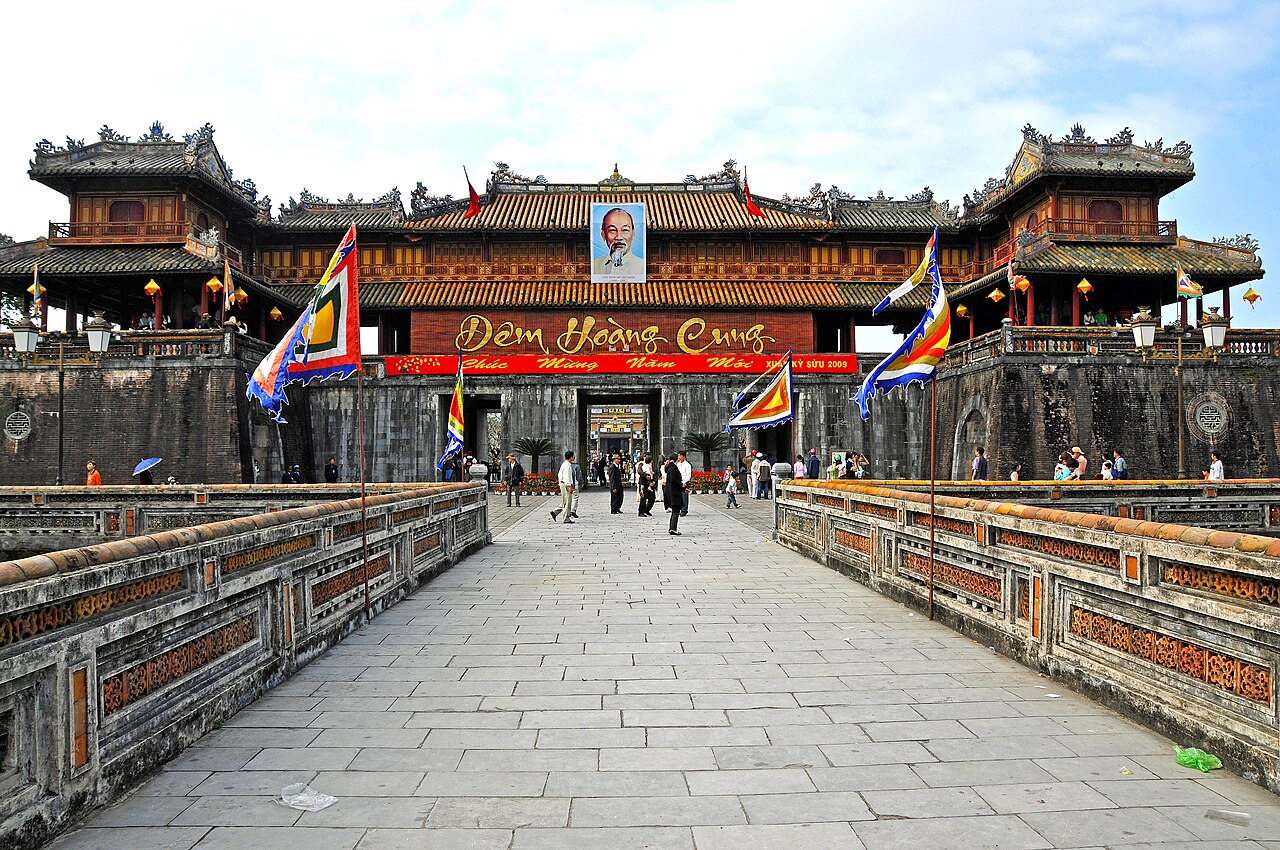
The Imperial City complex (Hoàng Thành) is the spatial and visual core of the Huế inscription: entered through the Ngọ Môn (Meridian Gate, five passage-ways surmounted by the Ngũ Phụng Pavilion “Five Phoenix Pavilion”, the site from which Emperor Bảo Đại announced his abdication on 25 August 1945 CE, ending the Nguyễn dynasty and the monarchy of Vietnam), the Imperial City’s primary axis leads north from the gate through the Thái Hoà Palace (Điện Thái Hoà, “Palace of Supreme Harmony”, the main ceremonial audience hall built 1833 CE, with a forward terrace of nine bronze urns representing the nine Nguyễn dynasty emperors up to the reign of Minh Mạng) to the Tử Cấm Thành (Forbidden Purple City, the innermost zone of the imperial compound, significantly damaged in the 1968 Tết Offensive and the 1975 fall of Huế, though the remaining structures — the Điện Cần Chánh audiences hall foundation, the Triệu Tổ Miếu ancestral temple — are being gradually restored by the Huế Monuments Conservation Centre). The Imperial City’s lateral courtyards contain a collection of nine dynastic bronze cannons (Cửu Vị Thần Công, “Nine Holy Cannons”, cast 1803–1804 CE from the melted-down weapons of the Tây Sơn dynasty defeated by Gia Long), each named for a season or a natural element; the bronze urns in the Thái Hoà Palace terrace (Cửu Đỉnh, “Nine Dynastic Urns”, cast 1835–1836 CE under Emperor Minh Mạng, each urn between 1.9 and 2.5 m in height and weighing between 1,900 and 2,601 kg, decorated with 162 relief images of Vietnamese landscapes, flora, fauna, and cultural objects) are among the finest examples of dynastic bronze casting in Southeast Asia and were inscribed on UNESCO’s Memory of the World Register in 2024 CE. The Thiên Mụ Pagoda (Chùa Thiên Mụ, “Heavenly Lady Pagoda”, approximately 4 km upstream on the Perfume River from the Huế citadel, accessible by river boat (龍船, 30 minutes from the Thuyền Rồng pier near the citadel’s south wall) or by road (approximately 10 minutes by bicycle or motorbike from the Ngọ Môn Gate), is the architectural landmark most closely associated with Huế in Vietnamese cultural consciousness — the seven-storey Phước Duyên Tower (福緣塔, 1844 CE, 21 m height, the most photographed building in Huế) rises above the Perfume River on a bluff at a meander that has been associated with auspicious geomantic properties since the founding of the Nguyễn lords’ capital at Huế in the 16th century.
South of the Perfume River (approximately 5–12 km from the Huế citadel, accessible by road via the Phú Xuân Bridge or upstream by river boat), the seven Nguyễn imperial mausoleums constitute one of the most extraordinary landscape-architecture ensembles in Southeast Asia: each emperor specified the design of his own mausoleum during his lifetime (a Vietnamese imperial tradition of commissioning the personal tomb as a leisure pavilion and meditation retreat before it became a funerary monument), resulting in seven distinct compositions each reflecting the individual emperor’s aesthetic sensibility and philosophical inclinations. The most visited is Tự Đức Mausoleum (Lăng Tự Đức, 8 km from Huế by road, 1864–1867 CE, the largest of the seven complexes at 475 m × 475 m, designed by Emperor Tự Đức himself as a poetic retreat with a lake, pavilions, lotus ponds, and bonsai-planted islands — the emperor is known to have spent hours in the lakeside Xung Khiêm Pavilion composing poetry, the form that Tự Đức believed was his most lasting achievement). Minh Mạng Mausoleum (Lăng Minh Mạng, 12 km from Huế by road or 45 minutes upriver by boat, 1840–1843 CE) is the most formally designed, with a geometric axis of ceremonial courts, marble terraces, stone guardian figure pairs, and a circular artificial lake (Minh Lâu Lake) leading to the circular burial tumulus — the most Sino-Vietnamese in character of the seven mausoleums, reflecting Minh Mạng’s documented admiration for Qing dynasty court culture and his emphasis on Confucian imperial orthodoxy as the foundation of Nguyễn legitimacy.
Practical information
Huế is accessible from Hanoi by train (approximately 14 hours, overnight sleeper recommended) or by Vietnam Airlines flight (approximately 1 hour, from Hanoi Nội Bài or Ho Chi Minh City Tân Sơn Nhất airports); by road, Huế is approximately 700 km south of Hanoi and 1,100 km north of Ho Chi Minh City, making it the central point of Vietnam’s UNESCO heritage trail. The Huế Monuments Conservation Centre issues a combined ticket (vé tổng hợp) covering the Imperial City, the Tự Đức Mausoleum, the Minh Mạng Mausoleum, and several other inscribed components — significantly cheaper than buying individual admission tickets and recommended for visitors spending more than half a day. The Imperial City (Đại Nội) is open daily 07:00–17:30, admission fee (reduced price after 15:00). For the imperial mausoleums, hiring a xe ôm (motorcycle taxi) or joining a half-day mausoleum tour from Huế city (available from all hotels and travel agencies) is more practical than attempting to visit independently, as the mausoleums are spread across a 12-km radius. Best visiting season: February–April (after the winter rains, before the summer heat — temperatures 20–28°C; the Huế Festival in April/June in even-numbered years brings cultural performance events throughout the Imperial City). Avoid visiting July–August (extreme heat, 38–40°C) and October–November (peak typhoon season, flooding common). The Đông Ba Market (Chợ Đông Ba, north bank of the Perfume River adjacent to the citadel’s east wall) is the primary traditional market of Huế and the best introduction to the regional cuisine (bún bò Huế beef noodle soup, bánh khoái crispy rice pancakes, nem lụi lemongrass pork skewers) before or after the monument visits.
Frequently Asked Questions
What was the Nguyễn dynasty and how did it unite Vietnam?
The Nguyễn dynasty (nhà Nguyễn, 1802–1945 CE) was Vietnam’s last ruling dynasty, founded by Nguyễn Ánh (Emperor Gia Long, r. 1802–1820 CE) after a decade-long war against the Tây Sơn dynasty — a peasant-rebellion-origin dynasty that had unified the previously divided Vietnamese territories in the late 18th century. Gia Long’s defeat of the Tây Sơn in 1802 CE and his proclamation of the empire of “Việt Nam” (the first time this name was used for the unified Vietnamese state, derived from the combination of the Chinese characters for south and Viet — a name Gia Long requested from the Qing emperor, who modified the original proposal “Nam Việt” because that name had been used by an ancient kingdom that China considered its tributary state) created the first territorial unification of modern Vietnam, from the Chinese border in the north to the Cà Mau Peninsula in the south. Gia Long’s political authority rested on two foundations: Vietnamese dynastic tradition (his claim as the descendant of the earlier Nguyễn lords who had governed the southern portion of Vietnam from Huế since the 17th century) and French military assistance (the Vietnamese Nguyễn prince had been helped to reconquer his territories by the French Bishop Pigneau de Béhaine, who organised a volunteer force of French officers and advisers that trained Nguyễn Ánh’s army in European fortification and artillery techniques — the French military presence that would later become the basis for France’s claim to a “civilising mission” in Vietnam). The Nguyễn dynasty’s 143-year rule (1802–1945) is the most contested period in Vietnamese historiography: North Vietnamese communist historical tradition portrays the Nguyễn emperors as collaborators with French colonialism (the dynasty survived by accommodating French control after 1883 under the status of a “protectorate” emperor with ceremonial functions), while southern Vietnamese and overseas Vietnamese diaspora historiography emphasises the dynasty’s cultural achievements, its patronage of Vietnamese literature and Confucian scholarship, and its physical legacy in the Huế monuments that constitutes the most tangible surviving evidence of Vietnamese imperial civilisation.
How was the Imperial City damaged in the 1968 Tết Offensive and what has been restored?
The Battle of Huế (31 January – 3 March 1968 CE) was the longest and most destructive single battle of the Vietnam War — 26 days of intense urban combat inside the Huế citadel between North Vietnamese and Viet Cong forces (who captured the city on the first day of the Tết Offensive and held it for 26 days) and US Marine and Army of the Republic of Vietnam forces. The battle caused massive damage to the Imperial City and Forbidden Purple City: the Tử Cấm Thành (Forbidden Purple City) lost approximately 60% of its buildings to artillery, fire, and ground combat, leaving the large central courtyard (Điện Cần Chánh, the Emperor’s daily audience hall) as a ruin, and the Thái Bình Lâu imperial reading library as a skeleton. Outside the citadel, the city of Huế suffered approximately 80% building destruction and more than 7,000 civilian deaths (including approximately 3,000–5,000 killed in the Huế Massacre, systematic killings of civilians and government officials by the North Vietnamese and Viet Cong occupying forces). The 1975 fall of Huế to North Vietnamese forces was peaceful by comparison (no battle in the city) but led to a period of neglect of the imperial monuments during the reunified Vietnam government’s first decades, when the imperial heritage was politically associated with the Nguyễn dynasty’s collaboration with French colonialism. UNESCO’s 1993 inscription initiated a sustained restoration programme: the Huế Monuments Conservation Centre (Trung tâm Bảo tồn Di tích Cố đô Huế) has progressively restored the Ngọ Môn Gate (restoration completed 2001), the Thái Hoà Palace (completed 2004), the Hữu Vu and Tả Vu lateral pavilions of the Imperial City’s inner court (completed 2011–2015), and the Hiển Lâm Các multilevel pavilion. The Forbidden Purple City remains largely unrestored, with the ruined foundations and surviving pavilion remnants preserved as an open archaeological landscape — a deliberate heritage management decision to maintain the ruins as authentic evidence of the war’s destruction rather than reconstructing buildings whose interior detail cannot be documented with certainty.
What is unique about the landscape design of the Nguyễn imperial mausoleums?
The Nguyễn imperial mausoleums (7 royal tomb complexes, 7 concubines’ tombs, and several princes’ tombs in the hills south of the Perfume River, all within a 15-km radius of the Huế citadel) are unique in the Southeast Asian imperial tomb tradition for their combination of Vietnamese geomantic siting, Chinese Confucian ceremonial spatial structure, and the individual emperor’s personal aesthetic vision expressed in garden design, poetry, and architectural ornament. The fundamental distinction from Chinese imperial tombs (such as the Ming and Qing tombs near Beijing, also UNESCO inscribed) is that each Nguyễn emperor designed his own mausoleum during his lifetime, treating the construction as both a funerary monument and a personal leisure retreat — most of the mausoleums were functional garden complexes used regularly by the living emperor before they became tombs, and several emperors composed the dedicatory poems, selected the tree species, and specified the placement of each pond and pavilion themselves. Emperor Tự Đức (r. 1848–1883 CE, the most literarily gifted of the Nguyễn emperors, who composed approximately 4,000 poems and spent years at the Lưu Khiêm Lake complex composing verse) expressed his aesthetic vision through a romantic lakeside garden with curved bridges, small islands planted with frangipani and magnolia, a bamboo theatre for private performances, and the Xung Khiêm Pavilion built over the water on a lotus-pond island — creating a Vietnamese adaptation of the Chinese literati garden tradition (文人园林, wenren yuanlin) that is explicitly unlike the formal Confucian ceremonial spaces of the Chinese imperial tomb tradition. Emperor Minh Mạng (r. 1820–1841 CE, the most Confucian-orthodox of the emperors) designed the Lăng Minh Mạng complex in the most formally structured manner — a bilateral axis of symbolic gates, ceremonial courtyards, stone parapets, and circular lake leading to the circular burial mound — reflecting his philosophical conviction that correct ceremonial spatial form was the necessary visible embodiment of proper Confucian imperial governance. The diversity of the seven mausoleums (from Tự Đức’s romantic garden to Minh Mạng’s ceremonial axis to Khải Định’s striking 1920s Art Deco and mosaic-ceramic decorated mausoleum, which integrates French colonial aesthetic influences with Vietnamese iconographic tradition) makes the Huế mausoleum ensemble the most aesthetically varied royal burial landscape in Asia.
Sources
- S1 — UNESCO World Heritage Centre — Complex of Hué Monuments (Ref. 678) — https://web.archive.org/web/20230601000000/https://whc.unesco.org/en/list/678/
- S2 — UNESCO World Heritage Centre — Statement of Outstanding Universal Value (Ref. 678) — https://whc.unesco.org/en/list/678/
Spotted an error? Write to editorial@culturalheritageonline.com and we correct it the same day.