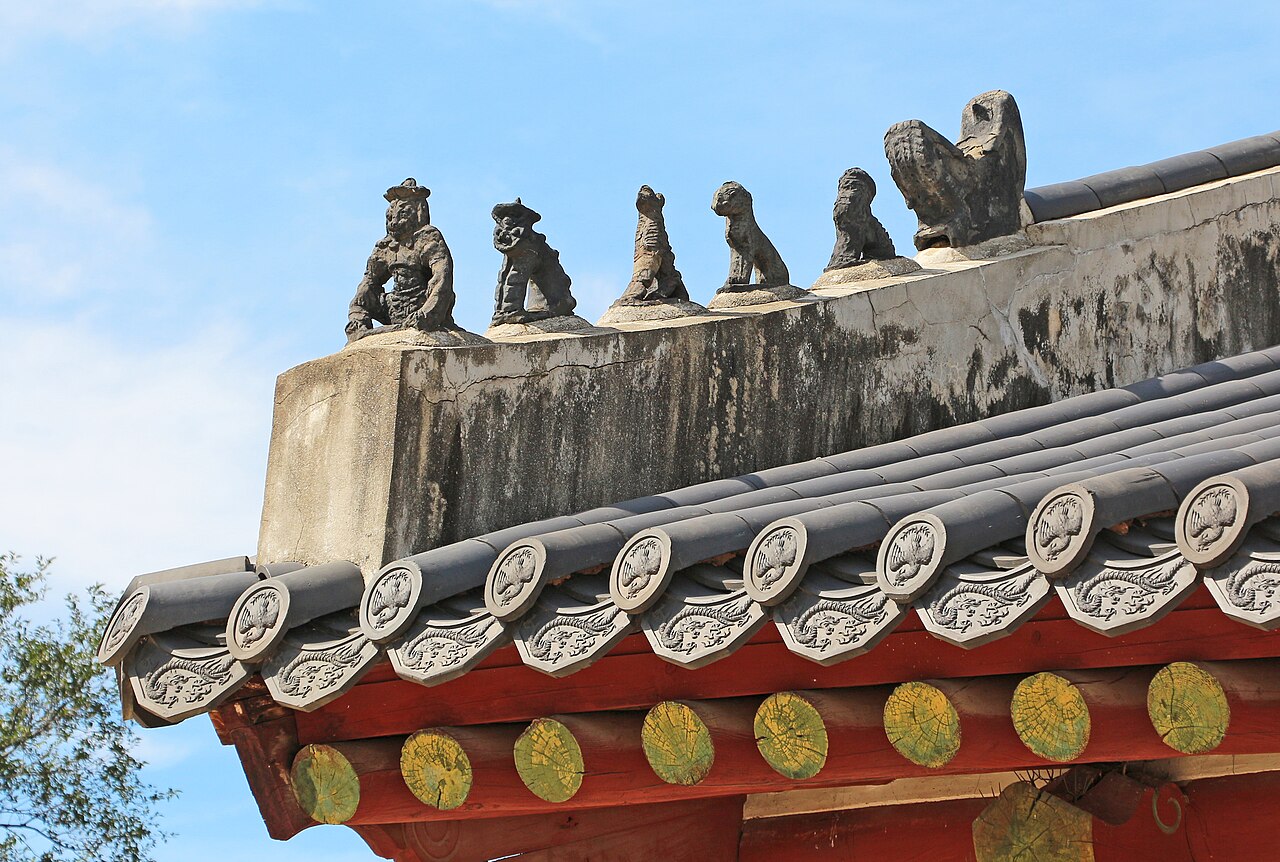
Jongmyo Shrine (종묘), inscribed by UNESCO in 1995, is the principal royal Confucian ancestral shrine of the Joseon dynasty (1392–1897 CE), located in central Seoul adjacent to Changdeokgung Palace and housing the spirit tablets of 19 Joseon kings and 30 queens in the Jeongjeon main hall — a 109-metre-long, single-storey wooden building with 19 chamber bays that is the longest wooden structure in Korea and one of the most architecturally austere royal buildings in East Asia, designed deliberately without ornamental detail so that the ancestral spirits housed within would not be distracted by material beauty. The associated Jongmyo Jerye ritual — a Confucian ancestral memorial ceremony first performed in 1394 CE, suppressed during the Japanese occupation (1910–1945), revived in 1969 and performed annually on the first Sunday of May — is the only surviving royal Confucian ancestral ritual of its original scale and completeness in East Asia, involving 64 participants in Joseon court robes performing choreographed ceremonial sequences to music played on a 600-year-old ensemble of bronze and stone instruments.
The Joseon royal heritage corridor in Seoul Changdeokgung Palace · Gyeongbokgung Palace · Bukchon Hanok Village — 0.5 to 1 km
Five Hundred Metres west of Jongmyo through the Changdeokgung Palace complex (창덕궁, inscribed UNESCO 1997 as “Changdeokgung Palace Complex”), the Secret Garden (Huwon, 후원) covers 78 of the palace’s 110 hectares with a landscape designed in deliberate contrast to the formal grid of Gyeongbokgung: winding paths through mature forest, 12 ponds of irregular shape, and 28 pavilions built at different periods from the 15th to the 19th century for specific royal leisure and scholarly functions. Changdeokgung served as the primary Joseon royal residence for 270 years (1615–1872 CE) after Gyeongbokgung was burned during the Japanese invasion of 1592 CE. Jongmyo and Changdeokgung together occupy the northeastern portion of the historic Joseon capital (Hanyang/Hanseong), and their juxtaposition — the ceremonial restraint of the shrine’s long unornamented hall against the refined naturalism of the palace’s forested garden — represents the duality of Joseon Confucian aesthetics in physical form. The walking connection between the two is direct: Jongmyo’s north entrance faces Changdeokgung’s south gate (Geumcheongyo Bridge), and the entire circuit (Jongmyo shrine precincts + Changdeokgung palace buildings + Huwon garden tour) can be covered in a single day. The Huwon garden tour (Korean-language guide only, timed entry, separate from palace admission) runs every 45 minutes from Changdeokgung’s ticket office.
One Kilometre west of Jongmyo along Jongno Street (the main commercial and ceremonial avenue of the Joseon capital, running east-west across central Seoul), Gyeongbokgung Palace (경복궁, “Palace of Shining Happiness”, constructed 1395 CE, the Joseon dynasty’s founding primary palace) anchors the western section of the Seoul UNESCO heritage cluster. Gyeongbokgung was the larger and more ceremonially significant palace but was burned in 1592, partially rebuilt, burned again in 1592–98, not restored until 1867–1872 CE, and used as a building site by the Japanese colonial government (which constructed the Japanese Government-General Building on the palace’s main axis, deliberately bisecting the palace’s ceremonial approach line, in 1926 CE; the building was demolished in 1995 CE as a Korean independence-restoration gesture). The present-day Gyeongbokgung complex (approximately 40% of the Joseon-era extent is reconstructed) contains the National Folk Museum of Korea and the National Palace Museum of Korea, and the daily Sumunjang Royal Guard Changing Ceremony (수문장교대의식) is performed at the Gwanghwamun Gate at 10:00 and 14:00. From Jongmyo, Gyeongbokgung is accessible by Seoul Metro Line 3 (Anguk Station) or on foot (approximately 20 minutes). Bukchon Hanok Village (북촌한옥마을), a neighbourhood of approximately 900 traditional hanok tile-roofed houses on the hill between Gyeongbokgung and Changdeokgung, occupies the same historic district and is the most intact surviving urban hanok residential quarter in Seoul.
Practical information
Jongmyo Shrine is located in Jongno-gu, central Seoul, adjacent to Jongno 3-ga Station (Seoul Metro Lines 1, 3, and 5). Opening hours: Wednesday–Monday 09:00–18:00 (19:00 in summer), closed Tuesday. The shrine is accessible only with a guided tour (Korean-language guide, approximately 45–60 minutes, departures at the hour); English-language audio guide available at the entrance. Admission fee applies; under-7 free. The Jongmyo complex consists of two distinct areas: the Jeongjeon (19-bay main hall housing the royal spirit tablets) and the adjacent Yeongnyeongjeon (supplementary hall housing ancestors not installed in the Jeongjeon, built 1421 CE, extended multiple times). The architecture’s austerity is total — no painted decoration on the exterior, grey tile roofs without colour, column bases without carved ornament — and visitors accustomed to the colour of Gyeongbokgung may find the experience disorienting in its deliberate bleakness. The annual Jongmyo Jerye ceremony (first Sunday of May) is open to public viewing; the ritual begins mid-morning and lasts approximately 3 hours, with the Jongmyo Jeryeak music (UNESCO Intangible Cultural Heritage) performed on reconstructed historic instruments including the pyeongyeong (stone chime), pyeongjong (bronze bell chime), and various wind and percussion instruments. Seoul’s major UNESCO-adjacent circuit from Jongmyo: Changdeokgung/Huwon (0.5 km) → Bukchon Hanok Village (1 km) → Gyeongbokgung (1.5 km) → Cheonggyecheon Stream restoration → Namsan Seoul Tower — a full-day walking circuit.
Frequently Asked Questions
What is the Jongmyo Jerye and how has it survived to the present day?
The Jongmyo Jerye (종묘제례, “Jongmyo Ancestral Rite”) is a Confucian memorial ceremony performed for the spirit tablets of the Joseon dynasty’s royal ancestors, classified by UNESCO as an Intangible Cultural Heritage of Humanity since 2001 and maintained in continuous performance by the Royal Ritual Preservation Society (Jongmyo Jerye Bojonhoe, an organisation of Joseon royal family descendants and Confucian scholars). The ceremony was first performed at Jongmyo in 1394 CE, immediately after the Joseon dynasty’s founding, and continued without interruption through the entire Joseon period (1392–1897 CE) — originally performed five times per year (spring, summer, autumn, winter, and a seasonal marker) with the full court in attendance. The Japanese colonial period (1910–1945) suppressed the ceremony as part of a policy of eliminating Korean royal institutions; it was revived in 1969 by a coalition of former court musicians, royal descendants, and cultural heritage advocates, and restructured to a single annual performance on the first Sunday of May. The Jongmyo Jerye involves 64 participants in Joseon period court robes performing three sequential ritual sections: a welcome ceremony for the ancestral spirits, the main offering ceremony (of food, silk, wine, and fragrant herbs), and a farewell ceremony. The ritual’s music (Jongmyo Jeryeak) is performed on a 64-instrument ensemble including stone chimes, bronze bells, drums, flutes, and string instruments — instruments first standardised in the court music bureau in 1464 CE and preserved in their original scale and temperament — making the Jongmyo Jeryeak the longest-running continuously performed court music tradition in East Asia. The choreographed dance (Ilmu, 佾舞, “Line Dance”) performed by two groups of 36 dancers — one performing civil dances with silk flowers and bamboo flutes (representing literary virtue), one performing military dances with wooden swords and shields (representing martial virtue) — is documented in a 1493 CE illustrated manual of court music and dance that still governs the performance to the present.
How does Jongmyo reflect Confucian architectural principles and how does it differ from Chinese and Japanese equivalents?
Jongmyo’s architectural design directly implements the Confucian ritual principle that ancestral shrines should be austere in order to concentrate the visitor’s attention on the moral and relational significance of the ceremony rather than on material beauty — a principle derived from the Zhouli (周禮, “Rites of Zhou”), the Zhou dynasty Chinese ceremonial manual that provided the theoretical foundation for Joseon Confucian ritual design. The Jeongjeon hall’s 109-metre continuous facade (the longest uninterrupted wooden elevation in Korea) represents the Joseon builders’ literal implementation of a Confucian prescription for linearity and order: each spirit tablet bay is identical, separated only by slightly projecting columns, with no hierarchical differentiation between bays (all 19 are equal in width and height) — a visual expression of the Confucian principle that all ancestral spirits deserve equal ceremonial respect regardless of the historical importance of the individual king. This is the most significant design difference from Chinese imperial ancestral shrines (the Beijing Imperial Ancestral Temple, Taimiao, uses a three-hall composition with a large central ceremonial hall and flanking subsidiary buildings, reflecting a hierarchical architectural composition), and from Japanese imperial shrines (which use a symbolic single small sanctuary building surrounded by natural forest rather than a single elongated ceremonial structure). The Korean Joseon design’s insistence on strict linearity and the absence of ornament reflects a more radical implementation of Confucian austerity than the Chinese or Japanese equivalents — the Joseon neo-Confucian reformers who designed the dynasty’s ceremonial architecture in the 14th–15th centuries were explicitly critical of the Chinese court’s accommodation of Buddhist and Daoist visual elements in ceremonial contexts, and the stripped-down grey-tile severity of Jongmyo reflects their determination to implement a pure Confucian ceremonial aesthetic.
What is the relationship between Jongmyo and the Changdeokgung Palace Complex UNESCO inscription?
Jongmyo and Changdeokgung are inscribed as separate UNESCO World Heritage sites (Jongmyo in 1995, Changdeokgung in 1997) despite being adjacent and functionally interconnected within the Joseon ceremonial landscape — a situation that reflects the sequential nature of UNESCO inscription rather than a classification of the two sites as architecturally or historically separate. The functional connection is deep: Jongmyo was founded by the first Joseon king (Taejo, r. 1392–1398 CE) in 1394 CE as the ceremonial heart of the new dynasty, constructed on the right side (east, the honored direction in Confucian spatial logic) of the planned capital Hanyang before the palaces were completed; Changdeokgung was constructed in 1405 CE by Taejong (r. 1400–1418 CE) on the same ridge as Jongmyo, with a secondary gate in Changdeokgung’s southern wall that allowed the royal family to move between palace and shrine without leaving the protected estate. The Huwon (Secret Garden) was developed as a private royal retreat from the 17th century onward in the forest north of the palace buildings, and the contrast between the Huwon’s intimate naturalism (irregular ponds, pavilion clusters, forested hills, the royal rice field Chunhyang-gak where the king performed ceremonial planting) and Jongmyo’s open ceremonial austerity (long, unadorned, linear, open to view) represents a deliberate aesthetic counterpoint within the Joseon royal estate — work and ceremony on one side, rest and contemplation on the other, separated by a 10-minute walk through the connecting gate. The two sites together cover approximately 120 hectares of the central Jongno district and constitute the most intact survival of a pre-20th-century royal ceremonial estate in a major East Asian capital city.
Sources
- S1 — UNESCO World Heritage Centre — Jongmyo Shrine (Ref. 738) — https://web.archive.org/web/20230601000000/https://whc.unesco.org/en/list/738/
- S2 — UNESCO World Heritage Centre — Statement of Outstanding Universal Value (Ref. 738) — https://whc.unesco.org/en/list/738/
Spotted an error? Write to editorial@culturalheritageonline.com and we correct it the same day.