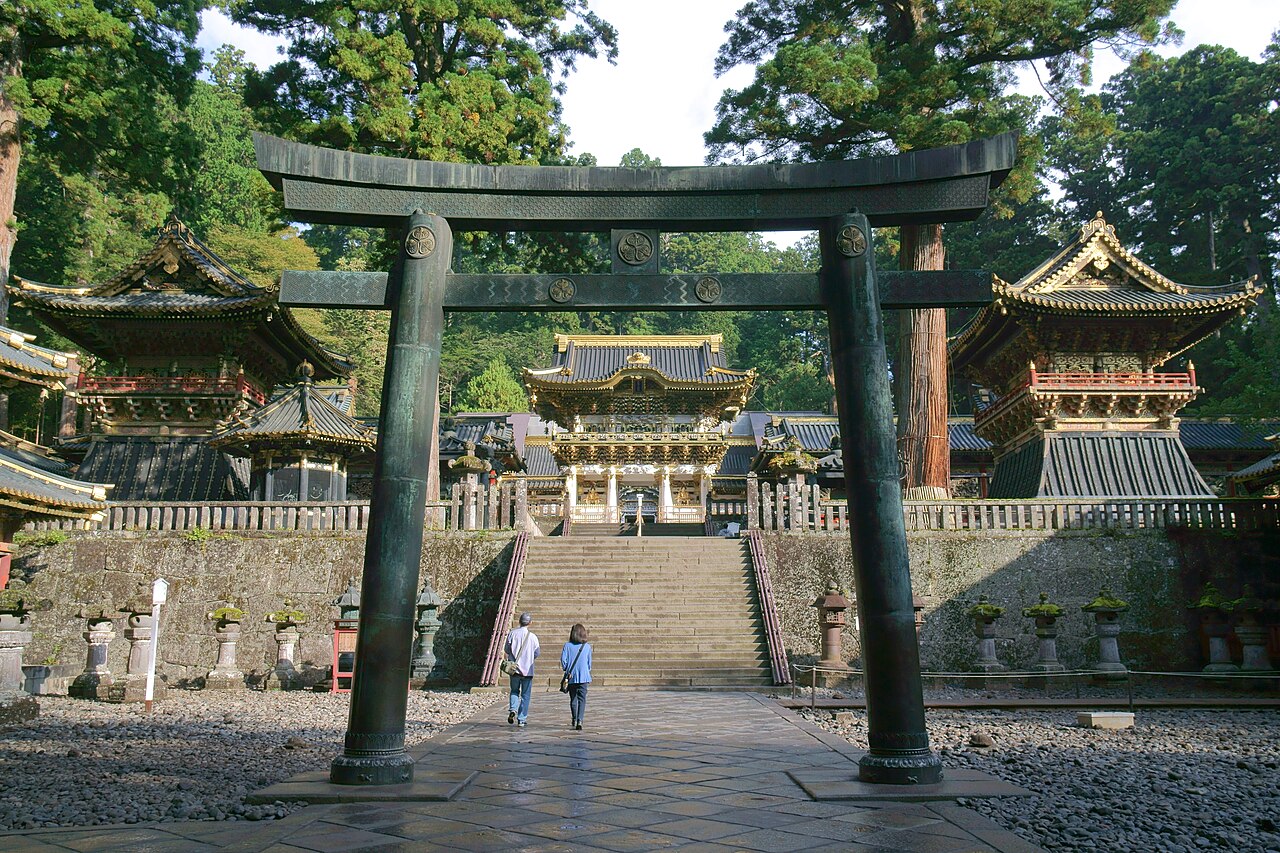
The Shrines and Temples of Nikko, inscribed by UNESCO in 1999, comprise 103 structures built between 1617 and 1636 CE in the mountains of Tochigi Prefecture to enshrine the founder of the Tokugawa shogunate, Tokugawa Ieyasu. The Toshogu Shrine complex applied 2.5 million sheets of gold leaf to a single mausoleum and employed 15,000 artisans over two years; the Three Wise Monkeys carved over the Sacred Stable — see no evil, hear no evil, speak no evil — remain the most reproduced motif in Japanese decorative art.
The Kanto region and Chubu within reach Gunma · Tokyo · Niigata · Shizuoka — 75 to 220 km
Seventy-five kilometres west of Nikko by local train to Maebashi and connecting services, the Tomioka Silk Mill and Related Industrial Heritage in Gunma Prefecture represents Japan’s entry into 19th-century global manufacturing. The silk mill was established in 1872 by the Meiji government as a model factory, using French machinery and French engineers recruited to transfer the technology of mechanical silk reeling to Japanese workers. The main building — the Cocoon Warehouse, the East and West Filature buildings — was constructed of red brick with French-Japanese timber framing on a plan drawn by the French engineer Paul Brunat; the brick was fired locally, the lime was sourced from Nirayama in Shizuoka, and the raw silk supply was organized from sericulture villages across the Gunma basin. Within 10 years, Japanese enterprises were copying and improving the French machinery, and by 1910 Japan had become the world’s largest silk exporter. The inscription covers not only the Tomioka mill itself but three related sites in Gunma that formed the upstream supply chain: the Tajima Yahei Sericulture Farm, the Takayama-sha Sericulture School, and the Arafune Cold Storage Facility used to suspend the silk-moth egg hatching cycle. From Nikko, the mill is reached by Tobu Nikko Line to Shinjuku (2 hours) and Joshin Dentetsu Line from Takasaki to Tomioka (30 minutes), or by a private car in approximately 90 minutes via Route 122 and the Kan-Etsu Expressway.
One hundred twenty kilometres south of Nikko by Tobu Nikko Limited Express to Asakusa (90 minutes) and subway, the National Museum of Western Art in Tokyo connects Japan’s heritage landscape to a unique piece of European architectural history. The museum, completed in 1959 by Le Corbusier, is one of 17 buildings across 7 countries that were inscribed together in 2016 as “The Architectural Work of Le Corbusier, an Outstanding Contribution to the Modern Movement.” The Tokyo museum is the only Le Corbusier building in Asia and the only one completed under his direct supervision in a country he never visited; the building was designed at Le Corbusier’s Paris studio as part of a postwar agreement under which France returned to Japan a collection of French Impressionist and Post-Impressionist works held in Japan since before the war. The museum’s exterior promenade ramp, the pilotis raising the building above the Ueno Park ground, and the rooftop sculpture garden are all consistent with Le Corbusier’s Carpenter Center at Harvard and the Chandigarh Capitol Complex — the same modular system applied to a Japanese climate and a Japanese collection context. The Ueno park surrounding the museum holds the Tokyo National Museum, the National Museum of Nature and Science, and several other national collections, making the complex a practical half-day extension to a Nikko visit.
One hundred ninety kilometres northwest of Nikko by Shinkansen from Utsunomiya to Nagaoka and ferry from Naoetsu or Niigata, the Sado Island Gold Mine (inscribed in 2024) is Japan’s most recent UNESCO World Heritage addition. The mine on Sado Island in the Sea of Japan produced gold from the 17th century through 1989 CE, supplying the Edo-period Tokugawa mint with the gold for the oban and koban coins that circulated as the shogunate’s highest-denomination currency. The mine tunnels were driven into the Nishimikawa gold deposit by Edo-period techniques: hand drilling with chisels, dewatering with waterwheels, and ore processing by amalgamation. What distinguishes the Sado inscription is the survival of the complete industrial sequence from ore extraction to gold refining, along with the townscape of Aikawa — the mining town that grew to 100,000 residents at peak production and retains its Edo-period merchant district. From Nikko, Sado is most practically reached by Shinkansen from Utsunomiya to Nagaoka (approximately 2 hours), connecting ferry from Naoetsu to Ryotsu (2.5 hours by jet ferry) or by direct Shinkansen to Niigata and ferry from Niigata (1 hour by jet ferry).
Two hundred twenty kilometres south of Nikko, in Izunokuni City in Shizuoka Prefecture, one component of the Sites of Japan’s Meiji Industrial Revolution lies closer than any other part of that inscription. The Nirayama Reverberatory Furnaces, built in 1857 under the direction of the Egawa clan, were the first successful reverberatory furnaces constructed in Japan — a Western technology for melting iron ore that the Tokugawa government urgently needed to cast cannon in response to American and Russian naval pressure. The four Nirayama furnaces were operational within eight months of beginning construction, based on Dutch technical manuals translated by Japanese scholars, and they produced the first successful iron cannon cast in Japan without direct Western technical supervision. The furnaces operated for only two years before being made obsolete by the Meiji industrial revolution’s access to superior British and German technologies, but their survival intact — unusually for Meiji-period industrial sites — justified their inclusion as the inscription’s most physically accessible component. From Nikko, Nirayama is reached by Shinkansen from Utsunomiya to Mishima (approximately 2 hours) and Izu-Hakone Railway to Mishima Tamachi (5 minutes walk).
North along the Tohoku corridor Iwate · Aomori · Hokkaido — 350 to 900 km
Three hundred fifty kilometres north of Nikko by Tohoku Shinkansen from Utsunomiya to Ichinoseki (approximately 90 minutes), the Hiraizumi UNESCO inscription preserves the remnants of the only serious political rival to Kyoto’s imperial cultural dominance during the Heian period. Hiraizumi, the capital of the Fujiwara of the North (Oshushu Fujiwara), held at its 12th-century peak a population of 100,000 and was described by the Chinese traveller Xu Jing as the equal of the Heian capital. The Motsuji Temple garden, the most completely preserved 12th-century garden in Japan, was designed according to Pure Land Buddhist cosmological principles: a central pond representing the lotus-covered lake of Amida’s paradise, with garden islands, approach bridges, and surrounding halls arranged to evoke the Western Pure Land during garden ceremonies. The Konjikido (Golden Hall) of Chuson-ji, the centrepiece of the inscription, is a small structure entirely covered in gold leaf inside and out, with the mummified remains of four Fujiwara lords interred beneath the altar — the only surviving intact Fujiwara-period structure. The Oshushu Fujiwara dynasty was destroyed by Minamoto no Yoritomo in 1189 CE, and Hiraizumi’s political moment lasted barely 100 years; what survives is remarkable precisely because the subsequent 800 years of neglect by the Kamakura and later shogunates prevented redevelopment.
Four hundred to eight hundred kilometres north by Tohoku Shinkansen to Shin-Aomori and local connections, the Jomon Prehistoric Sites in Northern Japan constitute the largest archaeological UNESCO inscription in Japan’s history. The 17 component sites, inscribed in 2021, preserve evidence of the Jomon culture — Japan’s pre-ceramic and then ceramic hunter-gatherer tradition — across a 10,000-year span from approximately 13,000 BCE to 300 BCE. The Sannai Maruyama site in Aomori City, the best-known component, documents a village occupied for approximately 1,700 years (3900–2300 BCE) with a population estimated at 500 at its peak; excavations have recovered the postholes of a six-pillared structure nearly 15 metres high, whose function remains debated — a watchtower, a warehouse, or a ritual structure. The Jomon people developed the world’s oldest known pottery (dated to approximately 16,000 BCE in Aomori, though this pre-dates the UNESCO inscription’s core period) and maintained complex long-distance trade networks for jade, obsidian, and amber across Honshu and Hokkaido. The Oshoro Circle near Otaru in Hokkaido, one of the inscription’s northernmost components, is a stone circle comparable in scale and construction period to the earliest phases of Stonehenge. From Nikko, the Aomori components of the inscription are reached by Tohoku Shinkansen from Utsunomiya to Shin-Aomori in approximately 2.5 hours.
Five hundred kilometres north of Nikko in the mountains of Aomori and Akita Prefectures, the Shirakami-Sanchi natural UNESCO site covers 169,700 hectares of temperate virgin beech forest — the largest surviving stand of primeval Siculo-Japanese beech in East Asia, inscribed in 1993. The forest has no access roads, no facilities within the core zone, and receives fewer than 100,000 visitors per year; the Tsugaru Shirakami hiking route follows the ridgeline along the western slopes and requires a full day’s walk between refuge huts. Shirakami-Sanchi is notable in Japan’s UNESCO landscape for being inscribed before the country had developed a clear precedent for natural site management under UNESCO standards; its inscription in 1993 alongside the cultural Horyu-ji and Himeji inscriptions constituted Japan’s first submission cycle and established the administrative framework that all subsequent Japanese submissions followed. From Nikko, the forest is reached by Tohoku Shinkansen from Utsunomiya to Shin-Aomori and JR Gono Line local trains toward Hirosaki (total journey approximately 3.5 hours to the trailhead towns).
Nine hundred kilometres north of Nikko, the Shiretoko Peninsula in Hokkaido is one of the world’s few remaining wilderness areas where polar pack ice extends to a temperate-latitude coastline. Inscribed in 2005, the site encompasses 71,100 hectares of peninsula and 37,780 hectares of adjacent sea, forming one of the most productive marine ecosystems in the North Pacific: the combination of nutrient-rich sea ice melt in spring and the warm Tsushima Current creates a phytoplankton bloom that feeds a food chain from capelin to brown bears, Steller’s sea eagles, and sperm whales. The brown bear population on Shiretoko is the densest in Japan; the peninsula’s rivers are documented spawning grounds for eight salmon species simultaneously. Access from the mainland is limited to the port of Utoro on the western coast and the road to Rausu on the eastern coast; no road crosses the peninsula itself, and the northern tip is accessible only by boat or helicopter. From Nikko, Shiretoko requires a Shinkansen to Tokyo, connecting Shinkansen to Shin-Hakodate-Hokuto and a further train to Abashiri or Kushiro, with local bus to Utoro — a total journey of approximately 8 hours from Nikko.
Practical information
Nikko is reached from Tokyo by two competing rail lines: the Tobu Nikko Line (Tobu Asakusa to Nikko, 110 minutes direct or 130 minutes with change, Tobu Specia pass required) and JR (Tokyo Station to Nikko via Utsunomiya on Shinkansen and local connection, approximately 110 minutes total). The Tobu line is generally cheaper and more frequent for day trips from Tokyo; the JR route is more useful for visitors with a JR Pass continuing to Tohoku. The Toshogu Shrine complex opens at 8:00 and closes at 17:00 (16:00 November to March). Entry to the Toshogu main compound, the Rinnoji Temple, and the Futarasan Shrine are purchased separately; a combined pass covers the major structures. The Yomeimon Gate — the most elaborately decorated structure, with 508 relief carvings of animals, flowers, and sages — is the principal architectural attraction. The cedar avenue leading to the shrines was planted in 1625 by the feudal lord Matsudaira Masatsuna and extends for 37 kilometres, now a nationally designated Natural Monument. Nikko can be covered in a single full day from Tokyo but rewards an overnight stay that allows an early morning start at the Toshogu before tour groups arrive.
Frequently Asked Questions
Why was the Toshogu Shrine built with such extraordinary decoration for a shogunal mausoleum?
Toshogu was built for Tokugawa Ieyasu, the founder of the Tokugawa shogunate, following his death in 1616 CE, on the instructions of his grandson Tokugawa Iemitsu. The scale and ornamentation — 2.5 million sheets of gold leaf on a single complex, 508 carved reliefs on the Yomeimon Gate alone, 15,000 artisans employed over two years — served a specific political purpose: to establish Ieyasu as a divinity on par with the great Shinto shrine deities, thereby grounding the Tokugawa dynasty’s right to govern in supernatural as well as military authority. The posthumous religious title granted to Ieyasu — Tosho Daigongen, the “Great Incarnation Illuminating the East” — elevated him to the status of a manifestation of a Buddha and a Shinto deity simultaneously, under the honji-suijaku framework of Buddhist-Shinto synthesis. The building style, known as Gongen-zukuri, was developed specifically for the Toshogu shrine complex and combines elements of Buddhist temple architecture with Shinto shrine forms in a way that had no exact precedent. The Three Wise Monkeys carved over the Sacred Stable, housing the white horses kept for the enshrined deity, were part of a series of eight relief panels depicting the life lessons of a virtuous life; the monkey panels, based on a Tendai Buddhist moral philosophy associating primates with human conduct, became the most reproduced motif in Japanese decorative art through centuries of woodblock-print reproduction.
How does Nikko’s location in Tochigi affect its connections to other UNESCO sites?
Nikko sits at the northern edge of the Kanto plain, 120 kilometres north of Tokyo, in a geographic position that makes it the gateway to the Tohoku UNESCO corridor rather than a node in the dense Kansai network. South and east lie Tokyo and the flat Kanto plain, where the National Museum of Western Art and the Meiji Industrial Revolution sites at Nirayama in Shizuoka are the closest UNESCO destinations. North and northeast, the Tohoku Shinkansen from Utsunomiya (30 minutes from Nikko by JR) connects to Hiraizumi (90 minutes from Utsunomiya) and Shin-Aomori (150 minutes), from which the Jomon Prehistoric Sites and the Shirakami-Sanchi beech forest are accessible. Westward, Tomioka Silk Mill in Gunma requires approximately 2 hours by local rail or 90 minutes by car, making it a practical companion for a Nikko visit extended to two days. The consequence is that Nikko is most logically visited either as a day trip from Tokyo on its own or as the southern anchor of a Tohoku heritage circuit, rather than as part of the Kansai or Chubu circuits that connect most of Japan’s other cultural UNESCO sites. A Japan Rail Pass (7 or 14 days) is recommended for anyone combining Nikko with Hiraizumi and the Jomon sites in a single trip, as the Tohoku Shinkansen distances accumulate quickly without rail coverage.
What is the best time of year to visit Nikko?
Nikko’s autumn foliage season — typically mid-October to mid-November — is consistently ranked among Japan’s finest and draws the largest crowds of any season. The mountain setting at 600 metres elevation means the colours arrive two to three weeks earlier than in Tokyo, and the combination of red maples against the gold-leafed Toshogu structures and the green cedar avenue is distinctive. Spring (April) sees cherry blossoms along the river approach and the Daiyagawa gorge, with smaller crowds than autumn. Summer (July–August) is Nikko’s high-activity period for hiking in the Okunikko mountain area: Chuzenji Lake, Kegon Falls (a 97-metre single-drop waterfall), and the Senjogahara marshland on the Oku-Nikko plateau provide a full day of natural heritage separate from the shrine complex. Winter is the quietest season; snow falls regularly from December, and the cedar avenue and Toshogu courtyard under snow offer unusual photography conditions, but some secondary structures may close for maintenance. The shrine complex is open year-round; the Oku-Nikko highland is most accessible June through October.
Sources
- S1 — UNESCO World Heritage Centre — Shrines and Temples of Nikko (Ref. 913) — https://web.archive.org/web/20230601000000/https://whc.unesco.org/en/list/913/
- S2 — UNESCO World Heritage Centre — Statement of Outstanding Universal Value (Ref. 913) — https://whc.unesco.org/en/list/913/
Spotted an error? Write to editorial@culturalheritageonline.com and we correct it the same day.