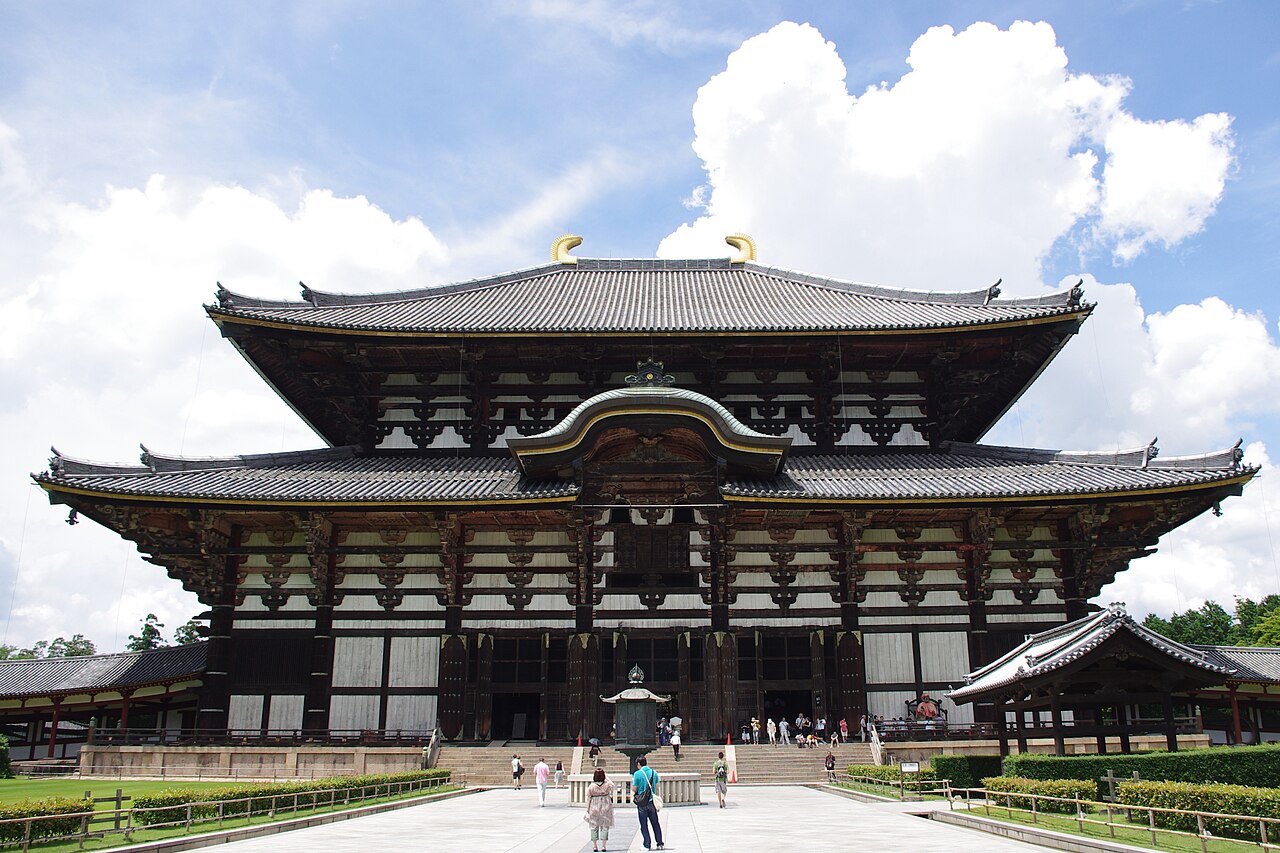
The Historic Monuments of Ancient Nara, inscribed by UNESCO in 1998, cover eight properties in Japan’s first permanent capital: Buddhist temples, Shinto shrines, and a palace site built during the 74 years that the court resided in Heijo-kyo between 710 and 784 CE. Nara’s Todai-ji houses the largest bronze Buddha in Japan within the largest wooden building in the world; the 752 CE dedication ceremony was attended by 10,000 monks from 60 countries, making it Japan’s largest international gathering to that date.
The Yamato plain and Kinki corridor Ikaruga · Osaka · Kyoto — 10 to 50 km
Ten kilometres southwest of Nara by JR Yamatoji Line, the Buddhist Monuments in the Horyu-ji Area in Ikaruga contain the oldest surviving wooden buildings on earth. Prince Shotoku, who authored Japan’s first constitution in 604 CE and formally established Buddhism as a state religion, founded the complex in 607 CE; after a fire in 670 CE destroyed the original, the West Precinct was rebuilt in the early 8th century. The Five-Storey Pagoda rests on a central pillar that is not structurally joined to the surrounding five floors: the pillar drops freely in a pit while the floors sway around it during earthquakes, absorbing lateral energy without transmitting it between levels. This shinbashira principle was adopted by the engineers of Tokyo Skytree in 2012 as the mechanical basis of the tower’s earthquake-resistance system. The Kondo (main hall) holds Japan’s earliest bronze triad — the Shaka Triad cast by Tori Busshi in 623 CE — still on its original altar platform. Horyu-ji is most efficiently reached from Nara by JR Yamatoji Line (10 minutes to JR Horyuji Station), making a morning at Nara and an afternoon at Horyu-ji a natural pair without requiring an overnight change of base.
Forty kilometres north by JR Nara Line or Kintetsu Kyoto Line, the 17 properties of the Historic Monuments of Ancient Kyoto span the millennium from 794 CE — when the court moved north from Nara — to the Edo period. The Nara monuments and the Kyoto monuments together document the two foundational phases of Japanese Buddhist state architecture, with Nara representing the Chinese Tang-influenced ambition of the 8th century and Kyoto demonstrating the subsequent domestication and elaboration of that tradition into distinctly Japanese forms. The Byodoin Phoenix Hall in Uji, part of the Kyoto inscription, was completed in 1053 CE during the Heian cultural peak and represents the apogee of Japanese Pure Land Buddhist architecture; its reflection in the central pond and its bronze roof-terminal birds appear on the Japanese 10-yen coin. Nijo Castle in central Kyoto, built in 1603 for the first Tokugawa shogun, represents the opposite social register from Nara’s state temples: private, defensive, secular, and equipped with floor mechanisms that squeaked under footstep pressure to prevent silent approach. The combination of Nara and Kyoto monuments on the same JR pass, separated by 45 minutes, makes the two inscriptions effectively one extended circuit.
Forty-five kilometres west-northwest of Nara via JR to Osaka, the Mozu-Furuichi Kofun Group in Osaka Prefecture frames the pre-Buddhist Japanese world that the Nara period supplanted. The 49 burial mounds, inscribed in 2019, were built between the 3rd and 6th centuries CE — the period immediately before and during the arrival of Buddhism from the Korean Peninsula’s Baekje kingdom. Nintoku-tenno-ryo Kofun, the largest mound, measures 486 metres in total length and carries three concentric moats, its total footprint exceeding the Great Pyramid of Giza. The keyhole shape — a round mound joined to a trapezoidal forecourt — is unique to the Japanese Kofun culture; it appears across all 49 mounds without exception and has no parallel in Chinese or Korean burial architecture of the same period. The Imperial Household Agency administers the mounds as imperial property and restricts interior access; the forested tumuli are visible from designated viewpoints along the outer moat path. The Kofun Group’s position in the chronology — representing the pre-Buddhist aristocratic tradition that Buddhism would absorb, adapt, and ultimately subordinate — makes it a meaningful companion to the Nara monuments for anyone tracing the formation of Japanese culture.
Eighty kilometres south of Nara by local rail through the Yoshino valley, the Sacred Sites and Pilgrimage Routes in the Kii Mountain Range connect the court Buddhism of Nara’s temples to the mountain asceticism that coexisted with and ultimately outlasted it. The three Grand Shrines of Kumano — Hongu Taisha, Nachi Taisha, and Hayatama Taisha — incorporated Buddhist bodhisattvas as local manifestations (honji-suijaku theory) during the Heian period, creating a syncretic tradition accessible to both Buddhist and Shinto devotees. Emperor Gotoba completed the Kumano pilgrimage 32 times; the trail south from Kyoto passed through Nara and Yoshino, and the cherry-blossom mountain of Yoshino — covered in approximately 30,000 wild trees — remains an integral part of the pilgrimage landscape even though Yoshino itself is not individually inscribed. The Kii inscription’s northern sector, Mount Koya, holds the Okunoin cemetery with 200,000 stone markers accumulated since 835 CE around the mausoleum of the founder Kukai. From Nara, the Yoshino sector of the inscription is reached by Kintetsu to Yoshino in approximately 80 minutes; Koyasan is reached via Osaka and the Nankai Koya Line.
West to the Seto Inland Sea and beyond Himeji · Hiroshima · Shimane — 70 to 510 km
Seventy kilometres west of Nara via Shinkansen from Shin-Osaka, Himeji Castle stands as the sharpest available contrast to Nara’s Buddhist monuments. The eight properties in the Nara inscription were all built within a single generation as expressions of imperial piety; Himeji was planned as a machine for killing attackers and completed in 1609 at the instruction of a Tokugawa vassal following the Battle of Sekigahara. The 83-building complex was designed around three concentric defensive rings, each with its own gates, walls, and fields of fire; an attacker entering through the outermost gate would pass through at least three more gates before reaching the main tower, each passage engineered to confuse direction and expose the approach to defenders firing from above. The castle’s white-plastered exterior — white plaster over a wooden frame over a stone base — was designed for fire resistance, not ornament; it was never breached in four centuries of ownership by 48 different lords. From Nara, Himeji is reached via JR Yamatoji to Osaka (40 minutes) and Shinkansen westward (30 minutes).
Three hundred sixty kilometres west of Nara by Shinkansen from Shin-Osaka to Hiroshima (90 minutes), the pair of Hiroshima UNESCO inscriptions represent the full historical arc of the Seto Inland Sea coast. Itsukushima Shrine on Miyajima Island stands over a tidal channel 20 minutes from Hiroshima by rail and ferry; the 16-metre O-torii gate has been rebuilt eight times since the 6th century, most recently in 1875, and now stands on a sand flat that visitors can walk to at low tide. The Hiroshima Peace Memorial preserves the ruins of the 1915 Industrial Promotion Hall, the only structure within 600 metres of the atomic bomb’s detonation point on 6 August 1945 that remained structurally upright; the dome was preserved specifically unreconstructed by city resolution and maintains that state under UNESCO designation. The Peace Memorial Museum requires at least 2 hours to engage seriously and closes at 18:00 (later in summer). Many visitors from Nara overnight in Hiroshima to accommodate both properties at appropriate pace before returning east or continuing west.
Five hundred ten kilometres west of Nara, the Iwami Ginzan Silver Mine and its Cultural Landscape in Shimane Prefecture was the world’s most productive silver source in the 1580s. The mine supplied an estimated one-third of global silver output during peak extraction and connected premodern Japan directly to early-modern global trade through Portuguese and Dutch merchants at the ports of Hakata and Sakai. The UNESCO inscription values not merely the mine shafts — 700 of them drilled into the mountain — but the complete operational landscape: the valley processing facilities below, the forested ore-extraction zone on the mountain slopes, and the preserved port-route town of Tomogaura at the estuary. Fifty-three shrines and temples recorded within the site boundaries reflect the wealth generated at peak activity, when the area’s population reached 200,000. From Nara, the mine is reached via Shinkansen from Shin-Osaka to Hiroshima (90 minutes) and limited express from Hiroshima to Oda City (80 minutes), with a bus to Omori Ginzan (15 minutes).
Practical information
Nara is served by two rail lines from Osaka and Kyoto: the JR Nara Line from Kyoto (45 minutes to JR Nara Station) and the Kintetsu Kyoto Line from Kintetsu-Kyoto Station to Kintetsu Nara (35 minutes). From Osaka, JR Yamatoji Line from Osaka-Tennoji to JR Nara (40 minutes) and Kintetsu Nara Line from Osaka-Namba to Kintetsu Nara (35 minutes) are both available. The eight UNESCO properties are distributed across the city and its immediate surroundings; Todai-ji, Kasuga Taisha, and Kofukuji are within a 20-minute walk of Kintetsu Nara Station, while the Nara Palace Site requires a further 20-minute walk or bus ride west. Entry to most temple grounds is paid separately. The Nara deer park requires no entry fee; deer crackers (shika senbei) are sold by vendors for a small fee and the deer are habituated to begging for them. Nara is best visited outside the summer peak (July–August) when temperatures regularly exceed 35°C; spring cherry blossoms and autumn foliage periods are crowded but manageable compared with Kyoto’s equivalent pressure. A JR Kansai Area Pass covers both the JR Nara Line and the Yamatoji Line onward to Horyu-ji.
Frequently Asked Questions
Why is Todai-ji’s Great Buddha Hall described as the world’s largest wooden building if it was rebuilt at a reduced scale?
Todai-ji’s Great Buddha Hall (Daibutsuden) holds the title of largest wooden building in the world by floor area in its current form — 57 metres wide, 50 metres deep, and 49 metres high — despite being rebuilt at approximately two-thirds the original floor plan after two fires destroyed the Tang-period original. The hall burned in 1180 CE during the Genpei War and was rebuilt in 1199 CE; it burned again in 1567 CE during the Miyoshi clan’s attack on Nara and was rebuilt in its current form in 1709 CE. The 1709 rebuilding reduced the hall’s width and depth to approximately two-thirds of the 8th-century original — a constraint imposed by the limited timber supply available in the Edo period — while maintaining sufficient interior volume to house the 15-metre bronze Great Buddha. No other standing wooden building in the world exceeds its current dimensions. The original 8th-century hall, if it had survived intact, would have been approximately 1.5 times wider than the existing building. The Great Buddha itself, cast between 743 and 752 CE, consumed 437 tonnes of bronze, 130 kg of gold, and 7 tonnes of vegetable wax; the casting required 51 repetitions of a partial-pour technique and employed 370,000 workers over the construction period according to contemporary records. The statue has been repaired and partially recast multiple times, but approximately 30% of the original 8th-century casting survives in the lower torso and base.
Are the 1,200 deer in Nara Park genuinely under legal protection?
Yes. The sika deer of Nara Park are designated National Natural Monuments under the Law for the Protection of Cultural Properties, a status that makes harming them a criminal offence. The protection has deep historical roots: under the Kasuga Grand Shrine’s religious administration during the Nara period, the deer were regarded as divine messengers (shika) of the deity Takemikazuchi-no-mikoto, who legend holds arrived at Kasuga Taisha riding a white deer from Kashima Shrine in 768 CE. Killing a Kasuga deer was historically punishable by death — a regulation maintained through the feudal period even as the rest of the Nara Buddhist establishment’s temporal authority was curtailed. The Meiji government’s 1871 separation of Buddhism from Shinto removed the formal religious protection, but local regulation and eventually national law maintained the protected status. The deer population is managed by the Nara Deer Preservation Foundation, which monitors numbers, treats injured animals, and mediates the occasional deer-human incident — the animals are completely habituated to humans and have learned to bow their heads in exchange for the crackers vendors sell in the park. In recent years, the Nara Deer Management Organization has also worked to address the deer’s habit of eating plastic bags discarded by tourists, which has caused digestive fatalities.
What distinguishes the Nara period’s Buddhist architecture from the Kyoto period’s temples that followed?
The Nara period (710–794 CE) Buddhist architecture was modelled directly on Tang Chinese prototypes: large, symmetrical compounds with a central axis, massive principal halls, multi-storey pagodas, and a deliberate emphasis on scale as a demonstration of state power. The Great Buddha Hall at Todai-ji and the East and West Pagodas of Yakushiji represent this Tang-derived approach, where the building mass and the Buddha statue it houses are sized to express imperial authority at a continental scale. The Kyoto period temples developed the same formal vocabulary into distinctly Japanese expressions over several centuries: halls became smaller and more refined; gardens became compositional elements rather than ceremonial approaches; asymmetry and integration with the natural landscape replaced the Tang axis plan. The Byodoin Phoenix Hall (1053 CE) rests in a garden pond and was designed to be seen reflected in the water — a spatial conception with no Tang precedent. The 15th-century karesansui dry gardens at Ryoan-ji reduced the garden to stones and gravel without a single plant. The transition from Nara to Kyoto is therefore also a transition from a state-sponsored architecture of demonstration to an aristocratic and monastic architecture of contemplation. Visiting both in sequence — Nara in the morning, Uji or Kyoto in the afternoon — makes the shift visceral rather than merely historical.
Sources
- S1 — UNESCO World Heritage Centre — Historic Monuments of Ancient Nara (Ref. 870) — https://web.archive.org/web/20230601000000/https://whc.unesco.org/en/list/870/
- S2 — UNESCO World Heritage Centre — Statement of Outstanding Universal Value (Ref. 870) — https://whc.unesco.org/en/list/870/
Spotted an error? Write to editorial@culturalheritageonline.com and we correct it the same day.