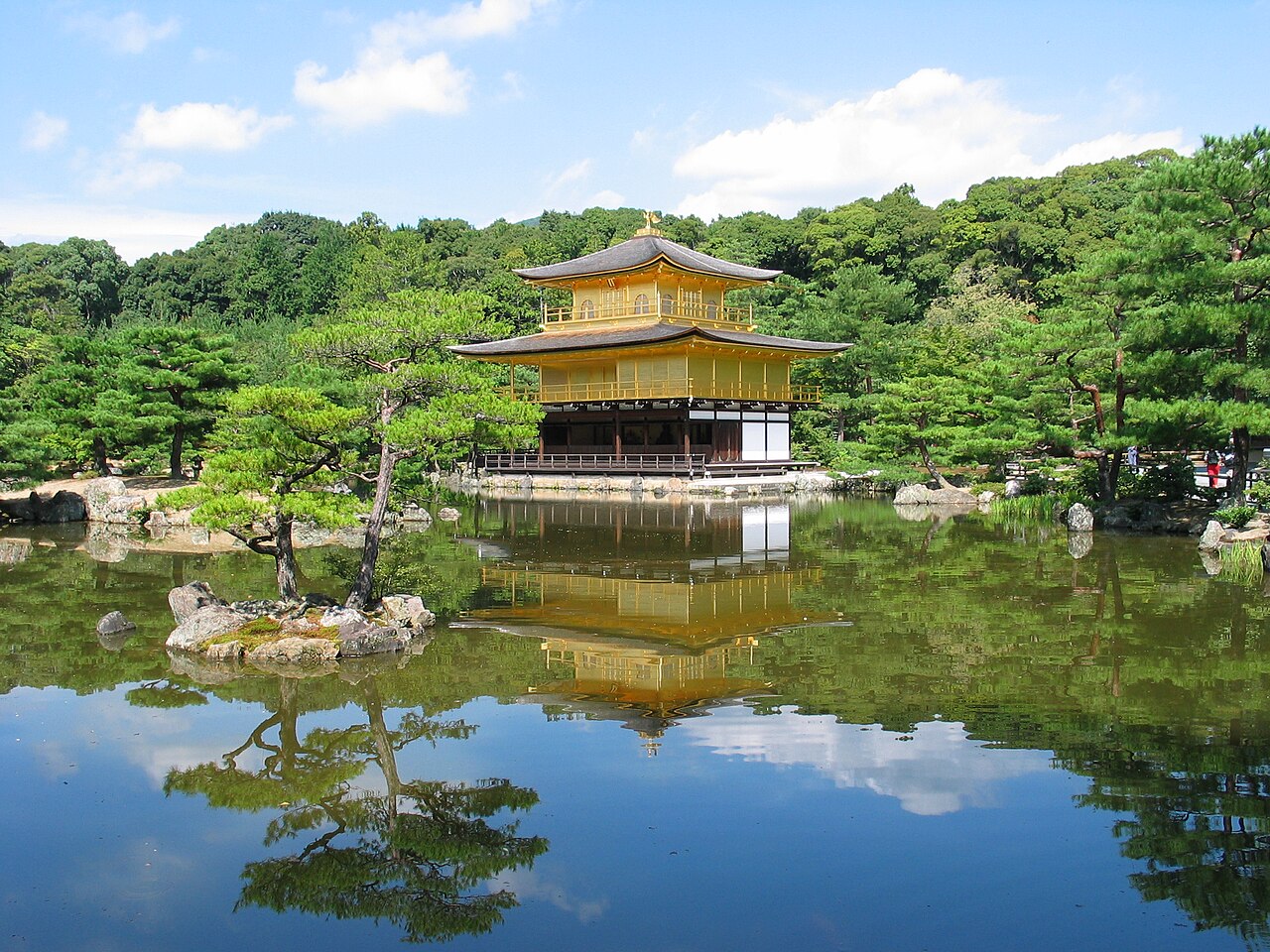
The Historic Monuments of Ancient Kyoto were inscribed by UNESCO in 1994: 17 properties across Kyoto City, Uji, and Otsu covering 13 Buddhist temples, 3 Shinto shrines, and 1 castle built across a millennium of continuous imperial patronage. Kyoto served as Japan’s capital from 794 to 1869 CE — the longest unbroken run in Japanese history — and its built heritage spans every major phase of Buddhist and Shinto architectural development from the Heian period to the early Edo era.
South and east: Nara, the Yamato plain, and the Kii pilgrimage mountains Nara · Ikaruga · Wakayama — 40 to 120 km
Forty kilometres southeast by JR Nara Line, the Historic Monuments of Ancient Nara preserve the pre-Kyoto century of Japanese capital building. When the court moved to Heijo-kyo in 710 CE, it modelled the city plan on Tang China’s Chang’an, with eight state-sponsored temple complexes built simultaneously. The Todai-ji Great Buddha Hall — the largest wooden building in the world — houses a 15-metre bronze Buddha cast during the reign of Emperor Shomu; the 752 CE dedication ceremony was attended by 10,000 monks from 60 countries in what was Japan’s largest international event to that date. The five surviving original Heian and Nara-period buildings at the site demonstrate construction techniques a century older than the oldest standing Kyoto structures. The 1,200 sika deer grazing in Nara Park are classified as National Natural Monuments and carry the legal protection of imperial decree since the 8th century; killing one was punishable by death until the Meiji period. Kasuga Taisha within the park burns 3,000 stone and bronze lanterns on February 3 and August 14-15 in the Mantoro festival — a tradition unbroken since 1136 CE.
Fifty kilometres south of Kyoto in Ikaruga, Nara Prefecture, the Buddhist Monuments in the Horyu-ji Area contain the world’s oldest surviving wooden buildings. Prince Shotoku, who authored Japan’s first written constitution in 604 CE, founded the original complex; after a fire in 670 CE, the West Precinct was rebuilt in the early 8th century. The Five-Storey Pagoda’s central shinbashira pillar rests independently in a pit, allowing the surrounding five floors to sway during earthquakes without transmitting shock forces — a principle rediscovered and applied at massive scale by the engineers of Tokyo Skytree in 2012. The Yumedono (Hall of Dreams) in the East Precinct is a private Asuka-period chapel whose principal Kannon statue was sealed in a wooden box and unwrapped only once annually in spring until 1884, when American art historian Ernest Fenollosa persuaded the monks to open it; the wrapping cloth, undisturbed for over a millennium, dissolved on contact with air. From Kyoto, Horyu-ji is reached by JR Nara Line to Nara (45 minutes) and JR Yamatoji Line south (10 minutes to JR Horyuji Station).
Between Kyoto and Osaka on the Kinai plain, the Mozu-Furuichi Kofun Group in Osaka Prefecture offers a pre-Buddhist counterpoint to the Buddhist monuments of the Kinki region. The 49 mounded tombs, inscribed in 2019, were built for Kofun-period rulers between the 3rd and 6th centuries CE — one to three generations before Buddhism arrived from the Korean Peninsula. Nintoku-tenno-ryo Kofun, the largest, has a total footprint exceeding that of the Great Pyramid of Giza; its triple-moated keyhole shape — a circular mound joined to a trapezoidal forecourt — is specific to Japanese burial culture. The Imperial Household Agency restricts interior access to the mounds, but the outer moat perimeter path provides a 2.8-kilometre circumnavigation of the main tumulus with viewpoints from which the forested keyhole profile is discernible. The contrast between the austere green mounds of Mozu-Furuichi and the gilded pavilions of Kyoto’s UNESCO temple set — separated by perhaps two centuries of construction — shows how comprehensively Buddhism reshaped Japanese material culture after 552 CE. Access from Kyoto is via Kintetsu to Osaka-Uehommachi and the Kintetsu Nagano Line to Furuichi Station.
One hundred twenty kilometres south of Kyoto by limited express to Wakayama, the Sacred Sites and Pilgrimage Routes in the Kii Mountain Range form the most extensive UNESCO inscription on Japan’s main island. The three Grand Shrines of Kumano — Hongu Taisha, Nachi Taisha, and Hayatama Taisha — absorbed both Buddhist bodhisattvas and Shinto deities into a single syncretic tradition during the Heian period, making them accessible to devotees of either tradition simultaneously. Emperor Gotoba completed the Kumano pilgrimage 32 times between 1190 and 1221 CE, and the retired-emperor pilgrimage to Kumano was so regular that the route became known as the “Ants’ Pilgrimage” for the procession of court nobles that followed. Mount Koya, in the inscription’s northern sector, holds 117 sub-temples founded by Kukai (Kobo Daishi) in 819 CE; the Okunoin cemetery at its centre has 200,000 stone markers around Kukai’s mausoleum, where his followers bring a formal meal twice daily in the belief that he meditates within, not deceased. The Kumano Kodo trail network was jointly designated with Spain’s Camino de Santiago as the world’s only dual World Heritage pilgrimage route. From Kyoto, Koyasan is reached via Osaka and the Nankai Koya Line to Gokurakubashi (approximately 2 hours).
West to Himeji, Hiroshima, and the Seto Inland Sea Himeji · Hiroshima · Shimane — 80 to 500 km
Eighty kilometres west by Shinkansen, Himeji Castle provides the starkest architectural contrast available on a single rail pass. Where Kyoto’s 17 UNESCO properties were built for devotion and ceremony across a millennium of court culture, Himeji was built entirely for war and completed in a single construction campaign between 1601 and 1609. The 83-building complex on its hillside has never been taken by assault, burned, or significantly altered; its white-plastered exterior, intended as fire protection, gives it the name Shirasagi-jo, the White Heron Castle. Three concentric gate sequences — each designed to disorient attackers and expose them to fire from loopholes above — must be passed before the main tower. A Shinkansen day trip from Kyoto to Himeji (35 minutes by Hikari or Nozomi) and back allows a half-day at the castle; the juxtaposition of the gilded monastic spaces of Kinkaku-ji in the morning and the white military precision of Himeji in the afternoon condenses the two dominant preoccupations of Edo-period Japan into a single day.
Three hundred forty kilometres west by Nozomi Shinkansen (90 minutes from Kyoto), the Hiroshima and Miyajima UNESCO inscriptions form a natural pair on the same railway and ferry connection. The Itsukushima Shrine on Miyajima Island has stood over the tidal channel of the Seto Inland Sea since the 6th century, with the existing buildings commissioned in 1168 CE by Taira no Kiyomori. The 16-metre O-torii gate rises from the water 200 metres offshore — visible at high tide as a freestanding monument, walkable to at low tide across exposed sand. At the Hiroshima Peace Memorial, the ruined dome of the former Industrial Promotion Hall stands exactly as it survived the atomic bomb detonation of 6 August 1945: the structure remained upright because the blast was nearly directly overhead, directing force downward rather than laterally. The Peace Memorial Museum in the surrounding park records the consequences with primary-source artefacts and testimony; it requires a minimum of 2 hours and closes at 18:00. From Kyoto, a day trip is feasible; most visitors prefer to overnight in Hiroshima to visit the Peace Memorial in the morning and Miyajima at two tide states during the day.
Practical information
Kyoto is served by JR Shinkansen at Kyoto Station, a major hub with direct Nozomi services to Tokyo (2 hours 15 minutes), Hiroshima (90 minutes), and Shin-Osaka (15 minutes). The 17 UNESCO properties are distributed across the city and its suburbs; no single walking route connects all. The Higashiyama cluster — Kiyomizu-dera, Nanzen-ji, Ginkaku-ji — is reached by city bus 100 or 206 from Kyoto Station in approximately 30 minutes. The western cluster — Kinkaku-ji, Ryoan-ji, Ninna-ji — requires a separate bus journey (Bus 205 from Kyoto Station, 30–40 minutes) or a 10-minute taxi from central Kyoto. The southern sites at Uji — Byodoin and Ujigami Shrine — are 15 minutes by Kintetsu Kyoto Line from Kintetsu-Kyoto Station. A minimum of 2 full days is recommended for the Kyoto UNESCO properties alone, with a third half-day for Uji. Autumn foliage (mid-October to mid-November) and spring cherry blossoms (late March to early April) are the peak seasons; accommodation books months in advance. A JR Kansai Area Pass covers all JR lines radiating from Kyoto Station for multi-day exploration.
Frequently Asked Questions
What is the significance of the Ryoan-ji rock garden that justified its UNESCO inscription?
Ryoan-ji’s rock garden is included in the Kyoto UNESCO inscription as one of the finest surviving examples of karesansui — dry landscape gardening — the aesthetic tradition that produced Japan’s most internationally recognized garden form. The garden was created in the late 15th or early 16th century; its designer is unknown, a point the temple acknowledges explicitly in its own literature. Fifteen stones of varying size are arranged in five groups on a bed of white raked gravel within a rectangular enclosure measuring approximately 25 by 10 metres, bounded by an oil-wax-treated clay wall. The compositional arrangement is such that from any single viewpoint along the veranda that serves as the viewing platform, only 14 of the 15 stones are visible; the 15th is always hidden behind one of the others. This property was noted by Japanese scholars from the Meiji period onward and became the centre of Western philosophical interpretation during the 1960s and 1970s — readings that framed it as a Zen philosophical statement about the limits of perception. Japanese scholarship more cautiously notes that the garden was almost certainly designed for aesthetic contemplation rather than as a philosophical argument, and that its authorship and programmatic intentions remain genuinely unknown. What the inscription recognizes is the exceptional quality of the spatial composition itself and the influence the garden has exerted on Japanese and international landscape design since its rediscovery in the 19th century. The garden is most legible in early morning before tour groups arrive, when the gravel is freshly raked.
Why did the Japanese imperial court remain in Kyoto for more than 1,000 years?
The Imperial Court remained in Kyoto from 794 CE because of the accumulated weight of religious geography and ritual investiture. The move from Nara was driven by anxiety about Buddhist political power: the monk Dokyo had been positioned by a regent empress to become emperor in 769 CE, and the court’s response was to establish a new capital explicitly without major Buddhist temples within the city limits. The new Heian-kyo was planned as a secular administrative capital, though Buddhist monasteries accumulated in the surrounding mountains within two generations and eventually became as politically formidable as those in Nara. Over the following millennium, actual governing authority passed repeatedly to military powers — the Kamakura, Ashikaga, and Tokugawa shogunates each effectively governed Japan from their own capitals while leaving the emperor in Kyoto as the source of ritual legitimacy. The Meiji reformers who overthrew the Tokugawa in 1868 relocated the emperor to Tokyo — then called Edo — because they needed the imperial presence at the seat of new governmental and economic power. The transfer was officially framed as a “temporary relocation” and the term used in Japanese legal documents remained ambiguous for several decades. Kyoto retains the title of former imperial capital; the Kyoto Imperial Palace remains imperial property maintained by the Imperial Household Agency and open to public visits by advance reservation.
How many days do I need to see Kyoto’s UNESCO sites and connect to Nara and Himeji?
A thorough visit to Kyoto’s 17 UNESCO properties alone requires a minimum of 2 full days. A practical 4-day circuit from a Kyoto base covers the following: Day 1, Kyoto eastern cluster (Kiyomizu-dera, Nanzen-ji, Ginkaku-ji, Heian Shrine); Day 2, Kyoto western and northern cluster (Kinkaku-ji, Ryoan-ji, Ninna-ji, Nijo Castle, Kamigamo Shrine); Day 3, morning Shinkansen to Himeji (35 minutes, 2–3 hours at the castle), return to Kyoto for afternoon; Day 4, JR Nara Line to Nara (45 minutes), Ancient Nara monuments and deer park in the morning, Horyu-ji by JR Yamatoji Line in early afternoon, return to Kyoto or continue to Osaka for departure. The Uji UNESCO properties — Byodoin and Ujigami Shrine — can be inserted as a half-day side trip on the morning of Day 4 before continuing to Nara. A JR Kansai Wide Area Pass (5 consecutive days) covers all required JR services including Shinkansen to Himeji and the Haruka from Kansai International Airport; for visitors arriving and departing via different airports, a standard JR Kansai Area Pass (2 or 3 days) combined with individual Shinkansen reservations may be more economical.
Sources
- S1 — UNESCO World Heritage Centre — Historic Monuments of Ancient Kyoto (Kyoto, Uji and Otsu Cities) (Ref. 688) — https://web.archive.org/web/20230601000000/https://whc.unesco.org/en/list/688/
- S2 — UNESCO World Heritage Centre — Statement of Outstanding Universal Value (Ref. 688) — https://whc.unesco.org/en/list/688/
Spotted an error? Write to editorial@culturalheritageonline.com and we correct it the same day.