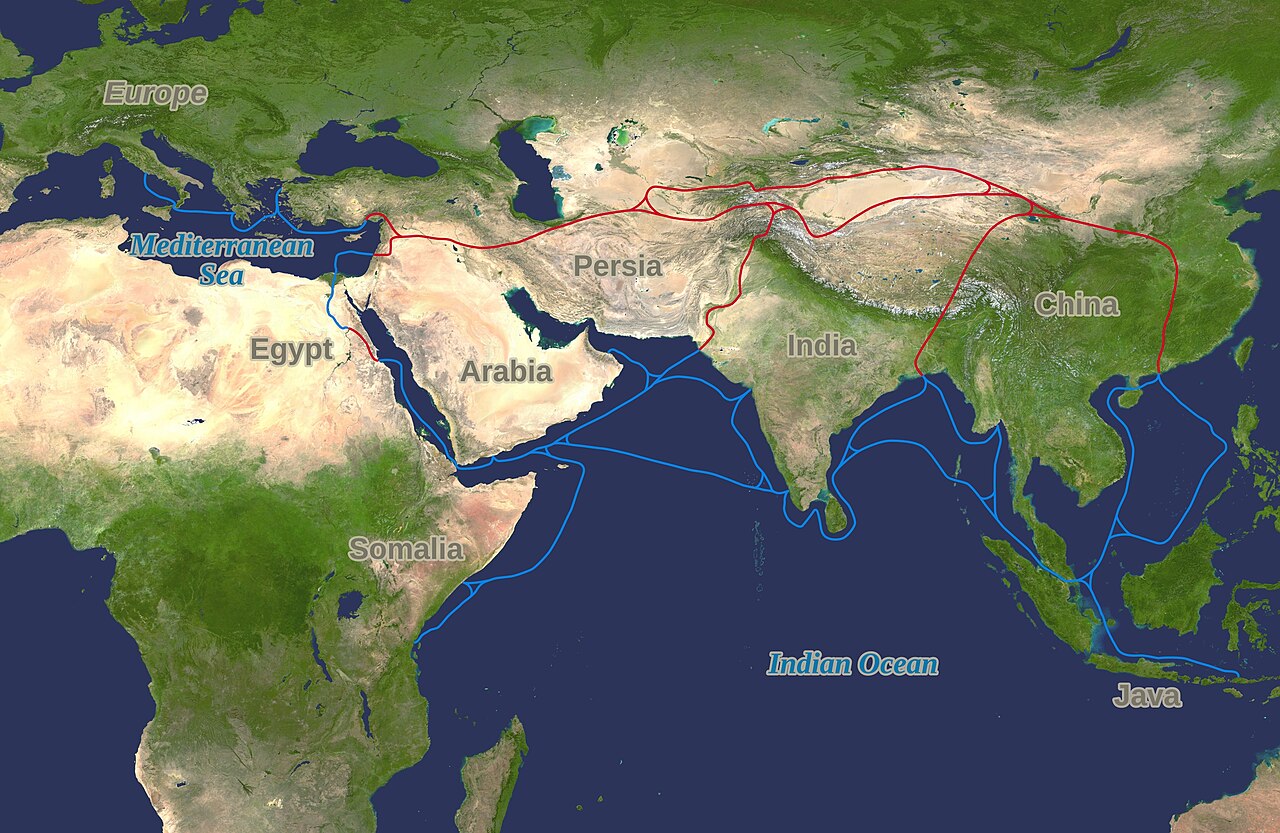
The Silk Roads: the Routes Network of Chang’an-Tianshan Corridor, inscribed by UNESCO in 2014 as a transnational serial site shared by China, Kazakhstan, and Kyrgyzstan, protects 33 component sites distributed along the 5,000-kilometre corridor of the Silk Road’s central land route — from Chang’an (modern Xi’an, Shaanxi Province, the Tang dynasty capital and the eastern terminus of the Silk Road) through the Gansu Corridor, the Xinjiang oasis cities, the Central Asian steppe, and the Tianshan mountain passes to Kyrgyzstan. The inscription covers the physical remains of the trade, diplomatic, and cultural exchange network that operated between approximately 200 BCE (the Han Emperor Wu’s diplomatic mission to the Yuezhi, which opened the Central Asian corridor) and the 16th century CE (when the Portuguese maritime route around Africa progressively reduced the overland Silk Road’s commercial significance): caravanserais, trading towns, Buddhist sacred sites, imperial fortresses, watchtowers, and sections of the road itself, collectively documenting the 1,700-year history of Eurasian overland exchange that transmitted silk, spices, precious metals, horses, Buddhism, Islam, paper, printing, gunpowder, the compass, and the Black Death westward and eastward along the same physical corridors. The Chinese section of the Chang’an-Tianshan Corridor inscription includes 22 component sites in five Chinese provinces (Shaanxi, Henan, Gansu, Ningxia, and Xinjiang), including the Mogao Caves (Dunhuang, Gansu), the Jiaohe and Gaochang ancient cities (Turpan, Xinjiang), the Xuanquanzhi relay station (the only fully excavated Han-dynasty Silk Road relay station, Dunhuang, Gansu), and the Han and Tang defensive works along the Hexi Corridor.
The Chang’an-Tianshan western arc: from the Tang capital to Central Asia Xinjiang Tianshan · Xi’an Big Wild Goose Pagoda · Mogao Caves Dunhuang — 600 to 1800 km
Six Hundred Kilometres west of Xi’an by road and rail (approximately 6 hours by conventional train from Xi’an to Lanzhou, or approximately 3.5 hours by the Yinchuan-Xi’an HSR and then Lanzhou-Xi’an HSR, then approximately 8 hours from Lanzhou to Zhangye/Jiayuguan on the Lan-Xin HSR), the Hexi Corridor — the 1,000-kilometre-long narrow corridor between the Qilian Mountains to the south and the Gobi Desert to the north, in Gansu Province — is the critical geographic bottleneck through which all Silk Road traffic between China and Central Asia passed for 2,000 years. The Hexi Corridor’s inscription components include the Jiayuguan Pass fortification complex (嘉峪關, the westernmost pass of the Ming-dynasty Great Wall, built 1372 CE, the traditional “First Pass Under Heaven” marking the boundary of the Chinese cultural world on the Silk Road) and the Xuanquanzhi Relay Station (Dunhuang County, the Han-dynasty relay station excavated 1990–1992, which yielded approximately 1,200 Han-period documents on wood and bamboo — the largest cache of Han administrative documents ever recovered, documenting in extraordinary detail the daily operations of the Silk Road’s official relay system: horse records, grain accounts, traveller registers, and official correspondence spanning 100 BCE to 150 CE). From Xi’an, the Hexi Corridor is reached by the Lan-Xin HSR from Xi’an North through Lanzhou (approximately 2.5 hours), Zhangye (approximately 5 hours from Xi’an North), Jiayuguan (approximately 6.5 hours), and Dunhuang (approximately 8.5 hours from Xi’an North via the Dunhuang Railway extension from Liuyuan).
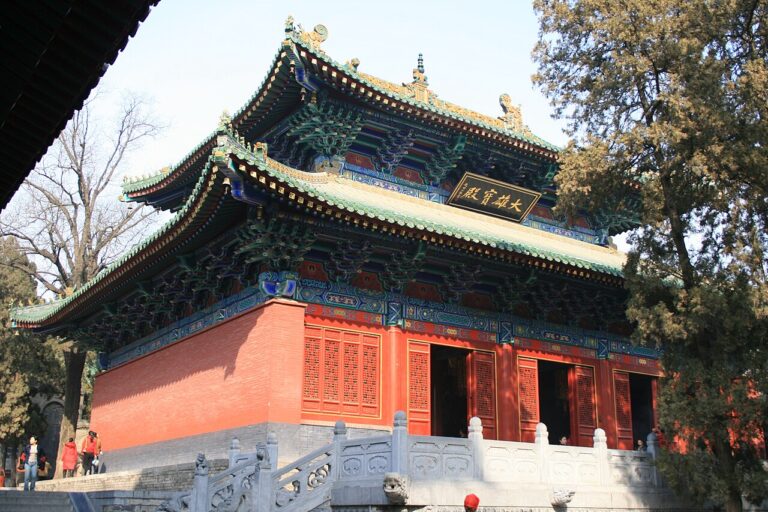
One Thousand Kilometres east of Xi’an by road and HSR (approximately 3.5 hours from Xi’an North to Zhengzhou East on the Zhengzhou-Xi’an HSR), the central Henan heritage zone — Longmen Grottoes at Luoyang (approximately 40 minutes west of Zhengzhou by HSR), the Historic Monuments of Dengfeng/Shaolin (1 hour southwest of Zhengzhou by coach), and Yin Xu at Anyang (45 minutes north of Zhengzhou by HSR) — is the most heritage-dense companion circuit to the Silk Roads inscription’s eastern terminus. The Chang’an-Tianshan Silk Roads inscription’s easternmost component site is the Yangguanzhen beacon tower system (阳关, Yang Guan) in the Dunhuang area, approximately 70 km southwest of the Mogao Caves; the historic capital of Chang’an (Xi’an) itself is the cultural starting point of the entire corridor, though Xi’an’s Tang-period monuments (the Big Wild Goose Pagoda, the Tang imperial tomb complex at Qianling, the Shaanxi History Museum’s Tang gold and silver collection) are not individually listed as Silk Roads serial inscription components. The relationship between the Silk Roads inscription and the Henan Buddhist heritage is direct: the Tang dynasty’s Buddhist patronage that produced the Longmen Grottoes’ Ancestor Worship Cave (672–675 CE) and the Shaolin Temple’s Tang martial monks (621 CE) was itself funded by the accumulated commercial wealth of the Tang Silk Road economy, whose Sogdian, Persian, and Indian merchant communities brought Buddhist texts, sculptures, and monks eastward along the same road system that carried Chinese silk westward. From Xi’an, the Henan circuit is reached by the Zhengzhou-Xi’an HSR (approximately 1.5–2 hours to Zhengzhou East).
Within the Xinjiang section of the Silk Roads inscription (the westernmost Chinese components), the primary visitor sites are: Jiaohe Ancient City (交河故城, Turpan, the best-preserved ancient earthen city on the Silk Road, 108 km south of Ürümqi, accessible by tourist bus from Turpan City in approximately 30 minutes); Gaochang Ancient City (高昌故城, 46 km east of Turpan City, the larger of the two ancient cities, the capital of the Uighur Kingdom of Gaochang 850–1208 CE, now a large walled ruin on the Turpan basin floor); Bezeklik Thousand Buddha Caves (67 km northeast of Turpan City, the Uighur Buddhist cave complex carved into the Flaming Mountain sandstone cliff, with murals spanning the 6th–14th centuries, significantly damaged by German archaeological expeditions 1902–1914 and by Cultural Revolution-period iconoclasm); and Subash Buddhist Ruins (Kuqa, Xinjiang, the Kucha kingdom’s capital Buddhist site, 5th–8th century CE, visible from the Kuqa oasis road as earthen mounds). From Ürümqi, Turpan is reached by the Lan-Xin HSR (approximately 45 minutes from Ürümqi South to Turpan North), and all three Turpan Silk Road sites are accessible by day-trip from Turpan City (hired car recommended, as the sites are 30–70 km from Turpan).
One Thousand Eight Hundred Kilometres from Xi’an to the Dunghuang Mogao Caves by road and rail (approximately 8.5 hours by the Lan-Xin HSR from Xi’an North to Liuyuan Station, then 1.5 hours by coach to Dunhuang, or approximately 2 hours by flight from Xi’an Xianyang Airport to Dunhuang Airport), the Mogao Caves (莫高窟, inscribed 1987 as a UNESCO World Heritage Site independently — predating the 2014 Silk Roads serial inscription) are the single most important archaeological and artistic site on the Silk Road and represent the Chinese Silk Road’s Buddhist heritage at its fullest extent. The 492 decorated cave chambers at Mogao contain approximately 45,000 square metres of wall painting — a continuous artistic tradition spanning the Northern Wei through the Yuan dynasty (4th–14th century CE), preserving a documentary record of Buddhist iconography, secular life, landscape painting, architectural illustration, and material culture that has no parallel anywhere on the Silk Road. The Dunhuang Library Cave (Cave 17, the Dunhuang manuscripts cache, discovered 1900 by the Daoist monk Wang Yuanlu and partially acquired by Aurel Stein in 1907 and Paul Pelliot in 1908 for European museums) contained approximately 40,000 manuscripts in Chinese, Tibetan, Sanskrit, Sogdian, Uighur, Hebrew, and Syriac — the world’s largest and earliest discovery of medieval manuscripts, documenting the full multilingual cultural exchange of the Silk Road oasis community. From Xi’an, the Mogao Caves are reached most efficiently by flight to Dunhuang Airport (approximately 2 hours, with Dunhuang accessible by flights from Xi’an, Ürümqi, Lanzhou, Chengdu, and Jiayuguan).
Practical information
The Silk Roads: the Routes Network of Chang’an-Tianshan Corridor is a transnational serial UNESCO inscription shared by China (22 components), Kazakhstan (8 components), and Kyrgyzstan (3 components). The Chinese components span 3,000+ kilometres from Xi’an (Shaanxi Province) through the Hexi Corridor (Gansu Province) to Xinjiang. Visitor access varies significantly by component: the Turpan basin sites (Jiaohe, Gaochang, Bezeklik) are among the most visitor-ready, with paved access roads, entry fees, and on-site museum facilities; the Hexi Corridor components (Xuanquanzhi relay station, Han beacon tower remains) are more remote and require private transport. Xi’an is the most practical base for visitors coming from outside China: Xi’an Xianyang International Airport (XIY) serves major international routes, and the city’s Tang-period heritage (Big Wild Goose Pagoda, Tang city wall, Shaanxi History Museum, Terracotta Warriors — which are not part of the Silk Roads inscription but are within 30 km) makes Xi’an the single most comprehensive city-level introduction to the Silk Road’s Chinese eastern terminus. For the Dunhuang Mogao Caves, advance booking of timed entrance slots is mandatory (maximum 6,000 visitors per day during peak season; priority allocation goes to digital exhibition ticket holders); the Dunhuang Research Academy’s online booking system is the only authorized channel. The Xinjiang components require awareness of the current visa and travel documentation requirements for Xinjiang, which differ from standard Chinese tourism rules for international visitors.
Frequently Asked Questions
Was the “Silk Road” a single road and who actually used it?
The term “Silk Road” (Seidenstraße in the German original, coined by the geographer Ferdinand von Richthofen in 1877) describes not a single road but a network of overland and maritime trade routes connecting China, Central Asia, South Asia, the Middle East, and the Mediterranean world from approximately 200 BCE through the 15th century CE. The UNESCO inscription formalises this network character by designating the inscription as “Routes Network” rather than a single road: the 2014 inscription covers the Chang’an-Tianshan Corridor specifically, which was the central steppe route running from Xi’an through the Hexi Corridor and Xinjiang to Central Asia — one of several land routes (alongside the northern steppe route through the Eurasian grassland and the southern Karakoram route through India) and the maritime routes (the Maritime Silk Road through the South China Sea, Indian Ocean, and Persian Gulf, inscribed separately under different UNESCO considerations). The actual users of the Silk Road were primarily professional merchants — particularly Sogdian merchants from the Central Asian city of Samarkand and the surrounding Sogdiana region (modern Uzbekistan and Tajikistan), who dominated Silk Road commerce from approximately the 4th to 8th centuries CE and whose trading colonies are archaeologically attested in Xi’an, Dunhuang, Turfan, and cities throughout Central Asia and the Middle East. The stereotype of Chinese merchants personally traveling to Rome with silk bales is historically inaccurate: Chinese merchants typically sold their silk to Central Asian intermediaries at the Jade Gate (Yumenguan) or Dunhuang; Sogdian, Persian, and later Arab and Turkish merchants transported the goods westward through their own commercial networks. The goods that actually traveled the Silk Road were not only silk (Chinese exports also included porcelain, bronze, lacquer, and paper), but also Roman glass, Byzantine gold coins, Indian spices, Central Asian jade and lapis lazuli, and West Asian glassware — and more importantly, ideas, religions, technologies, and diseases, for which the Silk Road’s cultural transmission was far more historically significant than its commercial volume.
What happened to the Dunhuang Library Cave manuscripts and where are they now?
The Dunhuang Library Cave (Mogao Cave 17) is a small side chamber sealed approximately 1,000 CE (most likely to protect the manuscripts from a Tangut Xi Xia military threat to the Dunhuang oasis), walled up and plastered over, and rediscovered in 1900 by Wang Yuanlu (汪圓籙), a self-appointed Daoist monk who had appointed himself caretaker of the abandoned Mogao cave complex. Wang found approximately 40,000–50,000 manuscripts, printed documents, paintings on silk and paper, embroideries, and religious objects stacked floor-to-ceiling in the small chamber, spanning the 4th to 11th centuries CE and written in at least eight languages (Chinese, Tibetan, Sanskrit, Sogdian, Uighur, Khotanese, Hebrew, and Syriac). The collection documents the full multilingual cultural production of the Dunhuang oasis community: Buddhist sutras, Confucian classic texts, Daoist texts, Manichaean and Nestorian Christian texts, administrative documents, calendars, medical texts, folk literature, and — perhaps most significantly — the world’s earliest dated printed book (the Diamond Sutra, printed 868 CE using wood-block printing, recovered from the cave by Aurel Stein in 1907, now in the British Library). The manuscripts’ dispersal is one of the most contested issues in 20th-century cultural heritage history: Aurel Stein (British-Hungarian archaeologist, for the British Museum/Government of India) acquired approximately 7,000 manuscripts and 6 cases of paintings in 1907; Paul Pelliot (French sinologist) acquired approximately 6,000 manuscripts and 200+ paintings in 1908; Sergei Oldenburg (Russian archaeologist) acquired specimens in 1914–1915; and Japanese expeditions acquired further materials. The majority of the remaining collection was transferred to Beijing (now held in the National Library of China) after Wang Yuanlu’s sales attracted official Chinese attention. The dispersal has been partially addressed by the International Dunhuang Project (a collaboration of the British Library, Bibliothèque nationale de France, Russian National Library, Otani Collection/Ryukoku University, and National Library of China since 1994), which has digitised approximately 100,000 Dunhuang documents and made them freely accessible online — effectively creating the world’s first major transnational digital reunification of a dispersed historical collection.
How did the Silk Road transmit Buddhism from India to China and what physical evidence survives along the route?
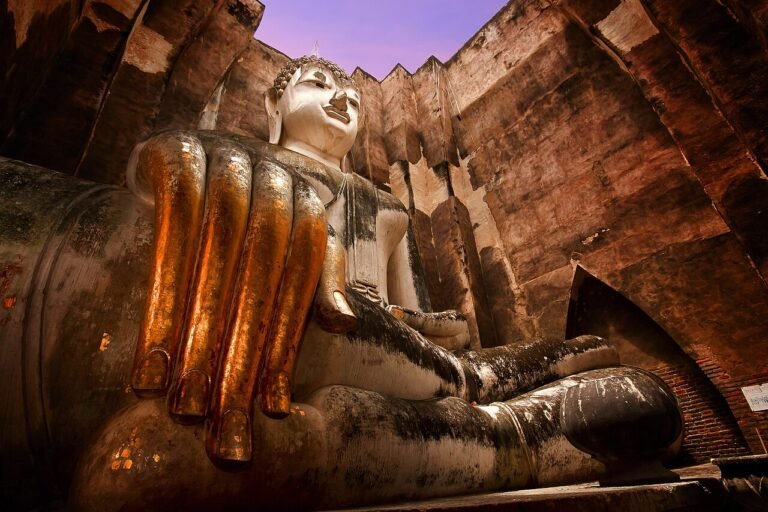
Buddhism’s transmission along the Silk Road from its South Asian homeland to China is one of the most consequential cultural transmissions in human history: the religion that dominated the cultural and artistic production of East Asia for more than 1,500 years arrived in China via the same overland routes that carried silk westward, carried by Indian and Central Asian monks, merchants, and diplomats traveling the Silk Road’s oasis cities from approximately the 1st century CE onward. The physical evidence along the Chang’an-Tianshan Corridor inscription’s component sites documents this transmission at multiple stages: the Kizil Thousand Buddha Caves near Kuqa (3rd–8th centuries CE) are the earliest phase of Buddhist cave art in China, showing Indian and Gandaharan (Pakistani) artistic conventions arriving in the Central Asian oasis environment; the Bezeklik Caves near Turpan (6th–14th centuries CE) document the same tradition adapted by the Uighur Buddhist kingdom of Gaochang, showing the synthesis of Indian, Sogdian, and Chinese artistic conventions; the Mogao Caves at Dunhuang (4th–14th centuries CE) represent the easternmost and most fully Sinicised phase of the Central Asian Buddhist art tradition, where Indian iconography has been filtered through Central Asian and Chinese artistic conventions into a distinctively Chinese Buddhist visual language. The pilgrimage accounts of Chinese Buddhist monks who personally traveled the Silk Road to India to collect Buddhist texts — Fa Xian (399–414 CE), who traveled from Chang’an to India via the Hexi Corridor and Central Asia and returned by the maritime route through Southeast Asia and wrote the first detailed Chinese account of the Buddhist sites of India; and Xuanzang (629–645 CE), whose 16-year pilgrimage from Chang’an through Xinjiang, Central Asia, and India returning via the Karakoram route provided the factual basis for the 16th-century novel Journey to the West) — provide the literary complement to the archaeological physical evidence that the Silk Roads inscription documents in the carved and painted cave sanctuaries, relay stations, caravanserais, and trading towns of the Chang’an-Tianshan Corridor.
Sources
- S1 — UNESCO World Heritage Centre — Silk Roads: the Routes Network of Chang'an-Tianshan Corridor (Ref. 1442) — https://web.archive.org/web/20230601000000/https://whc.unesco.org/en/list/1442/
- S2 — UNESCO World Heritage Centre — Statement of Outstanding Universal Value (Ref. 1442) — https://whc.unesco.org/en/list/1442/
Spotted an error? Write to editorial@culturalheritageonline.com and we correct it the same day.