
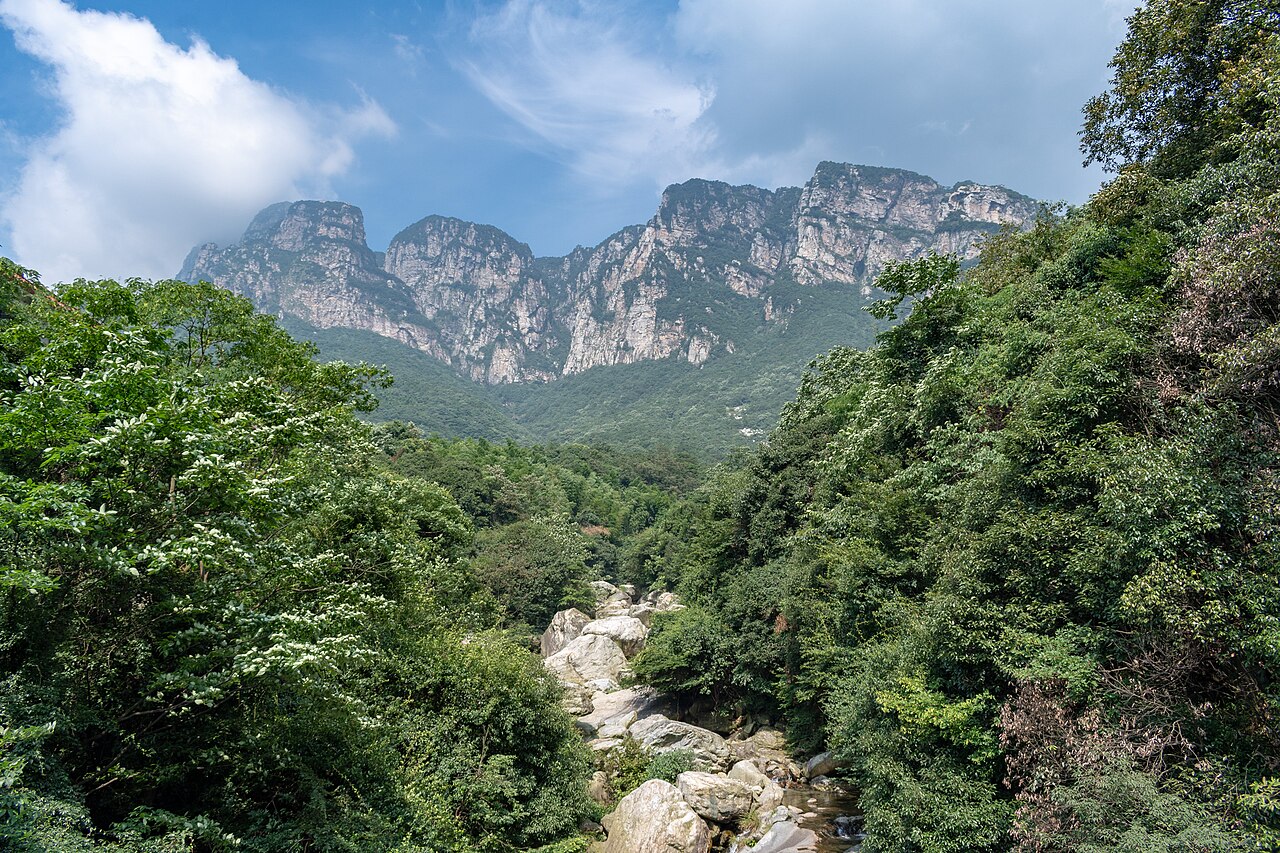
Lushan National Park (Mount Lu), inscribed by UNESCO in 1996 as a cultural landscape, is a mountain complex rising to 1,474 metres (Hanyang Peak) above the southern shore of China’s largest freshwater lake, Poyang Lake, in northern Jiangxi Province. The inscription recognises Lushan as an exceptional example of the Chinese “cultural mountain” — a natural landscape that has accumulated 1,600 years of Buddhist and Daoist religious significance, 1,000 years of Confucian academic tradition, and 100 years of modern Chinese political history. The White Deer Grotto Academy (Bailudong Shuyuan, established by Zhu Xi in 1179 CE and the most influential Confucian academy of the Song dynasty), the Eastern Lin Temple (Donglin Si, founded 386 CE, origin point of the Pure Land Buddhist tradition in China), and the Lushan Conference Centre (site of pivotal Chinese Communist Party meetings in 1959, 1961, and 1970) coexist within 15 kilometres of each other on the mountain’s slopes.
Poyang Lake and the Yangtze corridor Wuyishan · Huangshan · Nanchang — 150 to 400 km
One hundred fifty kilometres southeast of Lushan by road (approximately 2 hours via the G56 Hangkun Expressway), Mount Wuyi (inscribed 1999) in Fujian Province is the other major mixed cultural-natural inscription in southeastern China, sharing Lushan’s combination of scenic natural landscape and Confucian academic significance. Wuyi Mountain’s steep red sandstone gorges and the Nine-Bend River scenery below the peaks are the natural context for the Zhu Xi Academy at Wuyi — where the same Zhu Xi who established the White Deer Grotto Academy at Lushan in 1179 had also taught and written his major Neo-Confucian philosophical works. The connection between Lushan and Wuyi is direct: Zhu Xi (1130–1200 CE) held his two principal academic positions at the two mountains, making both inscriptions nodes in the same Neo-Confucian philosophical network of the Southern Song period. From Lushan (Jiujiang), Mount Wuyi requires road travel south to Nanchang and then to Shangrao and bus to the scenic area (approximately 4 hours total).
Two hundred kilometres east of Lushan by road via Nanchang (approximately 3 hours via the Nanchang-Hangzhou Expressway to Shangrao, then north), the Mount Sanqingshan National Park (inscribed 2008) in Jiangxi Province is in the same province as Lushan and documents the granite pillar landscape complementary to Lushan’s more rounded cloud-forest mountain form. Sanqingshan’s 2,158-metre summit towers above subtropical forest at the northern end of the Huaiyu Mountains in Shangrao Prefecture; its granite columns (the “Eastern Huamaster” pillar, the most famous, is 128 metres tall) emerge from the same Yanshanian granite batholiths that produced the Huangshan pinnacles 200 kilometres to the north. From Nanchang, Sanqingshan is reached by high-speed rail to Shangrao and bus (approximately 2 hours total).
Two hundred fifty kilometres northeast of Lushan by high-speed rail (approximately 1.5 hours from Jiujiang to Nanjing South, then to Huangshan North), the Huangshan (Yellow Mountain) inscription (inscribed 1990) in Anhui Province documents the granite pinnacle landscape of southern Anhui. The cultural connection between Lushan and Huangshan is the poetic tradition: both mountains are documented in the same body of Tang-Song classical Chinese poetry as the definitive landscape of the Jiangnan region (the Lower Yangtze cultural heartland). The Huangshan mountain painter tradition of the 17th century (Hongren, Shitao) was influenced by the Song and Yuan landscape painting tradition that had treated both Lushan and Huangshan as its primary subjects. Su Dongpo’s poem on Lushan — “You cannot see the true face of Lushan / Because you are standing inside it” (不識廬山真面目,只緣身在此山中) — is arguably the most quoted two lines of Tang-Song Chinese poetry, making Lushan the poetic touchstone mountain against which all Chinese mountain experience is measured. From Jiujiang, Huangshan is reached by high-speed rail (Jiujiang to Nanchang to Huangshan North, approximately 3 hours).
Three hundred kilometres north of Lushan by high-speed rail (approximately 2 hours from Jiujiang to Wuhan South on the Beijing-Guangzhou HSR), the Ancient Building Complex in the Wudang Mountains (inscribed 1994) in Hubei Province documents the most important Daoist mountain architecture in China. The Daoist and Buddhist traditions at Lushan and Wudang are historically entangled: the Eastern Lin Temple at Lushan (founded 386 CE) was one of the earliest Buddhist monasteries in the Yangtze highlands, and its Pure Land tradition (the practice of chanting Amitabha Buddha’s name as the primary path to salvation) diffused westward through Hubei to influence the religious communities of the Wudang area in the 5th–6th centuries. The Lushan Buddhist tradition and the Wudang Daoist tradition represent the two major sacred mountain complexes of the middle Yangtze highland zone: separated by 300 kilometres of river valley and 600 years of independent religious development, they share the same physical geography of isolated mountain summits above the Yangtze floodplain as their sacred landscape premise. From Jiujiang, the Wudang Mountains are reached by high-speed rail to Wuhan and then to Wudangshan Station (approximately 3 hours).
East toward the Yangtze Delta and south to Fujian Suzhou · Hangzhou · West Lake — 500 to 700 km
Five hundred kilometres northeast of Lushan by high-speed rail (approximately 3.5 hours from Jiujiang via Nanchang and Hangzhou), the Classical Gardens of Suzhou (inscribed 1997, extended 2000) document the Confucian-literati garden aesthetic at its most refined. The connection between Lushan and the Suzhou gardens is the White Deer Grotto Academy: the Neo-Confucian revival that Zhu Xi’s 1179 academy at Lushan inaugurated produced the intellectual culture that the Ming-Qing Suzhou garden owners — retired officials, many of them graduates of the examination system whose syllabus Zhu Xi’s Neo-Confucianism dominated — expressed in the physical form of their private gardens. The Master of Nets Garden (Wangshiyuan), the Lingering Garden (Liuyuan), and the Humble Administrator’s Garden (Zhuozhengyuan) were all built by officials whose philosophical formation was in the Neo-Confucian tradition that Lushan’s White Deer Grotto Academy institutionalised — making the Suzhou garden the domestic spatial expression of the same intellectual tradition that the Lushan academy represented in its institutional form.
Four hundred kilometres northeast of Lushan by high-speed rail (approximately 2.5 hours from Jiujiang via Nanchang and Hangzhou), the West Lake Cultural Landscape of Hangzhou (inscribed 2011) is the urban garden-lake whose cultural significance is most directly connected to Su Dongpo (Su Shi, 1037–1101 CE) — the same poet whose poem on Lushan (“You cannot see the true face of Lushan…”) is the most famous literary statement about the mountain. Su Dongpo administered Hangzhou as a Song dynasty governor twice (1071–1074 and 1089–1091) and shaped West Lake’s physical form through the construction of the Su Causeway; he wrote the second most famous West Lake poem (“Comparing West Lake to the Beauty Xi Zi”) in the same period that he wrote the Lushan poem. The two inscriptions — Lushan and West Lake — are bound together by Su Dongpo’s literary presence: the Tang-Song poetic tradition that made Lushan the paradigmatic Chinese mountain experience and West Lake the paradigmatic Chinese urban garden aesthetic are two products of the same Song literati cultural world. From Jiujiang, Hangzhou is reached by high-speed rail (via Nanchang, approximately 2.5 hours).
Five hundred kilometres northeast of Lushan by high-speed rail (approximately 3 hours from Jiujiang via Nanchang and Nanjing), the Imperial Tombs of the Ming and Qing Dynasties at Nanjing — specifically the Xiaoling Mausoleum of the Hongwu Emperor (added to the inscription in 2003) — connect Lushan to the political history of the same Yangtze valley region. The Ming Hongwu Emperor (Zhu Yuanzhang, r. 1368–1398 CE), who built his capital at Nanjing and established the Ming dynasty after overthrowing the Mongol Yuan dynasty, held his court at Nanjing 350 kilometres downriver from Lushan’s Jiujiang; the Lushan Conference Centre buildings (the Meilu Villa, built 1903 for the Qing official’s family who owned the mountain resort, and the conference hall built 1961 for the CCP Lushan Conference) are the 20th-century addition to a heritage accumulation that includes both the Song Confucian academic tradition and the Ming imperial geography of the Yangtze. From Jiujiang, Nanjing is reached by high-speed rail (approximately 2 hours).
Six hundred kilometres southeast of Lushan by high-speed rail (approximately 4 hours from Jiujiang via Nanchang and Fuzhou), the Fujian Tulou — Rural Dwellings in Fujian (inscribed 2008) document the vernacular communal fortified architecture of the Hakka and Min communities in Fujian’s western mountains: earthen rammed-earth communal houses (tulou) of circular or rectangular plan, housing dozens of families in a single massive defensive structure. The Hakka communities who built the tulou were the descendants of Han Chinese who migrated south from the Central Plains (Henan, Shanxi) during periods of dynastic collapse — the same migratory movement that produced the Eastern Lin Buddhist monastery at Lushan when the Eastern Jin court retreated to the Yangtze region after the Northern China collapse of 316 CE. The cultural geography of the Jiangxi-Fujian-Guangdong mountain border region is defined by successive waves of this southward migration, and the tulou tradition documents the latest phase (Song-Ming period) of the same process whose earliest Yangtze expression is the Buddhist community at Lushan.
Practical information
Lushan National Park is located in Jiujiang City, northern Jiangxi Province. The nearest high-speed rail station is Jiujiang Station on the Beijing-Guangzhou HSR (direct trains from Beijing West approximately 4 hours; from Wuhan approximately 90 minutes; from Nanchang approximately 40 minutes; from Guangzhou South approximately 4 hours). From Jiujiang Station, tourist buses and taxis serve the Lushan Mountain Gate at Guling Town (approximately 40 minutes, with approximately 400 curves on the mountain access road). Guling Town at 1,167 metres altitude is the mountain’s primary accommodation and service hub, a colonial-era resort town developed by Western missionaries and diplomats from the 1890s onward (the “Bund in the hills,” as it was called during the Republican period): it retains several hundred European and American-style stone villas and cottages from the 1895–1949 period, when Lushan was one of China’s primary international summer resorts. Visitor orientation from Guling: the White Deer Grotto Academy is accessed by road east (approximately 20 minutes) through the Sandie Spring waterfall area; the Donglin Temple (Pure Land Buddhism origin) is at the mountain base in the Xingzi County direction (approximately 45 minutes from Guling). The Lushan Museum in Guling Town houses artefacts from the CCP conferences and an exhibition on Lushan’s role in Chinese cultural and political history. Lushan’s most famous viewpoints — the Flower Path (Huajing, the path along the cliff edge above Rixin Lake), the Wulao Peak (Five Elder Peaks) at 1,436 metres, and the Hanpokou pass (the standard viewpoint for photographs of the mountain above the Poyang Lake plain) — require full-day walking circuits. The optimal visiting seasons are March–May (spring waterfalls, rhododendron bloom) and September–November (clear skies, autumn colour); summer (June–August) is hot and busy; winter brings ice formations on the Sandie Spring waterfall.
Frequently Asked Questions
What is the White Deer Grotto Academy and why was it important?
The White Deer Grotto Academy (Bailudong Shuyuan) was re-established at Lushan in 1179 by the Neo-Confucian philosopher Zhu Xi (1130–1200 CE) and served as the model institution for all subsequent Chinese academies of the Song, Ming, and Qing periods. The academy had a prior history: it was established in the early Tang period as a hermit scholar’s residence, briefly converted to a formal academy in the 940s CE by the Southern Tang state, abandoned after the Northern Song reunification, and in ruins when Zhu Xi arrived as the prefectural administrator of Nankang (the administrative county containing Lushan) in 1179. Zhu Xi restored the buildings, composed the White Deer Grotto Academy Regulations (Bailudong Shuyuan Jieshi) — a 200-word document specifying the subjects of study, the purpose of scholarship, and the conduct of students — and invited scholars from across the Song Empire to teach there. The Academy Regulations became the founding document of Chinese formal education for the next 700 years: every major Chinese academy from the 12th century to the 19th century (when the Western-style university model began displacing the traditional academy) was modelled on the White Deer Grotto precedent. Zhu Xi’s Neo-Confucian synthesis (combining Confucian moral philosophy with Buddhist meditative discipline and Taoist cosmological theory) became the mandatory intellectual framework for China’s civil examination system from the Yuan dynasty (1313) through the last Qing examination in 1905 — meaning that the official philosophical formation of every government official in China for approximately 600 years was defined by the tradition that Zhu Xi’s Lushan academy institutionalised.
What were the Lushan Conferences and why are they politically significant?
Three pivotal Chinese Communist Party (CCP) conferences were held at Lushan’s mountain resort complex: the Lushan Conference of July–August 1959 (the Eighth Plenum of the Eighth Central Committee), the Lushan Conference of August–September 1961 (a central work conference), and the Lushan Conference of August–September 1970 (the Second Plenum of the Ninth Central Committee). The 1959 conference is the most historically significant: Defence Minister Peng Dehuai presented a private letter to Mao Zedong criticising the excesses of the Great Leap Forward (the 1958–1961 campaign that caused a famine estimated to have killed 15–55 million people). Mao responded by circulating the letter publicly, initiating a political campaign against Peng as a “Right opportunist”; Peng was purged, replaced by Lin Biao as Defence Minister, and eventually died during the Cultural Revolution in 1974. The Lushan 1959 confrontation is considered by historians one of the critical moments that prevented the early correction of Great Leap policies, extending the famine’s duration. The 1970 Lushan Conference produced the conflict between Mao Zedong and Lin Biao over the constitutional question of the Head of State position, leading to Lin Biao’s failed coup attempt and death in a plane crash in Mongolia in September 1971. The conference facilities — the main meeting hall built 1961, the Meilu Villa (Chiang Kai-shek’s Republican-era residence, where both Nationalist and Communist leaders subsequently stayed), and the villas of the principal participants — are now accessible to visitors as part of the Lushan heritage complex.
Why is the Eastern Lin Temple at Lushan significant for Chinese Buddhism?
The Eastern Lin Temple (Donglin Si), founded at Lushan’s base in 386 CE by the monk Huiyuan (334–416 CE), is the origin point of the Pure Land (Jingtu) Buddhist tradition in China — the tradition that became, through subsequent centuries of development and popularisation, the most widely practised form of Chinese Buddhism. Huiyuan established the “Society of White Lotus” (Bailian She) at the Eastern Lin Temple, comprising 123 scholars, monks, and laypeople who took a collective vow to be reborn in the Western Pure Land (the paradise realm of Amitabha Buddha) through the practice of collective chanting of Amitabha’s name (nianfo, “buddha-recitation”). This vow-taking ceremony of 402 CE is considered the founding act of the Pure Land school in China. The Pure Land practice that Huiyuan’s society institutionalised differed from the meditation-centred Buddhist traditions (which required years of monastic training) by offering a path to salvation accessible to lay practitioners through simple devotional practice: the recitation of “Namo Amituofo” (Homage to Amitabha Buddha) as a daily practice. By the Tang-Song period, Pure Land practice had diffused throughout Chinese Buddhist communities from the monastic elite to the general population, and remains the dominant form of Chinese Buddhist practice today. Huiyuan’s Eastern Lin Temple was also significant for the Sino-Indian Buddhist dialogue: his translation bureau at Lushan produced Chinese versions of Indian Buddhist texts in collaboration with Kumarajiva (344–413 CE), the greatest Buddhist translator of the early Chinese tradition (whose translations of major sutras remain the standard Chinese canonical texts today).
Sources
- S1 — UNESCO World Heritage Centre — Lushan National Park (Ref. 778) — https://web.archive.org/web/20230601000000/https://whc.unesco.org/en/list/778/
- S2 — UNESCO World Heritage Centre — Statement of Outstanding Universal Value (Ref. 778) — https://whc.unesco.org/en/list/778/
Spotted an error? Write to editorial@culturalheritageonline.com and we correct it the same day.

.jpg)