
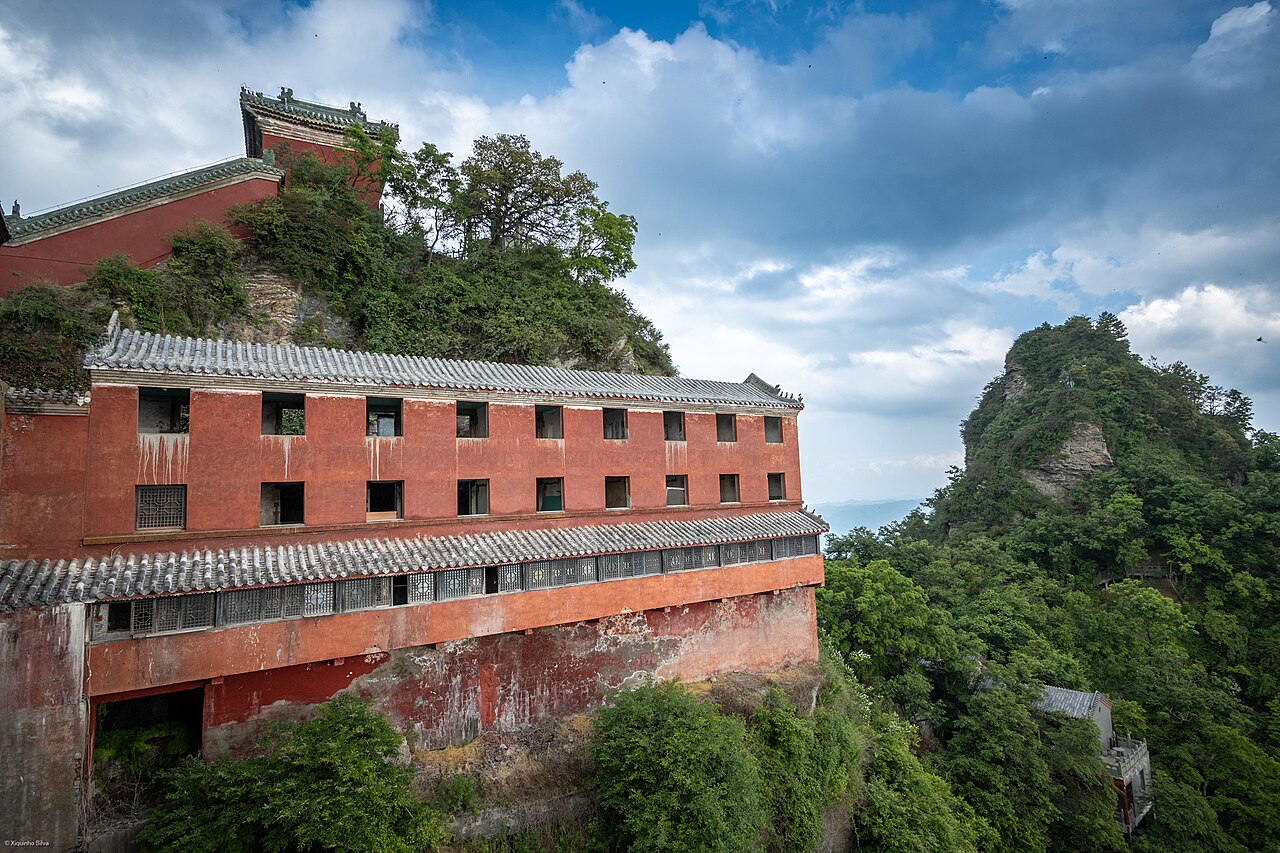
The Ancient Building Complex in the Wudang Mountains, inscribed by UNESCO in 1994, is the most comprehensive surviving example of Chinese Daoist mountain temple architecture: 33 architectural complexes built across the Wudang Mountains’ nine main peaks and their adjacent ridges in Shiyan City, Hubei Province, from the Tang dynasty (618–907 CE) through the early Qing (17th century), with the principal construction commissioned by the Yongle Emperor of the Ming dynasty (1403–1424 CE). The Wudang inscription covers nine palaces, nine temples, three clifftop shrines, and twelve pavilions, the most architecturally significant being the Golden Hall (Jinding, the all-gilded bronze summit temple at 1,612 metres, built 1416) and the Purple Cloud Palace (Zixiao Gong, the largest wooden temple complex, 1413). The mountain is the sacred centre of Chinese Wudang Taoism and the origin point of the Wudang school of internal martial arts (Wudang wushu), including the Wudang Taijiquan tradition attributed to the semi-legendary Taoist master Zhang Sanfeng.
The Three Gorges corridor and central Yangtze Three Gorges · Wulingyuan · Ancient City of Jingzhou — 200 to 400 km
Two hundred kilometres east of the Wudang Mountains by road (approximately 2.5 hours via the Xin Hanshi Expressway to Yichang), the Three Gorges area of the Yangtze River — while not separately inscribed as a UNESCO World Heritage Site — is the most significant natural and engineering landscape in Hubei’s immediate vicinity. The Qutang, Wu, and Xiling Gorges (collectively the Three Gorges) cut 200–600 metres deep through the Yangtze’s limestone canyon over 192 kilometres between Chongqing and Yichang; the Three Gorges Dam at Sandouping (completed 2006, the world’s largest hydroelectric dam by installed capacity at 22,500 MW) has submerged the lower sections of the gorges under a reservoir 600 kilometres long. The submerged area included significant Daoist and Buddhist temple sites — the Zhangfei Temple and the Shibaozhai pagoda (now surrounded by the reservoir) are two of the surviving structures — that were relocated or partially protected before inundation. The Wudang Mountains’ Tang-period Daoist heritage is contemporary with the oldest of the Three Gorges cliff-face temples; the same Yangtze river system connects the two areas by water.
Three hundred fifty kilometres east of the Wudang Mountains by road (approximately 4.5 hours via Xiangyang and Changsha to Zhangjiajie), the Wulingyuan Scenic and Historic Interest Area (inscribed 1992) in northwestern Hunan Province documents the quartzite sandstone pillar landscape of China’s central highland zone. The visual contrast between Wudang’s metamorphic rock mountain form — rounded, forested, with temple complexes built on the peaks and cliff faces — and Wulingyuan’s Devonian quartzite pillars (isolated vertical columns above forested gorges, with no permanent human settlements on the pillars themselves) represents the two dominant forms of sacred and scenic mountain architecture in the central Chinese highland: the sacred mountain where temples were built by human hands on the summit (the paradigm at Wudang, Mount Emei, Taishan, and the four sacred Buddhist mountains) versus the landscape of geological spectacle where the mountain’s aesthetic value is the unmediated rock form. From Wudang Mountains by road (via Shiyan to the G7011 Expressway), Zhangjiajie is reached in approximately 4.5 hours.
Two hundred kilometres southeast of the Wudang Mountains by road (approximately 2.5 hours via Xiangyang to Jingzhou), the Ancient City of Jingzhou (not currently UNESCO-inscribed but on China’s nomination list) and the Chu Culture zone of the Han River basin represent the pre-Daoist cultural context within which the Wudang Mountains’ religious significance developed. The Chu state (771–223 BCE) dominated the area that is now Hubei Province from its capital at Jiangling (modern Jingzhou); the Chu cultural tradition included an animist shamanic landscape belief system (documented in the Chu Ci, “Songs of the South,” a Han dynasty anthology of Chu poetry attributed primarily to Qu Yuan) that pre-dated the formalised Daoist tradition at Wudang but shared its mountain-spirit conceptual landscape. The famous Wudang deity (Zhenwu, the “Perfect Warrior,” the northern supreme deity of Taoism, depicted as a black-robed warrior with tortoise and snake guardians) was incorporated into the Chu shamanic spirit geography before the Daoist systematisation of the Han period; the mountain’s sacred character predates its formal Daoist designation.
Four hundred fifty kilometres northeast of the Wudang Mountains by high-speed rail (approximately 3 hours from Shiyan to Zhengzhou East on the Huheao-Wuhan-Guangzhou HSR, via Wuhan), the Longmen Grottoes at Luoyang (inscribed 2000) document Tang-dynasty Buddhist sculpture in the state that patronised the most important early building campaigns at the Wudang Mountains. The Tang Emperor Taizong (r. 626–649 CE) is credited in local tradition as the period when the first Tang temples were established at Wudang, creating the predecessor structures that the Yongle Emperor replaced with the current stone-and-bronze buildings in 1413. The Tang dynasty’s patronage of both Wudang’s early Daoist temple complex and the Longmen Buddhist caves reflects the Tang court’s syncretic policy of supporting Taoist, Buddhist, and Confucian traditions simultaneously — the Three Teachings (Sanjiao) policy that allowed the Wudang Daoist tradition and the Longmen Buddhist sculpture program to develop in the same political period without official competition. From Wudang Mountains (Shiyan), high-speed rail to Wuhan (approximately 90 minutes) then to Luoyang Longmen (approximately 90 minutes) covers the full route in 3 hours.
Connections north and northeast Forbidden City · Wuhangtai · Huangshan — 500 to 700 km
Five hundred kilometres north of the Wudang Mountains by high-speed rail (approximately 3.5 hours from Shiyan via Wuhan to Zhengzhou and north), the Peking Man Site at Zhoukoudian (inscribed 1987) and the Imperial Palaces of the Ming and Qing Dynasties — the Forbidden City (inscribed 1987) — anchor the northern end of the central Chinese heritage corridor. The Yongle Emperor who commissioned the Wudang Mountains’ primary construction (1413) simultaneously built the Forbidden City in Beijing (construction period 1406–1420) — both were Yongle’s signature architectural projects, planned and executed in the same decade by the same imperial construction administration. The Forbidden City (the world’s largest surviving palace complex) and the Wudang building complex (the largest surviving Daoist mountain temple complex) are the two poles of Yongle’s architectural ambition: the state’s formal centre of political authority in Beijing, and the sacred mountain whose Daoist deity (Zhenwu) the emperor claimed as his dynastic protector. Yongle’s personal devotion to Zhenwu — which the emperor himself attributed to the god’s miraculous assistance during his civil war against his nephew (the Jianwen Emperor) that brought him to power in 1402 — was the political motivation for the unprecedented scale of the Wudang building programme.
Six hundred kilometres east of the Wudang Mountains by high-speed rail (approximately 4 hours via Wuhan and Nanchang to Huangshan North), the Huangshan (Yellow Mountain) inscription (inscribed 1990) in Anhui Province documents the landscape that became the subject of China’s most influential 17th-century painting tradition. The Huangshan painters (Hongren, Shitao) and the Wudang martial arts masters (Zhang Sanfeng and the tradition he is credited with founding) are both products of the same Chinese cultural transformation of the Song-Ming period: the interiorisation of moral and spiritual cultivation as a physical practice, whether through the contemplative landscape aesthetics of Huangshan or the internal energy cultivation of Wudang Taijiquan. The concept of neidan (inner alchemy — the internal Daoist practice of cultivating qi, or vital energy, through breathing, movement, and meditation) that underlies the Wudang martial arts tradition is philosophically parallel to the Huangshan painters’ concept of the mountain as a landscape for moral and aesthetic self-cultivation. Both practices require the same relationship with the mountain as a physical environment that transforms the practitioner’s inner state. From Wudang via Wuhan, Huangshan is reached in approximately 4 hours by high-speed rail (Wuhan to Huangshan North).
Five hundred kilometres north of the Wudang Mountains by high-speed rail (approximately 3.5 hours via Wuhan to Zhengzhou to Mount Songshan area), the Historic Monuments of Dengfeng — “The Centre of Heaven and Earth” (inscribed 2010) at Dengfeng in Henan Province document the ritual and astronomical landscape of the Zhongyue (central sacred mountain) Songshan — the central of the Five Sacred Mountains of Chinese cosmology. Songshan is the axis mundi of the Chinese classical worldview: the mountain at the midpoint of the known territory, equidistant from the four cardinal sacred mountains (Taishan east, Huashan west, Hengshan north and south). The Shaolin Monastery at the base of Songshan’s southern slope, founded in 495 CE, is the origin point of Chan (Zen) Buddhism in China and the source of the Shaolin martial arts tradition — the historical predecessor of the internal martial arts that the Wudang tradition later systematised as a Daoist alternative. From Wudang via Wuhan, Dengfeng/Shaolin is reached by high-speed rail to Zhengzhou and then bus or local rail (approximately 3.5 hours total).
Four hundred kilometres south of the Wudang Mountains by high-speed rail (approximately 3 hours via Wuhan to Changsha to the Wulingyuan area), the Wulingyuan and Zhangjiajie area is the most accessible natural UNESCO site from Wudang along the central Hunan-Hubei highland corridor. The ancient building complex in the Wudang Mountains and Wulingyuan’s natural rock formations together define the two poles of the central Chinese highland heritage: the human sacred mountain (Wudang, with 600 years of deliberate temple construction on the peaks) versus the geological spectacle (Wulingyuan, with Devonian sandstone formations of natural origin). Both are accessible from the Wuhan HSR hub within 2–3 hours, making them a practical combined itinerary for visitors to the central Yangtze highland.
Practical information
The Wudang Mountains are in Danjiangkou City, Shiyan Prefecture, northwestern Hubei Province. The nearest high-speed rail station is Wudangshan Station on the Xiangyang-Wuhan HSR, approximately 15 kilometres from the mountain’s main entrance at Yuanhe Gate (served by shuttle bus, approximately 20 minutes). From Wuhan Tianhe International Airport, high-speed rail connects to Wudangshan Station (approximately 2 hours via Xiangyang). From Beijing South, Wudangshan Station is reached in approximately 5 hours (via Wuhan or via Zhengzhou and Xiangyang). The mountain’s scenic system is accessible via a combination of cable cars and walking trails: the main cable car (South Cliff Cable Car) ascends to the Qiongtai Gate (1,020 metres) area, from which walking trails lead to the main temple complexes; a second cable car serves the Golden Summit approach from the Taizi Slope area. The full ascent to the Golden Summit (1,612 metres) from the cable car upper station requires approximately 1.5 hours of steep stair walking. The Golden Hall (Jinding) at the summit — the all-bronze gilded temple cast in Beijing and transported in sections up the mountain in 1416 — is the most visited single structure; it measures 5.54 metres wide and 4.4 metres deep but appears larger from outside due to the cloud-and-mist surrounding effect at the summit. The Purple Cloud Palace (Zixiao Gong) in the middle mountain zone is the best-preserved wooden architecture in the complex and contains the best collection of Ming-period Daoist sculpture. Full coverage of the main complexes requires 2 full days. The Wudang International Wushu Tournament, held annually in September–October, draws martial artists from across China and internationally for competitions in Wudang Taijiquan, sword, and internal style forms.
Frequently Asked Questions
Who is Zhang Sanfeng and did he invent Taijiquan at Wudang?
Zhang Sanfeng is a semi-legendary Taoist master credited in the Wudang tradition with founding the Wudang school of internal martial arts (Wudang wushu) and specifically with inventing the soft internal style that later became known as Taijiquan (T’ai Chi Ch’uan). The historical record on Zhang Sanfeng is fragmentary and contradictory: the earliest reliable references to him appear in 15th-century Ming documents, which describe him as a wandering Taoist who lived during the Song period (960–1279 CE) and visited Wudang Mountain. The Yongle Emperor’s massive building campaign at Wudang was motivated in part by his claimed personal devotion to Zhang Sanfeng’s memory — the emperor sent multiple search missions throughout China to find Zhang Sanfeng (still believed to be alive in the 15th century due to his legendary longevity), without result. The primary modern martial arts scholarship (including the research of Tang Hao, Wu Tu-nan, and Xu Zhen from the 1920s–1940s) is divided on whether Zhang Sanfeng is a historical figure or a Taoist legendary template. The origin of Taijiquan itself is more securely attributed in the modern scholarly consensus to the Chen family of Chenjiagou village in Henan Province, with the Chen family’s own records indicating a 17th-century origin (approximately the Ming-Qing transition, 1644) by Chen Wangting. The Wudang attribution to Zhang Sanfeng predates the Chen family’s documented practice and is therefore either a historical record of an older tradition that the Chen family later systematised, or a retrospective attribution of legitimacy by the Wudang tradition.
Why did the Yongle Emperor have such a personal connection to Zhenwu and the Wudang Mountains?
The Yongle Emperor’s commissioning of the Wudang building complex (1413, the largest single Daoist building campaign in Chinese history) was explicitly attributed in imperial documents to gratitude for the divine assistance he claimed to have received from Zhenwu during his Jingnan Campaign (1399–1402) — the civil war against his nephew the Jianwen Emperor that brought him to power as the third Ming emperor. The Yongle Emperor (born Zhu Di, Prince of Yan) justified his rebellion against the legitimate emperor (his own nephew) with the claim that Heaven had transferred the Mandate to him, and attributed specific battlefield victories to miraculous interventions by Zhenwu (the Perfect Warrior, depicted with a black robe, a shield with tortoise and snake, and a sword). Several episodes from the civil war — including a claimed appearance of the black warrior deity above the battle lines at a critical moment — were incorporated into the official imperial narrative of the Jingnan Campaign to reinforce the legitimacy claim. The 1413 building campaign at Wudang was thus simultaneously a religious act (fulfilling a vow to Zhenwu for battlefield assistance), a legitimacy display (demonstrating that Zhenwu endorsed the Yongle reign by accepting this unprecedented honour), and a political investment (associating the Yongle regime with China’s most important Daoist deity in a visible and permanent way). The scale of the construction — 300,000 workers over three years, according to the official chronicle — was intended to exceed all previous Chinese mountain temple projects, which it did: the combination of the Yongle Emperor’s personal legitimacy need and the available Ming imperial resources produced the largest coordinated Daoist building programme ever undertaken.
What is the Golden Hall (Jinding) and how was it built at 1,612 metres?
The Golden Hall (Jinding, “Golden Summit”) is a bronze-gilded Daoist shrine measuring 5.54 metres wide, 4.4 metres deep, and 5.54 metres tall, built on the summit of Tianpeng Peak (1,612 metres) in 1416 by the Yongle Emperor. The hall is entirely made of gilded bronze — the outer walls, the roof tiles, the decorative ridge ornaments, the interior columns, the altar, and the seated Zhenwu statue inside are all cast or hammered bronze — making it the largest all-bronze Daoist ritual structure in China. The construction required casting and assembling the bronze components in Beijing (at workshops near the Forbidden City’s construction site, running simultaneously), then transporting the disassembled sections up the mountain. Contemporary records indicate the transportation required several thousand porters working relay chains up the mountain trails, a project that took multiple years. The Bronze Hall (Taijidian) at the base of the Jinding cliff dates from 1307 (Yuan dynasty) and is a smaller earlier example of the same all-bronze construction technique at Wudang, confirming that the bronze mountain shrine tradition preceded the Yongle building programme. The Golden Hall’s summit position creates a visual effect of floating above the clouds on overcast days, which is the characteristic appearance in Wudang tourist photography: the bronze roof emerging from a cloud bank, producing the visual image of a heavenly palace above the earthly world. The summit lightning rod system (a long thin bronze spike extending from the roof) has protected the hall from direct lightning strikes since its installation, but the surrounding rock and nearby structures have been damaged by frequent lightning at this altitude.
Sources
- S1 — UNESCO World Heritage Centre — Ancient Building Complex in the Wudang Mountains (Ref. 705) — https://web.archive.org/web/20230601000000/https://whc.unesco.org/en/list/705/
- S2 — UNESCO World Heritage Centre — Statement of Outstanding Universal Value (Ref. 705) — https://whc.unesco.org/en/list/705/
Spotted an error? Write to editorial@culturalheritageonline.com and we correct it the same day.
.jpg)