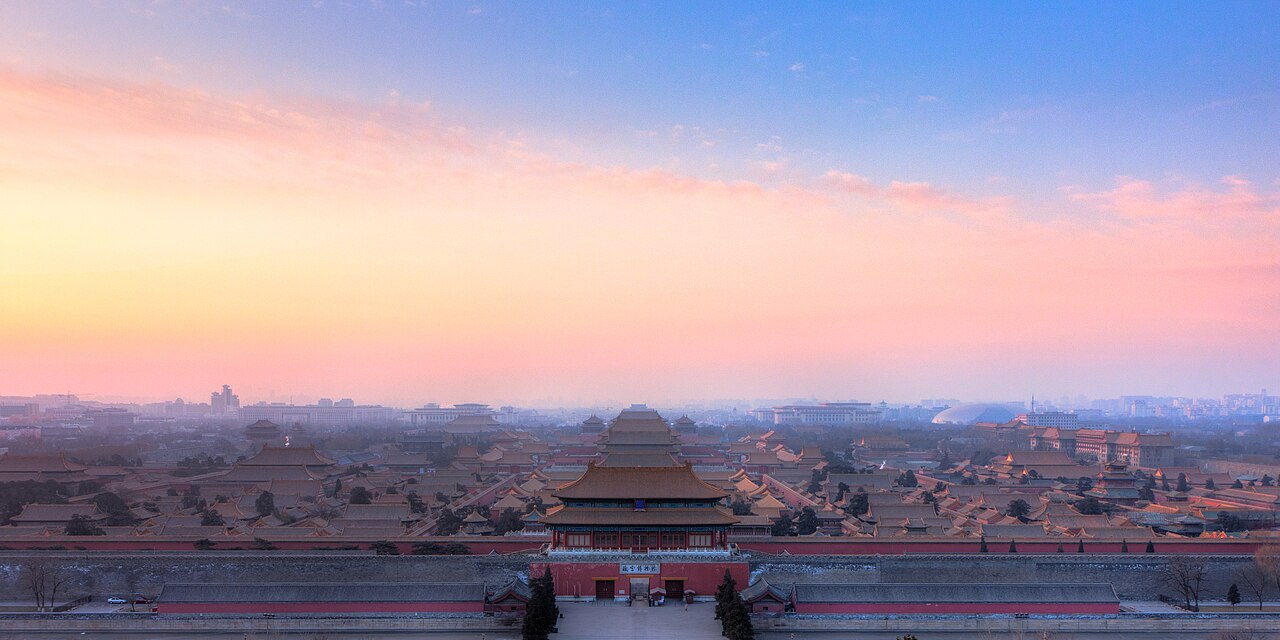
The Imperial Palaces of the Ming and Qing Dynasties in Beijing — the Forbidden City — inscribed by UNESCO in 1987, is the world’s largest surviving palace complex, covering 72 hectares within a 6.2-kilometre perimeter moat at the centre of Beijing. The 8,728 rooms of the palace complex housed the Ming and Qing imperial courts for 491 years (1420–1911): 24 emperors governed the Chinese empire from within its walls, and entry was forbidden to ordinary citizens without imperial summons. The Hall of Supreme Harmony (Taihe Dian) at the palace’s ceremonial axis — the largest wooden building surviving in China — is where emperors conducted the most important state ceremonies of the imperial calendar.
Central Beijing and the imperial axis Temple of Heaven · Summer Palace · Zhoukoudian — 4 to 50 km
Four kilometres south of the Forbidden City by subway (Line 5, approximately 10 minutes from Tiananmen East to Tiantan East Gate), the Temple of Heaven (Tiantan), inscribed in 1998, was built in 1420 CE — the same year as the Forbidden City — as the site of the emperor’s annual winter solstice sacrifice to Heaven. The Tiantan complex and the Forbidden City were both components of the same Ming dynasty ceremonial city plan: the north-south imperial axis visible in Beijing’s modern urban structure runs from the Bell and Drum Towers in the north through the Forbidden City and Tiananmen Square to the Temple of Heaven and the Yongdingmen Gate in the south, a distance of approximately 8 kilometres. The emperor left the Forbidden City on the winter solstice by formal procession along this axis to conduct the sacrifice at the Circular Mound Altar (Yuanqiu Tan) — the most politically significant ritual of the Chinese imperial year. The Temple of Heaven’s three principal structures — the Altar of Prayer for Good Harvests (Qinian Dian, a triple-eaved circular hall 36 metres high), the Imperial Vault of Heaven, and the Circular Mound Altar — are connected by the 360-metre Vermillion Steps Bridge (Danbiqiao), the ceremonial processional way.
Fifteen kilometres northwest of the Forbidden City by subway (Line 4, approximately 35 minutes to Xiyuan Station), the Summer Palace (Yiheyuan), inscribed 1998, is the 290-hectare imperial garden-park complex on Kunming Lake that served as the Qing court’s seasonal retreat. The Summer Palace’s Longevity Hill structures — the 24-metre Buddhist tower Fo Xiang Ge built 1750–1764 under Emperor Qianlong — and the 728-metre Long Corridor (a lakeside gallery with 14,000 painted panels) are the inscription’s defining features. Qianlong, whose 60-year reign (1736–1795) was the longest and culturally most productive of the Qing dynasty, designed the Summer Palace’s original landscape in 1750 by expanding a natural spring-lake. The Summer Palace was twice looted and burned by foreign forces (British and French troops in 1860 during the Second Opium War; allied forces in 1900 during the Boxer Uprising) and reconstructed on both occasions under Empress Dowager Cixi’s direction, accounting for the surviving buildings’ late Qing date despite their mid-18th-century design origins.
Forty-eight kilometres southwest of the Forbidden City by subway (Line 10 or 4 to Liuliqiao and bus to Zhoukoudian, approximately 90 minutes total), the Peking Man Site at Zhoukoudian (inscribed 1987) preserves the 700,000-year-old Homo erectus occupation of the North China Plain that the Forbidden City was built on in 1406. The 700,000-year gap between the Zhoukoudian Homo erectus and the Ming Yongle Emperor’s Forbidden City construction is the full span of human biological and cultural evolution in East Asia: the same North China Plain geography, the same limestone hills of Fangshan, and eventually the same Mandarin-speaking human population descended from the anatomically modern Homo sapiens who succeeded Homo erectus in the same territory approximately 40,000 years ago. From Zhoukoudian, the Forbidden City is visible as the endpoint of the same river-valley axis that channelled human movement through the Beijing plain since the Pleistocene.
Sixty kilometres northwest of the Forbidden City by the Badaling Express train (approximately 35 minutes from Qinghe Station), the Great Wall of China at Badaling (inscribed 1987) is the Ming dynasty’s northern defensive perimeter visible from the capital that commanded its construction. The Yongle Emperor who built the Forbidden City also directed the brick-facing of the Wall’s Beijing sections in the same decade; the two projects were inseparable components of the Ming northern frontier policy. The Wall at Badaling runs along the Yanshan granite ridge at an altitude of 700–900 metres; from the wall’s watchtowers, the flat agricultural plain that extends south toward Beijing (and within which the Forbidden City stands) is visible as the terrain the Wall was built to protect. The spatial relationship between palace and wall — the emperor in the centre, the Wall 60 kilometres north — is the physical expression of the Ming state’s political geography.
The imperial tombs and the Ming-Qing heritage circuit Ming Tombs · Shenyang · Qufu — 50 to 700 km
Fifty kilometres northwest of the Forbidden City by car (approximately 60 minutes), the Imperial Tombs of the Ming and Qing Dynasties at Changling and Dingling (inscribed 2000) are the burial complex of the emperors who built and inhabited the Forbidden City. The Ming Tombs’ Spirit Way — 7 kilometres of ceremonial road lined with 36 stone animal sculptures — leads to the Changling tomb of the Yongle Emperor, the same ruler who built the Forbidden City; the visual axis from the palace complex to the tomb complex 50 kilometres to the northwest was the imperial afterlife continuation of the ceremonial axis that ran from Tiananmen through the Hall of Supreme Harmony to the rear palace courts. The Dingling tomb (the only excavated Ming imperial burial, opened 1956–1957) contains the intact underground palace chambers of the Wanli Emperor (died 1620) with approximately 3,000 burial objects including gold crowns, silk robes, and blue-and-white porcelain, displayed in the adjacent Dingling Museum.
Seven hundred kilometres northeast of the Forbidden City by high-speed rail (approximately 2.5 hours from Beijing North to Shenyang North), the Shenyang Imperial Palace — added to the Forbidden City UNESCO inscription in 2004 as a serial component — was built by the Qing dynasty founder Nurhaci and his successor Hong Taiji (1625–1636) before the Qing conquest of China proper. The Mukden Palace covers approximately 6 hectares (compared to the Beijing Forbidden City’s 72 hectares) and preserves Manchu architectural features absent from Beijing: the Dazheng Hall (10-sided, following a Manchu military tent design) and the 10 Prince Pavilions flanking it document the Manchu military-administrative council system before its adaptation to Chinese palace conventions after 1644. The comparison between the Shenyang and Beijing palace complexes documents the architectural transformation of the Qing state from a Manchu military confederacy to a Chinese imperial dynasty in a single generation.
One hundred twenty-five kilometres northeast of the Forbidden City by high-speed rail (approximately 90 minutes from Beijing to Zunhua), the Eastern Qing Tombs (Dongling) at Zunhua in Hebei Province are the burial complex of the Qing emperors Shunzhi, Kangxi, Qianlong, Xianfeng, and Tongzhi, with associated empress and consort burials. The Empress Dowager Cixi’s tomb (Pu Tuo Yu Ding Dong Ling) at Dongling is the most elaborately decorated of any Qing imperial tomb: its stone-carved Buddhist reliefs were rebuilt at exceptional expense in 1895 on Cixi’s personal order, with phoenix imagery prominently displayed above dragon imagery (reversing the traditional gender hierarchy). The Western Qing Tombs (Xiling) at Baoding (140 km southwest of Beijing, approximately 90 minutes by high-speed rail) complete the Qing burial series, holding the burials of emperors Yongzheng, Jiaqing, Daoguang, and Guangxu.
Four hundred kilometres south of the Forbidden City by high-speed rail (approximately 2 hours from Beijing South to Qufu East), the Temple and Cemetery of Confucius and the Kong Family Mansion at Qufu (inscribed 1994) document the philosophical tradition that the Forbidden City’s ceremonial structure expressed in architectural form. The Ming and Qing courts conducted imperial veneration of Confucius and the Confucian canon as the basis of their administrative legitimacy; the Yongle Emperor who built the Forbidden City also commissioned the Yongle Dadian (22,877 manuscript volumes, the largest Chinese encyclopaedia ever compiled), drawing on the same Confucian scholarship tradition that the Qufu inscription embodies. The Forbidden City’s Hall of Literary Glory (Wenhua Dian), where emperors lectured on the Confucian classics, was the physical expression of this connection between palace administration and Confucian moral authority.
Practical information
The Forbidden City (Palace Museum, Gugong Bowuyuan) is located at the centre of Beijing, directly north of Tiananmen Square, accessible from Tiananmen East and Tiananmen West subway stations (Line 1). The museum is open every day except Mondays and during major holidays; entry requires advance ticket purchase via the Palace Museum website (pm.cn). Tickets for the main complex (outer and inner courts) and tickets for the treasury halls (Treasure Gallery and Clock Exhibition Hall) are sold separately; the Treasure Gallery requires an additional ticket. The outer Meridian Gate (Wumen) is the formal entrance; the north exit (Shenwumen) leads to the Jingshan (Coal Hill) Park, from which the panoramic view shown in the article image is photographed. The complete round-trip through the main axial buildings (south to north, Meridian Gate to Gate of Divine Prowess) covers approximately 2 kilometres; a thorough visit of the outer court, inner court, Treasure Gallery, Clock Hall, and eastern or western peripheral courtyards takes 4–6 hours. The Jingshan Park entrance (5 minutes from the Forbidden City north gate) provides the best elevated view of the palace layout and the imperial axis — the view from the Wanchun Pavilion at Jingshan’s summit shows the entire Forbidden City plan, from Tiananmen south to the Bell Tower and Drum Tower north, in a single panoramic field. Beijing Capital Airport is 30 km northeast (Airport Express subway to Dongzhimen in approximately 20 minutes, then Line 2 to Tiananmen); Beijing Daxing International Airport is 50 km south (Express train to Beijing West in approximately 40 minutes).
Frequently Asked Questions
Why was the Forbidden City forbidden?
The Forbidden City (Zijin Cheng, “Purple Forbidden City”) was forbidden to ordinary subjects because the palace complex was understood as the earthly equivalent of the Purple Star Enclosure — the celestial pole around which the heavens rotate in Chinese cosmology, identified with the north celestial pole and represented in Chinese astronomy as the residence of the Heavenly Emperor. The earthly emperor, as Son of Heaven (Tianzi), required a palace that replicated the inaccessibility and centrality of the celestial pole: just as no human could physically reach the north celestial pole, no ordinary person could enter the Forbidden City without imperial summons. This cosmological logic was reinforced by practical political theology: the emperor’s person was sacred and his daily life was governed by ritual prohibitions that prevented casual contact. Entry to the Forbidden City required official status and imperial permission; the consequences of unauthorized entry ranged from immediate execution (for serious intrusions into the inner courts) to imprisonment. The palace’s physical design reinforced this prohibition: the outer perimeter wall (10 metres high), the surrounding moat (52 metres wide), and the four corner watchtowers created a genuinely impenetrable barrier. Within the walls, successive gates filtered access — outer court officials could not enter the inner court; inner court eunuchs could not enter specific ritual areas; the emperor’s private quarters (the Palace of Heavenly Purity) were restricted even among residents. The “forbidden” character of the palace lasted until the Republic of China government opened the complex as the Palace Museum in 1925, 14 years after the last emperor (Xuantong/Puyi) abdicated in 1912.
How many rooms does the Forbidden City contain and how were they used?
The traditional Chinese count of the Forbidden City’s rooms is 9,999 (the maximum auspicious number below the 10,000 rooms of the Heavenly Palace), but this is a cultural formulation rather than an architectural survey. Modern counts by the Palace Museum’s conservation team have documented approximately 8,728 rooms in the surviving buildings — a room being defined as a bay of structure between columns (jian), not a separate enclosed space. The palace is divided functionally into the Outer Court (Waichao) and the Inner Court (Neiting). The Outer Court, comprising the three great ceremonial halls (Taihe Dian Hall of Supreme Harmony, Zhonghe Dian Hall of Middle Harmony, and Baohe Dian Hall of Preserving Harmony) and their flanking auxiliary buildings, was where state ceremonies were conducted, foreign ambassadors received, and the highest-level administrative decisions made. The Inner Court, comprising the three inner palaces (the Palace of Heavenly Purity for the emperor’s personal business, the Hall of Union, and the Palace of Earthly Tranquillity where the empress resided) and the Six Eastern and Six Western Palaces for imperial concubines, was where the imperial family lived and the daily ritual of the emperor’s personal life was conducted. The boundary between Outer and Inner Court was the Gate of Heavenly Purity (Qianqing Men) — the gate that officials of the outer administration were not permitted to pass. The Six Southern Storehouses (south of the Meridian Gate) and the Imperial Workshops (east of the Outer Court) added manufacturing, storage, and service spaces to the complex. Most of the approximately 8,728 rooms were ancillary to the main ceremonial and residential functions: storage, guard quarters, kitchens, workshops, and passage corridors connecting the major halls.
What happened to the Forbidden City’s collections when the Republic was established?
When the Qing dynasty ended in 1912, the last emperor Puyi (Xuantong Emperor, born 1906, abdicated 1912 at age 6) was permitted by the Republic of China government to continue living in the Inner Court under the “Articles of Favourable Treatment” — a negotiated settlement that gave him a stipend, the title of emperor within the Forbidden City walls, and custody of the palace collections. Puyi continued to live in the Inner Court until 1924, when the Nationalist warlord Feng Yuxiang expelled him from the palace and the Republic government established the Palace Museum (Gugong Bowuyuan) in 1925, opening the palace and its collections to the public for the first time. The collections at the time of the 1925 opening comprised approximately 1.17 million objects. During the Second Sino-Japanese War (1937–1945), approximately 13,427 crates of the most important objects were evacuated from Beijing to Nanjing and then further inland to Chengdu and later Emei; at the end of the war, the Nationalist government moved approximately 2,972 crates of the most important objects to Taiwan, where they form the collection of the National Palace Museum in Taipei (opened 1965). The Beijing Palace Museum therefore holds approximately 1.86 million objects (the number has grown through acquisition and archaeological recovery since 1925) and the Taipei National Palace Museum holds approximately 700,000 objects — the two institutions together represent the complete Qing imperial collection, divided since 1949 between the People’s Republic and the Republic of China on Taiwan.
Sources
- S1 — UNESCO World Heritage Centre — Imperial Palaces of the Ming and Qing Dynasties in Beijing and Shenyang (Ref. 439) — https://web.archive.org/web/20230601000000/https://whc.unesco.org/en/list/439/
- S2 — UNESCO World Heritage Centre — Statement of Outstanding Universal Value (Ref. 439) — https://whc.unesco.org/en/list/439/
Spotted an error? Write to editorial@culturalheritageonline.com and we correct it the same day.