
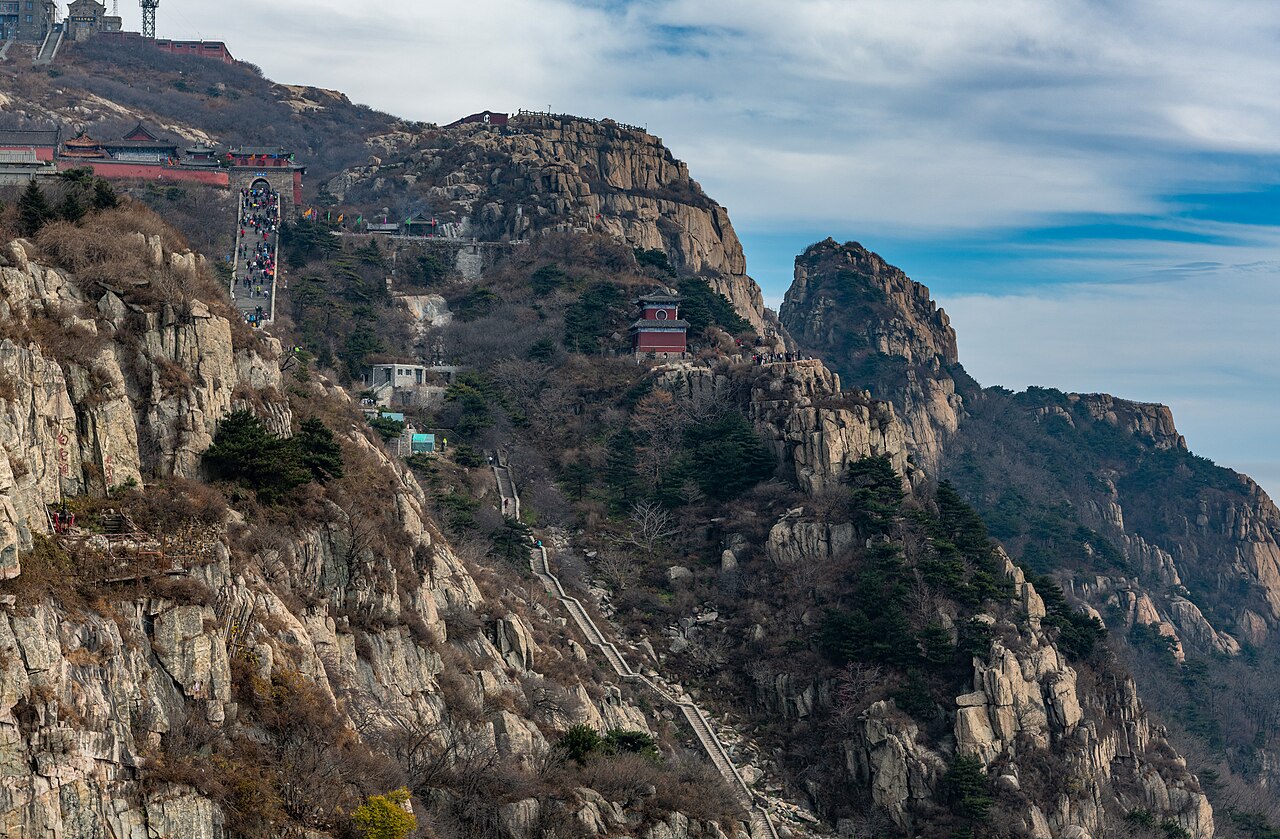
Mount Taishan, inscribed by UNESCO in 1987 as China’s first mixed cultural and natural World Heritage Site, is the easternmost and most venerated of the Five Sacred Mountains of Chinese civilization. The 1,545-metre peak above Tai’an City in Shandong Province has been a site of imperial sacrifice, Daoist and Buddhist pilgrimage, and calligraphic inscription for 3,000 years: 72 emperors performed the feng and shan sacrifices here from the Han dynasty (206 BCE – 220 CE) onward, asserting the mandate of heaven at the summit. Over 1,800 stone steles, carved tablets, and inscribed rock faces document the mountain’s 2,500 years of continuous ritual and literary use — the densest concentration of historical calligraphy in any single Chinese landscape.
The Shandong heritage corridor Qufu · Beijing · Grand Canal — 100 to 450 km
One hundred kilometres south of Tai’an by high-speed rail (approximately 30 minutes from Tai’an to Qufu East on the Beijing-Shanghai HSR), the Temple and Cemetery of Confucius and the Kong Family Mansion at Qufu (inscribed 1994) form the most directly connected UNESCO site to Mount Taishan in both geography and cultural significance. The Confucius Temple (Kongmiao), the Kong Family Mansion (Kongling), and the Cemetery of Confucius (Konglin) at Qufu document China’s most influential philosophical tradition at its origin point; the current temple complex’s 460 buildings span 16 hectares, making it the second-largest ancient architectural complex in China after the Forbidden City. Mount Taishan and Qufu were the two most sacred destinations in the Confucian world: emperors traditionally visited both sites on the same imperial circuit, conducting the feng and shan sacrifice at Taishan to assert the cosmological mandate and then honouring Confucius at Qufu to assert the cultural legitimacy that Confucianism provided. Emperor Qianlong of the Qing dynasty (reigned 1736–1795) visited Qufu 11 times and Taishan 11 times during his 60-year reign — the two sites were inseparable in the imperial ritual calendar.
One hundred eighty kilometres north of Tai’an by high-speed rail (approximately 45 minutes from Tai’an to Jinan and local rail), the Grand Canal UNESCO inscription (2014) includes canal sections running through Shandong Province — the Jining canal route and the Linqing route in western Shandong. The Grand Canal in its Shandong sections was the primary economic infrastructure for the grain tribute system that financed the imperial capital: millions of tonnes of Shandong and southern Chinese grain moved north through the canal each year to feed the Beijing court and its garrison. The same imperial infrastructure that maintained the canal’s Shandong routes sustained the ritual pilgrimages to Taishan — the grain tribute and the mountain pilgrimage both moved along the same roads and waterways of the Shandong plain. From Tai’an, the Jining section of the Grand Canal is reached by high-speed rail to Jining South (approximately 30 minutes).
Four hundred fifty kilometres north of Tai’an by high-speed rail (approximately 2 hours from Tai’an to Beijing South), the Imperial Palaces of the Ming and Qing Dynasties — the Forbidden City, inscribed 1987 — is the institution that conducted the most imperial visits to Taishan. The Qing emperors Kangxi (reigned 1661–1722) and Qianlong each made multiple feng and shan journeys to Taishan from Beijing, and their calligraphic inscriptions appear on multiple steles at the mountain’s summit and eastern route. The political axis that linked the Forbidden City to Taishan — the emperor governing from Beijing and asserting the cosmological mandate at the Shandong mountain 450 kilometres to the southeast — was the primary institutional expression of the same Confucian political theology that the Qufu inscription documents at ground level.
Three hundred kilometres northwest of Tai’an by high-speed rail (approximately 90 minutes via Jinan and Shijiazhuang), the Peking Man Site at Zhoukoudian (inscribed 1987) is in Fangshan District, 48 kilometres southwest of central Beijing. While geographically separated from Taishan’s cultural landscape, Zhoukoudian’s 700,000-year-old Homo erectus represents the prehistoric prelude to the Shandong cultural sequence documented at Taishan: the same North China Plain geography that supported Homo erectus at Zhoukoudian 700,000 years ago supported the first agricultural settlements, then the Shang and Zhou kingdoms, then the Confucian academy at Qufu and the imperial sacrifice at Taishan, in continuous cultural sequence from the Pleistocene to the Qing dynasty.
The Yellow River corridor and the Central Plains Xi’an · Luoyang · Datong — 600 to 800 km
Six hundred kilometres west of Tai’an by high-speed rail (approximately 2.5 hours via Zhengzhou), the Longmen Grottoes at Luoyang (inscribed 2000) contain approximately 100,000 Buddhist statues in 2,345 niches cut into the limestone cliffs of the Yi River gorge south of Luoyang. The Longmen complex documents Tang-dynasty (618–907 CE) Buddhist art at the same moment that Taishan’s imperial inscription tradition was at its peak: the Tang Emperor Gaozong conducted a celebrated feng ceremony at Taishan in 666 CE (one of the grandest in recorded history), and in the same decade his empress Wu Zetian commissioned the Fengxian Temple at Longmen with the 17-metre Vairocana Buddha (completed 672 CE). The two sites — Taishan’s imperial calligraphy and Longmen’s imperial Buddhist sculpture — are the two artistic expressions of the same Tang court’s cultural production, separated by 600 kilometres of the central Chinese plain.
Eight hundred kilometres northwest of Tai’an by high-speed rail (approximately 3.5 hours via Shijiazhuang and Datong), the Yungang Grottoes near Datong in Shanxi Province (inscribed 2001) predate the Longmen caves by 200 years: the principal Yungang caves were carved in 460–524 CE under Northern Wei patronage. Cave 20 at Yungang — the outdoor seated Buddha, 13.7 metres high, exposed after the cave front collapsed — is the most reproduced image from the inscription. The stylistic comparison between Yungang (Central Asian-influenced, Indian drapery folds, Gandha-style faces) and Longmen (Tang classical, purely Chinese facial types, Chinese drapery) documents the sinification of Buddhist art over 200 years of imperial patronage: from the Northern Wei’s direct translation of Central Asian models in the 5th century to the Tang court’s fully Chinese Buddhist iconography in the 7th. From Tai’an, Datong requires high-speed rail to Beijing (2 hours) and Beijing-Datong HSR (90 minutes).
Seven hundred kilometres west of Tai’an by high-speed rail (approximately 4 hours via Zhengzhou and Xi’an HSR), the Mausoleum of the First Qin Emperor with its Terracotta Army (inscribed 1987) at Lintong near Xi’an is the archaeological counterpart to Taishan’s calligraphic tradition. The First Emperor visited Taishan immediately after unifying China in 221 BCE and conducted what the historical record identifies as the first feng sacrifice; he had his own commemoration inscribed on a summit stele, none of which has survived. The same emperor whose terracotta army guards his burial is the first emperor recorded at Taishan — the mountain’s 2,500-year ritual history begins with the man whose mausoleum is the most famous excavated site in China.
Five hundred kilometres north of Tai’an by high-speed rail (approximately 2.5 hours via Shijiazhuang and Xinzhou), the Mount Wutai (Wutaishan) inscription in Shanxi Province (inscribed 2009) documents the northern Chinese Buddhist sacred mountain pilgrimage tradition — the counterpart to Taishan’s Daoist and Confucian sacred mountain tradition. Wutaishan’s five flat-topped peaks are understood as the earthly abode of the bodhisattva Manjushri (Wenshu Pusa); the mountain holds 53 surviving monasteries from the Northern Wei to the Qing dynasties (386–1912 CE), the largest concentration of historic Buddhist architectural sites in China. The comparison between Taishan (Daoist/Confucian imperial sacrifice site) and Wutaishan (Buddhist pilgrimage mountain) documents the two principal religious traditions’ approach to the sacred mountain as a locus of cosmic power in the same Chinese cultural landscape.
Practical information
Tai’an City is the base for visiting Mount Taishan and is directly on the Beijing-Shanghai high-speed railway: Beijing South to Tai’an in approximately 2 hours; Shanghai Hongqiao to Tai’an in approximately 3.5 hours. From Tai’an Station, the traditional eastern pilgrimage route begins at Dai Temple (Daimiao) in central Tai’an — a major Song-dynasty palace complex occupying 9.6 hectares, itself worth 1–2 hours — and climbs via 6,600 stone steps to the summit (5–8 hours round trip on foot). A cable car (Zhongtianjie Cable Car) covers the upper-middle section of the mountain; the lower cable car (Taiantian Jieyuan) covers the middle section. Most visitors combine partial walking with cable car descent. The summit area holds the Azure Cloud Temple (Bixia Ci), dedicated to the mountain goddess Bixia Yuanjun; the Jade Emperor Temple (Yuhuang Ding) at the highest point; and multiple rock-face inscriptions including one by the Tang Emperor Xuanzong (725 CE, the most elaborate surviving Taishan imperial text). Sunrise from the summit is the primary draw; a network of summit hotels (including the Taishan Hotel, altitude 1,400 m) allows overnight stays for the pre-dawn ascent. The mountain is busiest during Chinese public holidays (October Golden Week, May Day, Spring Festival) and the summer season (June–September); spring (April–May) and autumn (September–October) offer the best conditions.
Frequently Asked Questions
What are the feng and shan sacrifices and why were they performed at Taishan?
The feng and shan sacrifices (fengshan daji) were the most solemn ritual acts available to a Chinese emperor: the feng ceremony conducted at the mountain’s summit (an altar of packed earth, offerings to Heaven, and the sealing of a jade text in a stone coffer) and the shan ceremony at the mountain’s base (offerings to Earth, symmetrically addressed to the ground below). The rationale for performing them at Taishan derived from the mountain’s position as the easternmost of the Five Sacred Mountains — the direction associated in Chinese cosmology with sunrise, spring, growth, and life — and from its geological imposingness: Taishan rises abruptly 1,300 metres above the Shandong plain, making it visually dominant over the flat agricultural landscape for 100 kilometres in every direction. The rites were understood as the emperor’s direct communication with Heaven and Earth, asserting that his rule was divinely sanctioned (that he held the “mandate of heaven,” tianming). Only an emperor who had unified or pacified the realm could legitimately conduct the sacrifice; performing the ritual without such legitimacy was considered presumptuous and potentially fatal. The historical records identify 72 emperors as having performed the ceremony, but the list is partly legendary: the Han historian Sima Qian provides the first reliable accounts, noting that the Emperor Wu of Han (r. 141–87 BCE) conducted the sacrifice at least 4 times. The secrecy surrounding the summit ceremony’s content — several emperors ordered the ceremony sealed from the historical record — meant that the exact ritual actions were never standardized across dynasties.
How did Taishan become the subject of Chinese landscape painting?
Taishan’s visual representation in Chinese painting predates the Huangshan school by a millennium: from the Tang dynasty (618–907 CE) onward, Taishan’s vertical granite profile, pine forests, and cloud-sea views were standard subjects for Chinese landscape painters and calligraphers working in the “noble mountain” (mingshan) tradition. The Tang poet Du Fu (712–770 CE) wrote the most famous Chinese poem about Taishan (“Climbing the Mountain in Thought”), establishing the literary-visual connection between the mountain’s physical form and the aspirational human spirit that Chinese literati culture sustained. Unlike Huangshan — which was developed as a painting subject by the 17th-century Anhui school — Taishan’s cultural representation was diffuse across centuries of Chinese art rather than concentrated in a single regional school. The mountain’s cultural saturation (every surface with a horizontal face has been inscribed; the path from the gate to the summit is the longest outdoor gallery of Chinese calligraphy in the world) means that visiting Taishan is an immersion in 2,500 years of Chinese written culture as much as a physical ascent.
How long does it take to climb Mount Taishan and what is the best season?
The traditional eastern route from the Dai Temple in Tai’an City to the summit covers approximately 7.5 kilometres with approximately 6,600 stone steps and an elevation gain of 1,300 metres: a fit walker needs approximately 3–4 hours for the ascent and 2–3 hours for the descent. Many visitors take the cable car for part of the ascent or descent; the most common pattern is walking up via the main stone stairway and descending by cable car (Zhongtianjie to Zhongtianmen, then bus to the mountain base), which reduces the total time to 3–4 hours. The western route is steeper and less maintained; the Peach Blossom Valley route through the mountain’s northern forest is longer and quieter. Spring (April–May) is the most popular season for scenic conditions: the mountain peach and apricot blossoms appear in April, the cloud sea is frequent in May, and temperatures at the summit average 5–15°C. Autumn (September–October) is similarly popular for clear skies. Summer (June–August) is hot and crowded; winter (November–March) offers ice and snow conditions and dramatic low-angle light but requires appropriate footwear (crampons available for rent at the mountain gate). Sunrise at the summit is best observed from the Sunrise Watching Peak (Riguan Feng) on the eastern edge of the summit plateau — the peak appears approximately 10 minutes to the northeast of the summit hotel cluster.
Sources
- S1 — UNESCO World Heritage Centre — Mount Taishan (Ref. 437) — https://web.archive.org/web/20230601000000/https://whc.unesco.org/en/list/437/
- S2 — UNESCO World Heritage Centre — Statement of Outstanding Universal Value (Ref. 437) — https://whc.unesco.org/en/list/437/
Spotted an error? Write to editorial@culturalheritageonline.com and we correct it the same day.
.jpg)