
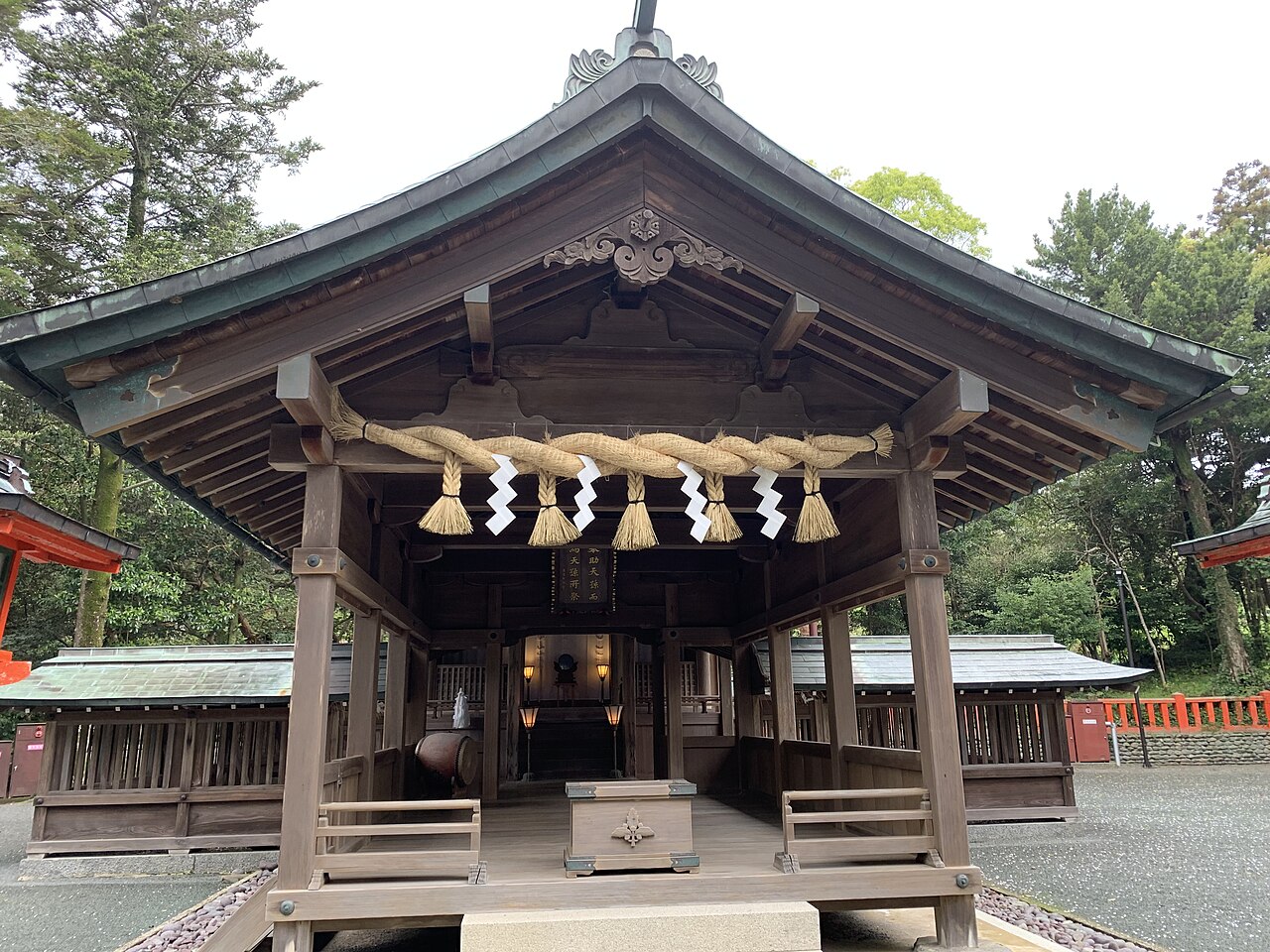
Okinoshima and Associated Sites in the Munakata Region, inscribed by UNESCO in 2017, documents the sacred island of Okinoshima — 60 kilometres offshore in the Genkai Sea between Kyushu and the Korean Peninsula — and the three shrines of Munakata Taisha in Fukuoka Prefecture. Over 80,000 ritual objects were deposited on Okinoshima across 1,400 years (4th–9th centuries CE) by navigators and court diplomats travelling the East China Sea trade route; the island was the sacred guardian of the sea passage between Japan and the Asian continent. Access remains restricted: only initiated male members of the Munakata Grand Shrine’s priestly lineage may land on the island.
Kyushu and the western sea routes Hiroshima · Nagasaki · Okinawa — 200 to 1,300 km
One hundred sixty kilometres east of Munakata City by Sanyo Shinkansen (Hakata to Hiroshima in approximately 60 minutes), the Itsukushima Shinto Shrine on Miyajima Island in Hiroshima Prefecture is the closest UNESCO World Heritage Site to the Okinoshima inscription by direct travel time. The Itsukushima Shrine (inscribed 1996) shares with Okinoshima the quality of sacred island topography: both are islands approached by sea and understood as dwelling-places of deities rather than human communities. Miyajima’s floating torii gate (the O-torii, 16 metres high, standing in tidal water 200 metres offshore) was built according to the same Shinto logic of marking a sacred sea approach that governed Okinoshima’s isolation. From Munakata City, Itsukushima is reached by JR Kagoshima Main Line to Hakata (approximately 45 minutes), Sanyo Shinkansen to Hiroshima (approximately 60 minutes), and JR and Miyajima Ferry from Miyajimaguchi (approximately 20 minutes).
One hundred eighty kilometres east of Munakata by the same Shinkansen corridor, the Hiroshima Peace Memorial (Genbaku Dome), inscribed in 1996, documents a different dimension of the sea passage that Okinoshima guarded: the Pacific War’s culminating moment on the same coastline that the 4th–9th-century navigators using Okinoshima as a waypoint were crossing toward Korea and China. The Genbaku Dome — the Industrial Promotion Hall gutted by the atomic bomb detonation of 6 August 1945 and preserved as a ruin — is a 10-minute walk from Hiroshima Peace Memorial Museum and 15 minutes by tram from JR Hiroshima Station. From Munakata, Hiroshima is 105 minutes by Shinkansen (Hakata to Hiroshima).
Two hundred ninety kilometres south of Munakata by Shinkansen and limited express (Hakata to Nagasaki by Nishikyushu Shinkansen in approximately 65 minutes), the Hidden Christian Sites in the Nagasaki Region (inscribed 2018) document the underground transmission of Catholic faith in Kyushu during the period 1587–1873, when Christianity was banned under the Tokugawa shogunate. The Okinoshima inscription and the Nagasaki Christian Sites together document the two directions from which foreign influence entered Japan via the Kyushu maritime approaches: the continental Buddhist-Confucian trade route to Korea and China that Okinoshima guarded, and the European missionary trade route through the East China Sea and Nagasaki harbour that the Hidden Christian inscription documents 1,000 years later. From Munakata City, Nagasaki requires Shinkansen via Hakata (approximately 90 minutes total to Nagasaki).
One thousand two hundred kilometres south of Munakata by domestic flight from Fukuoka (approximately 2 hours to Naha Airport, Okinawa), the Gusuku Sites and Related Properties of the Kingdom of Ryukyu (inscribed 2000) document the medieval Ryukyuan Kingdom whose trade routes depended on the same sea passage through the Genkai Sea that Okinoshima protected. The Ryukyu Kingdom (15th–19th centuries) traded actively with China, Korea, Japan, and Southeast Asia using the southern sea lanes that passed through the waters near Okinoshima; Okinoshima’s 4th–9th-century ritual offerings include objects of Korean, Chinese, and western Asian origin that document the same maritime commercial network the Ryukyuan state later formalized. From Fukuoka Airport, Naha (Okinawa) is reached by domestic flight in approximately 90 minutes.
East toward Kansai and the ancient imperial heartland Himeji · Kyoto · Nara — 430 to 650 km
Four hundred thirty kilometres east of Munakata by Sanyo Shinkansen (Hakata to Himeji in approximately 90 minutes), Himeji Castle (inscribed 1993) is the best-preserved feudal castle in Japan — a six-storey white-plastered keep completed in 1609 by Ikeda Terumasa, a Tokugawa vassal, on a hillside above the San’yo coastal plain. The castle’s white plaster exterior has given it the name “White Heron Castle” (Hakuro-jo); the complex of 83 buildings survives intact because it was never attacked or significantly damaged, and its recent restoration (2009–2015) returned the main keep to its original white appearance. The contrast between Himeji Castle (the most complete surviving expression of samurai military architecture) and Okinoshima (a sacred island accessible only to priests) documents the two poles of pre-modern Japanese institutional culture: military authority and religious isolation.
Five hundred kilometres east of Munakata by Sanyo Shinkansen (Hakata to Shin-Osaka in approximately 135 minutes), the Historic Monuments of Ancient Kyoto (inscribed 1994) comprise 17 Buddhist temples, Shinto shrines, and gardens documenting the imperial court culture that formed the institutional framework within which Okinoshima’s ritual objects were being deposited. The Munakata Taisha received imperial patronage from the Yamato court precisely in the 4th–9th centuries when Okinoshima’s ritual deposits were at their peak: the three Munakata goddesses (Tagitsuhime, Tagirihime, and Ichikishimahime, daughters of the sun goddess Amaterasu) were among the most officially venerated deities of the Yamato court. From Munakata City, Kyoto is reached by JR to Hakata and Shinkansen (approximately 2 hours 10 minutes).
Five hundred sixty kilometres east of Munakata by Shinkansen (Hakata to Shin-Osaka and JR to Nara, approximately 2 hours 30 minutes), the Historic Monuments of Ancient Nara (inscribed 1998) document the first permanent imperial capital (710–784 CE), established at the peak of the same continental exchange period that produced Okinoshima’s most elaborate ritual deposits. The Tōdai-ji Great Buddha Hall (completed 752 CE) and the Kasuga Grand Shrine at Nara were products of the same Nara-period Buddhist state patronage that funded the diplomatic voyages whose navigators left offerings at Okinoshima. The 7th–8th-century Korean and Chinese objects among Okinoshima’s 80,000 votive items are the material evidence of the sea route that linked the Nara court to the continent; the Nara court at the other end of the route is documented in the Todai-ji’s Great Buddha, cast in 747 CE from bronze produced partly using Korean technical knowledge.
Six hundred fifty kilometres east of Munakata (Hakata to JR Horyuji, approximately 2 hours 40 minutes by Shinkansen and JR), the Buddhist Monuments in the Horyu-ji Area at Ikaruga (inscribed 1993) hold the world’s oldest surviving wooden structures: the Horyu-ji main hall (Kondo) and five-storey pagoda, built approximately 607 CE under the direction of Prince Shotoku. The Horyu-ji complex is the architectural expression in Japan of the same Buddhist continental culture that the Okinoshima ritual deposits document through votive objects: the temple’s Korean and Chinese artistic influence is visible in its bronze sculptures (the Shaka Triad of 623 CE, cast by Tori Busshi in the Asuka style derived from Chinese models) and its wall paintings (the Kondo murals, damaged by fire in 1949, were painted in a style directly derived from Dunhuang cave painting).
Practical information
Munakata City is 40 kilometres northeast of Fukuoka (Hakata) by JR Kagoshima Main Line (approximately 45 minutes, frequent service from Hakata Station to Munakata-Uminakamichi Station or Munakata Station). The Hetsu-miya (Hetsu Shrine) at Munakata — the primary visitor point of the UNESCO inscription — is 10 minutes by taxi or local bus from Munakata Station. The Munakata Taisha Shimpokan treasury museum (Shimbpokan) adjacent to the Hetsu-miya is the inscription’s most important visitor facility: it displays approximately 100 of the 80,000+ ritual objects recovered from Okinoshima during mid-20th-century surveys, including 4th–5th-century Korean and Chinese bronze objects, 6th–7th-century glass beads from the Middle East, 8th-century gold and silver vessels, and stone offerings covering the full chronological range of the island’s 1,400-year ritual use. The Shimpokan is open Tuesday through Sunday (closed Mondays and major holidays); a small entry fee is charged. Okinoshima Island is not accessible to the general public. The annual festival on 27 May (the Okinoshima Festival) allows up to 200 male participants selected by lottery, under strict conditions: no women permitted, no photography, no speaking of the island’s contents to outsiders after departing, and no removal of any material — including a single fallen leaf. From Fukuoka Airport, Hakata Station is 5 minutes by subway; bus and taxi connections to Munakata City depart from Hakata Station.
Frequently Asked Questions
Why is Okinoshima Island closed to the public?
Okinoshima’s closure to general visitors is rooted in the Shinto understanding of the island as a divine dwelling (shintai — the physical body of the deity) rather than a place of human habitation or tourism. The three Munakata goddesses — Tagitsuhime, Tagirihime, and Ichikishimahime — are understood to reside on and in the island itself; the island’s soil, trees, plants, and rocks are extensions of the divine body, and removing anything from the island would violate the deity’s physical integrity. This logic has governed the island’s management since its first documented ritual use in the 4th century CE and has remained unchanged despite Japan’s modernization, its adoption of religious freedom laws, and international heritage designation. The UNESCO inscription formally recognized the island’s isolation as integral to its Outstanding Universal Value: the prohibition on female access and on removing island material are the conditions that have preserved the 80,000 votive objects intact for 1,400 years, which would not have survived had the island been open to collection or habitation. The inscription’s management plan does not require Japan to open the island to the public, and no Japanese institution has proposed doing so. The contrast between Okinoshima’s complete exclusion policy and Itsukushima’s managed public access (approximately 4 million visitors per year to Miyajima) illustrates the range of approaches that Shinto sacred island topography can take.
Who were the Munakata deities and what sea route did they protect?
The three Munakata goddesses (Munakata Sanjoshin) — Ichikishimahime, enshrined at the offshore island of Oshima’s Nakatsu Shrine; Tagitsuhime, enshrined on Okinoshima itself at the Okitsu-miya; and Tagirihime, enshrined at the Hetsu-miya on the Kyushu coast — are, in the Nihon Shoki and Kojiki creation narrative, daughters of the sun goddess Amaterasu born from the sword of the god Susanoo. Their function as maritime guardians is explicit in both texts: the imperial court sent offerings to the three goddesses specifically to ensure safe passage on the sea route to Korea (the Mimana/Kaya region of the southern Korean Peninsula) and to Tang-dynasty China. The sea route they protected — crossing the Genkai Sea from northern Kyushu, stopping at Oshima, crossing to the southern Korean coast, and then either proceeding up the Korean Peninsula or crossing the Korea Strait to China — was Japan’s only route to the Asian continent for the entire Yamato period (3rd–8th centuries CE). The 4th-century diplomatic missions that established the formal Japan-Korea-China cultural exchange, and the 7th–8th-century Kentoshi missions that brought Buddhism, Confucianism, Tang legal codes, and Chinese writing to Japan, all used this route. Okinoshima’s 80,000 votive objects are the physical record of 1,400 years of ritual acknowledgment of the goddesses’ protection of that passage.
What do the 80,000 votive objects reveal about ancient Japan’s trade networks?
The 80,000 ritual objects deposited at Okinoshima between the 4th and 9th centuries CE are one of the most extraordinary archaeological assemblages in Japanese history, and their origin diversity reveals the reach of the East Asian trade network at its early medieval peak. Among the objects documented in the Shimpokan museum surveys: 4th–5th-century Korean bronze mirrors and iron armour components (evidence of the diplomatic exchange with the Baekje and Gaya polities of southern Korea that accompanied early Japanese state formation); 6th–7th-century glass beads from South Asia and the Middle East (likely arriving via the Silk Road maritime route through Southeast Asia and then Korea); Tang-dynasty Chinese bronze mirrors and silk textiles (8th century, documenting the Kentoshi missions’ tribute and gift exchange); and Japanese ritual objects (bronze bells, comma-shaped jade beads, gilt-bronze horse fittings) that document the Yamato court’s own material culture at successive periods. The assemblage as a whole is the best surviving physical documentation of the Yamato court’s continental exchange economy — more complete than the famous Shosoin treasury in Nara, which preserves later objects in a controlled indoor environment. The Shosoin (the imperial treasure house at Todai-ji) and the Okinoshima deposits are two faces of the same 8th-century Japanese state’s cultural acquisition from the continent: the Shosoin’s contents were collected by Emperor Shomu’s court; the Okinoshima deposits were the ritual tribute to the goddesses who made that collection possible by guarding the sea route.
Sources
- S1 — UNESCO World Heritage Centre — Sacred Island of Okinoshima and Associated Sites in the Munakata Region (Ref. 1535) — https://web.archive.org/web/20230601000000/https://whc.unesco.org/en/list/1535/
- S2 — UNESCO World Heritage Centre — Statement of Outstanding Universal Value (Ref. 1535) — https://whc.unesco.org/en/list/1535/
Spotted an error? Write to editorial@culturalheritageonline.com and we correct it the same day.

_another.jpg)