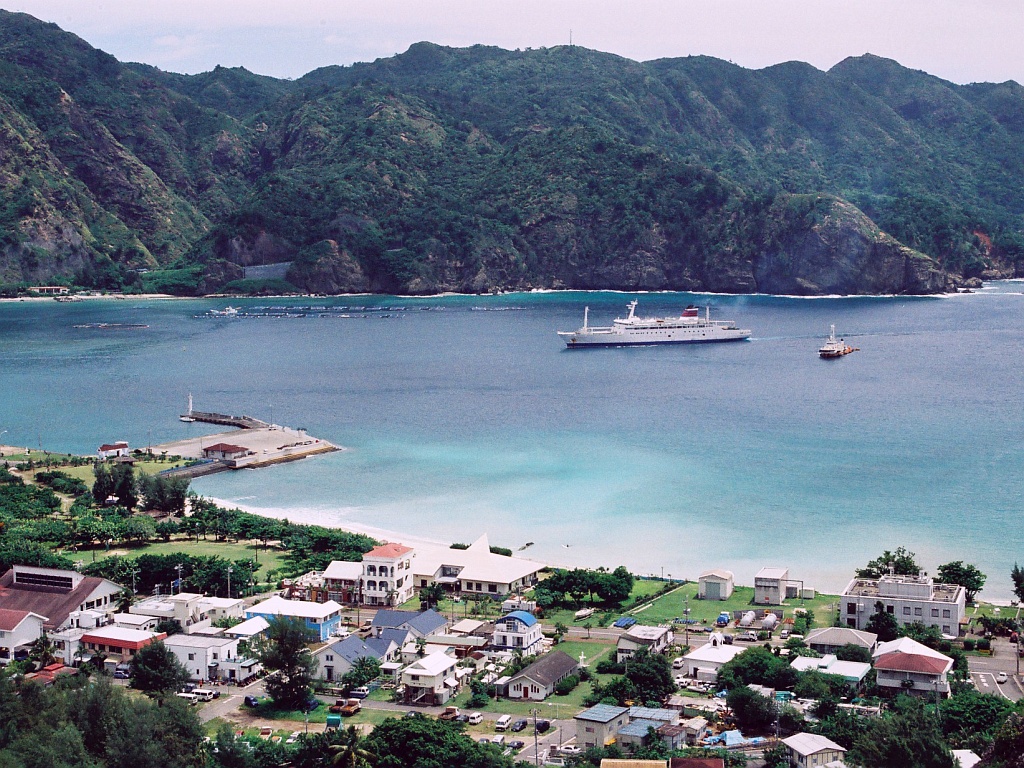
The Ogasawara Islands (Bonin Islands), inscribed by UNESCO in 2011, are a chain of 30 subtropical volcanic islands 1,000 kilometres south of Tokyo in the western Pacific. They have never been connected to a continental land mass: the island chain emerged from the sea floor as submarine volcanoes and has always been oceanic, meaning that every species on the islands reached them by swimming, flying, or floating on ocean currents. This origin makes the archipelago a laboratory for evolutionary divergence in isolation: the 195 endemic plant species (15% of all plant species known from the islands) and 100+ endemic land snail species represent separate evolutionary lineages from any continental ancestor. The 440 species of fish recorded in the surrounding reefs include species first described from Ogasawara that are not found anywhere else in the world.
The western Pacific and the island arc south of Japan Tokyo · Okinawa · Iwo Jima — 1000 to 1250 km
One thousand kilometres north of Ogasawara by the Ogasawara Maru ferry (25.5 hours from Ogasawara to Tokyo Takeshiba Port), central Tokyo holds Japan’s most accessible urban UNESCO cluster. The National Museum of Western Art, designed by Le Corbusier and completed in 1959, is in Ueno Park 30 minutes north of Tokyo Station — one of the 17 buildings across 7 countries inscribed in 2016 as the Architectural Work of Le Corbusier. The Ogasawara Islands’ complete isolation from continental influence and Le Corbusier’s architectural rationalism are the opposite poles of Japan’s UNESCO inventory: the most remote and the most urban, the most ecologically isolated and the most culturally connected. Visitors combining both inscriptions must account for the 25.5-hour ferry journey — the Ogasawara Maru departs weekly from Takeshiba pier in central Tokyo — making the Ogasawara circuit a minimum 6-day visit (2 days travel, 2 days on the island). The ferry schedule and the island’s remoteness make the Ogasawara Islands the least-visited UNESCO site in Japan by domestic tourists despite being a domestic territory: approximately 3,000 per week travel to the island in peak season (winter and early spring for whale watching, summer for sea turtles).
One thousand kilometres northwest of Ogasawara by ferry and domestic flight via Tokyo, Chichijima-to-Tokyo-to-Okinawa is the standard travel pattern for visitors combining the Ogasawara inscription with the Gusuku Sites and Related Properties of the Kingdom of Ryukyu in Okinawa Prefecture. The Ryukyu Kingdom (1429–1879) operated trading ships through the same western Pacific that the Ogasawara archipelago straddles; Ryukyuan vessels were documented navigating the waters south of mainland Japan in the pre-Edo period when Ogasawara was still uninhabited by Japanese nationals. The natural history connection between Ogasawara and the Okinawa-Amami inscriptions is biogeographic: both the Ogasawara chain and the Ryukyu chain represent oceanic islands whose biota derive from different source regions — Ogasawara from Micronesian and Asian tropical sources, Okinawa from tropical and subtropical Asia — producing different endemic assemblages in adjacent Pacific waters. From Ogasawara, Okinawa requires ferry back to Tokyo (25.5 hours) and flight (2.5 hours) — a minimum 2-day transit.
Two hundred fifty kilometres south of Ogasawara’s Chichijima by the same ocean, Iwo Jima (Ioto) in the Volcano Islands chain is administered as part of the Ogasawara Subprefecture. Iwo Jima is not part of the UNESCO inscription and is not open to civilian visits — it is an active Japan Self-Defense Forces facility on the island where the February–March 1945 Battle of Iwo Jima produced 26,000 American and 21,000 Japanese casualties. The volcanic terrain of Iwo Jima (Suribachi volcano) is visible on clear days from Ogasawara’s southern islands; the geographic and administrative proximity makes the combination of Ogasawara’s extraordinary biodiversity and Iwo Jima’s 20th-century military history one of the most extreme contrasts of context available in any UNESCO island inscription worldwide. Annual commemorative services on Iwo Jima are held for Japanese and American veterans’ families who are permitted entry; civilian access is otherwise restricted.
The Tokyo metropolitan heritage circuit Tokyo NMWA · Nikko · Tomioka — 30 to 200 km from Tokyo
The practical consequence of Ogasawara’s 1,000-kilometre separation from any other UNESCO inscription is that proximity guides for the islands necessarily pivot through Tokyo, the transit hub. From Takeshiba pier in central Tokyo, after returning from Ogasawara (25.5 hours), the full Kanto UNESCO circuit is available: the National Museum of Western Art (30 minutes by JR to Ueno), the Shrines and Temples of Nikko in Tochigi Prefecture (90 minutes by Tobu Nikko limited express from Asakusa), and the Tomioka Silk Mill in Gunma Prefecture (110 minutes from Tokyo Station by JR Takasaki Line and Joshin Dentetsu). These three cultural inscriptions — Le Corbusier’s building, Tokugawa’s shrine complex, and the Meiji silk factory — represent the full arc of Japan’s cultural UNESCO production from the 17th century through the 20th century, all within 200 kilometres of the Tokyo terminal from which the Ogasawara Maru departs. The Mozu-Furuichi Kofun Group (ancient burial mounds of Osaka Prefecture, inscribed 2019) is 500 kilometres southwest of Tokyo by Shinkansen (approximately 2.5 hours), making a combined Kanto-Kansai circuit the natural eastward extension from a Tokyo-based Ogasawara visit.
Practical information
The Ogasawara Islands are accessible only by sea or (in medical emergencies) by air. The Ogasawara Maru, operated by Ogasawara Kaiun, departs Takeshiba Pier in central Tokyo (10 minutes from Hamamatsucho Station) on a weekly schedule (approximately Tuesday departures in recent schedules, with the return departing Chichijima on the following Friday). The crossing takes 25.5 hours at cruising speed; the ship carries approximately 1,000 passengers in berths ranging from second-class shared dormitory to first-class private cabins. Reservations are mandatory and should be made months in advance for peak periods (New Year holiday, Golden Week in April–May, and school holidays). Accommodation on Chichijima is limited to approximately 2,000 beds across guesthouses, minshuku, and one larger resort hotel; accommodation must be reserved separately from the ferry. Hahajima (Mother Island), 50 kilometres south of Chichijima, is served by a daily high-speed boat from Futami Port (approximately 2 hours) and has accommodation for those wishing a more remote experience. Activities on the islands include diving (the Ogasawara coral reefs have been surveyed for 450 species of coral), whale watching (humpback and sperm whales winter in the surrounding waters, November through April), sea turtle nesting observation (June through August on Chichijima’s Minamijima beach), and forest walks to observe the endemic fauna. Biosecurity measures are stringent: footwear and equipment must be decontaminated before departure from the mainland to prevent introduction of invasive species that have already devastated some of the island’s endemic snail populations.
Frequently Asked Questions
Why are the Ogasawara Islands called the “Galapagos of the Orient”?
The comparison to the Galapagos Islands of Ecuador — the paradigmatic oceanic island evolution laboratory — is applied to Ogasawara because both archipelagos share the key conditions that produce evolutionary isolation: ancient volcanic origin, never connected to a continental land mass, remote location in an ocean far from the nearest continent, and sufficient geological age (the Ogasawara islands are approximately 48 million years old) to allow independent evolutionary lineages to develop from the colonizing ancestors. The Ogasawara endemic bird species — the Bonin petrel, the Bonin white-eye, and the Ogasawara woodpigeon — each descend from colonizing ancestor species that reached the islands by long-distance flight and then evolved in isolation from all closely related species. The 100+ endemic land snail species are the most dramatic instance of island diversification: land snails travel poorly over ocean water, so the colonization of each island and sub-island is a rare event producing long-isolated populations. The comparison is not perfect — the Galapagos are older, larger, and hold a more diverse large-vertebrate endemic fauna (giant tortoises, marine iguanas) than Ogasawara — but the principle of oceanic island evolution through isolation applies to both equally. UNESCO recognized this parallel explicitly in the 2011 inscription decision, comparing the biological significance of Ogasawara to that of the Galapagos (inscribed 1978 and the original exemplar of the oceanic island evolution site type in the UNESCO natural heritage catalogue).
How did humans first arrive on the Ogasawara Islands?
The Ogasawara Islands were uninhabited by any human population until 1830, when a group of Western settlers — primarily Americans and Europeans from Hawaii — arrived under the leadership of a former British sailor, Nathaniel Savory of Massachusetts. The Tokugawa shogunate nominally claimed sovereignty over the islands in 1827 but took no action to settle them; the first permanent residents were therefore Western in origin. A second settlement wave in 1861 brought Japanese colonists under Meiji government policy to establish Japanese sovereignty; the islands were formally incorporated into Edo Prefecture (later Tokyo Prefecture) in 1877. The mixed Western-Japanese heritage of the islands’ founding population is reflected in the surnames still carried by some Chichijima residents (Savory, Washington, Webb) and in the designation of early settler descendants as “Ogasawara-jin” (Ogasawara people) — a legally recognized category under Japanese nationality law. During World War II, the civilian population was evacuated to mainland Japan in 1944; the island was occupied by the United States from 1945 and returned to Japanese sovereignty in 1968, the most recent territorial return to Japan in the 20th century. The gap between 1830 human settlement and the geological age of the islands (48 million years) means that the human presence has had only 190 years to affect an ecosystem that evolved in complete isolation for 48 million years — the UNESCO inscription’s management priority is limiting the damage that 190 years of invasive species introduction has produced.
What is the ferry schedule and how long is a minimum Ogasawara visit?
The Ogasawara Maru operates on an approximately weekly schedule, typically departing Takeshiba Pier in Tokyo on Tuesday mornings and arriving at Chichijima’s Futami Port on Wednesday afternoons (25.5 hours). The return vessel departs Chichijima on Fridays and arrives in Tokyo on Saturdays. This fixed weekly cycle means a minimum visit is 6 days: depart Tokyo Tuesday, arrive Chichijima Wednesday, 2 full days on the island (Thursday–Friday morning), depart Friday, arrive Tokyo Saturday. An alternate schedule (departing Tuesday and returning the following Saturday by staying for the subsequent ferry) allows 9–10 days on the island and is the recommended minimum for serious diving, hiking, or whale/turtle observation. There is no option to stay for less than 4–5 days on the island: the next available ferry after the one that brought you departs approximately 6 days later. This schedule limitation significantly reduces casual or short-stay tourism; most visitors to Ogasawara plan the trip as a dedicated 7–10 day excursion rather than incorporating it into a multi-destination Japan itinerary. The ferry schedule is posted on the Ogasawara Kaiun website (Japanese) and via the Tokyo Metropolitan Government Ogasawara Office website (limited English). The Ogasawara Islands have never had a civilian airport — past proposals to build one have been opposed by environmental groups who argue that daily flight access would produce visitor volumes incompatible with the UNESCO natural values.
Sources
- S1 — UNESCO World Heritage Centre — Ogasawara Islands (Ref. 1362) — https://web.archive.org/web/20230601000000/https://whc.unesco.org/en/list/1362/
- S2 — UNESCO World Heritage Centre — Statement of Outstanding Universal Value (Ref. 1362) — https://whc.unesco.org/en/list/1362/
Spotted an error? Write to editorial@culturalheritageonline.com and we correct it the same day.