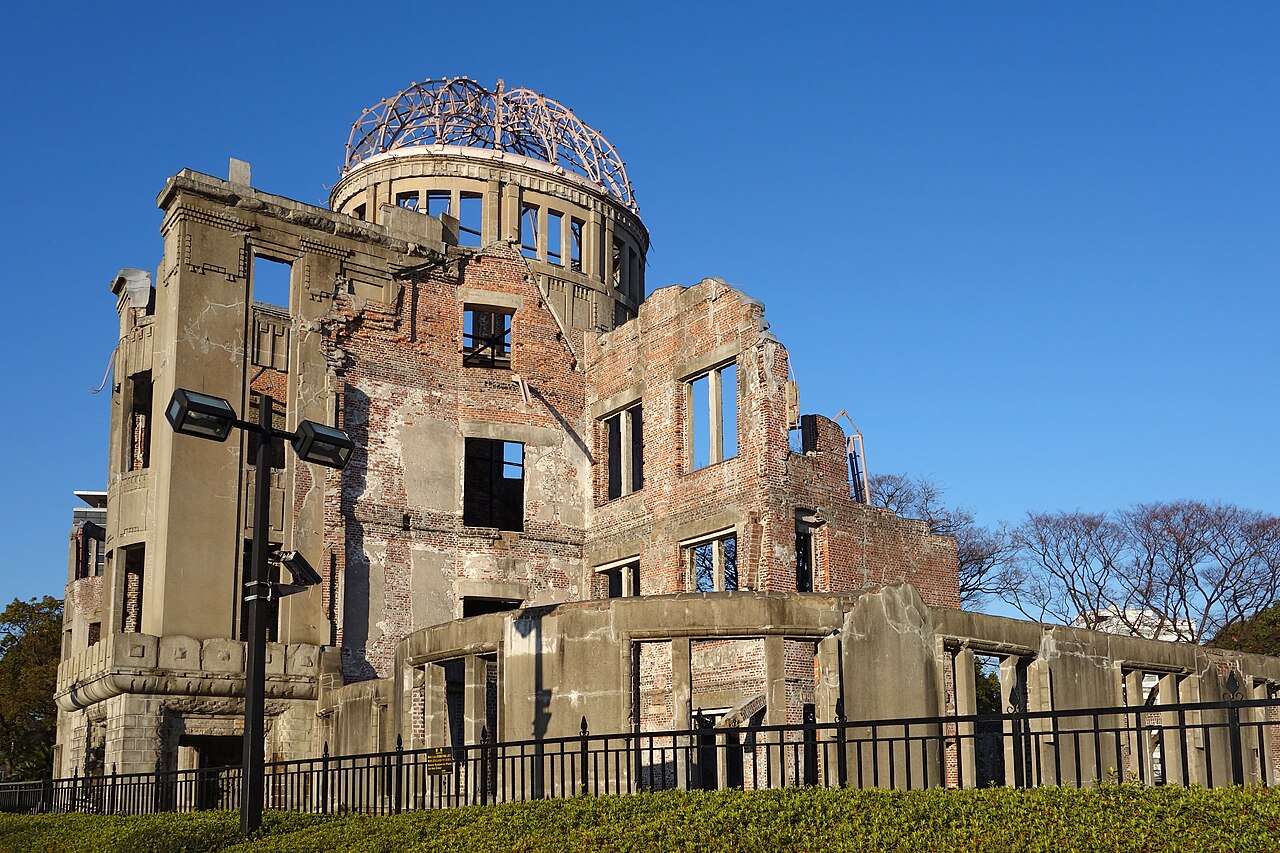
The Hiroshima Peace Memorial, inscribed by UNESCO in 1996, preserves the skeletal ruin of the former Industrial Promotion Hall — the only structure within 600 metres of the atomic bomb’s detonation point on 6 August 1945 to remain structurally upright. The building survived because the bomb detonated nearly directly overhead at 580 metres altitude, driving the blast force downward rather than laterally into the walls. Hiroshima City Council resolved to preserve the ruin unreconstructed as the most accurate physical testimony to the event available.
The Seto Inland Sea corridor Miyajima · Himeji · Shimane — 20 to 400 km
Twenty minutes from Hiroshima Station by JR and ferry, Itsukushima Shrine on Miyajima Island sits in the tidal channel of the Seto Inland Sea. The shrine was built over the water beginning in the 6th century to preserve the island’s sacred ground; the existing buildings date from the 1168 CE patronage of Taira no Kiyomori, who chose Miyajima because the island itself was considered a deity. The 16-metre O-torii gate stands 200 metres offshore — rebuilt eight times, most recently in 1875 — and at high water appears to float on the tidal channel. At low tide, visitors can walk through the exposed sand to its base. The paired Hiroshima inscriptions were processed together by UNESCO in 1996 and together form the densest pairing of contrasting historical registers in Japan’s UNESCO inventory: the shrine complex, built for devotion and aesthetic contemplation over 800 years, stands within easy ferry distance of the ruin that was created in a single instant in 1945 and preserved for exactly the same reason — the need to confront historical reality through physical presence. A JR day pass from any Kansai city covers both sites in a single excursion.
Two hundred twenty kilometres east by Sanyo Shinkansen, Himeji Castle provides the architectural counterpoint of Edo-period Japan to both the Hiroshima inscriptions. The 83-building complex was completed in 1609 under Tokugawa patronage and has never been taken by siege, burned, or significantly altered in four centuries. The castle’s white-plastered exterior, designed for fire resistance, gave it the name Shirasagi-jo (White Heron Castle). During the American firebombing raids of July 1945, Himeji City was heavily damaged but the castle was not struck; aerial photographs taken the morning after the raids show the white structure standing intact amid the ruins of the surrounding city. The proximity of the castle’s survival to the Peace Memorial’s destruction — both occurring in the summer of 1945 within 220 kilometres of each other — encapsulates the contingency that shaped Japan’s built heritage in the final phase of the Pacific War. From Hiroshima, Himeji is reached by Sanyo Shinkansen in approximately 55 minutes.
Two hundred sixty kilometres northwest of Hiroshima by limited express from Hiroshima to Oda City via Matsue, the Iwami Ginzan Silver Mine and its Cultural Landscape in Shimane Prefecture was the world’s most productive silver source in the 1580s. The mine supplied an estimated one-third of global silver production at its peak and financed the consolidation of the Tokugawa state. What makes the Iwami inscription unusual among UNESCO industrial sites is the preservation of the complete operational landscape: 700 mine shafts in the Nishimikawa gold deposit, the valley processing facilities below, and the port-route town of Tomogaura intact. At peak extraction the area supported 200,000 people and 53 religious sites. The mine’s connection to the Hiroshima sites runs through the same coastal geography — the San’in and Sanyo regions flanking the Chugoku Mountains — and through the same historical period: the silver that flowed from Iwami Ginzan through Hiroshima’s ports to Dutch and Portuguese merchants in the 16th and 17th centuries created the commercial infrastructure in which the Hiroshima region’s 20th-century industrial significance later developed.
Three hundred fifty kilometres southwest by Shinkansen from Hiroshima to Hakata and limited express to Nagasaki, the Hidden Christian Sites in the Nagasaki Region preserve the material and community traces of a religious practice that was illegal in Japan for 250 years. After the Tokugawa government executed 26 missionaries and converts in Nagasaki in 1597, the surviving communities dispersed to remote coastal villages and maintained Christianity in secret, adapting Buddhist ritual calendars and Shinto shrine structures as cover. The 12 inscribed properties include 10 churches or church ruins, the Hara Castle ruins where 37,000 Christians died in the 1638 Shimabara Rebellion, and the Ooura Cathedral in Nagasaki, completed in 1865 as the first Western-rite Gothic church in Japan and the only Western-style building in Japan designated a National Treasure. At Ooura Cathedral in 1865, a group of Urakami villagers disclosed to a French priest that they had maintained secret Christianity for seven generations — a moment the Vatican recorded as the “discovery of hidden Christians.” The Nagasaki atomic bomb of 9 August 1945 destroyed the Urakami Cathedral; the rebuilt cathedral stands above the hypocenter neighbourhood, 200 metres from the hypocenter marker.
East toward the Kansai ancient capitals Kyoto · Nara · Ikaruga — 340 to 400 km
Three hundred forty kilometres east by Sanyo Shinkansen from Hiroshima to Kyoto (approximately 90 minutes by Nozomi), the 17 properties of the Historic Monuments of Ancient Kyoto span the full millennium of Japan’s imperial capital history from 794 to 1869 CE. Hiroshima itself was established as a castle town in 1589 and administered by various lords under the Tokugawa shogunate — the region appears in the Hiroshima Domain records as a prosperous port and administrative centre, with no indication of its 20th-century significance to either side of the Pacific War. The Kyoto UNESCO monuments — including Kinkaku-ji, Ryoan-ji, Nijo Castle, and the Byodoin at Uji — document the court culture that administered the feudal Japan whose castle and maritime infrastructure Hiroshima represented at the regional level. For a visitor combining the Hiroshima UNESCO sites with Kyoto, the Nozomi Shinkansen reduces the journey to 90 minutes, making an early morning at the Peace Memorial followed by an afternoon in Kyoto entirely feasible.
Three hundred eighty kilometres east by Shinkansen to Kyoto and JR Nara Line onward (approximately 2 hours total), the Historic Monuments of Ancient Nara document Japan’s first permanent capital during the 710–784 CE period. Todai-ji’s Great Buddha Hall — the world’s largest wooden building — houses a 15-metre bronze Buddha whose 752 CE dedication ceremony was attended by 10,000 monks from 60 countries. Nara Park’s 1,200 sika deer, classified as National Natural Monuments, graze the same grounds where the imperial court administered the Buddhist state that produced Horyu-ji 10 kilometres to the southwest. The Kofukuji Five-Storey Pagoda at the park’s edge, rebuilt in 1426 CE, is the second-tallest wooden pagoda in Japan and the most recognizable visual symbol of the Nara cityscape. From Hiroshima, the most direct route to Nara is by Nozomi to Kyoto (90 minutes) and Kintetsu Kyoto Line to Kintetsu Nara (35 minutes), totalling approximately 2.5 hours.
Four hundred kilometres east via the same Shinkansen-and-Yamatoji route, the Buddhist Monuments in the Horyu-ji Area in Ikaruga contain the world’s oldest wooden buildings: 48 structures from the 7th and 8th centuries, including the Five-Storey Pagoda whose central pillar system absorbs earthquake energy without transmitting it between floors. Prince Shotoku founded the complex in 607 CE; its survival intact through the 8th-century founding of Nara, the 9th-century court move to Kyoto, the 15th-century Onin War, and the 20th-century Pacific War makes it the longest continuously preserved wooden structure anywhere on earth. From Hiroshima, Horyu-ji is most conveniently reached as an addition to a Nara day trip: Shinkansen to Kyoto or Osaka, then JR Yamatoji Line south to JR Horyuji Station.
Four hundred twenty kilometres east by Shinkansen to Osaka and local services into the Kii Peninsula, the Sacred Sites and Pilgrimage Routes in the Kii Mountain Range encompass Japan’s largest cultural UNESCO site: 237 kilometres of pilgrimage trail linking the three Grand Shrines of Kumano, the Yoshino mountain temples, and the Koyasan monastic complex. The Kumano pilgrimage tradition received imperial patronage continuously from the Heian period through the 19th century; Emperor Gotoba completed the journey 32 times. Mount Koya holds 117 sub-temples within its monastic compound; the Okunoin cemetery at its centre has accumulated 200,000 stone markers around the mausoleum of the founder Kukai since 835 CE. From Hiroshima, the Kii Mountains are most efficiently accessed by Shinkansen to Shin-Osaka and Nankai Koya Line to Gokurakubashi (cable car to Koyasan), a total journey of approximately 3 hours.
Practical information
The Hiroshima Peace Memorial Museum and Peace Memorial Park are in central Hiroshima, approximately 15 minutes on foot from Hiroshima Station via the Aioi Bridge. Tram line 2 from Hiroshima Station reaches the Peace Memorial Park in 15 minutes (Genbaku Dome-mae stop). The museum opens at 8:30 and closes at 18:00 in standard periods (19:00 in summer, extended hours in August around the anniversary). The A-Bomb Dome stands on the riverbank immediately adjacent to the park and is accessible at all hours. The Peace Memorial Museum requires a minimum of 2 hours for a serious visit; its primary-source artefact collection and testimony recordings are among the most significant historical museum presentations in Japan. The Itsukushima Shrine on Miyajima is reached from Hiroshima by JR Sanyo Line to Miyajimaguchi (25 minutes) and JR ferry (10 minutes); a day pass for both Hiroshima UNESCO sites and the Miyajima ferry is available from Hiroshima Station. Hiroshima is served by Hiroshima Airport (50 km east of the city, accessible by limousine bus in 45 minutes) and by JR Shinkansen at Hiroshima Station.
Frequently Asked Questions
Why was the A-Bomb Dome preserved rather than demolished after the war?
The decision to preserve the Genbaku Dome ruin was contested for years after the war before becoming permanent. In the first postwar decade, two positions competed in Hiroshima City politics: those who argued that the ruin was too painful a daily presence for survivors to live beside, and those who argued that its preservation was the most truthful available response to what had happened. Hiroshima City Council voted in 1966 to preserve the dome permanently and to maintain it in its current condition without reconstruction. UNESCO inscribed it in 1996 over the formal objection of the Japanese national government, which had argued that UNESCO inscription would complicate Japan’s diplomatic positions; the inscription was approved after representations by the Hiroshima municipal government and broad international support. The United States and China both abstained in the 1996 UNESCO vote. The dome’s preservation has been technically challenging: the structure’s steel and concrete frame is slowly deteriorating under weathering and requires ongoing structural reinforcement through internal anchoring systems. The last major reinforcement was completed in 2010–2015; periodic surveys monitor the condition of the remaining wall sections and the dome frame. Hiroshima City has committed to maintaining the ruin indefinitely as a “perpetual monument to the atomic bombing.”
What is the Peace Memorial Museum and how much time does it require?
The Hiroshima Peace Memorial Museum (Heiwa Kinen Shiryokan) presents the history of the atomic bombing through four interconnected sections: the pre-war history of Hiroshima as a military city, the physics and effects of the bomb, the testimony of survivors (hibakusha) documented in personal objects and recorded statements, and the post-war peace movement and nuclear arms control history. The most affecting section is the individual testimony room, where personal effects — a wristwatch stopped at 8:15, a child’s lunchbox with carbonized rice still inside, a stone step with the shadow imprint of a person vaporized on it — are presented with minimal commentary. The museum received 1.77 million visitors in 2023. A serious engagement with the museum requires at minimum 2 hours; many visitors take 3 to 4 hours, particularly in the testimony sections. The museum does not editorialize on the necessity or morality of the bombing; it presents what happened to the city and its 350,000 inhabitants, of whom 140,000 had died by the end of 1945. Audio guides in English, Japanese, Chinese, Korean, French, German, and Spanish are available at the entrance. Photography is not permitted in the personal artefact galleries.
How does the Hiroshima Peace Memorial relate to the Nagasaki atomic bomb sites?
Nagasaki received Japan’s second atomic bomb on 9 August 1945, three days after Hiroshima. The Nagasaki hypocenter is not a UNESCO World Heritage Site; the Nagasaki Atomic Bomb Museum and the Nagasaki Peace Park are national and municipal heritage sites. The UNESCO inscription for the Nagasaki region is the Hidden Christian Sites inscription (2018), which covers a completely different history: the 250 years of secret Christianity in the same region. The two cities’ 20th-century atomic history and the Nagasaki region’s 17th-century Christian history are geographically proximate but historically entirely separate. Visitors often combine both Hiroshima and Nagasaki on the same itinerary: from Hiroshima, Nagasaki is reached by Sanyo Shinkansen to Hakata (approximately 55 minutes) and limited express Kamome to Nagasaki (approximately 2 hours), making a 3-day circuit of Hiroshima–Miyajima–Nagasaki feasible with overnight stays in each city. The contrast between the two cities’ memorials — Hiroshima’s preserved ruin, Nagasaki’s rebuilt cathedral and reconstructed hypocenter park — reflects two different community responses to the same event, both equally legitimate as historical testimony.
Sources
- S1 — UNESCO World Heritage Centre — Hiroshima Peace Memorial (Genbaku Dome) (Ref. 775) — https://web.archive.org/web/20230601000000/https://whc.unesco.org/en/list/775/
- S2 — UNESCO World Heritage Centre — Statement of Outstanding Universal Value (Ref. 775) — https://whc.unesco.org/en/list/775/
Spotted an error? Write to editorial@culturalheritageonline.com and we correct it the same day.