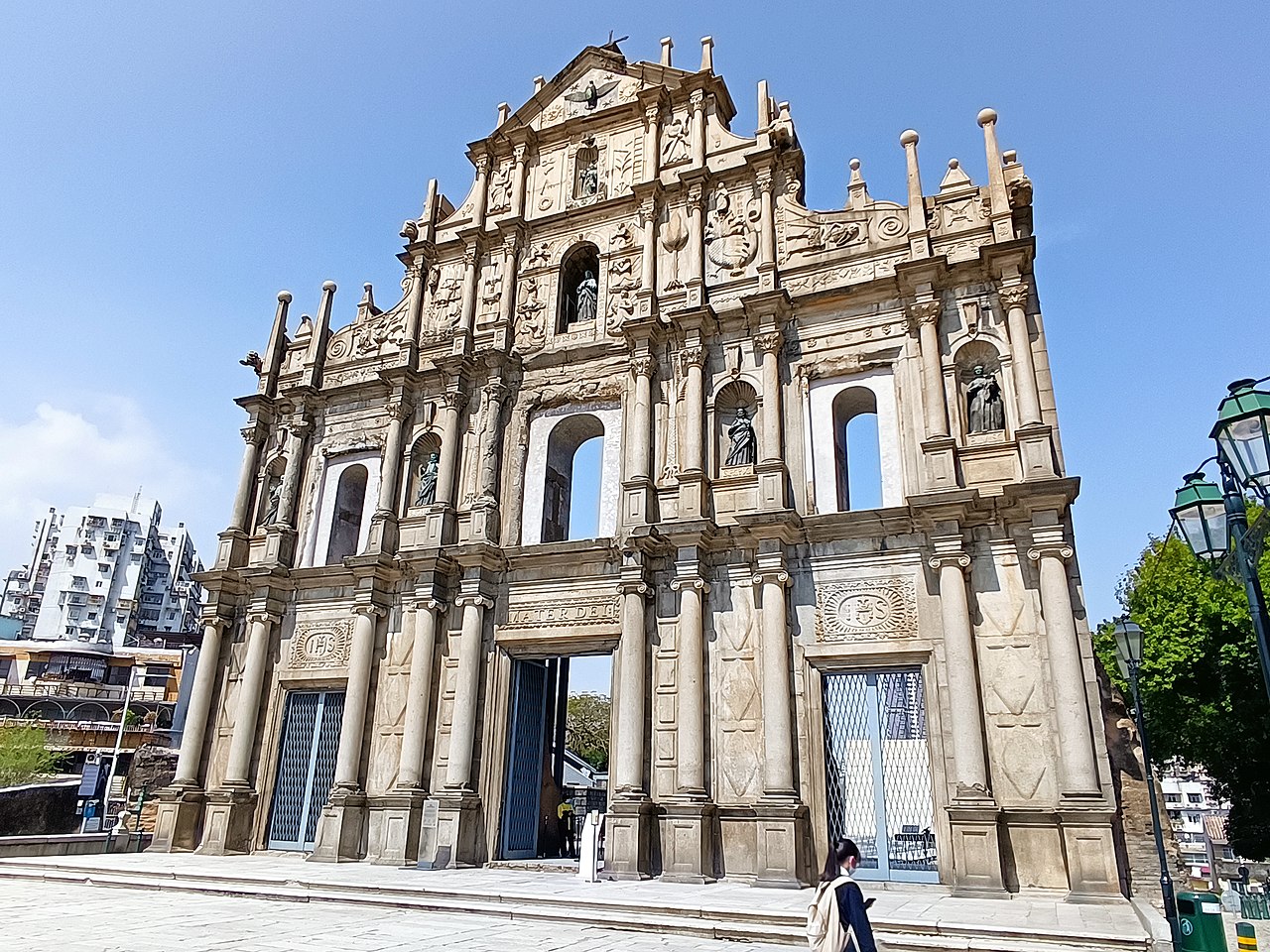
The Historic Centre of Macao (UNESCO 2005) covers 30 historic buildings, streets and open spaces in a Special Administrative Region of China located on the western side of the Pearl River Delta, 65 kilometres from Hong Kong. The inscription area includes the ruins of the Cathedral of St Paul (originally built 1602–1640 by Japanese Christian exiles and Jesuit missionaries), the A-Ma Temple (founded 1488, predating Portuguese arrival by 69 years), and the Guia Fortress with the oldest Western-style lighthouse on the Chinese coast, built in 1865. Macao has been a Portuguese administrative territory since 1557, making it the longest continuously European-administered territory in Asia, and reverted to Chinese sovereignty in December 1999.
Kaiping Diaolou and Kulangsu: other Pearl River and coastal sites where Chinese and Western architecture merged 280–600 km from Macao by road and rail via Guangzhou
Kaiping Diaolou and Villages (UNESCO 2007) is the UNESCO inscription most structurally comparable to Macao’s historic centre in its architecture and its social history. Kaiping County, in the Pearl River Delta hinterland of Guangdong Province, contains 1,833 surviving multi-storey watchtower-residences (diaolou) built between the late 19th century and the 1930s by returning emigrant communities—primarily men who had worked as labourers in the western United States, Canada, Australia and Southeast Asia and returned to their home villages with sufficient savings to build fortified houses combining local Cantonese building techniques with structural and decorative elements drawn from Romanesque arches, Baroque balconies, Spanish missions, Scottish castle battlements, and Islamic muqarnas. The result is a Cantonese rural landscape dotted with incongruous towers that can resemble simultaneously a Venetian campanile, a California mission facade, and a Guangdong farmhouse, sometimes in the same structure. Four diaolou clusters and a fifth historic village are inscribed: Zili, Jinjiangli, Sanmenli, Majianglong and the Fang clan settlement. Zili village’s 15 diaolou and 8 residential buildings are intact and the village has been inhabited continuously; the Ruishi Tower at Zili, 9 storeys and 25 metres tall, was completed in 1923 and contains period furnishings on each floor corresponding to the decade of construction—a material culture time capsule that documents exactly what a moderately prosperous Cantonese emigrant family considered worth importing from the West in 1923. Kaiping is 280 kilometres north of Macao by road and approximately 3 hours by a combination of ferry to Zhuhai, intercity bus or high-speed rail to Jiangmen, and local bus or taxi to Kaiping town and then to the villages (total journey approximately 3 hours 30 minutes). From Guangzhou, Kaiping is 150 kilometres southwest (2 hours by intercity bus or HSR to Jiangmen and bus). The thematic parallel with Macao is direct and productive for any visitor who has just seen the Portuguese-Baroque-Chinese fusions of Macao’s historic centre: both sites are physical records of what happens when significant capital, accumulated abroad, re-enters a Chinese Guangdong community and finds architectural expression through a fusion of foreign forms with local building traditions.
Kulangsu (Gulangyu), a Historic International Settlement (UNESCO 2017), occupies an island of 1.87 square kilometres off the coast of Xiamen, Fujian Province, 600 kilometres northeast of Macao (4 hours 30 minutes by high-speed rail from Zhuhai/Guangzhou to Xiamen, then 5-minute ferry to the island). Like Macao, Kulangyu became a centre of multi-national foreign residence: from 1903 it operated under an International Municipal Council with representatives from thirteen nations, each of which constructed consular buildings, churches, schools and private residences on the island according to their home architectural traditions. The resulting built environment contains Neoclassical British bank buildings, German church facades, Spanish-tiled villas, Amoy Deco—a specific hybrid style combining European structural forms with Hokkien decorative elements—and the grand piano industry (Kulangyu became, in the early 20th century, the highest per-capita piano ownership area in China, a direct product of Christian missionary music education). The International Municipal Council’s control of the island ended with Japan’s occupation in 1941 and was not restored afterward. Today the island is vehicle-free (no private cars are permitted) and accessible by ferry only; the 931 historic buildings in the inscription zone are concentrated in the central and northern parts of the island. The parallel with Macao is an extended one: both are small coastal territories where a sustained multi-generational foreign administrative presence produced a built environment that cannot be assigned to any single architectural tradition, and both were returned to Chinese sovereignty in the post-colonial period (Macao in 1999; Kulangyu’s international settlement formally dissolved in 1943).
Fujian Tulou and West Lake Hangzhou: architecture and water in the same coastal migration corridor 700–1,200 km from Macao by HSR via Guangzhou
Fujian Tulou (UNESCO 2008) covers 46 rammed-earth communal structures in Fujian Province, built by Hakka and other communities from the 12th to the 20th century CE as combined fortified residences, granaries, meeting halls and ancestral temples for entire lineage groups. The largest tulou, Chengqi Lou in Yongding County (completed 1709), is circular, 73 metres in outer diameter, four storeys tall, and was designed to house 72 apartments in its outer ring, with inner rings of two- and single-storey structures surrounding a central ancestral hall. The structural principle—an earthen wall 1.5 to 2.5 metres thick at the base, mixed with bamboo strips as tensile reinforcement, rising to 12–15 metres—makes the tulou genuinely earthquake-resistant: the Chengqi Lou survived the 1918 M7.3 Nanao earthquake without structural damage. The Hakka are a Chinese Han sub-group distinguished by their dialect (Hakka Chinese, still spoken natively by approximately 45 million people worldwide) and by their history of successive southward migrations from the Yellow River plain beginning in the 4th century CE, driven by successive waves of northern invasions; Fujian and Guangdong are the most concentrated areas of Hakka settlement. The Macao connection is tangible: Hakka workers and merchants were present in Macao’s commercial life throughout the Portuguese period, and the Pearl River Delta migration corridor that brought Kaiping’s diaolou builders to California and Australia also carried Hakka communities to Southeast Asia and beyond. Reaching the Yongding tulou cluster from Macao involves HSR from Zhuhai or Guangzhou to Longyan (4 hours 30 minutes from Guangzhou) then local bus to Yongding (50 minutes); an alternative route uses the Xiamen-Nanjing HSR to Nanjing South and bus to Yongding. A visit of one day covers 4–6 tulou in the Yongding cluster; the Tianloukeng Tulou cluster in Nanjing County (5 round circular and 1 square tulou in a valley viewable from above on a ridge path) is a separate 90-minute drive from Yongding.
West Lake Cultural Landscape of Hangzhou (UNESCO 2011) lies 1,200 kilometres north of Macao (5 hours by HSR from Guangzhou to Hangzhou via Shanghai), which places it at the far end of the Grand Canal that historically linked Macao’s Pearl River trade network to the Yangtze Delta and the imperial capitals of China. The Grand Canal (itself UNESCO-inscribed in 2014) carried silk, porcelain, tea and rice southward to Guangzhou and into the maritime trade routes from which Macao took its commercial significance; ships passing through Hangzhou on the canal’s southern terminus carried goods that would eventually reach Portuguese merchants in Macao and be loaded onto Macau-Goa-Lisbon carracks. West Lake itself covers 6.39 square kilometres of shallow freshwater lake surrounded by hills on three sides and the city of Hangzhou on the fourth, with three artificial islands, two causeways (the Su Causeway from 1089 CE and the Bai Causeway from the Tang period), and ten classically defined “scenic views” (Xī Hú Shí Jǐng, established in the Southern Song dynasty, 1127–1279 CE) that have been continuously celebrated in Chinese painting, poetry and garden design for nearly 900 years. The UNESCO inscription recognised West Lake as an outstanding example of a cultural landscape that has shaped Chinese aesthetic ideals for natural scenery, specifically the concept of ideally proportioned water-mountain scenery (shān shuǐ) that influenced garden design across East and Southeast Asia. For a visitor connecting from Macao’s historic centre, Hangzhou provides the imperial and literati end of the same trade corridor that sustained Macao’s existence as a Portuguese trading post.
Practical information
Macao is most easily reached from Hong Kong (65 km west) by high-speed ferry from the Macau Ferry Terminal in Sheung Wan or from the Hong Kong–Zhuhai–Macao Bridge, which opened in 2018 as the longest sea crossing bridge-tunnel in the world at 55 kilometres total; taxis cross the bridge from the Hong Kong side to Macao in approximately 40 minutes. Direct flights to Macao International Airport operate from major Chinese cities and from several Southeast Asian hubs. The 30 heritage components of the historic centre are concentrated in a walkable central zone of approximately 2 square kilometres on the Macao Peninsula; a full circuit of all 30 sites on foot takes 4–5 hours and requires no transport between sites except for the Guia Fortress, which is on a hill north of the central cluster (taxi or cable car from the base of Guia Hill).
The best visiting conditions are October through December, when temperatures are mild (20–25°C) and humidity lower than the June–September typhoon season. Macao casinos attract very large visitor numbers on weekends from Hong Kong and mainland China; the historic centre is significantly less crowded on weekdays and in the early morning (before 9 am) when the St Paul’s Ruins forecourt is nearly empty. The A-Ma Temple operates on traditional festival schedules; the A-Ma Festival (the 23rd day of the 3rd lunar month, typically late April or early May) involves processions and ceremonies that are not normally visible to visitors outside the festival period.
Frequently Asked Questions
What makes Macao’s architecture different from other Portuguese colonial cities?
Macao’s built heritage differs from Portuguese colonial cities in Africa, Brazil or India primarily in the degree of mutual architectural exchange between Portuguese and Chinese construction practices over nearly 450 years of coexistence on the same small peninsula. In most Portuguese colonial contexts, European and indigenous architectural traditions remained largely distinct: European public buildings and churches were built by Portuguese craftsmen and followed metropolitan models; indigenous residential architecture continued its local traditions in adjacent neighbourhoods. In Macao, by contrast, the same buildings frequently combine Portuguese Baroque structural organisation with Chinese decorative craftsmanship on their exterior surfaces, Portuguese tile (azulejo) work in interiors with Chinese timber joinery systems, and Portuguese urban planning frameworks (the largo, or open square) with Chinese feng shui orientation principles that influenced specific building siting decisions. The most explicit example is the Cathedral of St Paul: the church body (burned in 1835) was constructed by Japanese Christian refugees and Jesuit lay brothers who had been expelled from Japan following the Shimabara Rebellion’s aftermath; the surviving stone facade shows Portuguese Baroque compositional logic in its three-tiered structure but incorporates carved bas-relief panels depicting a Chinese junk, a chrysanthemum (Japanese imperial symbol), and Jesuit emblems in the same decorative programme. No single European or Asian tradition is capable of fully explaining this facade’s iconographic programme. The other component of Macao’s uniqueness is the temporal span: while the Portuguese presence in India at Goa lasted from 1510 to 1961, and in Brazil from 1500 to 1822, Macao’s continuous Portuguese administration from 1557 to 1999—442 years—produced multiple generations of locally born residents (Macanese) of mixed Portuguese-Chinese heritage whose architectural patronage was itself a synthesis rather than a colonial imposition.
What is the A-Ma Temple and why does it predate the Portuguese arrival in Macao?
The A-Ma Temple (in Cantonese, Maa Gok Miu; in Mandarin, Ma Ge Miao) is a complex of six pavilions built against and into a granite outcrop on the southwestern shore of the Macao Peninsula, dedicated to the goddess Mazu (A-Ma in Cantonese), patron deity of fishermen and sailors throughout southern China, Taiwan, and Southeast Asian Chinese communities. The temple’s foundation date is traditionally given as 1488, during the Ming Hongzhi period—69 years before the establishment of Portuguese settlement—based on a stele inscription within the complex that records a renovation in 1605 and references an existing temple structure. The earliest pavilion, the Prayer Hall at the base of the granite outcrop, contains a large relief carving of a sailing junk on the rock face beside it; this carving, and the temple’s position at a natural harbour entrance, confirm its function as a sailors’ shrine at what was already a fishing community anchorage before Portuguese merchants arrived. The name “Macao” itself derives from “A-Ma Gou” (Bay of A-Ma) in the Cantonese pronunciation of “Aa-Maa Gok”: Portuguese sailors who first anchored in the bay in 1513 asked local fishermen the name of the place, and received the name of the temple and its bay. The temple has been in continuous active religious use since its foundation, conducting daily worship and seasonal festivals according to the Mazu liturgical calendar. Six of the major Mazu festivals per year involve significant ceremonies at the A-Ma Temple; the Spring Festival and the anniversary of Mazu’s birthday (23rd day of the 3rd lunar month) bring the largest congregations. The Portuguese administration never attempted to convert the temple site to Christian use or to restrict access to it, making the A-Ma Temple one of the few pre-colonial religious structures in a former European colonial territory to have survived the colonial period in continuous and uninterrupted traditional use.
How does Macao’s UNESCO inscription relate to the casino economy that now dominates the territory?
Macao’s casino economy and its UNESCO heritage inscription exist in a relationship that is legally separated but physically proximate. The Historic Centre inscription covers 30 specific buildings and open spaces that are protected under Macao law (Law No. 11/2013, the Cultural Heritage Protection Law) from demolition or significant structural alteration; the casinos, which are concentrated on the Cotai Strip (a reclaimed land area between the islands of Taipa and Coloane) and in the northern part of the Macao Peninsula, are largely located outside the protected inscription zone. The practical consequence is visible: within a 10-minute walk of the St Paul’s Ruins and the Senado Square (two of the most photographed heritage components), the urban landscape transitions abruptly from restored late-18th century Portuguese civic architecture to Grand Lisboa’s 49-storey lotus-blossom tower (2007) and the Venetian Macao’s 39-floor resort complex on Cotai. The UNESCO World Heritage Committee’s periodic reporting on Macao’s inscription has noted concerns about the visual buffer zones around several heritage components and about the intensity of visitor flows through the historic centre, which is used as a pedestrian corridor between ferry terminals and casino hotels. Macao received approximately 39 million visitors in 2019 (the last pre-pandemic year of normal visitation), the overwhelming majority of whom were day visitors from mainland China arriving for the casinos; the heritage sites benefit from incidental foot traffic from visitors moving between casinos, but the UNESCO inscription’s Outstanding Universal Value depends on the physical integrity of the protected buildings, not on the economic context surrounding them.
Sources
- S1 — UNESCO World Heritage Centre — Historic Centre of Macao (Ref. 1110) — https://web.archive.org/web/20230601000000/https://whc.unesco.org/en/list/1110/
- S2 — Cultural Affairs Bureau of Macao — https://whc.unesco.org/en/list/1110/
- S3 — Kuhn, Dieter. <em>The Age of Confucian Rule: The Song Transformation of China</em>. Harvard University Press, 2009. ISBN: 978-0-674-03661-1.
Spotted an error? Write to editorial@culturalheritageonline.com and we correct it the same day.