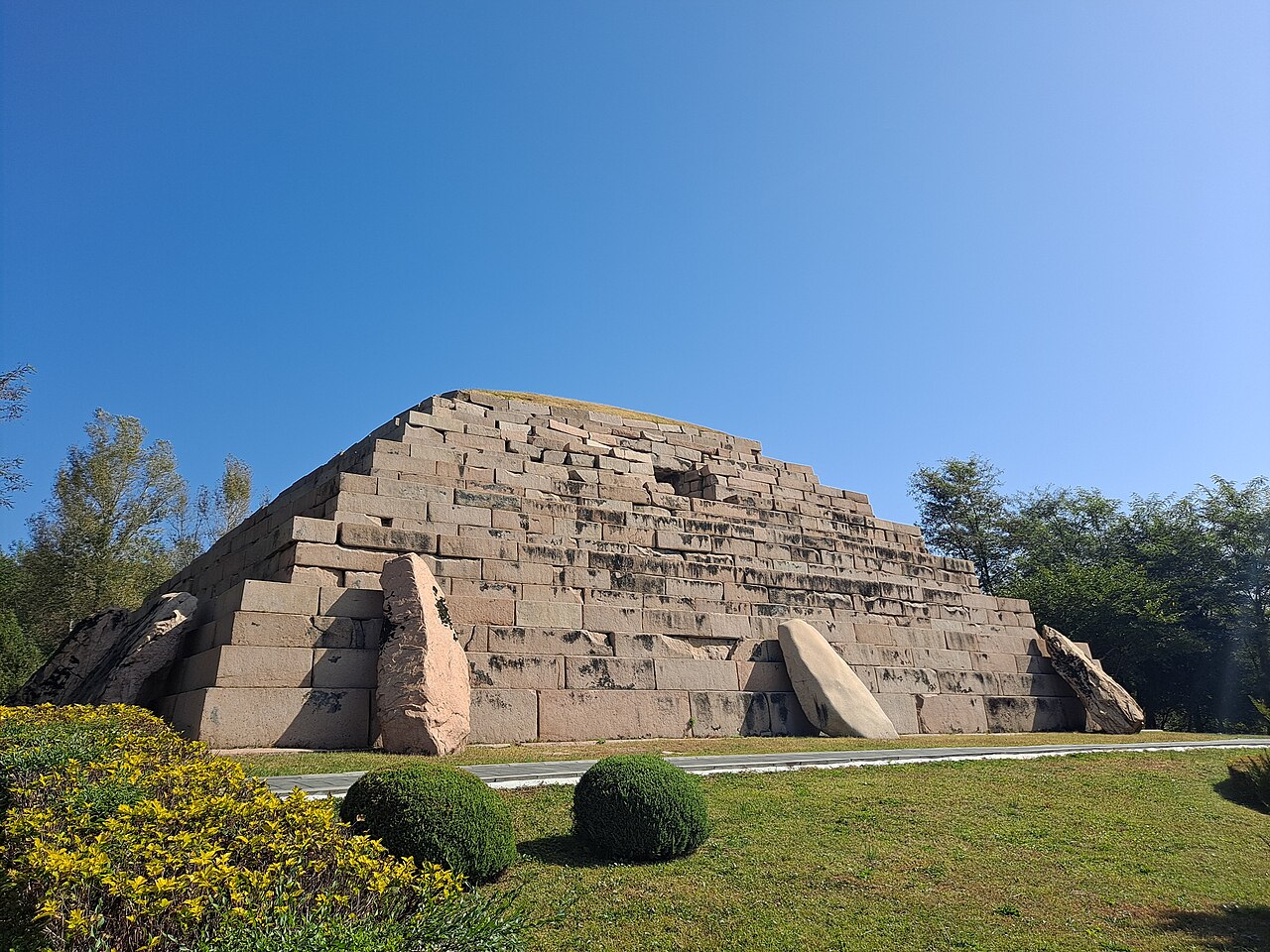
The Capital Cities and Tombs of the Ancient Koguryo Kingdom (UNESCO 2004) covers sites in Ji’an, Jilin Province, northeastern China, including Wandu Mountain City and 39 royal and noble tombs with mural paintings dating from the 3rd to 7th centuries CE. Koguryo existed as a kingdom from approximately 37 BCE to 668 CE—705 years—dominating the northern Korean Peninsula and Manchuria at its height. The General’s Tomb at Ji’an, a stepped pyramid of 1,100 granite blocks weighing up to 40 tonnes each, was constructed for King Jangsu (r. 413–491 CE) and measures 31.58 metres per side at the base with a height of 12.4 metres.
Korean peninsula sites that share Koguryo’s political and cultural world 400–600 km south via Dandong ferry to South Korea
The Baekje Historic Areas (UNESCO 2015) are the most direct cultural counterpart to the Koguryo sites at Ji’an. Baekje and Koguryo were rival kingdoms that co-existed on the Korean peninsula from roughly the same founding era—Baekje tradition places its founding at 18 BCE, one generation after Koguryo’s 37 BCE—and the two states maintained a rivalry that shaped the peninsula’s political geography for six centuries. The serial inscription covers three Baekje capital cities: Gongju (Ungjin period, 475–538 CE), Buyeo (Sabi period, 538–660 CE), and Iksan, across 8 archaeological sites and 45 heritage elements. The Gongju Songsan-ri Tomb Cluster contains seven tumulus tombs including the Tomb of King Muryeong, discovered intact in 1971 after more than 1,400 years undisturbed, yielding 4,600 artefacts including a stone epitaph giving Muryeong’s precise dates of birth (461 CE) and death (523 CE)—one of the few ancient Korean royal tombs dateable to the year from internal evidence rather than from later chronicles. The contrast with Ji’an is immediate: both inscription groups are royal burial complexes of the same peninsula tradition, but where Koguryo built stepped granite pyramids in a northeastern continental style with Manchurian influences, Baekje built earthen tumuli in a southern Korean tradition with documented exchange links to Liang Dynasty China (502–557 CE) and the Yamato state in Japan. Buyeo, 130 kilometres south of Gongju, holds the Jeongnimsaji Five-Story Pagoda, one of the earliest surviving stone pagodas in Korea (early 7th century CE), and the Nakhwaam Rock above the Baengmagang River, where Baekje palace women are recorded in later chronicles as having drowned during the Tang-Silla conquest of 660 CE. Reaching the Baekje sites from Ji’an requires crossing from northeastern China to South Korea: the overland route passes through Shenyang and Dandong to the ferry crossing to Incheon (approximately 26 hours by ship), or by air from Shenyang or Changchun to Seoul Incheon (2 hours flight), then intercity bus south to Gongju or Buyeo (2 hours from Seoul).
Changdeokgung Palace and its Huwon garden (UNESCO 1997) in Seoul represent the next phase of Korean state-building after Koguryo’s fall. When Silla defeated Koguryo in 668 CE with Tang Chinese military support, the peninsula entered the Unified Silla and then Goryeo periods before the Joseon dynasty (1392–1897) established its capital at Hanyang (present-day Seoul) and constructed Changdeokgung in 1405 as a secondary palace to the principal Gyeongbokgung. The Joseon kings consciously positioned their dynasty as heirs to a continuous Korean political tradition that included Goryeo (which derived its name directly from “Koguryo”) and the pre-Koguryo Gojoseon kingdom. Changdeokgung’s Injeongjeon main throne hall, rebuilt after Japanese invasion fires in 1608, retains the original structural alignment from 1405. The Huwon (literally “rear garden”), 78 acres of landscaped garden with 28 pavilions arranged around a series of ponds, was reserved for exclusive royal use until the late 19th century and remained closed to general visitors until 1983; today access is by timed guided tour only, with visitor numbers capped per session to prevent overcrowding of the garden paths. From Seoul’s Anguk station (subway line 3), the palace entrance is a seven-minute walk. The 600-kilometre distance from Ji’an reflects a flight of roughly 1 hour 30 minutes from Changchun Longjia Airport to Seoul Incheon.
Joseon-era education and defence sites of the Korean peninsula 600 km south of Ji’an; within 50 km of Seoul
Seowon, Korean Neo-Confucian Academies (UNESCO 2019), comprises nine private academies established during the Joseon dynasty (16th–17th centuries CE) as institutions for Confucian scholarship and the veneration of Confucian scholars. The oldest in the inscription, So수seowon in Yeongju, North Gyeongsang Province, was founded in 1543 by Ju Se-bung, a county magistrate who established it in honour of the scholar An Hyang (1243–1306), who had introduced Neo-Confucian texts from Yuan China to Korea during the Goryeo period. The seowon system arose partly in reaction to the perceived corruption of the official state examination system (gwageo) and created an alternative circuit of intellectual authority: graduates of the private academies carried social prestige that sometimes rivalled that of the government schools. At their 17th-century peak, over 600 seowon operated across the peninsula; the Joseon government attempted to restrict their number from the 1650s onward, culminating in the regent Heungseon Daewongun’s order of 1871 to close all but 47 seowon as part of a centralising reform. The nine inscribed academies survived that closure and retain their original buildings. Dosanseowon in Andong, 270 kilometres south of Seoul by intercity bus (3 hours), is the academy built to honour Yi Hwang (Toegye, 1501–1570), whose portrait appears on the South Korean 1,000-won banknote; the academy sits on a hillside above the Nakdong River and its lecture halls, dormitories and ritual space are arranged in a formal linear sequence from south (entrance gate) to north (shrine) following the canonical seowon plan. The physical distance from the Koguryo sites in Ji’an to the seowon landscape is approximately 600 kilometres, but the intellectual distance is equally significant: the seowon tradition of Joseon-period Korea was self-consciously constructed as a revival of Chinese classical learning within a Korean social framework, whereas Koguryo Buddhism and wall-painting traditions were absorbed from Chinese states and transformed in a specifically Manchurian-Korean synthesis.
Namhansanseong Fortress (UNESCO 2014) is a mountain fortress 25 kilometres southeast of central Seoul (subway line 8 to Sanseong station, then bus or taxi up the mountain, approximately 1 hour from Seoul city centre). The current fortress walls, 11.7 kilometres in perimeter encircling a highland plateau at 480 metres elevation, were rebuilt and extended beginning in 1624 following the first Manchu invasion of 1627, and again after the catastrophic Manchu siege of 1636–1637. During the second siege, King Injo and the royal court took refuge in Namhansanseong for 47 days beginning on 14 January 1637; the fortress proved impossible for the besieging Later Jin (Qing) forces to assault directly, but the Korean forces were unable to receive reinforcements or supplies, and King Injo capitulated on 30 January 1637, emerging from the fortress to perform the ceremonial of submission before the Qing emperor Hung Taiji. This submission, recorded as the Samjeon Doctrine in Korean historical memory, ended the Joseon dynasty’s alliance with the Ming and forced acknowledgment of Qing suzerainty. The fortress’s significance as a UNESCO inscription rests partly on this specific historical episode: the site embodies the moment when the northeastern Asian political order in which Koguryo had originally been a major power was definitively reorganised under Manchu (Qing) hegemony, completing a process that the Qing conquest of the Koguryo-successor Goryeo by the Mongols had begun four centuries earlier.
Practical information
Ji’an, the centre of the Chinese Koguryo inscription, is 230 kilometres east of Tonghua, Jilin Province, connected by a two-lane highway (approximately 3 hours by road); a railway line links Ji’an to Tonghua (2 hours), from which trains continue to Shenyang (3 hours further). The Koguryo sites in Ji’an—Wandu Mountain City, the General’s Tomb, the Tomb of King Jangsu, and the surrounding tumulus clusters—are administered through a combined ticketed park; the General’s Tomb and Tomb of King Jangsu are a 10-minute drive apart within the park grounds. The best season for visiting is May through September; July and August bring high humidity but the surrounding forests are in full foliage. Winter (December–February) brings harsh temperatures typical of Manchurian continental climate (-15°C to -25°C overnight) and reduced service at smaller sites.
Combining the Ji’an Koguryo sites with the Korean peninsula UNESCO sites described above requires international travel. The most logical itinerary proceeds Ji’an–Shenyang by train (1 day), Shenyang to Seoul Incheon by flight (2 hours), then Seoul–Gongju–Buyeo for the Baekje sites (2 days), Changdeokgung and Namhansanseong in Seoul (1 day), and Dosanseowon in Andong (1 day return by KTX to Andong). A five-day South Korea itinerary following the flight from Shenyang covers all four Korean UNESCO sites described here.
Frequently Asked Questions
Why was the Koguryo kingdom inscribed separately on both the Chinese and North Korean UNESCO lists in the same year?
The UNESCO inscription of the Capital Cities and Tombs of the Ancient Koguryo Kingdom in 2004 was a simultaneously processed inscription covering sites in two different countries: the Chinese component covered Ji’an, Jilin Province (39 tombs, Wandu Mountain City, Guonei Fortress), while the North Korean component covered Pyongyang and the nearby Goguryeo Tombs Complex of Koguryo, inscribed under a slightly different name but in the same 2004 session of the World Heritage Committee. The dual inscription arose because Koguryo’s territory straddled what is now the border between China and North Korea: Ji’an (ancient Guonae-seong) was the second Koguryo capital from approximately 3 CE to 427 CE, while Pyongyang (ancient Pyongyang-seong) was the third and final capital from 427 CE until the kingdom’s fall in 668 CE. The simultaneous listing of the same historical kingdom’s heritage by two different contemporary states reflected both the sites’ physical distribution and a degree of historical-political sensitivity: Chinese academic discourse of the early 2000s, associated with the “Northeast Project” (Dongbei Gongcheng) research programme run from 2002–2007, argued that Koguryo should be classified as a regional Chinese state rather than as an ancient Korean state, a position that the South Korean academic establishment and government formally contested. The UNESCO inscription itself avoids taking a position on the ethnic or political nationality of Koguryo, describing it as an ancient kingdom without attributing it to either Chinese or Korean cultural heritage specifically. Visitors to Ji’an should be aware that interpretive materials at the site reflect the Chinese academic position.
What do the tomb wall paintings at Ji’an actually show, and why are they significant?
The Koguryo tombs at Ji’an whose interiors survive with mural paintings include the Wukui Tomb, the Jian Tomb Number 1, and several others in the Ji’an tomb clusters, though access to painted interiors is restricted for conservation reasons and most visitors see the murals through reproductions or facsimile displays at the site museum. The paintings cover a range of subjects specific to Koguryo aristocratic culture. Genre scenes show daily life activities including feasting, wrestling matches (ssireum, a form of Korean wrestling with documented continuous tradition from Koguryo to the present), hunting with composite bows on horseback, and acrobatic performances. Cosmological paintings depict the Four Directional Guardians (Blue Dragon of the East, White Tiger of the West, Red Phoenix of the South, Black Tortoise-Serpent of the North), a cosmological framework shared with Han Chinese tradition but given specific Koguryo iconographic treatment. Celestial navigation imagery shows stars, constellations, and solar and lunar symbols in arrangements that correspond to identifiable astronomical configurations. The most technically sophisticated paintings are in the later tombs (late 6th–early 7th century CE) and demonstrate knowledge of foreshortening, layered pigment application, and spatial composition that is directly comparable to contemporary Sui and Tang Chinese court painting. The significance for art history lies in the tombs’ datability: because Koguryo tomb construction is documented in chronicles and some tombs bear dedicatory inscriptions, the paintings can be assigned to specific decades, providing a fixed chronological reference for the development of East Asian figural painting before the Tang period, from which few datable examples survive at all.
Is it possible to visit the North Korean component of the Koguryo UNESCO inscription?
The Goguryeo Tombs Complex of Koguryo inscribed by North Korea in the same 2004 UNESCO session covers 63 individual tombs in two clusters: 16 tombs in the Pyongyang area (Nam-po and Pyongyang environs) and 47 tombs in the South Hwanghae Province. Access to North Korea for foreign tourists is conducted exclusively through state-approved tour operators, of which a small number of Chinese and European companies have historically offered programmes. As of mid-2026, North Korea remains effectively closed to most foreign tourists following the country’s own border closures from early 2020; the situation has not returned to the limited-access conditions that prevailed from roughly 2010 to 2019. When access was available, the standard Pyongyang itinerary—typically 5–8 days, entering by Air Koryo flight from Beijing or by train from Dandong—included visits to the Koguryo tomb murals in the Pyongyang environs as a standard component of the heritage circuit alongside the Kumsusan Palace of the Sun, the DMZ at Panmunjom, and Kaesong. The tomb access was managed by the Korean Central History Museum, which provided state-assigned guides; independent movement to the tomb sites was not permitted. Visitors interested in the Koguryo inscription should check current access conditions through specialist North Korea tour operators at the time of planning, as the situation changes with political developments. The Ji’an Chinese component remains fully accessible and provides a complete encounter with the royal tomb architecture even without the Pyongyang murals.
Sources
- S1 — UNESCO World Heritage Centre — Capital Cities and Tombs of the Ancient Koguryo Kingdom (Ref. 1135) — https://web.archive.org/web/20230601000000/https://whc.unesco.org/en/list/1135/
- S2 — Jilin Provincial Cultural Heritage Bureau — https://whc.unesco.org/en/list/1135/
- S3 — Kuhn, Dieter. <em>The Age of Confucian Rule: The Song Transformation of China</em>. Harvard University Press, 2009. ISBN: 978-0-674-03661-1.
Spotted an error? Write to editorial@culturalheritageonline.com and we correct it the same day.